Viewing entries in
exhibition

MIA FINEMAN *Casa Susanna

MIA FINEMAN *Casa Susanna

MIA FINEMAN
Casa Susanna - 160 Ways to Be Seen Without Being Seen


written + interview AMANDA MORTENSON


These days, visibility begins with a screen, curated, uploaded, compressed into metrics before it even has a chance to breathe. The Casa Susanna photographs were born in another tempo. Their images were exchanged by hand, slipped into envelopes, held close. The Metropolitan Museum of Art’s Casa Susanna exhibition opens a door into this quieter visual world, one that sustained a cross-dressing community in 1960s New York long before hashtags or timelines existed.


In that era of strictly defined gender roles, Susanna Valenti and her wife Marie Tornell operated two small resorts in the Catskills. They were modest in size but expansive in purpose—safe havens where guests could arrive as themselves and leave the constraints of their day-to-day identities behind. The gatherings at these resorts and in New York City became a ritual. Cameras were constant companions, tools for recording and for becoming. Each photograph affirmed an identity, captured a gesture, and expanded a shared archive of self-expression.


Andrea Susan (American, 1939–2015)
Donna (Buff/Cynthia) in a navy dress in Susanna and Marie’s, New York City apartment, 1960s, Chromogenic print, 12.9 x 9 cm
Art Gallery of Ontario, Purchase, with funds generously donated by Martha LA McCain, 2015 / Photo ©AGO


The exhibition gathers around 160 works from three major collections—photographs from the Art Gallery of Ontario, from artist Cindy Sherman’s personal holdings, and from The Met’s own collection, gifted by Betsy Wollheim, whose father was part of the Casa Susanna circle. The selection includes chromogenic prints, silver gelatin prints, and Polaroids—the latter a breakthrough technology for this community. Polaroid cameras delivered instant results without the risk of sending film to a commercial lab, a critical safeguard in a time when gender nonconformity could lead to blackmail, arrest, or worse. In their own time, members of Casa Susanna used the term “transvestite” to describe themselves, a word now widely recognized as pejorative. The exhibition uses “cross-dressing” to describe the practice of wearing clothing associated with another gender than one’s daily presentation. The photographs show the kind of femininity these guests aspired to inhabit.

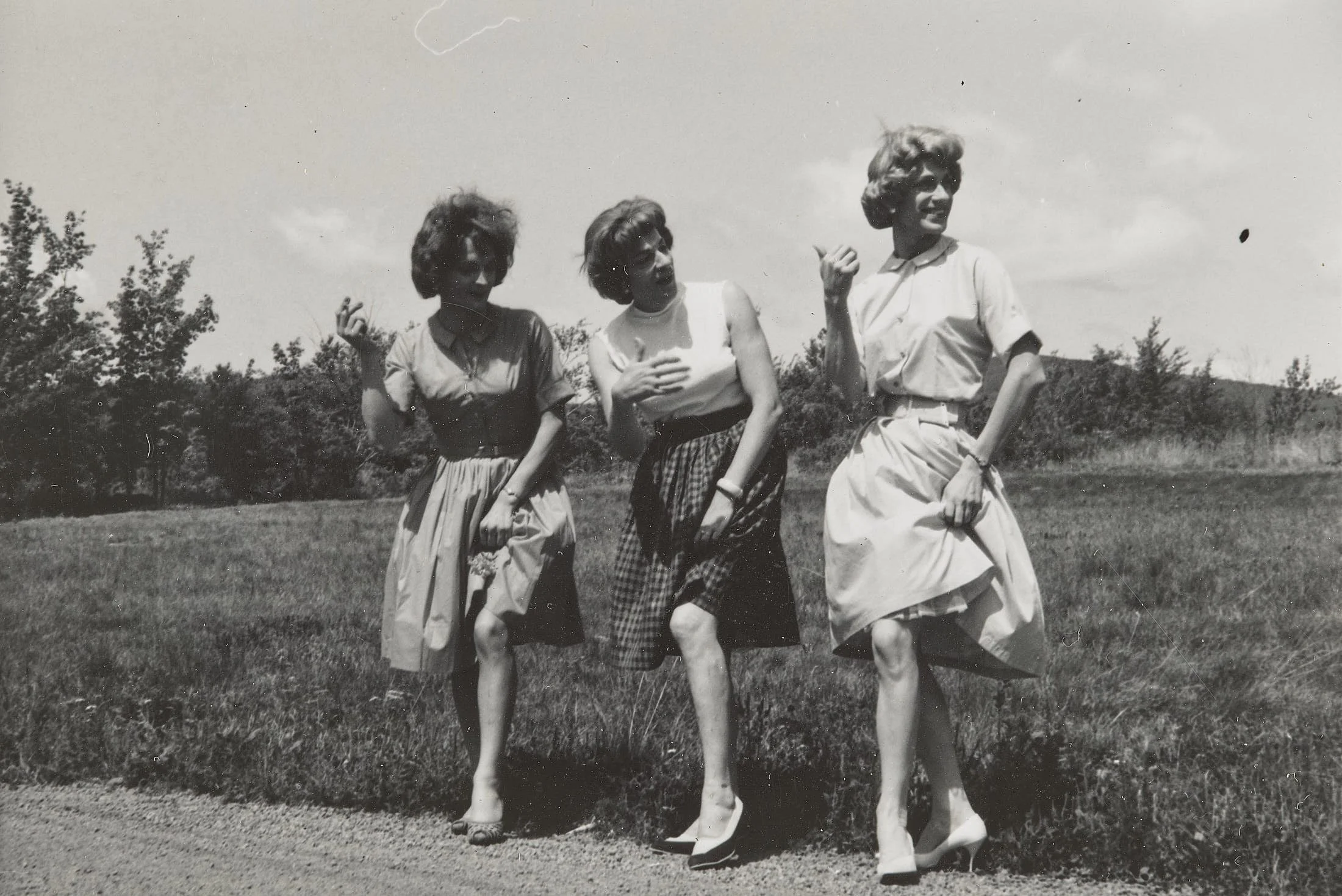
The ideal was deliberate, even nostalgic—rooted in the postwar archetypes found in McCall’s and Ladies’ Home Journal: the well-put-together neighbor, the serene housewife, the respectable matron. In the photographs, every detail—hemline, handbag, hairstyle—becomes a note in the visual composition of that identity. Poses are practiced and drawn from the vocabulary of mid-century magazine photography, with a hand on the hip and a pointed foot, knees together when seated, and legs crossed at the ankle. The images carry tenderness and defiance, each present in equal measure.They resist cultural norms simply by existing, but they also protect and nurture “the girl within,” as Susanna herself described it. In this way, the lens becomes a co-conspirator, a mirror that reflects back the self each sitter longed to see.

The exhibition extends beyond the walls to include issues of Transvestia, the underground magazine that served as a lifeline for the community. Published six times a year and mailed directly to subscribers, it offered autobiographical essays, style advice, and fiction alongside readers’ photographs. Functioning as a pre-digital social network, it stitched together a far-flung group into something resembling a public, though one that operated entirely out of sight. The curatorial approach, led at The Met by Mia Fineman, preserves this intimacy. Many of the photographs are small, close to the dimensions of a smartphone screen, but their presence in the gallery invites a different kind of looking. Here, scale becomes personal, measured in proximity. Standing before them, the viewer is drawn into the same hand-held space their original owners occupied, the same vantage from which they were once studied, treasured, and shared.
The quietest details in the exhibition are often the most affecting. A snapshot of Sheila and her wife Avis in matching dresses, tailored so they could wear them together; the patterned wallpaper behind Susanna and Felicity as they laugh in a summer kitchen. These are lived moments, captured for the circle that understood them, free from the staging of outside expectations.

Casa Susanna refrains from universalizing its story, presenting its subjects outside the frame of contemporary trans narratives. It invites visitors to encounter a community as it saw itself, through the images it made for its own eyes. In doing so, it restores a fragment of history to the broader photographic canon, reminding us that some of the most radical acts of visibility happen far from public view.


“One of the most important things you cannot experience when viewing images on a screen is a true sense of scale — the physical size of a picture in relation to your own body.”

Mia Fineman speaks with LE MILE
for Offline Edition - FW 2025 Nr. 39


Unknown [Gloria in Susanna and Marie’s New York City apartment] 1960s Chromogenic print 3 1/2 x 3 9/16 in. (8.9 x 9 cm) Art Gallery of Ontario, Purchase, with funds generously donated by Martha LA McCain, 2015 Photo © AGO

Unknown
Gloria in Susanna and Marie’s New York City apartment, 1960s, Chromogenic print, 8.9 x 9 cm
Art Gallery of Ontario, Purchase, with funds generously donated by Martha LA McCain, 2015 / Photo ©AGO

Andrea Susan (American, 1939–2015)
Photo shoot with Lili, Wilma, and friends, Casa Susanna, Hunter, NY, 1964–1968, Chromogenic print 8.4 x 10.8 cm

Art Gallery of Ontario, Purchase, with funds generously donated by Martha LA McCain, 2015 / Photo ©AGO


Amanda Mortenson
These days, visibility begins with a screen. They´re curated, uploaded, compressed into metrics before it even has a chance to breathe. But the Casa Susanna images were never chasing an audience. How does their analog quietness speak to us now, in this overstimulated world?

Mia Fineman
In our current moment, when our visual lives are so completely dominated by screens, I think people — or at least some people — are beginning to crave firsthand encounters with the physicality of images, whether on the pages of books or magazines or on the walls of a museum or gallery. One of the most important things you cannot experience when viewing images on a screen is a true sense of scale — the physical size of a picture in relation to your own body. Ironically, these twentieth-century snapshots are almost exactly the size of a phone screen, created to be held in the palm of your hand.


Photography has always had a thing for secrets. When you first saw the Casa Susanna images, what did they whisper to you before you even read a word?

The first thing I noticed was that these are images of men wearing women’s clothes, makeup, and wigs — yet they are not drag queens. They are not performing an exaggerated, theatrical version of femininity. Rather, they are making a deliberate effort to appear authentic, to “pass” as ordinary women.
In their time, members of the Casa Susanna circle described themselves as “transvestites,” a term now widely considered pejorative. In the exhibition, we use the preferred term “cross-dressing” to describe the practice of wearing clothing typically associated with a gender different from one’s daily presentation.


What kind of woman did these guests want to become and what kind of woman did the camera let them be?

Their ideal of femininity was highly conventional, even somewhat old-fashioned for the time, rooted in the gender stereotypes of the 1940s and 1950s found in magazines such as McCall’s and Ladies’ Home Journal. The women they aspired to emulate were well-put-together and ladylike — the neighbor, the housewife, the respectable matron. The camera became a tool for creating and expressing these identities, drawing on the visual language of magazine photography and family snapshots. Posing was deliberate: when standing, often with a hand on one hip and one foot pointed and extended; when seated, with knees together and legs crossed at the ankles.


Unknown
Susanna standing by the mirror in her New York City apartment, 1960 – 1963 Color vintage print, 23 x 19 cm

Collection of Cindy Sherman / Photo ©AGO

Unknown [Susanna standing by the mirror in her New York City apartment] 1960 – 1963 Color vintage print 9 1/16 x 7 1/5 in. (23 x 19 cm.) Collection of Cindy Sherman Photo © AGO


“These are images of men wearing women’s clothes, makeup, and wigs — yet they are not drag queens. They are not performing an exaggerated, theatrical version of femininity.”

Mia Fineman speaks with LE MILE
for Offline Edition - FW 2025 Nr. 39


In a way, the lens was a co-conspirator, do you think these photographs were acts of resistance, or rituals of tenderness? Maybe both?

For those in the circle, seeing photographs of themselves dressed en femme was a profoundly powerful and affirming experience. The images carry a tenderness alongside a quiet resistance to prevailing cultural norms and expectations. Above all, the photographs functioned like magic mirrors, reflecting back an internalized self-image — what Susanna called “the girl within.”


How do you curate something that was never meant to be seen in a museum?

It’s not unusual. Most photographs, from the 19th century up through the present, were never meant to be seen in museums. That’s what makes the photographic medium so interesting—it’s capacious and touches on every aspect of our lives..


Let’s talk about the Polaroid. What role did that specific technology play in shaping the identities we see in these frames?

During this period, gender-nonconforming people faced intense persecution and lived with the constant threat of blackmail and denunciation. Sending film to a commercial lab carried a significant risk. A few members of the community learned to process film themselves, but the arrival of the Polaroid camera in the late 1950s proved especially popular among cross-dressers, offering both privacy and instant results.


Unknown [Lili on the diving board, Casa Susanna, Hunter, NY] September 1966 Chromogenic print 5 1/16 x 3 9/16 in. (12.8 x 9 cm) Art Gallery of Ontario, Purchase, with funds generously donated by Martha LA McCain, 2015 Photo © AGO

Unknown
Lili on the diving board, Casa Susanna, Hunter, NY, September 1966, Chromogenic print, 12.8 x 9 cm

Art Gallery of Ontario, Purchase, with funds generously donated by Martha LA McCain, 2015 / Photo ©AGO

 
Unknown [Sheila and her GG Clarissa and friend, reading Transvestia] 1967 Gelatin silver print 3 5/16 x 4 5/16 in. (8.4 x 10.9 cm) Collection of Betsy Wollheim Photo © AGO

Unknown
Sheila and her GG Clarissa and friend, reading Transvestia, 1967, Gelatin silver print, 8.4 x 10.9 cm

Collection of Betsy Wollheim / Photo ©AGO


What’s the quietest detail in the entire exhibition? The one that most people miss, but you still think about on your way home?

I was surprised to learn that several members of the Casa Susanna circle had wives or girlfriends who accompanied them to cross-dressing gatherings. There is a small photograph in the exhibition of a cross-dresser named Sheila with her wife Avis, standing together in front of a fireplace in matching patterned dresses. They had these dresses tailored so they could wear them together. Avis wrote a column for their community magazine recounting her struggle to understand Sheila’s cross-dressing, with concerns ranging from anxiety about being outed to frustration over sharing the family clothing budget.

There’s something almost radical about someone printing their truth in black-and-white and mailing it across the country, long before Likes existed. These photos were passed hand to hand, folded, hidden, held close. What does "Offline" mean inside a show like Casa Susanna, where the act of sharing was slower, riskier, and maybe more intimate?

The members of this community exchanged pictures at gatherings and sent them by mail. They also published them in an underground magazine called Transvestia. It put out six issues a year, distributed to subscribers by mail. It was a community magazine in the sense that nearly all the content was created by its readers. In effect, the magazine functioned as a social network that helped them ease their loneliness and connect with others.

If you had to choose one photograph from the show to hang in your home — not as a curator, but as Mia — which one would it be and why?

There’s a photograph of Susanna and Felicity (whose public identity was John Miller, the brother of photographer Lee Miller) joking around in the kitchen at one of the resorts. I love how it shows Susanna’s sassiness and warmth, and the playful connection between the two women. I also love their tailored summer dresses and the vintage scenic wallpaper behind them. I’d be happy to look at this picture every morning.


header image
Unknown
Susanna, Marilyn, and Marianne, Hunter, NY, 1963
Gelatin silver print, 9 x 12.5 cm
Collection of Cindy Sherman
Photo ©AGO

NARGES MOHAMMADI *The Architecture of Memory

NARGES MOHAMMADI *The Architecture of Memory

NARGES MOHAMMADI
*The Architecture of Memory


written ALBAN E. SMAJLI


Inside Brutus Rotterdam, the exhibition No One Bats an Eye by Narges Mohammadi opens with quiet force. The Barbarella space, raw and industrial, carries the rhythm of a sewing machine that hums like breath. Sand, alabaster, and clay form a fragile architecture of remembrance. A house takes shape, not as shelter, but as memory made visible.


Narges Mohammadi, born in Kabul in 1993, brings together fragments of her early life with the material language she has refined across her practice. Trained in art history in Utrecht and visual arts at the Royal Academy of Art in The Hague, she moves between sculpture, installation, and sound. Her process carries the intimacy of craft and the urgency of history.

 
Narges Mohammadi photo by Laura Siliquini LE MILE Magazin Digital

Narges Mohammadi
seen by Laura Siliquini

 
Narges Mohammadi photo by Laura Siliquini LE MILE Magazine

Narges Mohammadi
seen by Laura Siliquini


In No One Bats an Eye, alabaster becomes her instrument. She hollows the stone until only a translucent layer remains. “The act of removing feels essential,” she says in the interview. “It reveals the fragility of what we carry and what remains when survival becomes daily work.” Around her, the space expands with sand and clay sculptures, enlarged family photographs pressed into loam, and domestic shapes that seem to breathe. Each object feels ordinary and ceremonial, the sewing machine, cast in alabaster, evokes her mother’s worktable. “That sound of stitching was always present,” she says. “It meant care. It meant making things last a little longer.” A lamp carved from stone glows faintly under the light. Nearby, eggs rest on the floor, symbols of both nourishment and expectation.


Mohammadi’s approach to sculpture stems from material empathy. Her earlier works in concrete, soap, halva, and straw explored endurance through touch and scent. Here, she turns to the quiet translucency of alabaster to explore what she calls “the skin of memory.” “When I carve,” she explains, “I am not building something new. I am uncovering what was already there.”

The exhibition forms a sequence of rooms, each suspended between intimacy and distance. A bench sculpted from sand invites pause, a doorway veiled in fabric opens toward light. The atmosphere moves between tenderness and gravity. Poverty, resilience, and dignity exist as shared presences rather than subjects. “The work is not about pity,” she says. “It is about visibility. About giving shape to what often stays unnamed.”

 
LE MILE Magazine Narges Mohammadi Exhibition Brutus Rotterdam Narges Mohammadi, Er kraait geen haan naar, solo exhibition at Brutus, Rotterdam. Photo_ Laura Siliquini. Courtesy of the Artist & Copperfield, London

Narges Mohammadi
Er kraait geen haan naar, solo exhibition at Brutus, Rotterdam

seen by Laura Siliquini / courtesy of the Artist & Copperfield, London


Her vision resonates deeply with Brutus, an artist-driven space known for its openness to experimentation. Within its rough architecture, her installation extends beyond sculpture into social texture. Friends and collaborators assisted in the making — sifting, molding, and assembling. The process became a form of communal repair. “I wanted to build with others,” she says. “Each gesture carries someone’s care.”

No One Bats an Eye holds the resonance of inheritance. The materials carry weight and light at once, they suggest the persistence of memory through touch, the continuity of warmth through scarcity. Rubiah Balsem’s opening words framed the exhibition as a threshold: an invitation to see empathy as architecture. The work exists as a quiet resistance — a monument built from gentleness.


Through every detail, Mohammadi’s practice affirms the presence of life within constraint. Her sculptures stand as vessels of remembrance, translucent and porous, filled with breath. They hold stories of endurance, hospitality, and transformation, offered without spectacle, sustained by grace.

No One Bats an Eye remains on view at Brutus Rotterdam until December 14, 2025.

WOLFGANG TILLMANS *Passages Silencieux, Espace Louis Vuitton München

WOLFGANG TILLMANS *Passages Silencieux, Espace Louis Vuitton München

WOLFGANG TILLMANS
*Passages Silencieux, Espace Louis Vuitton München


written AMANDA MORTENSON


At Espace Louis Vuitton München, the exhibition Passages Silencieux opens as an expansion of Wolfgang Tillmans’ long meditation on seeing — an installation where the act of looking becomes a physical experience, drawn across space through quiet momentum.


The artist arranges his photographs as if tracing the rhythm of time itself, building a choreography that extends from wall to wall, where perception gathers and disperses in intervals of silence. Every print, whether held by glass or left exposed to air, carries its own pulse, its own measure of gravity within a larger constellation of reflections and correspondences.

 
LE MILE Magazine WOLFGANG TILLMANS PASSAGES SILENCIEUX Escape Louis Vuitton HIMMELBLAU 2005

HIMMELBLAU, 2005
C-Print, 61 x 50,8 cm

© Courtesy Galerie Buchholz; Maureen Paley, London; David Zwirner, New York and Fondation Louis Vuitton, Paris

 
LE MILE Magazine WOLFGANG TILLMANS PASSAGES SILENCIEUX Escape Louis Vuitton IN THE MORNING 2015

IN THE MORNING, 2015
Inkjet print, 40,6 x 30,5 cm

© Courtesy Galerie Buchholz; Maureen Paley, London; David Zwirner, New York and Fondation Louis Vuitton, Paris


The works span more than thirty years of practice, moving through portraits, abstractions, still lifes, fragments of cities, gestures of intimacy, and the mutable surfaces of nature. Tillmans dissolves the distance between these categories, allowing each image to breathe within the next. There is no direction or hierarchy in the room, only an open field of vision where light itself becomes connective tissue. The viewer walks through an environment that unfolds without announcement, where each picture transmits its own frequency — sometimes barely perceptible, sometimes charged with intensity.


Tillmans’ engagement with materiality remains central, since his earliest experiments with a photocopier in the late 1980s, his fascination has turned around the transformation of image into surface, and the subtle instability of reproduction. The works gathered here trace this continuum, from the photocopied beginnings to the camera-less abstractions of the Einzelgänger series, where exposure becomes event, and chemistry performs as both subject and form. The paper carries evidence of touch, of dust, of manipulation — every imperfection rendered luminous through repetition. In certain works, like Berlin (2006), the texture of ink and fiber becomes as vivid as skin. The print is alive, a terrain where the physical and the optical merge.


“The image is a good starting point for thinking about the world,”

Wolfgang Tillmans

 
Wolfgang Tillmans à la Bpi, janvier 2025 © Centre Pompidou LE MILE Magazine

Wolfgang Tillmans à la Bpi, janvier 2025
© seen by Florian Ebner / Courtesy Galerie Buchholz


Across the two floors of Espace Louis Vuitton, the installation builds a rhythm that resists narrative. The absence of chronology allows the images to exist as fragments of a continuous present, drawing together past and recent works into a single movement. Portraits from the 1990s coexist with abstractions made decades later, their proximity generating a quiet energy that pulses through the exhibition. Time feels suspended — neither archival nor contemporary, but circular, returning upon itself through the gaze of the viewer.
The Munich space introduces its own temperature, a clarity of light that sharpens perception and gives volume to the surrounding air. Tillmans’ installation responds to it with precision, letting the architecture act as a membrane for the photographs’ frequencies. The rooms are rather tuned, the sequence of walls, angles, and voids composes a subtle resonance between image, surface, and reflection. The encounter unfolds through duration rather than direction — a process of immersion rather than observation.


Passages Silencieux extends the Fondation Louis Vuitton’s Hors-les-murs programme, which carries works from its Paris collection into other cultural contexts. Within this framework, Tillmans’ exhibition reads as a continuation of his evolving dialogue with the image — a dialogue that began in motion and remains unfinished. The works gathered here propose a language of stillness that is never static, an equilibrium in which perception moves freely through the quiet intervals between images. The exhibition feels less like a retrospective than a moment of suspension — a passage between past and what is still unfolding. The silence in the title echoes through the space as atmosphere and method, shaping the experience of looking into something almost physical. The images remain open, breathing within the architecture, waiting for the viewer to step close enough to feel their pulse. Enjoy Yourself!

Passages Silencieux is on view at Espace Louis Vuitton München, Maximilianstraße 2a, from 17 October 2025 to 14 March 2026, presenting a selection of works by Wolfgang Tillmans from the Fondation Louis Vuitton Collection as part of its Hors-les-murs programme.

 
LE MILE Magazine WOLFGANG TILLMANS PASSAGES SILENCIEUX Escape Louis Vuitton WET ROOM (BARNABY) 2010

WET ROOM (BARNABY), 2010
Inkjet print, 40,6 x 30,5 cm

© Courtesy Galerie Buchholz; Maureen Paley, London; David Zwirner, New York and Fondation Louis Vuitton, Paris

 
LE MILE Magazine WOLFGANG TILLMANS PASSAGES SILENCIEUX Escape Louis Vuitton TORSO 2013

TORSO, 2013
Inkjet print on paper, 207,5 x 138 cm

© Courtesy Galerie Buchholz; Maureen Paley, London; David Zwirner, New York and Fondation Louis Vuitton, Paris


Banner Image
PLAYGROUND LUXEMBOURG (DOS 2005), 1986
C-Print, 30,5 x 40,6 cm

© Courtesy Galerie Buchholz; Maureen Paley, London; David Zwirner, New York and Fondation Louis Vuitton, Paris

AARON JOHNSON 
*We All Shine On

AARON JOHNSON 
*We All Shine On

AARON JOHNSON 

*We All Shine On


written SIMON RIEPE


It’s a sunny Wednesday in Madrid - Bowman Hal, the new gallery space at SOLO CVS near Plaza de España, is filled with vibrating colours. Surrounded by floating heads, luminous orbs and smiley faces with multiple eyes the artist Aaron Johnson is guiding through a spirit realm, his solo exhibition WE ALL SHINE ON.


Aaron Johnson was born in St. Paul, Minnesota (USA) and studied molecular and cellular biology before committing fully to art. After moving to New York and with no traditional training in painting, he discovered the work of Jackson Pollock and began exploring free, gestural painting. It echoed his background in science and his atelier became a laboratory. Experiments like colour flowing over canvases consisting of used socks glued together resulted in grotesque, yet already otherworldly figures.

Until in 2018, he showed SOLO „How the Lemons Got Loose“. The painting is part of the SOLO Collection and is his first artwork made by using acrylics on a soaking wet canvas, the technique that is keeping him engaged since then. He begins with mark-making and establishing a colour sensibility. The first day is an intense, wet process on the floor. He pours paint on watery canvas, tilts, lifts, sprays. Watches colour flow, merge and transform. Johnson is happy to give away to chance and encourages the matter to reveal itself. He is especially interested in an abstract occurrence he calls ‚Orbs‘. It’s thicker colour poured on more liquid acrylic on a wet surface. The thick colour gets ripped apart creating halo-like forms that give a lead for the next day. Then, when all is dried up, he hangs the canvas upright and starts to resolve the composition. Multiple eyes, mouthes and sometimes feed are added, giving the abstract flow of colour a more figurative from. He calls them „Moon Monks“ (2025), „Star Travelers“ (2025) or „River Spirit, Tree Spirit“ (2025). Spirits which have emerged from the process itself. And it seems like Johnson merely helped them to reveal themselves to the world.

 
LE MILE Magazine Aaron Johnson We All Shine On Installation View Aaron Johnson We Wait For You, 2025 Acrylic on canvas 157.5 x 127 cm

Aaron Johnson
We Wait For You, 2025
Acrylic on canvas
157.5 x 127 cm

 
LE MILE Magazine Aaron Johnson We All Shine On Installation View

Aaron Johnson
We All Shine On Installation View / © Bowman Hal


Missing a deeper connection with nature, Johnson moved from NYC to LA about 2 years ago. There, surrounded by cacti and green mountains, animism slipped into his body of work, believing that nature holds consciousness. His paintings have grown lighter, happier, infused with a sense of connection. Spirits rise out of rivers and trees, glowing ancestors linger in skies, pairs of figures merge into one another like lovers or reunited souls. The beings in WE ALL SHINE ON remind us, that we are all just made of stardust, that we just form a small part of the bigger picture. And they are welcoming us into their circle and let us get in touch with the interconnectedness.


It is striking that one has a hard time leaving the exhibition without feeling lifted, happy and hopeful. Do Johnson’s spirits have a healing power? In today’s climate of crisis - wars , right wing politics, ecological collapse - these canvases feel like an intentional counter-image. Johnson does not paint apocalypse. He paints visual rehearsals for connection, realism where light and colour choose kindness. We all must be able to imagine a positive feature before we can build it. And WE ALL SHINE ON helps us do exactly that.
Yet, amid the cosmic vastness, there’s always a sense of humor: big feet, goofy teeth, smiley faces. Johnson’s work doesn’t want to sermonize, it invites. Because the end is not inevitable. The door is always open.

 
LE MILE Magazine Aaron Johnson We All Shine On Installation View Ascension, 2022 Acrylic on canvas 213 x 183 cm

Aaron Johnson
Ascension, 2022
Acrylic on canvas
213 x 183 cm
We All Shine On Installation View / © Bowman Hal

 
LE MILE Magazine Aaron Johnson We All Shine On Installation View Earth Angel, 2025 Acrylic on canvas 157.5 x 127 cm

Aaron Johnson
Earth Angel, 2025
Acrylic on canvas
157.5 x 127 cm


The exhibition is presented at Bowman Hal, a new gallery space of SOLO CVS in Madrid, in collaboration with Almine Rech. Bowman Hal is part to the international SOLO project, which supports artists through exhibitions and commissions. It’s own collection holds over 1200 works of art. For Johnson, who’s paintings are already in the MoMa in New York or the Weisman Foundation in Los Angeles, this solo exhibition marks another step in a career that spans from science studies over sock paintings to cosmic spirits and showcases his latest body of work.


WE ALL SHINE ON is on view at Bowman Hal in Madrid until November 15, 2025. If you’re able to go, give yourself time. Let the orbs do their work. Choose your favorite and stay a minute longer than what might feel reasonable. And you might notice… the paintings breathing back.


credit for header image:
Aaron Johnson / We All Shine On Installation View / © Bowman Hal

Pictures via PR
thanks to SOLO CONTEMPORARY