
MIA FINEMAN
Casa Susanna - 160 Ways to Be Seen Without Being Seen
written + interview AMANDA MORTENSON
These days, visibility begins with a screen, curated, uploaded, compressed into metrics before it even has a chance to breathe. The Casa Susanna photographs were born in another tempo. Their images were exchanged by hand, slipped into envelopes, held close. The Metropolitan Museum of Art’s Casa Susanna exhibition opens a door into this quieter visual world, one that sustained a cross-dressing community in 1960s New York long before hashtags or timelines existed.
In that era of strictly defined gender roles, Susanna Valenti and her wife Marie Tornell operated two small resorts in the Catskills. They were modest in size but expansive in purpose—safe havens where guests could arrive as themselves and leave the constraints of their day-to-day identities behind. The gatherings at these resorts and in New York City became a ritual. Cameras were constant companions, tools for recording and for becoming. Each photograph affirmed an identity, captured a gesture, and expanded a shared archive of self-expression.
Andrea Susan (American, 1939–2015)
Donna (Buff/Cynthia) in a navy dress in Susanna and Marie’s, New York City apartment, 1960s, Chromogenic print, 12.9 x 9 cm
Art Gallery of Ontario, Purchase, with funds generously donated by Martha LA McCain, 2015 / Photo ©AGO

The exhibition gathers around 160 works from three major collections—photographs from the Art Gallery of Ontario, from artist Cindy Sherman’s personal holdings, and from The Met’s own collection, gifted by Betsy Wollheim, whose father was part of the Casa Susanna circle. The selection includes chromogenic prints, silver gelatin prints, and Polaroids—the latter a breakthrough technology for this community. Polaroid cameras delivered instant results without the risk of sending film to a commercial lab, a critical safeguard in a time when gender nonconformity could lead to blackmail, arrest, or worse. In their own time, members of Casa Susanna used the term “transvestite” to describe themselves, a word now widely recognized as pejorative. The exhibition uses “cross-dressing” to describe the practice of wearing clothing associated with another gender than one’s daily presentation. The photographs show the kind of femininity these guests aspired to inhabit.
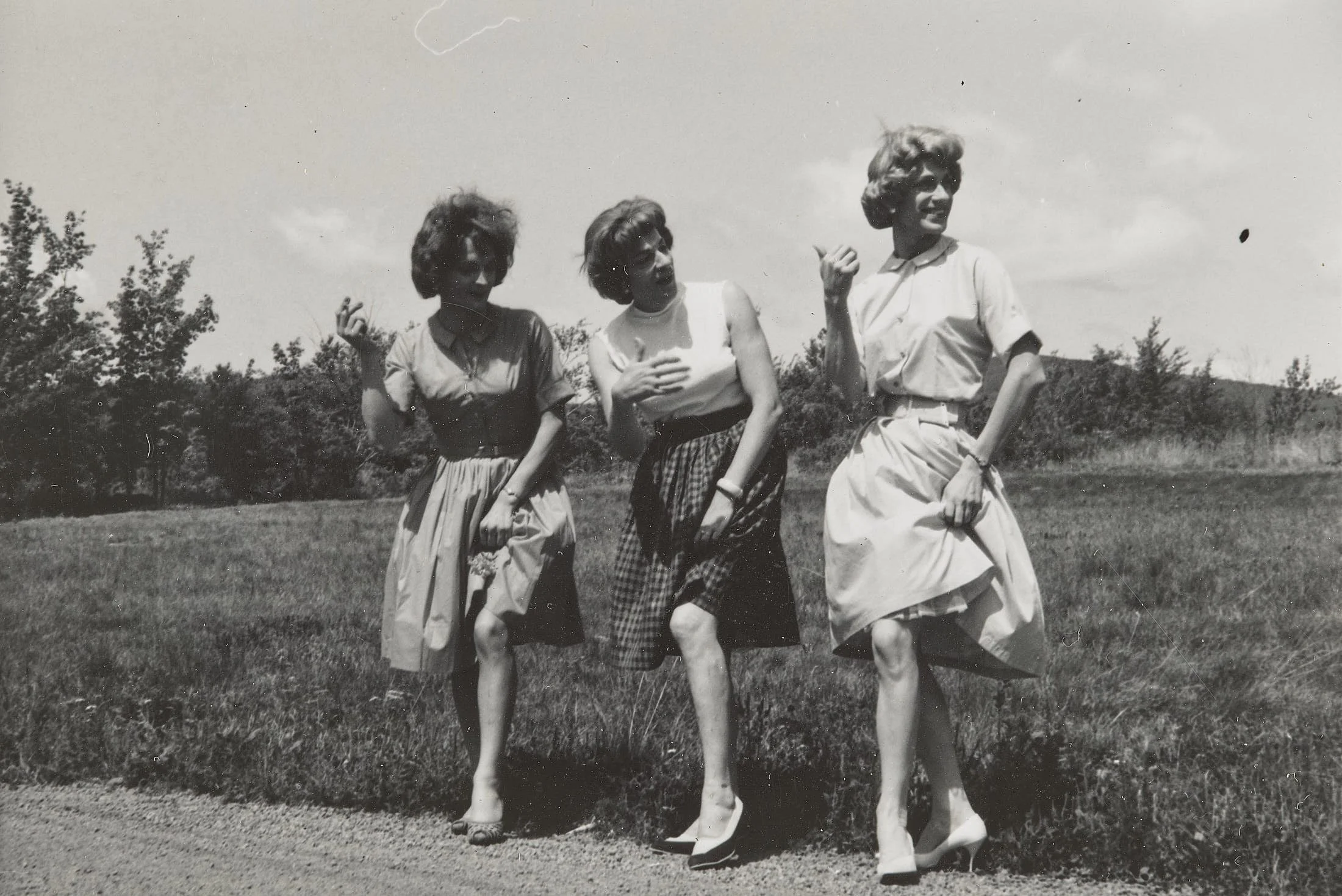
The ideal was deliberate, even nostalgic—rooted in the postwar archetypes found in McCall’s and Ladies’ Home Journal: the well-put-together neighbor, the serene housewife, the respectable matron. In the photographs, every detail—hemline, handbag, hairstyle—becomes a note in the visual composition of that identity. Poses are practiced and drawn from the vocabulary of mid-century magazine photography, with a hand on the hip and a pointed foot, knees together when seated, and legs crossed at the ankle. The images carry tenderness and defiance, each present in equal measure.They resist cultural norms simply by existing, but they also protect and nurture “the girl within,” as Susanna herself described it. In this way, the lens becomes a co-conspirator, a mirror that reflects back the self each sitter longed to see.
The exhibition extends beyond the walls to include issues of Transvestia, the underground magazine that served as a lifeline for the community. Published six times a year and mailed directly to subscribers, it offered autobiographical essays, style advice, and fiction alongside readers’ photographs. Functioning as a pre-digital social network, it stitched together a far-flung group into something resembling a public, though one that operated entirely out of sight. The curatorial approach, led at The Met by Mia Fineman, preserves this intimacy. Many of the photographs are small, close to the dimensions of a smartphone screen, but their presence in the gallery invites a different kind of looking. Here, scale becomes personal, measured in proximity. Standing before them, the viewer is drawn into the same hand-held space their original owners occupied, the same vantage from which they were once studied, treasured, and shared.
The quietest details in the exhibition are often the most affecting. A snapshot of Sheila and her wife Avis in matching dresses, tailored so they could wear them together; the patterned wallpaper behind Susanna and Felicity as they laugh in a summer kitchen. These are lived moments, captured for the circle that understood them, free from the staging of outside expectations.
Casa Susanna refrains from universalizing its story, presenting its subjects outside the frame of contemporary trans narratives. It invites visitors to encounter a community as it saw itself, through the images it made for its own eyes. In doing so, it restores a fragment of history to the broader photographic canon, reminding us that some of the most radical acts of visibility happen far from public view.
“One of the most important things you cannot experience when viewing images on a screen is a true sense of scale — the physical size of a picture in relation to your own body.”
Mia Fineman speaks with LE MILE
for Offline Edition - FW 2025 Nr. 39
![Unknown [Gloria in Susanna and Marie’s New York City apartment] 1960s Chromogenic print 3 1/2 x 3 9/16 in. (8.9 x 9 cm) Art Gallery of Ontario, Purchase, with funds generously donated by Martha LA McCain, 2015 Photo © AGO](https://images.squarespace-cdn.com/content/v1/52c0509ae4b0330e4569351f/c5552ea0-419f-42de-95d0-e72f76da9816/Casa-Susanna-The-Met-Exhibition-LE-MILE-Magazine-Gloria+in+Susanna+and+Maries+New+York+City+apartment_AGO.121804-Standard+Print.jpg)
Unknown
Gloria in Susanna and Marie’s New York City apartment, 1960s, Chromogenic print, 8.9 x 9 cm
Art Gallery of Ontario, Purchase, with funds generously donated by Martha LA McCain, 2015 / Photo ©AGO

Andrea Susan (American, 1939–2015)
Photo shoot with Lili, Wilma, and friends, Casa Susanna, Hunter, NY, 1964–1968, Chromogenic print 8.4 x 10.8 cm
Art Gallery of Ontario, Purchase, with funds generously donated by Martha LA McCain, 2015 / Photo ©AGO
Amanda Mortenson
These days, visibility begins with a screen. They´re curated, uploaded, compressed into metrics before it even has a chance to breathe. But the Casa Susanna images were never chasing an audience. How does their analog quietness speak to us now, in this overstimulated world?
Mia Fineman
In our current moment, when our visual lives are so completely dominated by screens, I think people — or at least some people — are beginning to crave firsthand encounters with the physicality of images, whether on the pages of books or magazines or on the walls of a museum or gallery. One of the most important things you cannot experience when viewing images on a screen is a true sense of scale — the physical size of a picture in relation to your own body. Ironically, these twentieth-century snapshots are almost exactly the size of a phone screen, created to be held in the palm of your hand.
Photography has always had a thing for secrets. When you first saw the Casa Susanna images, what did they whisper to you before you even read a word?
The first thing I noticed was that these are images of men wearing women’s clothes, makeup, and wigs — yet they are not drag queens. They are not performing an exaggerated, theatrical version of femininity. Rather, they are making a deliberate effort to appear authentic, to “pass” as ordinary women.
In their time, members of the Casa Susanna circle described themselves as “transvestites,” a term now widely considered pejorative. In the exhibition, we use the preferred term “cross-dressing” to describe the practice of wearing clothing typically associated with a gender different from one’s daily presentation.
What kind of woman did these guests want to become and what kind of woman did the camera let them be?
Their ideal of femininity was highly conventional, even somewhat old-fashioned for the time, rooted in the gender stereotypes of the 1940s and 1950s found in magazines such as McCall’s and Ladies’ Home Journal. The women they aspired to emulate were well-put-together and ladylike — the neighbor, the housewife, the respectable matron. The camera became a tool for creating and expressing these identities, drawing on the visual language of magazine photography and family snapshots. Posing was deliberate: when standing, often with a hand on one hip and one foot pointed and extended; when seated, with knees together and legs crossed at the ankles.
Unknown
Susanna standing by the mirror in her New York City apartment, 1960 – 1963 Color vintage print, 23 x 19 cm
Collection of Cindy Sherman / Photo ©AGO
![Unknown [Susanna standing by the mirror in her New York City apartment] 1960 – 1963 Color vintage print 9 1/16 x 7 1/5 in. (23 x 19 cm.) Collection of Cindy Sherman Photo © AGO](https://images.squarespace-cdn.com/content/v1/52c0509ae4b0330e4569351f/158c7a10-a813-4aa0-a02b-d184a06c982b/Casa-Susanna-The-Met-Exhibition-LE-MILE-Magazine-Susanna+standing+by+the+mirror+in+her+New+York+City+apartment_EXH.169577-Standard+Print.jpg)
“These are images of men wearing women’s clothes, makeup, and wigs — yet they are not drag queens. They are not performing an exaggerated, theatrical version of femininity.”
Mia Fineman speaks with LE MILE
for Offline Edition - FW 2025 Nr. 39
In a way, the lens was a co-conspirator, do you think these photographs were acts of resistance, or rituals of tenderness? Maybe both?
For those in the circle, seeing photographs of themselves dressed en femme was a profoundly powerful and affirming experience. The images carry a tenderness alongside a quiet resistance to prevailing cultural norms and expectations. Above all, the photographs functioned like magic mirrors, reflecting back an internalized self-image — what Susanna called “the girl within.”
How do you curate something that was never meant to be seen in a museum?
It’s not unusual. Most photographs, from the 19th century up through the present, were never meant to be seen in museums. That’s what makes the photographic medium so interesting—it’s capacious and touches on every aspect of our lives..
Let’s talk about the Polaroid. What role did that specific technology play in shaping the identities we see in these frames?
During this period, gender-nonconforming people faced intense persecution and lived with the constant threat of blackmail and denunciation. Sending film to a commercial lab carried a significant risk. A few members of the community learned to process film themselves, but the arrival of the Polaroid camera in the late 1950s proved especially popular among cross-dressers, offering both privacy and instant results.
![Unknown [Lili on the diving board, Casa Susanna, Hunter, NY] September 1966 Chromogenic print 5 1/16 x 3 9/16 in. (12.8 x 9 cm) Art Gallery of Ontario, Purchase, with funds generously donated by Martha LA McCain, 2015 Photo © AGO](https://images.squarespace-cdn.com/content/v1/52c0509ae4b0330e4569351f/a1477c4a-2457-4789-a42c-d451bef2c0ee/Casa-Susanna-The-Met-Exhibition-LE-MILE-Magazine-Lili+on+the+diving+board%2C+Casa+Susanna%2C+Hunter%2C+NY_AGO.121772-Standard+Print.jpg)
Unknown
Lili on the diving board, Casa Susanna, Hunter, NY, September 1966, Chromogenic print, 12.8 x 9 cm
Art Gallery of Ontario, Purchase, with funds generously donated by Martha LA McCain, 2015 / Photo ©AGO
![Unknown [Sheila and her GG Clarissa and friend, reading Transvestia] 1967 Gelatin silver print 3 5/16 x 4 5/16 in. (8.4 x 10.9 cm) Collection of Betsy Wollheim Photo © AGO](https://images.squarespace-cdn.com/content/v1/52c0509ae4b0330e4569351f/7c014898-8ebf-49bc-8c17-92b403b88b9b/Casa-Susanna-The-Met-Exhibition-LE-MILE-Magazine-Sheila+and+her+GG+Clarissa+and+friend%2C+reading+Transvestia_EXH.169756-Standard+Print.jpg)
Unknown
Sheila and her GG Clarissa and friend, reading Transvestia, 1967, Gelatin silver print, 8.4 x 10.9 cm
Collection of Betsy Wollheim / Photo ©AGO
What’s the quietest detail in the entire exhibition? The one that most people miss, but you still think about on your way home?
I was surprised to learn that several members of the Casa Susanna circle had wives or girlfriends who accompanied them to cross-dressing gatherings. There is a small photograph in the exhibition of a cross-dresser named Sheila with her wife Avis, standing together in front of a fireplace in matching patterned dresses. They had these dresses tailored so they could wear them together. Avis wrote a column for their community magazine recounting her struggle to understand Sheila’s cross-dressing, with concerns ranging from anxiety about being outed to frustration over sharing the family clothing budget.
There’s something almost radical about someone printing their truth in black-and-white and mailing it across the country, long before Likes existed. These photos were passed hand to hand, folded, hidden, held close. What does "Offline" mean inside a show like Casa Susanna, where the act of sharing was slower, riskier, and maybe more intimate?
The members of this community exchanged pictures at gatherings and sent them by mail. They also published them in an underground magazine called Transvestia. It put out six issues a year, distributed to subscribers by mail. It was a community magazine in the sense that nearly all the content was created by its readers. In effect, the magazine functioned as a social network that helped them ease their loneliness and connect with others.
If you had to choose one photograph from the show to hang in your home — not as a curator, but as Mia — which one would it be and why?
There’s a photograph of Susanna and Felicity (whose public identity was John Miller, the brother of photographer Lee Miller) joking around in the kitchen at one of the resorts. I love how it shows Susanna’s sassiness and warmth, and the playful connection between the two women. I also love their tailored summer dresses and the vintage scenic wallpaper behind them. I’d be happy to look at this picture every morning.
header image
Unknown
Susanna, Marilyn, and Marianne, Hunter, NY, 1963
Gelatin silver print, 9 x 12.5 cm
Collection of Cindy Sherman
Photo ©AGO