Viewing entries in
fashion

ELIZABETH DULAU *Transformation Characters Across Star Wars, Netflix & Stage

ELIZABETH DULAU *Transformation Characters Across Star Wars, Netflix & Stage

ELIZABETH DULAU
*Transformation Characters Across Star Wars, Netflix & Stage


written + interview Alban E. Smajli


Actor Elizabeth Dulau is entering a season shaped by roles with weight—political, historical, emotional. As Kleya Marki in Andor, she returns to the Star Wars universe for its final chapter, joining Diego Luna and Stellan Skarsgård.


Her presence remains precise and charged with a quiet urgency. In House of Guinness, created by Steven Knight for Netflix, she plays Lady Henrietta. The story follows the Guinness family across Ireland and New York in the 19th century, navigating legacy and fracture after the death of Benjamin Guinness. Dulau also voices the Piebald Deer in Wicked, a brief but memorable role.

She has appeared in Maternal, All The Light We Cannot See, The Outlaws, and Gentleman Jack, building a body of work that feels grounded and deliberate. Each performance speaks in its own register. In this interview, Elizabeth shares thoughts on transformation, emotional access, and the quieter moments that shape a role.


LE MILE Magazine COVER Elizabeth Dulau wears dress SPORTMAX shoes SPORTMAX earrings BONVO

dress SPORTMAX
earrings BONVO


Alban E. Smajli
You’re orbiting galaxies in Andor, slipping into corsets for House of Guinness, and voicing trembling deer in Wicked—what does it feel like to be a shapeshifter in a world constantly asking for identity?

Elizabeth Dulau
Yeah, this is an important discussion. I am a firm believer that actors should be allowed to transform into people far removed from themselves but there are boundaries that shouldn’t be crossed. There are some lanes that I very clearly do not belong in and that’s ok, that’s someone else’s lane. There’s still scope for shapeshifting within the lanes available to you.

I think it’s also important to acknowledge however, that a person’s identity can in many ways change throughout their life. This pressure to clearly define oneself is something that feels counterintuitive to me. As I’ve gotten older, I’ve realised actually being more of a shapeshifter in some respects feels natural to me and maybe that is part of my identity. It allows for growth and change and playing and to be honest that is why I’m drawn to being an actor. It allows me to really explore all the different sides of myself. To be honest, none of the roles I’ve played (yes, even the deer in Wicked) feel like someone other than myself. Every character feels like a singular thread of myself I pull on and enhance in order to transform.

The industry often feels like a theatre within a theatre. Where do you find the unscripted moments that still feel real?

I think these moments are found in the people you meet. Every now and then you’ll come across a real gem of a person with whom you can drop any professional guard and just be a messy human. I’ve certainly found that with Jacob James Beswick on Andor and Jennifer Macbeth on Maternal. People like them don’t come along often and I think it’s important to sit up and take notice when they do.


House of Guinness is soaked in legacy and loss. How do you personally move through stories drenched in history without getting stuck in the past?

When playing any character that is in a situation far removed from your own it’s important to remind yourself that your shared humanity connects you. Yes, do your research on the world in which they live, the etiquette, the politics, the faith systems but they are still a flawed person just like you. They will feel love, desire, rage, jealousy, grief and you can access their inner lives through your own experience of these things.

You’ve been part of massive universes (Star Wars) and deeply intimate dramas (Maternal). Which scale do you dream in?

My god I LOVE this question! I think my dreams range throughout many different scales. I am a big daydreamer and was often made to think it was a problem. I was constantly told to stop daydreaming and concentrate! But I realised while I was at drama school that my daydreaming is what helps me connect to my characters. I can happily spend hours dreaming up backstories for my characters to enrich their presence. I like to take the same approach to my own life too, dreaming up an ideal future for myself to then take steps towards it.

Fashion—do you see it as armour, as performance, or as rebellion? Or something more private?

I see it as all of the above. Fashion is one of the most accessible forms of self-expression and we’re always expressing ourselves with it whether we realise it or not. What we choose to cover ourselves with externally reflects something that’s going on internally. Maybe it’s a front, armour, a performance or a truly authentic expression of how we’re feeling in that moment. I love using fashion as a mode of creativity and character. When filming self-tapes for an audition, a really easy way to feel like that character might be throwing on a shirt or a pair of shoes that make you walk differently. In our everyday lives we can put on a different combination of pieces that make us feel like a subtly different version of ourselves and that feels so exciting to me.

 
LE MILE Magazine COVER Elizabeth Dulau wears dress SPORTMAX shoes SPORTMAX earrings BONVO

dress + shoes SPORTMAX
earrings BONVO

 
LE MILE Magazine Editorial SS25 Elizabeth Dulau wears coat SELF-PORTRAIT tights FALKE shoes ROGER VIVIER

coat SELF-PORTRAIT
tights FALKE
shoes ROGER VIVIER
belt + earrings FASHION ARCHIVE


“None of the roles I’ve played (yes, even the deer in Wicked) feel like someone other than myself.”

Elizabeth Dulau speaks with Alban E. Smajli
for LE MILE Digital SS25


How do you prepare for a role that requires emotional submersion—but still demands you show up, camera-ready, hair lit, line perfect?

All the camera-ready elements I don’t even think about. That’s someone else’s job. I let them look after that. As for the emotional submersion, there are a combination of factors at play. Good prep is always a winner. Again, I will often use daydreaming in the run up to a shoot to flesh out their life. I also use music a lot. Music accesses a part of our brains that logic simply can’t, so I create various playlists for each character and just before we shoot I’ll listen to a song that’s helpful. But the moment the director calls action I let go of all that prep and just focus on my scene partner, trying to change them and allowing myself to be changed by them. You have to trust that all your prep is there in the background without you having to hold on to it.


There’s a certain hush in your roles—quiet strength, subversion, layered tension. Where does that stillness come from?

I think this comes from a certain amount of internal conflict. I’m often drawn to characters whose outer projection is quite different to their inner lives. Kleya for example has a very cold and controlled exterior but I played her with the conviction that deep underneath all those external layers is someone who loves very deeply and holds a lot of hurt and rage. There’s something a little wild in her. I think this sense of stillness is born from the tension between those inner and outer lives. I’m suspended between the two.

Imagine a film directed by your future self—what genre would it be, and what would the costume department look like?

I’m very intrigued by sci-fi actually. I think it’s a really useful tool with which to ask questions about our world. And I have lots of questions! The costumes would probably be pretty elaborate. I’d need to get Michael Wilkinson on the team!

You’ve been part of a galaxy far, far away and now a dynasty built on stout. What story hasn’t been told yet, that you're dying to step inside?

I’m really inspired by filmmakers like Mark Ruffalo who use film as a form of activism, shining a light on important issues. Personally, I think there are more stories that need to be told about the climate crisis because there’s still so much apathy towards this issue.

The real change would only come about when government and major corporations commit to change but I believe we could bring about that change if we collectively put enough pressure on them. There’s so much potential for film and TV to create social movements, just look at Netflix’s Adolescence or ITV’s Mr Bates vs the Post Office. Both dramas created such a huge public response that the government took action and maybe there’s scope to do the same with the climate crisis.


talent ELIZABETH DULAU
photographer ANTONIO EUGENIO
stylist PRUE FISHER
hair ERIKA NEUMANN
male up PHOEBE HEARD
photographer assistant DANIEL EYNON

Special thanks to Grace Yeoman, PR Pinnacle
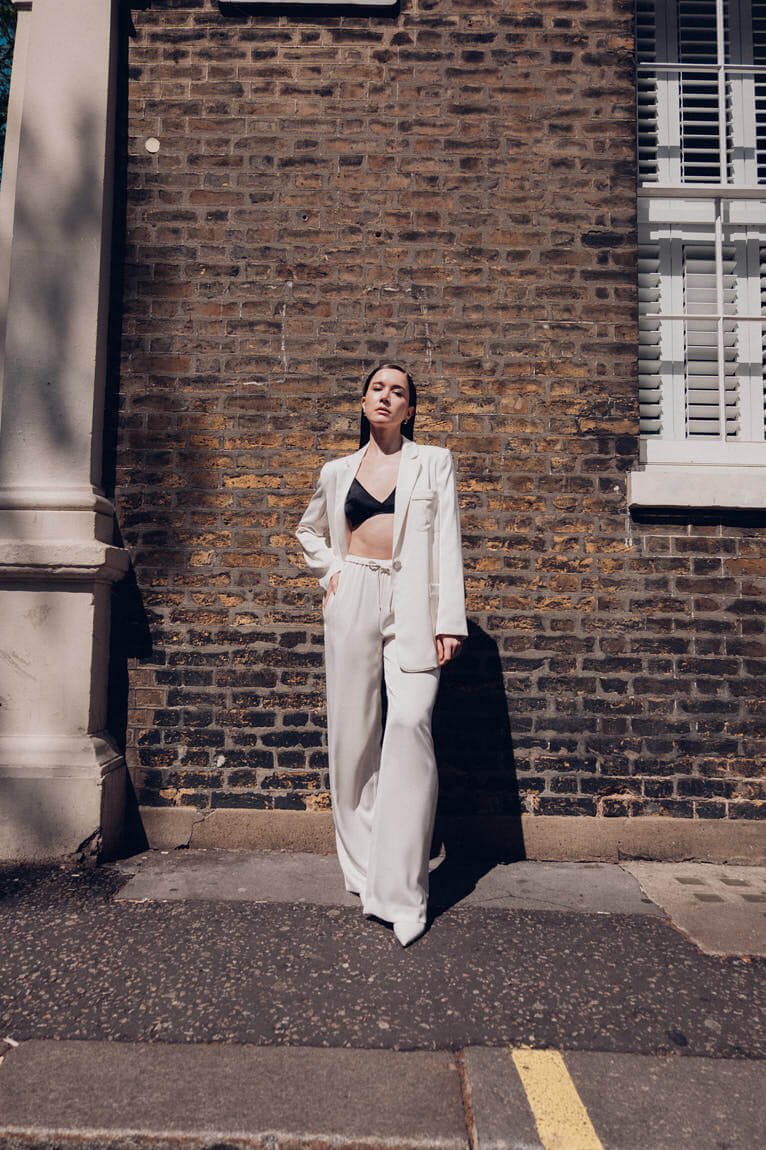
 
 
LE MILE Magazine Editorial SS25 Elizabeth Dulau wears blazer  ARMANI EXCHANGEtrouser  ARMANI EXCHANGEbra  INTIMISSIMIshoes  MANOLO BLAHNIK

blazer ARMANI EXCHANGE
trouser ARMANI EXCHANGE
bra INTIMISSIMI
shoes MANOLO BLAHNIK
earrings FASHION ARCHIVE
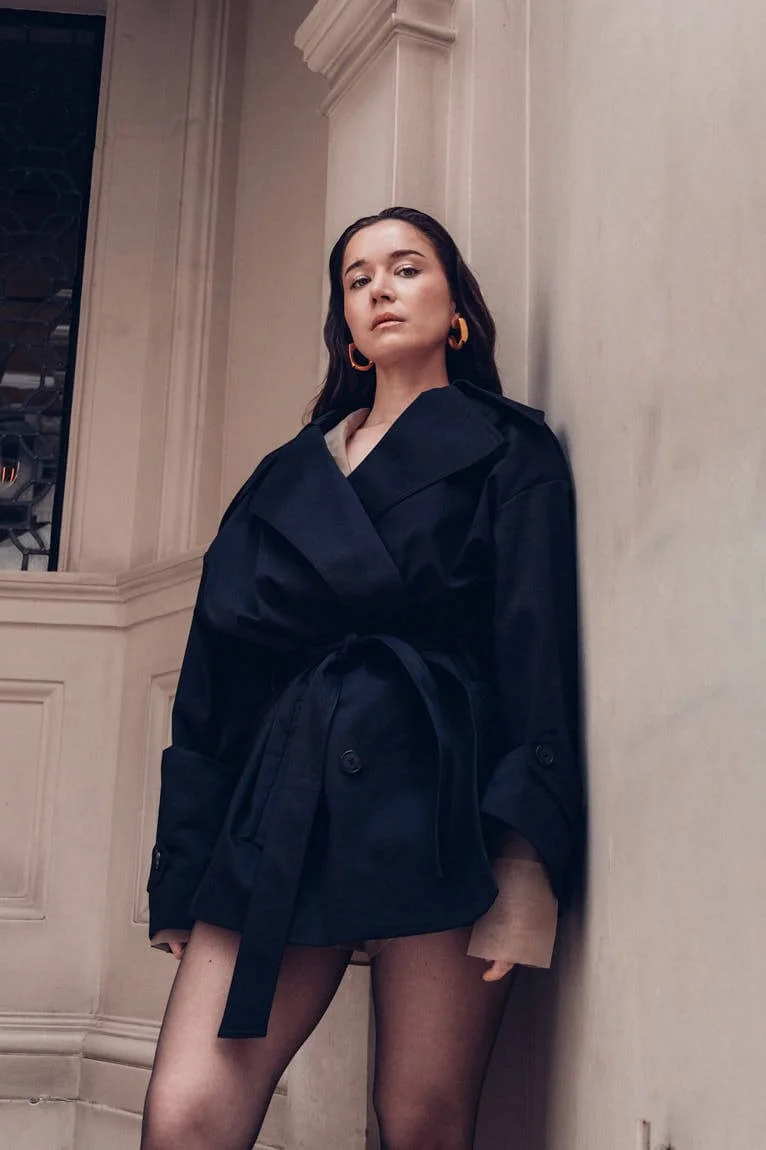


Coat The Frankie Shop LE MILE Magazine Editorial SS25 Elizabeth Dulau lemilestudios

coat THE FRANKIE SHOP
tights FALKE
earrings MISHO

 
LE MILE Magazine Editorial SS25 Elizabeth Dulau wears Shirt: The Frankie Shop Shorts: The Frankie shop Belt: stylists own Tights: Falke Shoes: Manolo blahnik Earrings: Misho

shirt + shorts THE FRANKIE SHOP
tights FALKE
shoes MANOLO BLAHNIK
earrings MISHO
belt FASHION ARCHIVE


“Fashion is one of the most accessible forms of self-expression… What we choose to cover ourselves with externally reflects something that’s going on internally.”

Elizabeth Dulau speaks with Alban E. Smajli
for LE MILE Digital SS25


FRANCO MASINI *Between Cities, Scripts, and Style

FRANCO MASINI *Between Cities, Scripts, and Style

FRANCO MASINI
*Between Cities, Scripts, and Style


written + interview ALBAN E. SMAJLI


Franco Masini moves with intent to generate monumentum. Actor, producer, reader of places, collector of moments—he expands his practice through curiosity and risk.


His latest project, a theatre production he’s independently bringing to life, marks a shift toward authorship. Ownership of process. Control of tone. A story he performs and constructs. Fashion is part of his language. He responds to designers like Adrian Appiolazza and Jonathan Anderson for their ability to distort form with precision. He keeps a close eye on Matias Carbone, an Argentinian voice now emerging across Europe. Masini assembles identities. and his wardrobe edits itself in real time.


watch FILM


Full look - Moschino Tie - Fursac LE MILE Magazine FRANCO MASINI Spring Summer 2025 Menswear Editorial Cover

full look MOSCHINO
tie FURSAC

 
Blazer - Transe Paris Vest - Igor Dieryck Jewelry - ALT Paris LE MILE Magazine FRANCO MASINI Spring Summer 2025 Menswear Editorial

blazer TRANSE PARIS
vest IGOR DIERYCK
jewelry ALT PARIS


Alban E. Smajli
Your career moves like a shifting lens—what’s in focus for you right now?

Franco Masini
I love the movement of my career. I think it’s really important to stay focused on new things and to have opportunities to learn and grow as an actor. My next step is to produce a new theatre show—I’ve already acquired the rights.

Which designers are speaking your language this season, and what are they saying?

There are many new designers doing amazing work. I really like Adrián Appiolaza and Jonathan Anderson—they’re very creative and always producing unique and thoughtful pieces. I also really like Matías Carbone from Argentina, who is expanding his brand into Europe.

If your wardrobe were a film, who’s directing?

My wardrobe has many different elements. I think it would need a very unique director. I enjoy changing styles, designers, and colours, and creating my own “Franco” style. I get bored easily—haha!

Art and fashion exist in dialogue. Where do you see the conversation heading?

Art and fashion are two things I really enjoy. I love how creators express their own perspectives through clothing.


Museums capture time, fashion rewrites it—what recent art exhibition has stayed with you?

I really liked ARCO in Madrid—a week of contemporary art, with so many creatives and amazing artists.


What does personal luxury look like for you beyond the obvious?

Personal luxury, for me, is in meaningful moments with the people I love—like visiting new places, discovering new countries, or sharing great food with friends. That’s the best.


What city makes you feel most like yourself?

I think Buenos Aires is the place—full of movement, art, cinema, friends, and always something to do. Madrid feels like my second home. It’s also incredible.


Morning ritual or midnight impulse—when do you feel most alive?

I feel most alive in the morning. I love waking up, going for a run near the river, and then having breakfast with a book. I really enjoy reading in the morning.

If you could archive a single look from your life, what would it be?

That’s hard to say because my life is in constant motion—and I love that. I’m always meeting new people, living in new places, exploring new cultures. I appreciate my job because it allows me to reach so many parts of the world.

What’s the last thing that truly surprised you?

The last thing that surprised me was meeting Adrien Brody at Paris Fashion Week. I really admire his work, and it was great to talk with him. We were seated in the same row. I’ve seen all of his movies.


Full look - Jacquemus Jewelry - ALT Paris LE MILE Magazine FRANCO MASINI Spring Summer 2025 Menswear Editorial

full look JACQUEMUS
jewelry ALT PARIS

 
Full look - Moschino Jewelry - ALT Paris LE MILE Magazine FRANCO MASINI Spring Summer 2025 Menswear Editorial

full look MOSCHINO
jewelry ALT PARIS


He begins his days by the river, running along the water as the city slowly wakes. What follows is quiet and deliberate: coffee, a book, the kind of solitude that aligns the mind before the rest of the world demands attention. Mornings carry a clarity that sets the pace for everything that comes after—travel, conversations, creative shifts, the layering of roles and identities. Buenos Aires flows through him with instinctive rhythm, while Madrid offers a different current, equally present in his internal map. Each place contributes to the structure he’s building—fluid, expansive, unfinished by design. His idea of luxury moves away from display and towards sensation. A shared plate with friends, the atmosphere of a new neighborhood, the texture of unfamiliar languages and streets—these are the moments that stay.

The value is in gathering feeling, in building a personal archive made of people, places, and presence. At Paris Fashion Week, he found himself seated next to Adrien Brody. A quiet dialogue unfolded—film, performance, process. Nothing staged. Just two people exchanging thoughts in a shared space, surrounded by movement but anchored in something still.
Franco Masini lives in progression. Style evolves, environments shift, energy recalibrates. What stays is the drive to create—not as an end point but as a state of being, a continuous act that shapes and reshapes itself in response to what enters, what unfolds, and what he chooses to carry forward.


Full look - Arturo Obegero Shoes - Camper Jewelry - ALT Paris Watch - Cartier LE MILE Magazine FRANCO MASINI Spring Summer 2025 Menswear Editorial

full look ARTURO OBEGERO
shoes CAMPER
jewelry ALT PARIS
watch CARTIER

 
Full look - Evan Benjamin Socks and shoes - Moschino LE MILE Magazine FRANCO MASINI Spring Summer 2025 Menswear Editorial

full look EVAN BENJAMIN
socks + shoes MOSCHINO


credits
photographer LOUIS TERAN
stylist SIMON NNDJOCK
talent FRANCO MASINI
set designer CLARA DE GOBERT via APICORP AGENCY
movement director ROBIN LABARRERE
hair PAUL GOMEZ
make up MANON CANA via BUREAU ALAGNA
nails MAHARA DIARTE-ZEROUALI
casting director MARVIN LATOURNALD with MODELS LANE
production TABATHA RUSSO at BUREAU ALAGNA
photographer assistant STEVEN BAILLIN

special thanks to Tatiana Dumabin

DYLAN LLEWELLYN *Brewing Moments

DYLAN LLEWELLYN *Brewing Moments

DYLAN LLEWELLYN
*Brewing Moments


written + interview Sarah Arendts


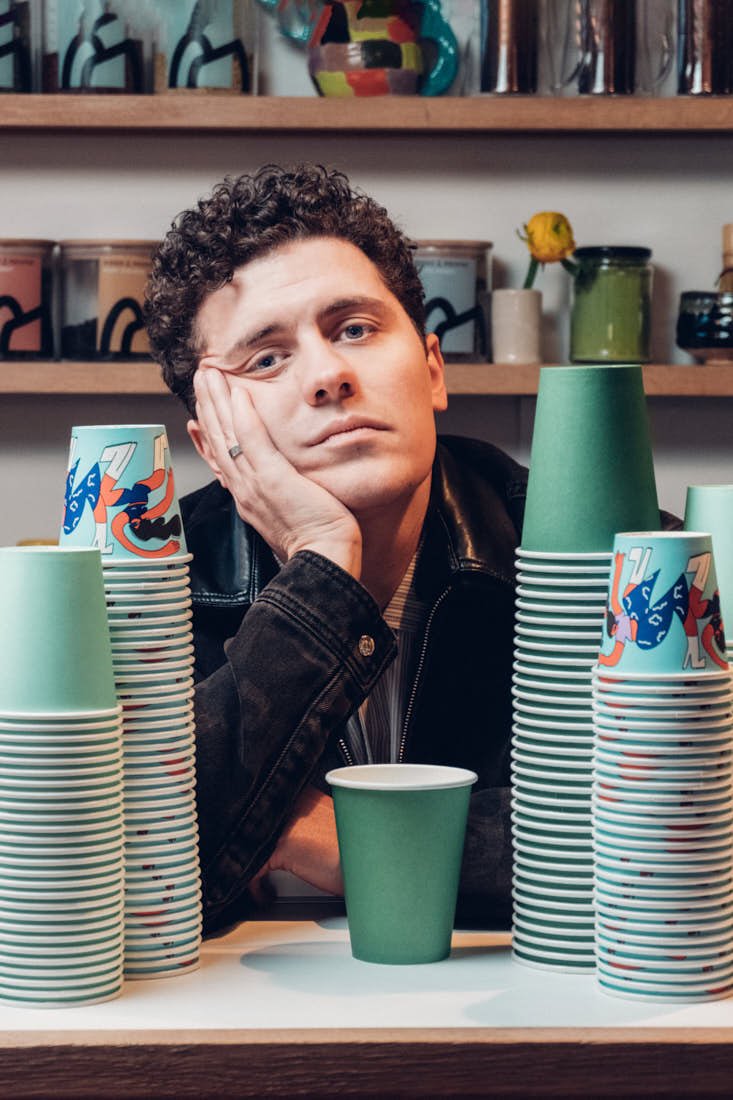
Dylan Llewellyn moves through stories like an architect of feeling. Captured mid-conversation, coffee in hand, the setting mirrors the essence of his work—unfiltered, natural, alive in the moment.


Every role expands the space it occupies, stretching humor into unexpected depths and carving out moments that stay long after the scene ends. His presence on screen is charged—words, expressions, silences all calibrated for maximum impact.


LE MILE Magazine Dylan Llewellyn Actor Interview in a cafe Jacket and shirt by NANUSHKA

jacket + shirt NANUSHKA


Comedy fuels his process. A living language of timing, movement, and instinct. The humor lands, not as an escape, but as an excavation of something real. Derry Girls, Big Boys, Beyond Paradise—each project a new rhythm, built with precision, delivered with an effortless pulse. Llewellyn works with momentum. The industry shifts, names rise and fall, but the resonance of his performances embeds itself deeper. Not tied to nostalgia, not chasing permanence. Just sharp storytelling, lived-in characters, and the kind of presence that doesn’t ask for space—it takes it.


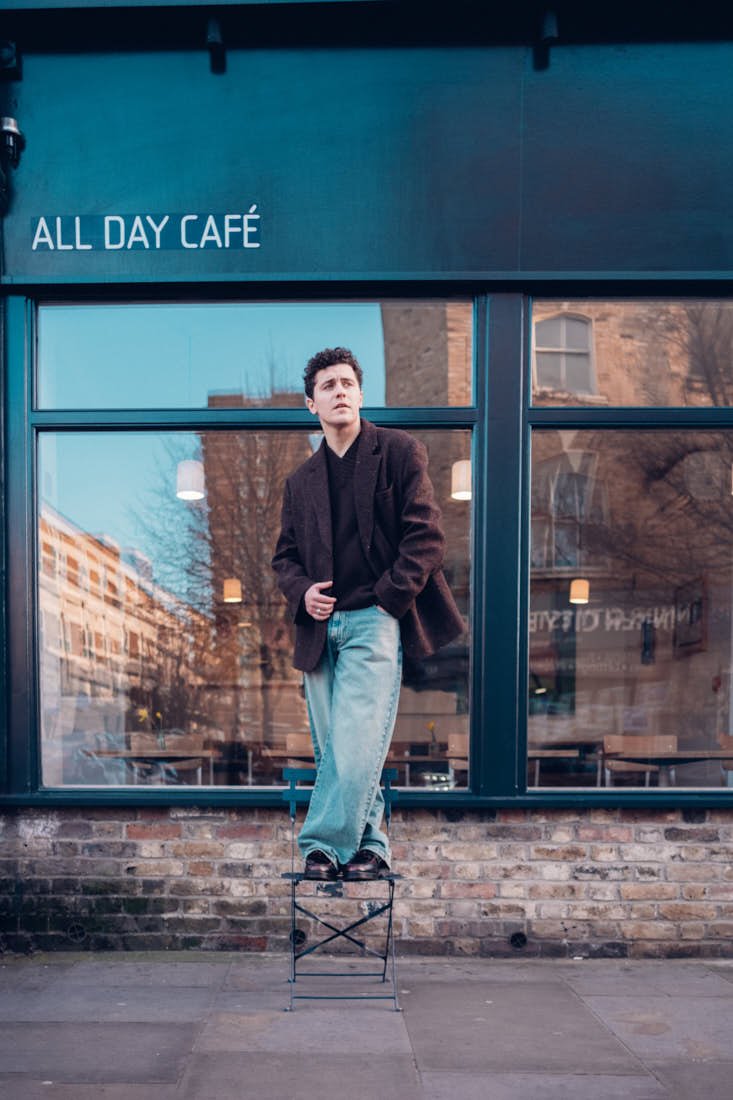
LE MILE Magazine Dylan Llewellyn Actor Interview All Day Cafe knitwear SANDRO blazer THE FRANKIE SHOP jeans O.FILES loafers DR MARTENS socks FALKE rings MAYA MAGAL

knitwear SANDRO
blazer THE FRANKIE SHOP
jeans O.FILES
loafers DR MARTENS
socks FALKE
rings MAYA MAGAL

 
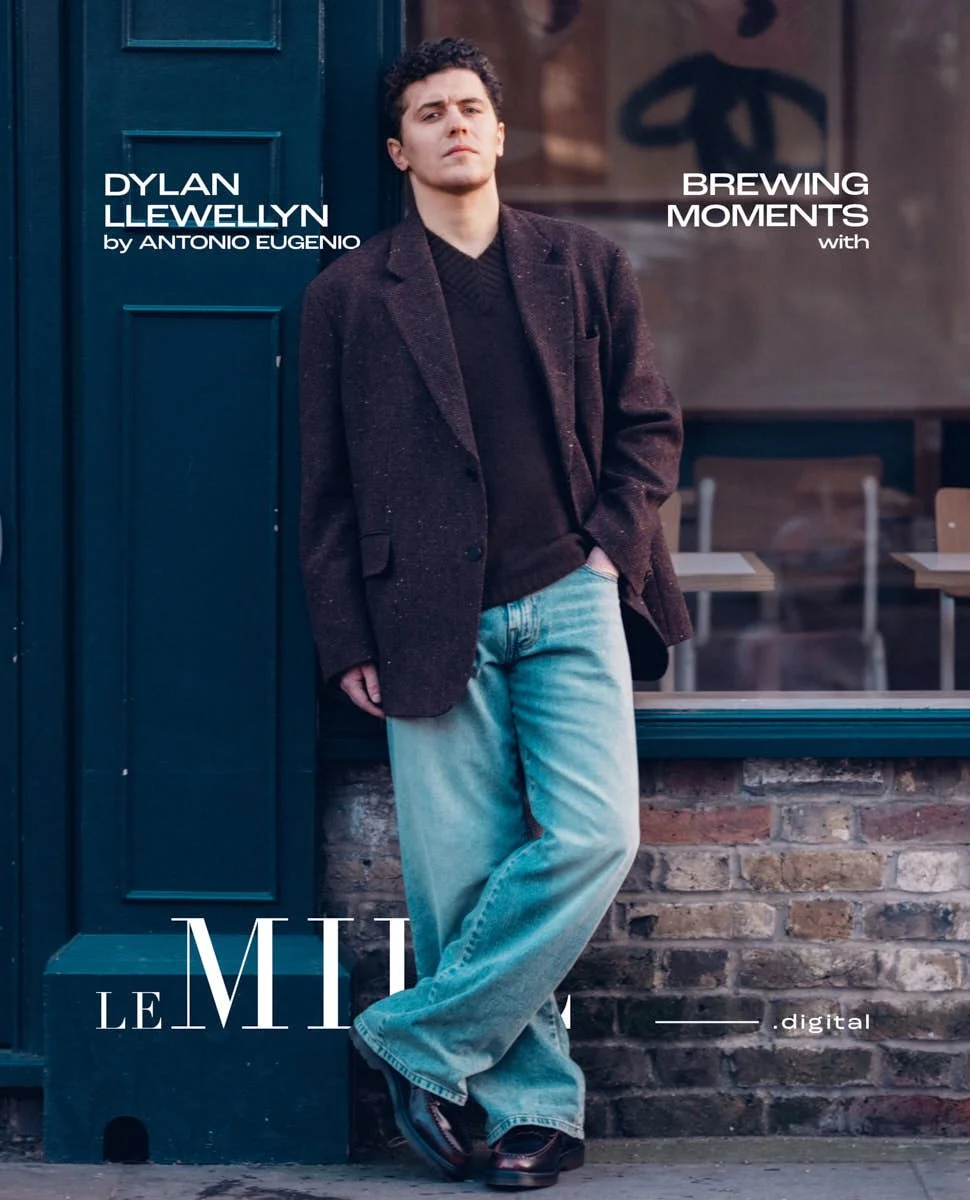
LE MILE Magazine Dylan Llewellyn Actor Interview cover knitwear SANDRO blazer THE FRANKIE SHOP jeans O.FILES loafers DR MARTENS socks FALKE rings MAYA MAGAL
 

Sarah Arendts
What does comedy allow you to express that drama doesn’t?

Dylan Llewellyn
I think comedy lets you have more freedom with your performance. You can go from being extremely serious and deadpan, but still leaning into the humour, to being super silly and over the top. There’s a whole variety of comedic styles to explore and I think that’s the main difference.

You’ve inhabited roles that capture the awkwardness, rawness, and humor of coming of age. Can you think of a moment in your life that felt like it could be part of one of your shows?

I think we’ve all experienced that classic moment of getting ID'd when you're in your teens. I remember going to see a 15-rated movie in the cinema when I was around 17 years old. They wouldn’t let me in because I didn’t have my passport or ID on me, so I had to call my parents to come down with it. My older brother came in and asked the staff where I was… They said “Oh, he’s just waiting in the bar.” My brother goes, “Oh what, so you let him hang in the bar but not let him watch the 15-rated movie?” That was quite a funny classic story of growing up and being ID’d.


Fame doesn’t last forever. What’s the one thing you hope to leave behind in the industry?

What I hope to leave behind in the industry and my acting career is just a sense of joy in the roles I’ve played – from Derry Girls to Big Boys. Those comedic roles have been such a joy and so much fun to perform. I’ve also loved working with so many talented actors along the way. I hope it inspiresyounger generations to get into comedic acting and to carry on that torch. For me, The Inbetweeners inspired me growing up, especially during school days. I grew up watching them and thought I’d love to do something like that. Then Derry Girls came along, followed by Big Boys, so yeah, I hope I can do the same for another young actor or actress.


Jack’s journey in Big Boys is deeply personal yet universal. What’s the most surprising reaction you’ve received from fans?

I think what surprised me most about the response to Big Boys is just how many people relate to it. But at the same time, it’s not that surprising because all those subjects – grief, mental health struggles, friendship, family, and sexuality – are so relatable. A lot of people can connect with those topics. What really stands out to me is how much it’s hit home for so many, with people speaking out about how much those themes mean to them, especially the dynamic of friendships – specifically the dynamic of the gay and straight friendship between Jack and Danny.


You played Wally Nightingale in Pistol, a musician lost in punk history. Do you think he would be remembered differently if he were around today?

When it comes to Wally Nightingale, the character I played in Pistol, it’s a really sad story. He lived the rock and roll lifestyle but without the fame or the money that came with it. I think, and I hope, he’ll be remembered fondly as one of the roots for the Sex Pistols – someone who helped lay the foundation for what they became. I really want him to be credited and recognized as such.


Your characters are often outsiders finding their place. Do you see yourself in them?

Yeah, I think I bring a little of myself into all my characters. I lean into their characteristics more and just make them themselves – their own personalities, their own people. I’ve played a lot of vulnerable, awkward, coming-of-age characters who are finding themselves. But I’ve also played characters who are more confident, like Kelby Hartford [from Beyond Paradise]. I think Kelby is very confident in himself, and even Wally Nightingale from Pistol was pretty confident in his abilities.

Some roles stay with actors forever. Have any of your characters changed the way you see the world?

I think the character of James in Derry Girls has made me learn about Irish history and developed my appreciation for Irish people and how amazing they are. The character of Jack in Big Boys shows the incredible bravery of people discovering themselves, both with their sexuality and with grief, as well as their mental health. I think Wally Nightingale in Pistol made me see the world with more appreciation for music, for being kind of weird, and not caring about being normal. I think that was the whole message of Pistol, the show, and the Sex Pistols in general – it was all about letting your freak flag fly and being okay with not being normal. The whole punk revolution shows that, so yeah, I think I’ve learned a lot from these characters, their stories, and the show’s stories.


Both storytelling and life are temporary. Do you try to make things last, or do you embrace their short-lived nature?

I think I do try to make things last whenever I can but I also embrace the short-lived nature of things as well. I think you can enjoy both sides of it. That’s kind of me to a T – I’m definitely someone who’s glass half full but also half empty at the same time. I think you can see both sides of it and I feel likeit’s a healthy way to look at things – considering every perspective and mentality. Yeah, it’s a tough one, I think.


What’s a role you’d never take—and why?

Actually, there are lot of roles I am open to and really want to take a crack at. I mean, I'd love to play villain or a darker role, or just a role that’s completely different from what I’m usually cast in. I'm always up for the challenge and I’d love to explore those kinds of roles more and really get my acting teeth into them


“Comedy lands, not as an escape, but as an excavation of something real.”

Dylan Llewellyn speaks with Sarah Arendts
for LE MILE Nr. 38 - Spring/Summer 2025 Edition


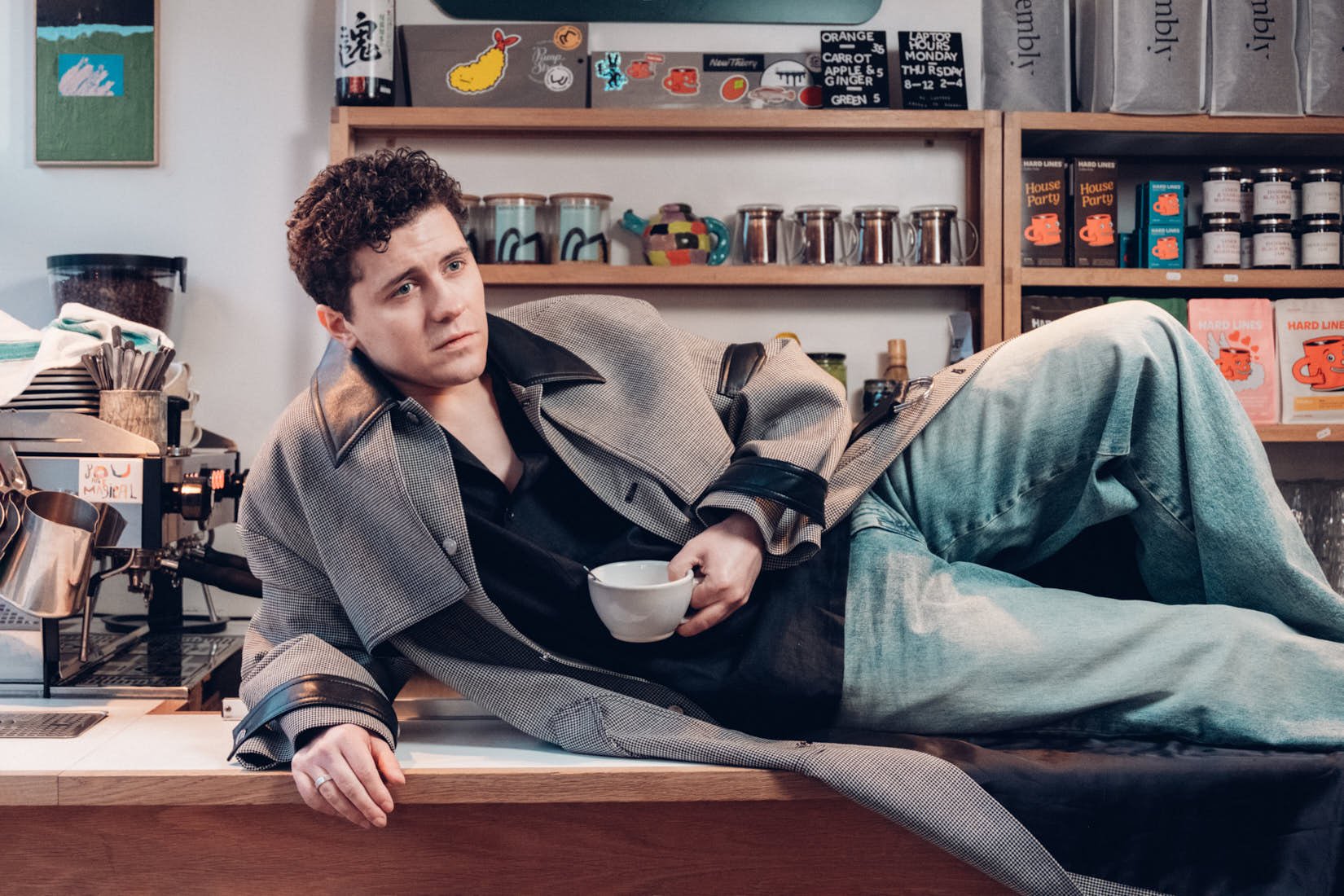
LE MILE Magazine Dylan Llewellyn Actor with coffee mug in a cafe wearing Coat NANUSHKA Shirt DOLCE & GABBANA Jeans O.FILES Ring MAYA MAGAL

coat NANUSHKA
shirt DOLCE & GABBANA
jeans O.FILES
ring MAYA MAGAL


credits
talent DYLAN LLEWELLYN
photographer ANTONIO EUGENIO
stylist MILLIE CULLUM
grooming CHARLIE CULLEN using @babylissprouk & @shakeupcosmetics
photographer assistant DANIEL EYNON
fashion assistant AMY HARFOOT
location Special thanks to Mae + Harvey, East London

KRIS MARSHALL *Inside the Mind of DI Humphrey Goodman

KRIS MARSHALL *Inside the Mind of DI Humphrey Goodman

KRIS MARSHALL
*Inside the Mind of DI Humphrey Goodman


written + interview Alban E. Smajli


Kris Marshall moves through roles like pages in a living archive. Each return to DI Humphrey Goodman is a recalibration, a quiet shift in tone, pace, inflection.


The detective doesn’t arrive fully formed; he extends through time, carried by instinct, built through decisions that remain invisible until they aren’t. Kris Marshall works with precision. He feeds the character small changes—gestures, rhythms, interior logic. In Beyond Paradise, nothing is static. Everything folds back into the work: his references, the sea, the energy of a long shoot, the movement of strangers who never knew they were being studied.


LE MILE Magazine Kris Marshall by David Reiss Editorial Cover Story  actor wears Jumper : Ralph Lauren Trouser: Ralph Lauren Socks: Falke Shoes: Sandro Sunglasses: The Avantguard Jacket: The Frankie Shop

jumper + trousers RALPH LAUREN
socks FALKE
shoes SANDRO
sunglasses THE AVANTGUARD
jacket THE FRANKIE SHOP


He rarely speaks in absolutes. Scripts are approached like open systems. Scenes are lived, not performed. He notes structure, then lets it bend. The repetition of a character over seasons becomes an act of endurance, not rehearsal. Ideas are planted early and left to unfold over time.

Memory plays a role. So does observation. He remembers the weight of theatre nights, the long haul of production days, the silence that follows a line well delivered. Meals with Pacino in Italy exist in the same archive as his first stage rehearsals—held not for anecdote, but for texture.

In conversation, Marshall cuts through sentiment. He speaks clearly about work. The physical toll. The mental timing. The need to rest before the next scene. Acting, for him, is not escape—it is a study in repetition, and the possibility of nuance inside repetition.
This interview traces Marshall’s ongoing practice—returning to characters not to resolve them, but to remain in conversation with them. He shares what drives him on set, what surprises still occur, and what advice he carries forward. No grand epiphanies. Just a steady commitment to showing up, seeing clearly, and staying inside the craft.

 
LE MILE Magazine Kris Marshall by David Reiss Editorial Cover Story RALPH LAUREN suit and shirt SANDRO tie

suit + shirt RALPH LAUREN
tie SANDRO

 
LE MILE Magazine DIGITAL COVER KRIS MARSHALL by David Reiss SS25 wearing COS


“Every character I play is a part of me… Which has to be true otherwise you’re not going to believe it yourself, so how can you expect other people to.”

Kris Marshall speaks with Alban E. Smajli
for LE MILE Digital SS25 - on Beyond Paradise


Alban E. Smajli
What keeps drawing you back to DI Humphrey Goodman? Is there still more of him to uncover, or do you just enjoy the ride?

Kris Marshall
Well, I’m not gonna lie and say that enjoying the ride isn’t a part of it, because both incarnations of him have lived by the sea, and I spend as much of my free time in it and on it as possible. Which is joyous. But there’d be no point if I didn’t feel there was more of his character to discover. As I get, shall we say, less young, it’s important to convey his changes as well, so there’s that, and I’m constantly throwing in new ideas and homages to my favourite detectives and other characters in TV and film that have influenced me.

From Love Actually to Beyond Paradise, your career spans rom-coms, crime dramas, and theatre. Where do you feel most at home?

Not working!.. No I’m kind of kidding. I came up through theatre, it’s all I did for the first 6 years, and even though after that I’d probably only do a play every 4 or 5 years, you can never replicate that kind of peril and immediacy on TV and film. But there’s something about building a character over a long shoot, and the fact no two days are the same, that I’ve always found beguiling.


Humphrey is a detective who sees the world differently. What’s a case you’d love to see him tackle in Beyond Paradise?

A corrupt politician. He’s renowned for being pretty open-minded, fair and kind, but he has a healthy disdain for and a delight in unpicking capricious and arrogant people who view him as strange and hopeless. It’s the Columbo/Marple gene, to lure antagonists to their doom!… Failing that, anything to do with surfing, for reasons mentioned above.


You’ve played both hopeless romantics and sharp-witted detectives. Which role is closer to the real Kris Marshall?

I would say both and neither. If that’s not too obtuse. I think Jack Nicholson said ‘Every character I play is a part of me’… Which has to be true otherwise you’re not going to believe it yourself, so how can you expect other people to. But also, they’re not me, because I study other people’s mannerisms and walks and use them as well. 


What do you think makes Beyond Paradise resonate so strongly with viewers?

Well, of course the location is beautiful, bucolic and colourful. But also, people love puzzle solving, so it’s somewhat interactive on that front. But the main reason is it’s not too dark and violent and doesn’t take itself too seriously, so it’s watchable across demographics. I’ve met people who say it means a lot to them as it’s something they can bond watching with their parents and children, which I think is delightful. 


You stepped back into Sanditon's Tom Parker and Beyond Paradise's Humphrey Goodman. How does revisiting a character change your perspective on them?

Filming is often arriving at a location you’ve never seen, and then getting the best takes within the allotted time, before you move on to another location you’ve never seen!… Whereas in theatre, you get to go back and slightly alter and hone your performance every night. So getting the chance to revisit a character again on film is, if you’ll forgive the mixed metaphors, another crack at the cherry. 


Theatre, film, TV—each demands a different energy. Do you approach acting differently on stage versus on screen?

I guess they all involve conserving energy. Filming is getting up at 5.30am, working until 7pm and then eating and getting enough rest to do that for anything up to 6 months. Theatre is all about building enough energy through the day for an evening performance, and then not getting too carried away with enjoying the nighttime after the show…Because the older I get the earlier I’m up!


Keeping in mind that you’ve worked with some of the most celebrated actors in the industry, what’s a moment that still sticks with you?

Working with Al Pacino on The Merchant of Venice. We were away on location in Italy and nearly every night after work he’d insist on us all having a sit-down meal in different restaurants. One night he even came clubbing with us younger actors, and seeing this absolute legend grooving to a heavy bass in a European nightclub was something I’ll never forget.


Have you ever been truly surprised by a plot twist in one of your own scripts?

Nothing that particularly springs to mind I have to say. Although I’ve had a fair few scripts through where you get to page 5 and it says ‘And then he dies’!… And you’re thinking, I’m actually quite insulted you thought I might want to play this role man…!!


If you could time-travel back in time, what advice would you give to your younger self?

That whatever it is you think is the right way to do it, is the right way to do it…
And stop smoking dude…

credits

talent KRIS MARSHALL
photographer DAVID REISS
stylist PRUE FISHER
grooming JOLANDA COETZER


LE MILE Magazine Kris Marshall by David Reiss Editorial Cover Story actor wears full look RALPH LAUREN socks FALKE shoes SANDRO

full look RALPH LAUREN
socks FALKE
shoes SANDRO


LE MILE Magazine Kris Marshall by David Reiss Editorial Cover Story actor wears suit + shirt FURSAC boots SANDRO

suit + shirt FURSAC
boots SANDRO

 
LE MILE Magazine Kris Marshall by David Reiss Editorial Cover Story actor wears suit + shirt FURSAC boots SANDRO


“Getting the chance to revisit a character again on film is, if you’ll forgive the mixed metaphors, another crack at the cherry.”

Kris Marshall speaks with Alban E. Smajli
for LE MILE Digital SS25 - on Beyond Paradise


NEIL ZHAO *The Material Alchemy

NEIL ZHAO *The Material Alchemy

NEIL ZHAO
*The Material Alchemy


written + interview TAGEN DONOVAN


Neil is a designer redefining contemporary fashion with his sharp, conceptual approach to materiality and form. His work transcends traditional boundaries, transforming overlooked objects into thought-provoking statements that blur the lines between fashion, sculpture, and cultural commentary.


By challenging convention, Neil invites audiences to reconsider the value and potential of everyday materials, sparking a deeper reflection on the intersection of utility and aesthetics. At the core of Zhao’s work is an exploration of permanence and ephemerality—how garments, trends, and even the industry itself exist in a state of constant flux. His designs embrace the tension between the fleeting and the enduring, questioning what it means to create in a world where change is the only constant. This philosophy is embodied in Zhao’s acclaimed Tyre Bag, a piece constructed from industrial material and repurposed into a high-fashion object, subverting expectations and revealing the beauty in the mundane. Across his collections, Neil employs techniques such as layering, deconstruction, and exaggerated repetition, crafting garments that mirror the transient nature of contemporary culture.


LE MILE Magazine NEIL ZHAO Interview Portrait London

Bastien Dausse
seen by Cécile Prunet / (c) Cécile Prunet


As the fashion industry navigates an era of profound socio-political, and environmental shifts, Neil stands among a new generation of designers reshaping its trajectory. His work responds to the moment yet resists easy categorisation—offering a perspective that is as inquisitive as it is uncompromising. By pushing the boundaries of materiality, Neil not only captures the spirit of the times but also challenges the industry to rethink its assumptions about creativity, consumption, and sustainability. In this interview, we explore Neil’s creative process, his evolving relationship with fashion, and what it means to design in an era defined by constant change. Through his innovative vision and commitment to reimagining the ordinary, Neil offers a fresh perspective on the future of design.


“For me, lasting means never settling for what is safe or what already works. Reinvention is key.”

Neil Zhao speaks with Tagen Donovan
for LE MILE .Digital - THE MATERIAL ALCHEMY


LE MILE Magazine NEIL ZHAO Interview

(c) Neil Zhao

LE MILE Magazine NEIL ZHAO Interview

(c) Neil Zhao


Tagen Donovan
Your use of the unexpected pushes the boundaries of what fashion can be. How do these choices speak to the theme of impermanence, and what do they reveal about the lifecycle and reinvention of everyday objects?

Neil Zhao
I'm captivated by the mundane and the present moment. My latest collection, showcased last November, reflects this fascination. Currently, as a second-year fashion design student, I'm fully immersing myself in this unique phase—observing my environment and drawing inspiration from it. This might be my only time as a fashion design student, and I aim to capture this transient experience.

Viewing fashion through an anthropological lens offers unique insights. How does this approach help you decode the cyclical nature of the industry?

At its core, fashion reflects human nature—people crave novelty, whether driven by seasonal trends or the pressures of capitalism. Yet, while fashion constantly reinvents itself, certain staples remain.

Blazers, jeans, and button-down shirts don’t disappear; instead, they evolve. Each cycle brings a fresh perspective—through cuts, fabrics, or styling—breathing new life into familiar silhouettes while maintaining their essential form.

With roots across Australia, China, and Norway, how has this multicultural backdrop shaped your perspective on cultural aesthetics?

I think my background has given me a sharper sensitivity to cultural nuances. Having lived in each of these countries for at least six years, I’ve become attuned to the subtle, often unspoken differences between them. It’s not just the obvious distinctions—like food, language, or greetings—but also the ways people from different places naturally respond to certain situations.

At the same time, I find it fascinating to observe the common threads that connect people across cultures. Despite their differences, there are shared instincts and behaviors that transcend borders, revealing an underlying universality in how we interact and relate to one another.

Your work is guided by conceptual underpinnings. In your 2023 RESET showcase at Central Saint Martins, you layered multiple jackets atop one another, creating a striking visual. How does this technique of superimposing reflect the transient meanings of contemporary fashion?

I’m fascinated by the fact that every time I walk into a mall, I see the same garments on the racks—again and again. There’s something compelling about that repetition, the way fashion continuously recreates the same pieces with only slight variations.

It’s intriguing how trends evolve, yet certain silhouettes, fabrics, and styles resurface in endless cycles, reinforcing the idea that fashion is in a constant state of reinvention rather than true transformation.


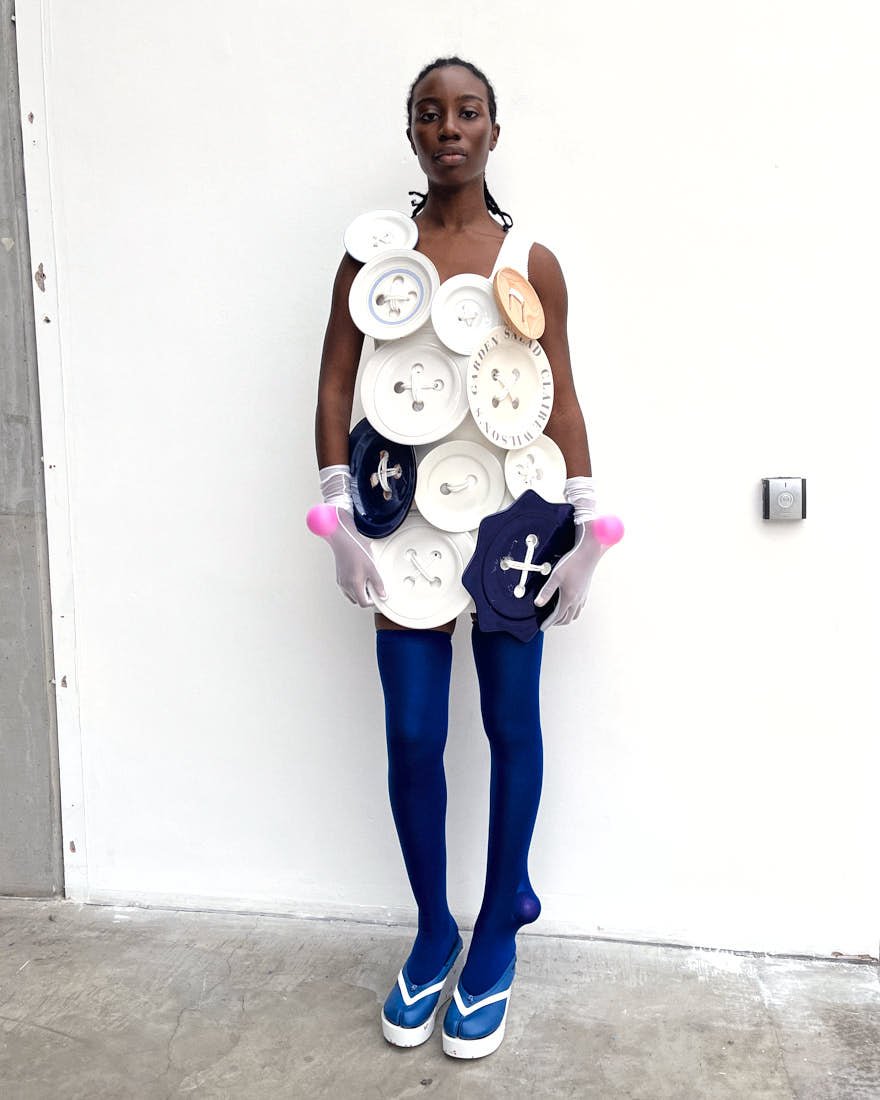
Your first presentation at Sarabande’s East London Space, If You Don’t Get It, It’s for You, reimagined pin cushions, buttons, and fabric swatches as garments. Could you elaborate on the symbolism behind this collection?

These are the tools of fashion—the things that all of us at my school share in common. Beyond that, we are very different. We come from different countries, subcultures, and ethnicities. We may dress differently, but we all share the same workspaces, hang out in the same smoking areas, go to the same bars, and talk to each other. This kind of community, where such a diverse group of people are brought together through a shared craft, is something you wouldn’t see anywhere else outside of a fashion school. And I find that really interesting.


Fashion often captures the spirit of its time. How does the zeitgeist inform your creative process, and how do you balance creating designs that feel relevant to the present while embracing their inevitable transience? In such a fast-paced industry, do you believe timelessness is still possible?

I’m deeply interested in what’s happening right now. However, it’s hard to pinpoint exactly how the zeitgeist influences my practice—it's difficult to recognise when you’re living through it. That’s what I find exciting about it. I want to look back at my work and see that it was truly reflective of its time.

As for timelessness, I don’t really believe in it—at least not at this point in my career. Sometimes, it feels like the concept of timelessness is used as an excuse to create uninspired work. But who knows? Maybe one day I’ll want to create something timeless, too.


What does “lasting” mean to you in an industry defined by constant change?

For me, lasting means never settling for what is safe or what already works. Reinvention is key. I admire artists who completely depart from their previous work—sometimes it works, sometimes it doesn’t, but that’s what makes it interesting. The ability to take risks and keep evolving is what makes something truly lasting.

Lastly, what’s next for you? What are you excited to explore in 2025?

I want to reinvent myself—try something new. Of course, I’ll hold onto the things I love and stay true to myself, but I’m curious to see how I can use my sensibilities to create something that feels fresh and different.

Follow @kan_du_choke_meg_litt


LE MILE Magazine NEIL ZHAO Interview

(c) Neil Zhao

LE MILE Magazine NEIL ZHAO Interview

(c) Neil Zhao


“Sometimes, it feels like the concept of timelessness is used as an excuse to create uninspired work.”

Neil Zhao speaks with Tagen Donovan
for LE MILE .Digital - THE MATERIAL ALCHEMY


SPENCER CARROLL *Chromatic Visions

SPENCER CARROLL *Chromatic Visions

SPENCER CARROLL
*Chromatic Visions


written + interview TAGEN DONOVAN


Spencer Carroll is emerging as a distinctive voice in the fashion industry, capturing attention with a compelling blend of heritage and innovation.


A recent graduate of Central Saint Martins, Carroll’s work stands out for its seamless integration of traditional influences with modern, forward-thinking designs. Each garment not only showcases the designer’s technical skill but also reflects a unique ability to engage viewers through visual deception and a playful sense of nostalgia.

Alongside Carroll’s formative material experimentations, his early involvement with the sport of fencing played a crucial role in shaping his design ethos. The sport’s protective uniform introduced him to the concepts of structure and protection—elements that have become central themes in his design philosophy. This influence prompted a departure from conventional fashion boundaries, evolving each collection into complex constructions that challenge traditional perceptions of clothing. Carroll artfully balances vulnerability with strength, reflecting the protective and transformative aspects of fencing, which continue to permeate his practice, imbuing each piece with layers of meaning and complexity.


Spencer Carroll Interview x Le Mile Magazine Tagen Donovan

Spencer Carroll, atelier


“I tend to draw inspiration from my immediate surroundings. As for my philosophy, I believe it cannot be pinned down; it is an ever-evolving space.”

Spencer Carroll speak with Tagen Donovan
for LE MILE Issue N3. 37 - AGE OF CHANGE


Spencer Carroll Interview x Le Mile Magazine Tagen Donovan
 
Spencer Carroll Interview x Le Mile Magazine Tagen Donovan
 

Tagen Donovan
How would you describe your design philosophy?

Spencer Carroll
I tend to draw inspiration from my immediate surroundings. While maintaining a very optimistic outlook, which also informs my perspective. Altogether, these elements work together in guiding my exploration into contemporary and dynamic areas. And as a naturally curious person, I’m constantly observing and engaging with everything around me. As for my philosophy, I believe it cannot be pinned down; it is an ever-evolving space.

Can you walk through the process of developing your graduation collection from initial concept to final execution?

The concept was developed in response to specific art galleries and exhibitions. Viewing the works of Jeff Koons and John Chamberlain, and observing the craftsmanship required to create these metal structures, was truly inspirational. Further exhibitions showcased by Mika Rottenberg (’GRUPPENAUSSTELLUNG’ at Hauser & Wirth) and Senga Nengudi (DIA Foundation, Beacon) reinforced my connection to the colours, textures, and shapes that were evolving in my mind. It provided the visual confirmation that I needed to pursue the collection, merging art with fashion.
Once I had finalised my concept, I began designing the shapes. The initial stage of experimentation involved a long, playful period of absorbing all of the elements. In part, this approach led to a refinement process, ensuring that the collection was both wearable and desirable. Throughout the conceptualisation stage, it was key to keep the influence of art integrated, defining the shapes within the narrative.

Your collection aims to evoke a sense of playful nostalgia. How do you see this balance between past and present fitting into a broader narrative of cultural change and modern expression?

By drawing on nostalgia, it compels one to reflect and process ideas with a contemporary expression. Sometimes, you might not realise that you are referencing the past because you are working on it in the present; thus, all the modern elements naturally integrate into your narrative subconsciously.
Although the objects I create are physical, they often acquire a much larger presence in the digital realm. Similar to art, clothing is viewed through various media formats, and stories are shared on social media. Therefore, a digital presence is crucial to me as a designer. My collection translates well into the digital space, which is a modern expression that will continue to resonate.

What aspects of Koons' and Chamberlain's work resonated with you the most, and how did you reinterpret these elements to reflect the cultural metamorphosis we see in today's fashion landscape?

With both of these artists there is an alchemy at play. Chamberlain's sculptures, made from steel auto parts, turn something that was designed to be of use – that had a previous life – into powerful pieces of art. It is this transformation of auto parts into these beautifully and intricately constructed sculptures that is so compelling. The shape of his works influenced the silhouettes within my collection.
Koons’ work draws on pop iconography and advertising to create unique and highly desirable pieces of art. Seeing his colourful balloon sculptures in a bright white gallery, with all of the reflections of the gallery environment, was incredibly inspiring. They naturally felt fashionable to me, so it was an easy transition to incorporate their appeal into my collection. There is an optimism in Koon‘s work which I’ve always loved.


Drawing further inspiration from shiny objects, packaging, and digital brights found in newsagents and market stalls, how did you ensure that these everyday inspirations maintained a cohesive and elevated aesthetic in your collection?

These elements are very much a part of my childhood memory and provide an atmosphere that I wanted to incorporate into my collection. At first, I fully indulged in exploring these elements to an extreme via the methods of drawing and production of prototypes. As I began the process of gradually refining to a core essence, this latterly informed my final designs.
My initial experiments were not about clothing per se , but a more literal take on art and playfulness, using balloon shapes and forms wrapped around the body. I didn’t want that element to be filtered out. In essence, each outcome of the engineered prints were maintained with the refinement of the silhouettes.

The rigorous process of playfulness and experimentation gradually distilled into the final pieces, through colour and maintaining the integrity of the story.

In the spirit of radical creativity, how did you incorporate the idea of visual deception, seen in Koons' solid aluminium works, in your garments?

It was important to me to honour the visual deception evoked in Koons' work—the play of the illusion of metallic foil fabric giving the appearance of inflated parts – when the reality is that the fabric is not metallic and that the parts are not inflated. I liked the blend of the overall play on the theme of Koons' work into a fashion landscape.

Can you explain the techniques you used to create the illusion of inflated structures and metallic sheens, and how these methods represent a blend of innovation and traditional craftsmanship?

After I finalised the concept, I produced a high volume of photography to capture the light diffusion on the balloon's surface. Metallic balloons have a joyful appeal to me, and I knew the print needed to be strong. It took a lot of print and colour testing, alongside fabric selections to get the right finish. The digitally engineered prints involved copious experimentations and perfecting, in order to maintain the desired visual impact.

What were some of the biggest challenges you faced while creating this collection?

Maintaining the integrity and desire to fabricate them as if they are pieces of art was a constant focus for me in this collection. Also, blending this process with intricate garment detailing through precise pattern cutting was essential to the collection's success from its conception.

Each silhouette was carefully designed and draped. Ultimately, the real challenge was rooted within the engineering of the prints—ensuring believability through rigorous material trials, while integrating sculptural elements.

From your experience at CSM and your professional roles at AREA and Alexander Wang, what do you see as the biggest challenges for new designers entering the industry today?

CSM is an incredible environment to experiment – allowing space for challenging yourself and your perceived limitations. Similarly, my roles at AREA and Alexander Wang made sense of the reality of the industry. Fashion thrives on experimentation, and both brands encourage forward thinking and creative ideas. Overall, the challenges for new designers and production within the industry will be to embrace environmentally sound practices. I believe this may become apparent through the means of technology and innovation. Looking towards the future, I am confident that we will see change, as at the core of design is an intrinsic link to change.

Now that you’ve graduated, what’s next for you and your label?

My immediate plan is to work within the industry, perfect my craft, and learn the business. I am currently creating the 'Chromatic Inflation' made-to-order capsule collection. This made-to-order approach aligns perfectly with the brand’s ethos of creating truly dynamic garments and artworks. Looking more broadly to the future, I am also working towards exhibitions in London and New York. These exhibitions will continue my exploration of the materiality of fashion fabrication and contemporary art, allowing me to showcase my work to a broader audience. While continuing to develop new collections, each inspired by themes discovered by art and my immediate surroundings.


Spencer Carroll Interview x Le Mile Magazine Tagen Donovan

Spencer Carroll, portraits

 
Spencer Carroll Interview x Le Mile Magazine Tagen Donovan


“By drawing on nostalgia, it compels one to reflect with a contemporary expression. A digital presence is crucial to me as a designer.”

Spencer Carroll speak with Tagen Donovan
for LE MILE Issue N3. 37 - AGE OF CHANGE


Visually inspired by the iconic inflated art of Jeff Koons and the welded metal sculptures of John Chamberlain, Carroll adeptly translates the gleaming, reflective qualities of these robust art forms into fashion. The paradoxes in these works—such as the illusion of inflated balloons in Koons’ solid aluminium sculptures—provide the conceptual foundation for Carroll’s latest collection. Each garment amplifies these contradictions, appearing both light and airy yet grounded in meticulous craftsmanship. This is achieved through Carroll’s innovative use of photographically engineered prints, which create the illusion of inflated structures within his garments. By combining high-resolution digital imagery with textile manipulation, he replicates the appearance of volumetric forms and metallic surfaces with remarkable precision.

Spencer Carroll stands out as a designer who deftly navigates the intersection of tradition and modernity, engaging profoundly with the ongoing dialogue between the past and the future. In an era marked by rapid transformation, Carroll’s approach to fashion is both a tribute to historical craftsmanship and a bold leap into contemporary innovation. His work, distinguished by a seamless blend of time-honoured techniques and forward-thinking principles, reflects the zeitgeist of an age characterised by significant cultural and technological shifts. Through his creations, Carroll not only mirrors current trends but also embeds his designs deeply in the narratives of change, defining a new chapter in the evolving story of fashion.


visuals (c) Spencer Carroll, 2024

STIJN KOKS *Fashion, Process, and the Power of Objects

STIJN KOKS *Fashion, Process, and the Power of Objects

STIJN KOKS
*Fashion, Process, and the Power of Objects


written + interview SARAH ARENDTS


Stijn Koks builds worlds. Objects hold weight, fabric carries memory, silhouettes tell untold stories.


His work moves through instinct, shaped by process rather than control. Knights of Nostalgia extends this language—sci-fi headpieces, repurposed textures, the raw and the unreal. Film becomes a pulse, turning garments into atmospheres. Koks reworks discarded pieces, not to recycle, but to shift meaning. In this interview, he speaks about movement, material, and the tension between impulse and precision.


watch KNIGHTS OF NOSTALGIA


“It’s a childlike imagination. Playful, but with depth. Irony never outweighs sincerity.”

Stijn Koks speaks with Sarah Arendts
for LE MILE .Digital


LE MILE Magazine LE MILE Magazine Stijn Koks Interview 2025
 
LE MILE Magazine LE MILE Magazine Stijn Koks Interview 2025
 

Sarah Arendts
Your designs feel like relics of a past that never existed—surreal and nostalgic. Is your work about rewriting childhood or weaponizing it?

Stijn Koks
Weaponizing it. Reclaiming its imagination, but with a mature edge. It's about tapping into the raw, unfiltered emotions of that time—when everything was heightened, strange, and full of possibility—and turning them into something more potent, even unsettling. Harnessing childhood elements is not just a sweet reminder of the past, but a tool for imagining the future.

"Knights of Nostalgia" feels like a playground for the imagination. What’s the first thing you built when the idea hit you, and what did you destroy along the way?

I started with sci-fi-inspired headpieces, repurposing old cowhides and jeans—blending raw with refined. The goal was to create something that felt both nostalgic and futuristic? ‘Vintage sci-fi’ might be the best way to put it. I relied heavily on intuition throughout this collection, which sometimes led me to ideas that will never see the light of day. Still, I already have a million things I’d do differently next time, but I wouldn’t have reached that realization without going through this first. Because the process was so instinctive, editing became a constant push and pull—stripping things until the collection as a whole felt right (for now).


Fashion is often called armor, but your pieces feel more like portals. Are you dressing people to escape or confront the world?

I’d say confront, I don’t think there is much happiness in escaping. If I could spark a little imagination, that’d be great. It’s about navigating the complexities of the world, not running from them. There’s strength in facing the chaos head-on, and wearing something that makes you feel invincible. These pieces are tools for transformation, not retreat—focusing on things we can engage with, rather than escape from.


Walter van Beirendonck and Henrik Vibskov are both titans of the absurd. What lessons from their studios have you carried into your own chaos?

Mainly, the pace. At that level, creativity isn’t just about ideas—it’s intertwined with the business side of fashion. In art school, there’s endless room for absurdity, but in the industry, that space shrinks. Yet, they both find a way to make it work regardless. What intrigues me is the constant tension between artistic integrity and commercial viability. If you lean too much into what sells, you risk diluting your authenticity.

They were careful to preserve that balance. It reminds me of that Henry Ford quote: “If I had asked people what they wanted, they would have said faster horses.” I have zero interest in cars but that quote is cool.


Which designer or brand feels like a kindred spirit to your vision?

It shifts all the time but currently I like ERL. They have a nice, nostalgic, playful feel.


Your work demands a kind of physical interaction—it’s loud and textured. Do you think fashion in the metaverse can ever match the tactility of the real?

No. I’m currently in the middle of creating a large installation for my upcoming show, working with wooden branches and metal elements—letting the process take the lead. It’s all about problem-solving in real time, finding ways to connect and shape different materials as I go. I start with a general idea, but the execution is always shaped by the process itself. The same applies to my garments—the concept evolves as I dive deeper into creation. Along the way, you discover better ways to bring an idea to life, and materials often behave in unexpected ways. That kind of tactility simply doesn’t translate to the digital world. Sure, it’s fun to customize your metaverse avatar, but isn’t it cooler to be the actual avatar in real life?


Recycling, repurposing, rebuilding—your process feels part alchemy, part storytelling. Do you see discarded objects as ghosts waiting to be reanimated?

Absolutely. That’s where the idea of readymades comes in—transforming everyday objects, often discarded or overlooked, into something more profound just by shifting their context. A broken chair or a chandelier, for example, both hold certain references and could become vessels for something new—or something funny and unexpected, triggering a fresh perspective. That said, not everything carries that kind of value. Some things are just trash.

The film for "Knights of Nostalgia" is pure fantasy, but it’s also a manifesto. How do you use moving images to expand the language of your line?

The film for Knights of Nostalgia is almost the soul of the collection—like a visual pulse that injects life into the narrative. Moving images allow me to create an atmosphere that transcends static imagery or theusual fashion show format. Through film, the viewer can engage with the collection on a deeper, more visceral level. Fashion is fundamentally storytelling, but film gives that story a fluidity—it’s where fantasy and reality blend, and I get to play with those boundaries. It’s the ideal medium to expand the collection’s universe, capturing not just the look, but the mood, the atmosphere, and the symbolism. The movement, the soundtrack, the pacing—all contribute to turn the collection from something you wear into something you feel. Shoutout to the team for bringing this attitude to life.


There’s something wildly anarchic about pulling childhood toys into adult wardrobes. Are you reclaiming innocence, or are you throwing it into the fire?

I could never part ways with my action figure collection. Showing them off feels right, almost like paying tribute to a part of myself that shaped who I am today. I don’t think you ever truly outgrow your toys; they’re woven into the foundation of who you’ve become. The toys you played with as a kid reveal a lot about your personality, your interests, your imagination. So, why not embrace that? Incorporating them into adult life feels less like clinging to innocence and more like honoring the things that made you, you.

How do you stop irony from swallowing sincerity?

I’m always trying to strike a balance between kitsch, a bit of wittiness, and a level of maturity. I’m not interested in childishness, but rather in a childlike sense of imagination—something playful without losing depth. Back in art school, I was constantly experimenting, mocking certain aesthetics while exaggerating others, trying to find that sweet spot. It’s a careful process of navigating irony without letting it overpower the sincerity I want to preserve. So, I’d say it’s a fine line that I continue to explore.

Since your silhouettes blur edges and identities, breaking free from binaries, does gender even exist in your design vocabulary?

So, if I’m a rabbit walking into a local giraffe store, and I find this knitted balaclava made for zebras—it has two holes for ears, two for eyes. I have four legs, so it suits me as an oversized Raf Simons sweater. I’m walking out of the store with the zebra balaclava. I guess, as a designer, all I’m doing is giving suggestions based on how I feel at the time. A particular casting doesn’t exclude any other wearers—someone else might pull off the look even better. I can only encourage that.


What’s the last fashion show or collection that stopped you in your tracks, and why did it feel so electric?

I’m afraid I’m stating the obvious, but Maison Margiela’s Artisanal 2024 show was absolutely mental. Storytelling at its finest, and truly beautiful.


LE MILE Magazine LE MILE Magazine Stijn Koks Interview 2025 artist portrait

STIJN KOKS
Portrait

 
LE MILE Magazine LE MILE Magazine Stijn Koks Interview 2025


“There’s no happiness in escape. Strength comes from facing the chaos head-on. They’re tools for transformation.”

Stijn Koks speaks with Sarah Arendts
for LE MILE .Digital


credits
director JEROEN KOOISTRA
creative director STIJN KOKS
production company UNDERSCORE
producer WILLEM BEELAERTS VAN BLOKLAND
D.O.P. BOYD BAKEMA
1st AC TOM SELBECK
steadicam JARON JOOSTEN
gaffer BORIS PETERS
bestboy LENNERT ROIJACKERS
edit STAN VRIEND
grading BOYD BAKEMA
music TOM BRUINS
music mastering TIJMEN VAN STEKELENBURG

models
CARLOS KOK + MEGAN IRUSTA CORNET + KRISTJÁN STEINN KRISTJÁNSSON + COOSJE FROENTJES
styling assistant SOPHIE KOKS
production assistant JADE KLOET
all lookbook images seen by JELLE KOITER

CHELSEA WERNER *In The First Place

CHELSEA WERNER *In The First Place

CHELSEA WERNER
*In The First Place


forward Hannah Rose Prendergast
interview Alban E. Smajli


Chelsea Werner has a flair for gymnastics. By that, I mean she’s known to nail her routine in front of an audience, so much so that they call her “Showtime.”


Growing up in the Bay Area as part of an athletic family, Chelsea tried a few sports, but gymnastics was the one that stuck. Progress came gradually at first, though she ultimately thrived in the competitive environment, thanks to a coach who treated her like any other gymnast.

In 2012, Chelsea won her first gold medal at the USA Special Olympics and claimed the title for four consecutive years. Naturally, it wasn’t long before the decorated athlete took a shine to modelling. With her bright blue eyes, beaming smile, and fearless attitude, it’s clear the camera loves Chelsea Werner as much as we do.

 
LE MILE Magazine Cover AGE OF CHANGE Chelsea Werner by Manon Clavelier

LE MILE Magazine, AGE OF CHANGE Nr. 37
Fall/Winter 2024-25

Chelsea Werner photographed by Manon Clavelier

 
LE MILE Magazine Chelsea Werner photo by Manon Clavelier lemilestudios top  KENZA LATRIDES  collar  AMBUSH shorts  ÖCTAGON bag  COPERNI shoes + earrings  FASHION ARCHIVE

top KENZA LATRIDES
collar AMBUSH
shorts ÖCTAGON
bag COPERNI
shoes + earrings FASHION ARCHIVE


“Every gymnastics skill I learn takes me much longer to achieve than other gymnasts. I require much more repetition to master any new skill. Some of my skills have taken five years to achieve.”

Chelsea and Lisa Werner speak with Alban E. Smajli
first published: LE MILE Magazine - AGE OF CHANGE, Issue Nr. 37


LE MILE Magazine Chelsea Werner photo by Manon Clavelier lemilestudios

sunglasses AMBUSH
boots FASHION ARCHIVE


top ÖCTAGON
shirt AMBUSH
coat HELMUT LANG


Alban E. Smajli
Chelsea, you have broken so many barriers in gymnastics and beyond. What initially inspired you to take up gymnastics, and did you ever imagine you'd achieve such heights?

Chelsea & Lisa Werner
I started Special Olympics gymnastics when I was 8. I loved being part of a team and having teammates. I especially loved the competitions and having the crowd cheering for me. I was just having fun and had no idea I would ever become a World Champion gymnast.

Winning the World Championships in gymnastics three times is an incredible feat. Congratulations on all the success! Can you walk us through what it felt like to stand on that podium for the first time?

For most of my gymnastics career, I have competed in USA Gymnastics. I train and compete with gymnasts who have no disabilities. For many years, I always took last place. I rarely ever got an award. It was usually only once a year that I got to compete in Special Olympics.
When I won my first World Championship in London, I felt like I was in a dream. I was very emotional when they raised the United States flag and played my national anthem.

Your journey is not just about winning medals but also about challenging perceptions. What has been the most significant challenge you’ve faced as an athlete with Trisomy 21, and how did you overcome it?

Individuals born with Down Syndrome have low muscle tone. We can improve it, but it takes a lot of work. Every gymnastics skill I learn takes me much longer to achieve than other gymnasts. I require much more repetition to master any new skill. Some of my skills have taken five years to achieve.


Gymnastics demands immense physical and mental strength. Can you share a particularly tough moment in your career and how you pushed through it?

My biggest challenge happened last year. I had my first mental block. This is not uncommon in gymnastics. Many gymnasts quit gymnastics when this happens. After tumbling for over 15 years, I couldn’t tumble at all.

It took many months to get over it. I had to go back and relearn how to do even the simplest tumbling. My coach was very patient and persistent with me. I got my tumbling back just in time for my third World Championship in South Africa.


You’ve become a role model for many. Your achievements have paved the way for future generations. What advice would you give to young athletes with disabilities who are just starting out?

I would say to be proud of every little accomplishment. Don’t compare yourself to anyone else. Focus on your own goals and find a coach who believes in your goals along with you.

The upcoming theme for LE MILE is "AGE OF CHANGE." How do you see your role in advocating for more inclusivity and recognition for athletes with disabilities?

Thanks to social media, athletes with disabilities are finally getting recognized. I get recognized all over the world as a result of social media. I am one example of what an individual with a disability can achieve as an athlete. Hopefully, I am opening some doors for up-and-coming athletes with disabilities. We all need and deserve the same opportunities to reach our full potential.

Aside from gymnastics, you’ve also pursued modeling and advocacy. How do these different aspects of your career complement each other?

I have been performing in front of cameras and crowds for a long time. I am very comfortable in front of a camera. The modeling world is becoming more diverse, but models with disabilities are still underrepresented. I am trying to change this and advocating for more representation.

If you could change one thing about the gymnastics world to make it more inclusive, what would it be?

I would love to see more individuals with disabilities included in gymnastics. When I compete in USA Gymnastics, I am always the only one with a disability. I am seeing and hearing that a wave of up-and-coming gymnasts with Down Syndrome is on their way! Many of the parents say that it is a result of seeing my achievements. That makes me so happy!


Looking ahead, what are your dreams and goals for the next phase of your career, both in and out of gymnastics?

I usually don’t think too far in advance. I live more in the present. For now, I still love gymnastics and modeling. In the future, I would love to help teach young girls gymnastics!

 
LE MILE Magazine Chelsea Werner photo by Manon Clavelier lemilestudios dress  KENZA LATRIDES others  FASHION ARCHIVE

dress KENZA LATRIDES
others FASHION ARCHIVE

 
LE MILE Magazine Chelsea Werner photo by Manon Clavelier lemilestudios

all FASHION ARCHIVE


“The modeling world is becoming more diverse, but models with disabilities are still underrepresented. I am trying to change this and advocating for more representation.”

Chelsea and Lisa Werner speak with Alban E. Smajli
first published: LE MILE Magazine - AGE OF CHANGE, Issue Nr. 37


LE MILE Magazine Chelsea Werner photo by Manon Clavelier lemilestudios

all FASHION ARCHIVE


credits

talent CHELSEA WERNER
seen MANON CLAVELIER
styled CLAUDE PAYEN DE LAPIERRE
produced MELANY COHEN
make up CHARLOTTE NGUYEN
hair MIWA MOROKI
nails MAËLWENN LOBBÉ

fashion assistant KATERYNA DUDCHENKO
light technician CAMERON KOSKAS
digital operator VASSILI BOCLÉ

fashion director GINEVRA VALENTE
artistic director ALBAN E. SMAJLI

Special thanks
Lisa Werner, Jéremy Charolais, Nathalie Dersoir, Bienvenu, and all the Stade Charléty staff


LOLITA ENO LE MILE Magazine Interview


Carlo Lucidi *Artistic Narratives

Carlo Lucidi *Artistic Narratives

Carlo Lucidi
*Artistic Narratives

written + interview Amanda Mortenson


Carlo Lucidi, renowned curator and artist, continues to bridge contemporary creativity with timeless narratives.


His latest project, Dipingo fiori per non farli morire (I paint flowers so they will not die), celebrates the 70th anniversary of Frida Kahlo’s passing through an extraordinary exhibition of contemporary jewelry.

Opened on November 30, 2024, at Sala Santa Rita in Rome, the showcase features over 300 pieces by 80 international artists. These works, crafted from diverse materials such as gold, ceramics, and recycled metals, reflect themes of resilience, identity, and feminine creativity—key elements of Kahlo’s enduring legacy.


Crown Hanna Katarina Alexandra LE MILE Magazine galleria carlo lucidi Frida Kahlo

crown
Hanna Katarina Alexandra

 
Necklace Mercedes Castro Corbat LE MILE Magazine galleria carlo lucidi Frida Kahlo

necklace
Mercedes Castro Corbat


Amanda Mortenson
Carlo, with “I Paint Flowers So They Will Not Die,” you've curated an all-female lineup of artists in tribute to Frida Kahlo. What drew you to explore femininity and resilience through the medium of contemporary jewelry?

Carlo Lucidi
That's an important question, and I like starting to talk about my project from this perspective. First, a premise about contemporary jewelry: it’s a highly current form of communication and expression, with dynamics all its own, both connected to and distinct from fashion and art. The fact that it’s such a unique phenomenon makes it less subject to market forces and trends, granting it an inherent freedom and openness to engage with the challenges present in both the art world and the world at large.

That said, my desire to promote it and convey its artistic and poetic essence has often come up against the difficulty of making it accessible, of sparking curiosity in potential collectors, art lovers, and the simply intrigued.

Frida Kahlo is an iconic artist, and this year, with the seventy-year anniversary of her passing, I felt a strong urge to delve into the process of narrating her story. Her reflections on impermanence, suffering, and community have always struck and fascinated me deeply. Given her inspirational role in today’s world, it felt necessary to honor her legacy by dedicating this exhibition to female voices. That’s why the open call was exclusively for women and non-binary artists. Of course, this was not without controversy, but life is made of difficult choices. In being misunderstood for these decisions, I felt, in some way, once again in tune with Frida Kahlo.


The pieces on display feel like vessels for stories beyond adornment—a raw, intimate language of survival and beauty. How do you think jewelry can capture these layers in ways traditional art forms might not?

The lack of a strong and structured market behind it is the real struggle of contemporary jewelry. It’s often seen by the visual arts world as a simple, inadequate attempt, by the fine jewelry market as a 'crude' use of rough techniques, and by the fashion world as a curious but ultimately minor accessory, something small and difficult to define commercially, and impossible to brand for the big names. Yet, this inadequacy is precisely contemporary jewelry’s greatest strength: a field where exploration happens without rules, free from trends, and as the result of genuine, personal research that doesn’t only exist on an expressive level. That’s true of all art forms. In contemporary jewelry, though, the research also considers wearability—whether it’s possible, practical, or even comfortable for everyday use. The act of creating a piece while imagining it as an artwork frames not just the object itself, but also the act of wearing it as part of the design. It invites the audience not just as observers, but as wearers, or at least as people who wonder what wearing it would feel like. Is it possible? Adequate? Comfortable? This specificity, when applied to themes as powerful as survival and beauty, draws the audience into the same questions raised during creation, placing them in a much more active role compared to most other art forms.


“Frida Kahlo is an iconic artist, and this year, with the seventy-year anniversary of her passing, I felt a strong urge to delve into the process of narrating her story.”

Carlo Lucidi speaks with Amanda Mortenson
LE MILE .Digital

 
Carlo Lucidi wearing Brooch By AnuKirkinen LE MILE Magazine galleria carlo lucidi Frida Kahlo

Carlo Lucidi
wearing brooch Anu Kirkinen


Brooch Anu Kirkinen LE MILE Magazine galleria carlo lucidi Frida Kahlo

brooch
Anu Kirkinen

 
Necklace Slawa Tchorzewska LE MILE Magazine galleria carlo lucidi Frida Kahlo

necklace
Slawa Tchorzewska


Frida Kahlo’s presence looms large in this exhibit. If she could walk through your gallery today, what do you hope she’d feel or recognize in these works?

Frida would see so many women asserting themselves in the art world, building communities, and facing the same questions she grappled with in her own work. She would see her face, her themes, her flowers, the monkeys, the birds, but most importantly, she would recognize through the eyes (or perhaps the hands) of the artists present what she achieved in her life: transforming her suffering into true wonder. I’d hope she would recognize herself in the interpretations these artists have made of her, but even if she didn’t, I would love to hear her dialogue with them. The exchange of human experience would be priceless.


The exhibition touches on the transformative power of art. In a world constantly changing, how do you see the role of contemporary jewelry evolving as a medium for cultural and personal expression?

I believe that personal and cultural expression is crucial, ethically and politically, especially when the world around us seems driven by forces of homogenization, simplifying rather than enriching. Contemporary jewelry, because of its heterogeneity, its transformative nature, and its ability to embody the artist’s expression on the wearer’s body, is a powerful way to resist without weapons. To show one’s individuality is always to enrich the other with questions and the possibility of exchange. In a world as fast-paced as ours, where first impressions seem to matter more than ever, the ability to make a statement through something worn on the body is simply brilliant.


“The act of creating a piece while imagining it as an artwork frames not just the object itself, but also the act of wearing it as part of the design.”

Carlo Lucidi speaks with Amanda Mortenson
LE MILE .Digital


"I Paint Flowers So They Will Not Die"
Location: Sala Santa Rita, Rome
Dates: November 30 – December 4, 2024
More info: culture.roma.it

Over 80 women and non-binary artists from around the world present more than 300 pieces of contemporary jewelry in homage to Frida Kahlo. Organized by the Associazione Metamorfosi and curated by Carlo Lucidi, the exhibition delves into themes of strength, resilience, and feminine identity. Each piece weaves personal expression with Kahlo's reflections on impermanence and renewal. Free admission.


CHARLIE ROWE *Quiet Rhythms, Unexpected Directions

CHARLIE ROWE *Quiet Rhythms, Unexpected Directions

CHARLIE ROWE
*Quiet Rhythms, Unexpected Directions


written + interview Alban E. Smajli


Charlie Rowe is a study in understated charisma. At just 27, he’s amassed a body of work that spans two decades, quietly orbiting around some of Hollywood’s heaviest hitters while carving out a space that’s distinctly his own.


“It brings a palpable energy to the set,” he says of working alongside Noah Baumbach, George Clooney, and Adam Sandler. “There’s certainly an anticipation. But they are three lovely people who are fantastic at what they do. I just tried to observe and soak in as much as possible. I was tremendously lucky to be there.”


full look ALEXANDER McQUEEN

TEAM CREDITS

seen + art direction ANTONIO EUGENIO
styled IGNACIO DE TIEDRA
talent CHARLIE ROWE via PINNEACLE PR UK
grooming TERRI CAPON
photo assistant MITCHELL KEMP


“Argyle knits and sweaters. Scottish Highland, Folk-core style. But also perhaps a bag. I’m yet to find my perfect man bag. I’d like to co-create that. I’m sick of rucksacks.”

Charlie Rowe speaks with Alban E. Smajli
for LE MILE .Digital


LE MILE Magazine Charlie Rowe by Antonio Eugenio JOSS ROWE

full look JOSS ROWE

 
LE MILE Magazine Charlie Rowe by Antonio Eugenio JOSS ROWE
 

For Rowe, luck might play a part, but there’s also a certain rhythm—both to his choices and the roles that choose him. “A bit of both,” he admits when asked if he’s drawn to characters or if it’s all about timing. “I audition for parts that have a rhythm that interests me or at least the project, as a whole, has a rhythm that speaks to me. Whether I get them or not… now that is up to the universe aligning.”

It’s clear that this rhythm extends beyond film. Fashion weaves into his identity, not just as an actor, but as someone who’s grappled with—and grown from—some youthful experiments. “I had a hat phase at an oddly young age,” he says. “I was watching a lot of Mad Men and wearing fedoras and trilbys. I had a bald head at the time, so it was mainly to cover it, and it was not my greatest look.”


These days, Rowe’s relationship with fashion feels more intentional. “Argyle knits and sweaters. Scottish Highland, Folk-core style,” he says when asked about a potential fashion collaboration. “But also perhaps a bag. I’m yet to find my perfect man bag. I’d like to co-create that. I’m sick of rucksacks.”

On set, Rowe relishes the unexpected. “This is the job; searching for something unexpected,” he reflects. “Directors and good direction are essential as sometimes an actor can overcomplicate the search for something surprising. Most of my unexpected choices have come from simple notes and relaxation.”

 
LE MILE Magazine Charlie Rowe by Antonio Eugenio LE MILE Magazine Charlie Rowe by Antonio Eugenio DOLCE & GABBANA Digital Cover

full look DOLCE & GABBANA


full look FERRAGAMO


“I love improv. A good script never feels too restrictive. I actually like the repetition of film as you can keep finding more and more, if everyone is on board.”

Charlie Rowe speaks with Alban E. Smajli
for LE MILE .Digital


LE MILE Magazine Charlie Rowe by Antonio Eugenio LE MILE Magazine Charlie Rowe by Antonio Eugenio DOLCE & GABBANA

full look DOLCE & GABBANA

 
LE MILE Magazine Charlie Rowe by Antonio Eugenio shirt + trousers  ALEC BIZBY shoes  DOLCE & GABBANA

shirt + trousers ALEC BIZBY
shoes DOLCE & GABBANA


Even the structure of film, often seen as rigid, is something Rowe navigates with ease. “I love improv, though I’m not particularly well-versed in the craft of it. I would love to do more. But a good script never feels too restrictive. I actually like the repetition of film as you can keep finding more and more, if everyone is on board.”

As he steps further into the spotlight, Charlie Rowe’s evolution feels less like a meteoric rise and more like the steady heartbeat of someone who’s always known exactly where they’re headed—searching, always listening, and quietly redefining what it means to lead.

The Rebirth of Lester Kamen *Finding Harmony in Chaos

The Rebirth of Lester Kamen *Finding Harmony in Chaos

The Rebirth of Lester Kamen
*Finding Harmony in Chaos


written + interview Chidozie Obasi


Recent years found many artists rejecting “coolness” (a buzzword of the early noughties) for a more introspective approach.


Oxford-based Lester Kamen’s journey of early music pursuits could partially relate to such an example, which has seen him swapping pitches—from the court to the piano—with a somewhat freewheeling vein that’s currently searching its edge.

 
Lester Kamen LE MILE Magazine by Cosimo Buccolieri coat & jacket THE FRANKIE SHOP, shirt QL2, pants CHRISTIAN BOARO, loafers SANTONI

coat + jacket THE FRANKIE SHOP
shirt QL2
pants CHRISTIAN BOARO
loafers SANTONI

 
Lester Kamen LE MILE Magazine by Cosimo Buccolieri coat & jacket THE FRANKIE SHOP, shirt QL2, pants CHRISTIAN BOARO, loafers SANTONI
 

“I'm continuously exploring myself because I have feelings of being tangled, and maybe I don't express them well in words as I do with music, which is my comfort zone where I feel like I can thrive.”

Lester Kamen speaks with Chidozie Obasi


Lester Kamen LE MILE Magazine by Cosimo Buccolieri coat  TOM FORD jacket  DIOR HOMME shirt  MEIMEIJ short skirt  QL2 long skirt  MEIMEIJ loafers  SANTONI

coat TOM FORD
jacket DIOR HOMME
shirt MEIMEIJ
short skirt QL2
long skirt MEIMEIJ
loafers SANTONI

 
Lester Kamen LE MILE Magazine by Cosimo Buccolieri jacket  FERRAGAMO shirt  PAUL SMITH pants + loafers  ZEGNA

jacket FERRAGAMO
shirt PAUL SMITH
pants + loafers ZEGNA


“I'm continuously exploring myself because I have feelings of being tangled, and maybe I don't express them well in words as I do with music, which is my comfort zone where I feel like I can thrive,” opines Kamen. “My mum's been a piano teacher since I was born, so for the whole time I've had a really deep music knowledge in my house. I've also had guitars, but one thing that my mum never did is force me into learning, or taking grades and all that.”

With early stints as a footballer, Kamen later withdrew from this practice as he was diagnosed with blood clots in his leg, meaning he has to take a particular drug that wouldn’t let him play football full time. “I can have a kick about with my friends, however I can't play fully, and when I was younger my whole life was about pursuing this sport—but I used to sing in my own time while playing guitar and piano just as a thing on the side; and after the doctor told me I couldn't play again, such a decision took a toll to me and I needed something where I can pour my heart into. It eventually happened step by step, and I felt like I started to lean on to music as a way of expressing myself because football was my outlet back in the day.”


Weirdly, it’s interesting how newcomers build up their own obstacles to pleasure. It’s exactly the reason why the scale and complexity of the music industry imply that those with the means to deeply understand and acknowledge the meaning of their artistic practice could lead the way on the long haul. Not only by expressing mere passion. Which pretty much epitomises the discernment between an artist and a singer.

“I feel that it's very important to have a body of work before you jump into things too much,” Kamen offers, who’s currently working on his first compendium of songs to present by the start of next year. “Because if one song does extremely well, and people are expecting a lot more but you don't have a body of work, you will find yourself having to press the breaks on everything whilst you have the pressure of writing something.”

Another reason why he’s taking it slowly, working to ensure he gets it right before pouring his songs out and into the wide world. “Well, I gave myself this period of time to create this body of work that once it's out, there'll be enough songs that are not just a few, but that feel like a whole body of work. And I did have to spend some time just not releasing anything and being quiet so that, again, the bigger the body of work, the more it feels like I'm prepared for what this music industry has in store.”

 
Lester Kamen LE MILE Magazine by Cosimo Buccolieri pants  PAUL SMITH
 
Lester Kamen LE MILE Magazine by Cosimo Buccolieri pants  PAUL SMITH

pants PAUL SMITH


Will his music be ready for his next act? “As I write more songs, I would like my words to be simpler and simpler in a way that I can say a lot with a little,” he offers. “Maybe I haven't said that, but again, when you're left to your own devices, you can write a song that can convey something in as little words as you want.”

All in all, his songs do not have a theme per se, and upon questioning, Kamen was reluctant to “philosophise” over his music practice, which I thought was a shame. In other words, let the lyricism speak for itself, which these could do plenty if honed rather rigorously.

 
Lester Kamen LE MILE Magazine by Cosimo Buccolieri total look MCQUEEN

total look MCQUEEN

 
Lester Kamen LE MILE Magazine by Cosimo Buccolieri total look LORO PIANA

total look LORO PIANA


“As I write more songs, I would like my words to be simpler and simpler in a way that I can say a lot with a little.”

Lester Kamen speaks with Chidozie Obasi


Lester Kamen LE MILE Magazine by Cosimo Buccolieri jacket THE FRANKIE SHOP, sweater CANAKU, shirt GRIFONI, t-shirt DIOR HOMME, skirt THE FRANKIE SHOP, pants ZEGNA

jacket THE FRANKIE SHOP
sweater CANAKU
shirt GRIFONI
t-shirt DIOR HOMME
skirt THE FRANKIE SHOP
pants ZEGNA

Lester Kamen LE MILE Magazine by Cosimo Buccolieri jacket THE FRANKIE SHOP, sweater CANAKU, shirt GRIFONI, t-shirt DIOR HOMME, skirt THE FRANKIE SHOP, pants ZEGNA
 

TEAM CREDITS
seen COSIMO BUCCOLIERI via Studio Repossi
fashion director + stylist CHIDOZIE OBASI
head of production JESSICA LOVATO
fashion coordinator DAVIDE BELOTTI
make up KIM GUTIERREZ via Studio Repossi
hair GAETANO PANE via Julian Watson Agency
talent LESTER KAMEN


photography assistant ANTONIO CROTTI
production assistant ANJA MENEGON
fashion assistants GINEVRA ELISA VITALI + GLORIA MOLTRASIO + VERONICA VAGHI


(c) LE MILE Magazine, Cosimo Buccolieri

CAELIAN DEL’MARE *On Identity, Rebellion, & Finding Home

CAELIAN DEL’MARE *On Identity, Rebellion, & Finding Home

CAELIAN DEL’MARE
*On Identity, Rebellion, & Finding Home


written + interview Alban E. Smajli


Caelian del’Mare is a force shaped by the vibrant chaos of Kreuzberg, the vivid energy of Istanbul, and the cinematic pull of Los Angeles.


Rooted in his Berlin upbringing, the actor moves through life with an authenticity that feels as raw as the streets he calls home. His work is an exploration of identity, movement, and resilience—layers formed through early experiences that continue to fuel his creativity.
In this exclusive conversation with LE MILE Digital, del’Mare shares how Kreuzberg’s diversity shaped his worldview, how Istanbul’s markets ignited his determination, and how the rhythm of dance connects to the emotional depths of his roles. Whether reflecting on the transformative power of a name or imagining a character yet to be played, del’Mare embodies the energy of someone constantly in motion, constantly evolving.

 
Caelian del'Mare LE MILE Magazine Interview by Julian Melzer

jersey CAYEMO


“Berlin, Kreuzberg! This is where I was born, where I grew up. These streets taught me life. It’s not just a place; it’s a part of me.”

Caelian del’Mare speaks with Alban E. Smajli
for LE MILE .Digital


Caelian del'Mare LE MILE Magazine Interview by Julian Melzer op: Stylist own Pants: Holzweiler Jacket: Stylist own Shoes: Camper Glasses: Andy Wolf Bag: Vintage

pants HOLZWEILER
jacket + bag FASHION ARCHIVE
shoes CAMPER

 
Caelian del'Mare LE MILE Magazine Interview by Julian Melzer op: Stylist own Pants: Holzweiler Jacket: Stylist own Shoes: Camper Glasses: Andy Wolf Bag: Vintage
 

Alban E. Smajli
Berlin, Istanbul, Los Angeles—where does Caelian del’Mare feel most at home, or are you constantly searching for something beyond places?

Caelian del’Mare
Berlin, Kreuzberg! This is where I was born, where I grew up. These streets taught me life. It’s not just a place; it’s a part of me. So much love, but also so many contradictions—it’s rough around the edges. Many say that if you’re born here, you never truly leave, no matter where you go, and that’s true. I could move elsewhere, but I want my big breakthrough to come without even realizing it’s happening. I want to show my people that I have what it takes to be the next movie star.

When you step into the skin of a character, how much of Caelian stays outside?

There’s always something of me in every role, maybe just a nuance. My early, often tough experiences sparked my creativity and gave me a unique perspective on characters. As an actor, I am confident and serious but also relaxed enough to approach any role flexibly. My expressions give my performances a certain intensity that often resonates well with people. It feels like I bring parts of myself into every role while transforming into the character.


From short film to feature film—is it just a change in runtime, or does each format demand something entirely different from you as an actor?

Each format has its own rhythm. In a short film, you have to portray the character quickly and precisely, almost like a poem that touches directly. A feature film, on the other hand, gives you more time to unfold the character step by step and take the audience on a deeper journey. For me, that means each format requires a different approach.


You’ve trained in street and urban dance—do you find that rhythm and movement unexpectedly guide you in intense scenes?

Absolutely. Dance gave me a kind of language for rhythm and body movement that goes beyond words. Sometimes, it’s not the dialogue but the movements that bring the moment to life. The rhythm of the body can build tension. This connection to movement often gives me access to the emotions of the character.

Your name, Caelian del’Mare, has an almost mythical quality. Does it influence how people in the industry perceive you or the roles you’re drawn to?

I’m completely at peace with my identity and real name, and I don’t deny it in any way. But my stage name, Caelian del’Mare, represents a creative extension of myself. It allows me to show a different side of me and create something that stands apart from my everyday life. The name was born from my desire for change and hope for something new – it symbolizes a fresh start. It’s entirely possible that I’m perceived differently because of the stage name, as it establishes a distinct creative identity. Still, it remains a part of me, and it’s not about hiding or completely changing who I am but about presenting my art from a new perspective.

What is your creative rebellion? Is there a rule in filmmaking you’d like to break but haven’t had the chance to yet?

There are no rules. I’ve seen a lot in life, more than one might guess from the outside. There were times when I felt lost, unsure of who I truly was or where I belonged. Acting gives me the chance to step into roles that are far removed from the life I was born into. It’s as if I’m living out all the dreams I could never fulfill. I’m not just playing a character – I’m living everything I might never have experienced. Every role I play is a piece of me that I find and lose. It’s a journey that changes me more than I ever thought it would.

 
Caelian del'Mare LE MILE Magazine Interview by Julian Melzer GCDS

total look GCDS


“There’s always something of me in every role, maybe just a nuance. It feels like I bring parts of myself into every role while transforming into the character.”

Caelian del’Mare speaks with Alban E. Smajli
for LE MILE .Digital


Was there ever a costume or look for a character on set that felt so close to your personal style you wanted to take it home?

Yes, absolutely! Once, I played a character who wore a worn leather jacket and black boots—it reminded me of Marlon Brando, a simple yet authentic look. The jacket felt like it had a story, and it just clicked with me. At the end of the shoot, the costume designer practically had to wrestle it out of my hands.

When you play someone complex, like Umut in Tek Yol, do you lose parts of yourself in the process?

With Umut, I played a very complex character, defined by intense emotions and contradictions. He is aggressive, doesn’t take anything lying down, and is full of energy, but at the same time, he is also emotional and a true charmer – the 36 Boys were my inspiration. From the very first moment, I had a vivid mental picture and genuine thoughts about him.

These thoughts allowed me to experience the character with all his depth and pain. My name comes from a boy who wanted change – that boy was me, Merdan Karatas. I created a new identity to achieve what no one believed in.

Is there a story or character the world hasn’t seen yet that you’re eager to bring to life?

I’d love to play a character struggling with their inner self, someone who sees the world differently and is often misunderstood. Someone who lives for themselves despite all the obstacles in their way. I’m fascinated by how such people think and feel, and I’d love to portray that role as vividly as possible.

What’s next—are there any projects, collaborations, or creative directions you’re looking to explore?

There’s no official new film project at the moment, but plenty of exciting opportunities are on the horizon. A few open castings and collaborations are being discussed, and I’m excited to see where it all leads.


Caelian del'Mare LE MILE Magazine Interview by Julian Melzer jersey  CAYEMO

jersey CAYEMO


shirt ASKET

production credits

talent CAELIAN DEL´MARE
seen JULIAN MELZER
styled KLAAS HAMMER
photo assistant IMKE HOYNDORF
production LIAM MONOT
post production lemilestudios


“My name comes from a boy who wanted change – that boy was me, Merdan Karatas. I created a new identity to achieve what no one believed in.”

Caelian del’Mare speaks with Alban E. Smajli
for LE MILE .Digital


JÓRGE LÓPEZ *Hot Pursuit

JÓRGE LÓPEZ *Hot Pursuit

JÓRGE LÓPEZ
*Hot Pursuit


interview Juan Marti


Madrid’s heat blazes like an open flame, pushing the city to its edge, and in the midst of it, Jórge López appears like a shot of cool relief. Known worldwide as one of Chile’s most electric talents, he’s captivated screens with an intensity that refuses to fade.


Jórge López defies the usual trajectory, choosing a path of substance over spectacle. In an exclusive interview and photoshoot with LE MILE Magazine, he reveals a moment of genuine connection—focused on new roles, personal pursuits, and a vision that’s both dynamic and unapologetically his own.


total look Dsquared2

 
LE MILE Magazine 37 Jorge Lopez Cover Total look Loewe

total look LOEWE


“I know it's going to surprise you, now it's my turn to play the villain, an ambiguous man, with intentions that are difficult to understand.”

Jórge López with Juan Marti
first published: LE MILE Magazine, AGE OF CHANGE Nr. 37 Edition, Fall/Winter 2024


team credits

seen ANDREW JIM
styled SERGI PADIAL
producer JUAN MARTÍ
grooming SERGIO ÁLVAREZ
retoucher ISMAEL VILLAR
talent JORGE LOPEZ
production assistant VINI DORE
fashion assistant ANDREA ESTIRADO
artist (painted backdrops) LUCHO CAMPOS


LE MILE Magazine 37 Jorge Lopez Cover Total look Dsquared2

total look DSQUARED2


total look DOLCE & GABANNA


Juan Marti
What have you been up to these days?

Jórge López
I confess that I don't stop; I haven’t had time to be still since the summer started. I just got back from Mexico a few days ago after finishing a project. Now I’m in Madrid, dying from the heat.

Speaking of the film and your roles, which character have you been focusing on?

I know it’s going to surprise you—it’s my turn to play the villain, an ambiguous man with intentions that are difficult to understand. But it’s been a real gift because I returned to Disney with Tini, the Argentine star. We both return to that place that saw us grow, which has now become a platform for all kinds of audiences and produces a wide range of content. Our project is a real thriller that explores identity and how our environment influences us as we develop as people and individuals, as well as the situations we can get caught up in when we’re unclear about who we are or when we become someone we don’t want to be.


Where do you want to focus right now?

I’m giving myself a period of self-care. I’m trying to break away from the conventional idea of success and the endless work spiral. I love working, and I want to keep working, but I also want to live. I want my life project to be my main focus. In Chile, I’m remodeling my house, and here I just finished renovating my apartment. I want to accomplish personal goals, even jotting down ideas as they come to me. I’m also considering a trip to Angola.

What do you have coming up?

An adventure that, for now, has no end and that I plan to enjoy. I really want to explore that part of Africa and learn its dances, to connect with my body and my side as a dancer. I want to nurture myself, to travel alone. I love traveling solo; it’s an experience that forces you to be self-sufficient and resilient.


LE MILE Magazine 37 Jorge Lopez Cover Total look Loewe

total look LOEWE


total look DIOR MEN


“I'm trying to get away from the conventional concept of success that surrounds us and the endless spiral of work.”

Jórge López with Juan Marti
first published: LE MILE Magazine, AGE OF CHANGE Nr. 37 Edition, Fall/Winter 2024


OMAR RUDBERG *Northern Star

OMAR RUDBERG *Northern Star

OMAR RUDBERG
*Northern Star


written + interview Juan Marti


Passion can be a dangerous feeling in the heart of the wrong person. Such an emotion makes us do crazy things but also great deeds.


That has been the case with young singer and actor Omar Rudberg: The Swedish-Venezuelan singer and actor was born with the most radiant passion running through his veins and from minute one it was clear to him.

His desire to express himself through music dominated his world and in early childhood he started working hard on his musical technique. Making the audience dance, feel and enjoy with his voice was his light bulb in an adolescence where we all wondered who we wanted to be and where we wanted to go. Omar's talent eliminated any kind of doubt and from the beginning of his solo career, through the years as a member of the boy band FO&O, Omar has shined with his own light. Becoming one of the most recognized voices and faces in Sweden thanks to starring in the Netflix hit show Young Royals, Omar lives an artistic moment of maturity and reinvention, where he feels free and powerful to unleash his most honest passions. A well-deserved feat, then, for a promising star.

 
LE MILE Magazine Omar Rudberg Nicola Pagano lemilestudios total look  VERSACE necklace  SWAROVSKI

total look VERSACE
necklace SWAROVSKI


“You gotta take risks and throw yourself out there, because if you don’t, you’ll never find out what could’ve happened if you did.”

Omar Rudberg with Juan Marti
first published: LE MILE Magazine, AGE OF CHANGE Nr. 37 Edition, Fall/Winter 2024


team credits

seen NICOLA PAGANO
creative fashion director CHIDOZIE OBASI
fashion editor DENNIS CAPPABIANCA
head of production JESSICA LOVATO
contributing editor LEONARDO MARTINO
talent OMAR RUDBERG via NEXT MANAGEMENT

make up MATTIA ANDREOLI
hair DOMENICO PAPA
video editor ALEXANDRE JOUX
set designer ALESSIA SORESSI

fashion coordinator LEONARDO VANTAGGI
fashion assistants LAURA GIROLAMI, JULIA ANTONIN, NICOLÒ PIOMBINO, IRENE MOTTO-ROS
production assistant ANJA MENEGON


LE MILE Magazine Omar Rudberg Nicola Pagano lemilestudios total look DSQUARED2

total look DSQUARED2

 
LE MILE Magazine Omar Rudberg Nicola Pagano lemilestudios cardigan ALEXANDER MCQUEEN trousers LEONARDO VALENTINI boots DSQUARED

cardigan ALEXANDER MCQUEEN
trousers LEONARDO VALENTINI
boots DSQUARED2


Juan Marti
Omar, it is a pleasure to talk to you. I would like to start talking about changes. This year has been very important for you and I would like to know how you face the new chapters in your life. What feelings do moments of change awaken in you?

Omar Rudberg
This year is one of the most exciting and important years of my career. I really get to release my new music for the international market and it’s very exciting. I don’t know what’s going to happen next—that’s what I love about what I do, even though it’s sometimes scary.

Do you consider yourself someone who is not afraid of risks or are you a more cautious person who prefers to think twice?

That really depends on my mood. Sometimes I wake up and I’ll think multiple times to do things right, and sometimes I don’t. I’ve learned from taking risks and I’ve gained from them. I would never be where I am today if I hadn’t taken the risks I’ve taken in my life.


When it comes to making an important decision, do you prefer to go it alone or do you like to seek advice from someone you trust?

I definitely seek advice from my real ones. I trust the ones that are close to me, and I know they’ll always tell me their honest opinions. Seeking advice is never a bad thing. And sometimes it can even change the way you see things and suddenly, everything is so much more clear.

Musically, 2024 has meant your expansion as a singer to a much wider audience. Have you felt pressure or nerves when facing this new challenge?

I think that I’m my worst enemy when it comes to pressure. I put a lot of pressure on myself sometimes and that has been something that I’ve had to work on.

I like that one of the first singles of this new stage is Bye Bye. It is clear that you are saying goodbye to a stage, but beyond that, what other things are you saying goodbye to with that song?

Actually, the first single of this new era was Red Light. But yeah, I’m basically saying Bye Bye to bad habits, bad relations and bad energy. I feel free and I’m doing what I love and what I want to do and nothing or no one will stop me!


LE MILE Magazine Omar Rudberg Nicola Pagano lemilestudios coat JIL SANDER by Lucie and Luke Meier trousers THE FRANKIE SHOP

coat JIL SANDER by Lucie and Luke Meier
trousers THE FRANKIE SHOP


watch making of film


“I would never be where I am today if I hadn’t taken the risks I’ve taken in my life.”

Omar Rudberg with Juan Marti
first published: LE MILE Magazine, AGE OF CHANGE Nr. 37 Edition, Fall/Winter 2024


LE MILE Magazine Omar Rudberg Nicola Pagano lemilestudios total look DIESEL

total look DIESEL

 
LE MILE Magazine Omar Rudberg Nicola Pagano lemilestudios shirt THE FRANKIE SHOP skirts MOSCHINO earrings LAG WORLD necklace SWAROVSKI

shirt THE FRANKIE SHOP
skirts MOSCHINO
earrings LAG WORLD
necklace SWAROVSKI


Last February was your first solo concert. You did it in Stockholm in front of thousands and thousands of people. How did you experience that concert? Do you have any special memories?

That day was one of the most amazing days of my life. I felt so much joy, love and energy. I still can’t believe to this day that it all happened. I’m so thankful for every single human being that came to the show. It was an honor to be able to give them a bomb ass show!

Sweden is the country where you grew up but you were born in Venezuela, how do you keep your roots alive with this beautiful country?

My roots are just in me. I’ve always seen myself as a Venezolano. My mom and my family are number one to me. I eat Venezuelan/Latin American food everyday, listen to the music everyday, and I speak my Venezuelan Spanish everyday. I can’t wait to go back and visit my home country. Venezuela Libre. ¡Hasta el final!

As a big fan of crime novels that I am and you being from Stockholm I would like to ask you if you are also a fan of that genre that is so acclaimed in Sweden, any recommendations?

If you like crime tv shows, then I’d see Snabba Cash on Netflix. It’s not a novel but it’s a really good Swedish show.

I have to congratulate you because I really liked your debut in Karusell, I'm a big slasher fan. How did you prepare for the role, are you a fan of horror movies?

Thank you! I do like horror movies. For me it’s a fun experience watching a horror movie with friends or family. Since Karusell only was my second project to film, it was important for me to feel like I was playing a new character far from Simon in Young Royals. Dante is pretty much the opposite of what Simon was so it was kind of easy for me to find who Dante was.


Karusell confronts its protagonists with the pending accounts of what happened in their adolescence, what were you like when you were in high school?

I never went to high school. I was busy touring Scandinavia and the US with my band at the time. In school I was a loud and crazy kid with my friends. But I was also very shy and insecure at times.

This year the Netflix series you starred in, Young Royals, one of their biggest hits came to an end. What lessons have you been able to learn from that incredible experience?

You gotta take risks and throw yourself out there, because if you don’t, you’ll never find out what could’ve happened if you did. I’m glad I did—even if it meant skipping mathematics in high school.

I'm sure the years you spent filming Young Royals were incredible, can you tell me about any moments you hold dear to your heart?

The whole casting process to me is something I’ll always remember. It was a very weird and special time in my life before the casting started. But when Young Royals came into my life it changed me.

I would like to end the interview talking about new beginnings, what can we expect from the new…

You can expect a lot of great new music and live shows!! Because I’m releasing new music very soon and I’m going on tour! Also, 2025 is going to be NEXT level.


“I don’t know what’s going to happen next—that’s what I love about what I do, even though it’s sometimes scary.”

Omar Rudberg with Juan Marti
first published: LE MILE Magazine, AGE OF CHANGE Nr. 37 Edition, Fall/Winter 2024


NEMO *Fame, Freedom, and the Art of Doing Nothing

NEMO *Fame, Freedom, and the Art of Doing Nothing

NEMO
*Fame, Freedom, and the Art of Doing Nothing


written + interview Alban E. Smajli


Nemo’s world is a delicate line—fame on one side, fierce privacy on the other. Talking with LE MILE, Nemo is clear: silence is as essential as sound.


Fresh off the Eurovision win, Nemo is headed somewhere quieter, carving space for nothingness in Aix-en-Provence, where everything else can fall away. Nemo creates music as a universe—crafting worlds, experimenting with genre, and aligning their art with their wardrobe, where every stitch resonates with sound. Privacy, once blurred in the rush of recognition, is now an obsession.
In the spaces between spotlight and solitude, Nemo finds the balance—where the loud meets the quiet, where raw edges mix with crafted lines. Their art? Pure and boundless, spilling over into fashion, music, and a life that answers only to their own rhythm.

 
LE MILE Magazine NEMO Singer Julian Melzer lemilestudios wearing mcm

shirt MCM
pants NAMILIA
jewelry PANDORA


“I think I'm learning to do nothing in my downtime. I’m going to Aix-en-Provence in France, and my plan is to do absolutely nothing. If this works out, then I would say that what gets stripped away when the lights fade is, ideally, everything.”

Nemo speaks with Alban E. Smajli
for LE MILE .Digital


LE MILE Magazine NEMO Singer Julian Melzer lemilestudios PINKRAININTHEBRAIN

dress  RITUAL UNIONS


total look TOEBROCK
sunglasses MCM


Alban E. Smajli
How do you balance the rawness of your personal life with the glossy, sometimes artificial world of fame? What gets stripped away when the lights fade?

Nemo
I think I'm learning to do nothing in my downtime. I worked through my first vacation after, like, five months of working full-time every day. I’m going to Aix-en-Provence in France, and my plan is to do absolutely nothing. If this works out, then I would say that what gets stripped away when the lights fade is, ideally, everything. I work in cycles of full awareness, being fully present when working and giving it my all, then having days where I do nothing at all. I think that's a balance. I mean, I crave to create.

Your style is a statement on its own. How do fashion and your art collide? Is your wardrobe a mirror or a mask for the world to interpret?

I think my wardrobe aims to reflect my music in the best possible way. So, in that sense, it’s a mirror of my music, my art. It’s either a mirror or an extension of it, sometimes both. That’s what I strive for, from stage to street.


Where does your artistic identity end and your private self begin? Or is the concept of privacy already extinct in your universe?

No, privacy is really important to me. I’m realizing this as I become more exposed, both as a person and as a public figure. Through this, I’ve come to see how essential privacy is. I didn’t understand this at the start, as my public and private lives were intertwined—everyone in my public life was also part of my private life. But as I became more recognized, especially to the degree that happened this year, I began craving privacy, moments for myself and with friends, away from the public eye. I value being with people who don’t overanalyze or categorize everything I do. So yes, privacy has become very important to me.

Does the music industry’s obsession with genre labels suffocate creativity? How do you intend to break those constraints with your next moves?

I always aim to create something fresh, something that opens a door not many have stepped through—or maybe even one no one has. In a world where almost every sound has been explored, new genres rarely arise, so mixing elements—genres, moods, contrasts—is how something entirely new can emerge. The more daring you are with mixing, the more likely you are to hit those moments. That’s my goal in music, and I think it's there in many of the new songs I’m working on. This explosion of constraints. I might put that in my bio: 'I’m an exploder of constraints.'

 
LE MILE Magazine 2024 DIGITAL COVER LAYOUT NEMO
 

team credits

talent NEMO
seen JULIAN MELZER
styled KLAAS HAMMER
hair + make up LEO STERN
photo assistant YEONGHYEON KANG
fashion assistant KATHARINA PITTACK
production LIAM MONOT

post production lemilestudios


“Privacy is really important to me. I’m realizing this as I become more exposed, both as a person and as a public figure. [...] I value being with people who don’t overanalyze or categorize everything I do.”

Nemo speaks with Alban E. Smajli
for LE MILE .Digital


LE MILE Magazine NEMO Singer Julian Melzer lemilestudios PINKRAININTHEBRAIN


Are you craving a deeper integration between music and the fashion world in your future?

Definitely. I’ve been working closely with many designers recently and learning so much about fashion, especially in the UK. I’ve met some wonderful people, and I feel the urge to expand my vision through fashion. It’s a powerful way to express myself, alongside music, singing, and writing. Integrating fashion more closely feels essential. The experience over the last few months has been eye-opening, and I look forward to more collaborations, launching my own line, and possibly participating in Fashion Weeks. These are things I’d truly enjoy.

Your lyrics seem to hold the weight of entire worlds. What's the one theme you keep circling back to, even when you try to escape it?

A general theme in my music has been freedom—finding freedom in yourself and defining it personally. That’s at the core, and even when it’s not directly in the lyrics, it’s in the sounds I choose, the worlds I create, and the feel of my music. So, I’d say that’s the recurring theme.


The Eurovision crown is still yours. What’s next? What keeps you awake at night now that you’ve tasted this level of success?

I’ve learned a lot over the past half year. The main thing is that I love creating without limits and collaborating with musicians I admire. Recently, I’ve been working with people I hadn’t had the chance to work with before, and it’s opened a new world for me, pushing me beyond my comfort zone. That’s a feeling I love. My aim is to make music, release albums, play concerts for the rest of my life, and create work that deeply resonates with me and challenges the conventional views of music and art, as well as myself. Those are my goals.


LE MILE Magazine NEMO Singer Julian Melzer lemilestudios krisztian P namilia mcm

jacket + pants NAMILIA
shirt MCM
sunglasses KRISZTIAN P


“The experience over the last few months has been eye-opening, and I look forward to more collaborations, launching my own line, and possibly participating in Fashion Weeks. These are things I’d truly enjoy.”

Nemo speaks with Alban E. Smajli
for LE MILE .Digital


JOEL SÁNCHEZ *Breaking New Ground

JOEL SÁNCHEZ *Breaking New Ground

JOEL SÁNCHEZ
*Breaking New Ground


written Juan Marti


Sometimes it's all down to fate. It happens when the stars conspire like the witches of Mcbeth and without expecting it, someone appears who makes a great impact, a person with something special.


LE MILE Magazine Cover AGE OF CHANGE JOEL SANCHEZ

LE MILE Magazine, AGE OF CHANGE Nr. 37
Fall/Winter 2024-25

JOEL SANCHEZ wears
total look JIL SANDER by Lucie and Luke Meier


watch film


“It allows you to live a thousand lives and makes your own life more complete because it makes you look into your psychology and above all into people's.”

Joel Sanchez speaks with Juan Marti
first published: LE MILE Magazine - AGE OF CHANGE, Issue Nr. 37


That thing is difficult to explain but it's what makes you can't take your eyes off them, that makes you interested in the way they dress, the way they talk, even the way they smoke. Joel Sánchez is one such example: he has that thing that dazzles before the cameras and he has been able to prove it with only one TV series behind him.

His character in the successful spin off of Money Heast, Berlin, made millions of people fall in love with him all over the world thanks to his mischievousness, attractiveness and comedy. Critics and audiences have deemed him as the show's "breakout star", and for good reason. The entertainment and fashion industries have surrendered to Joel as he deals with maturity and professionalism the wave of fame that has burst into his life. But the actor, with a splendid future ahead of him, maintains his relaxed attitude and tries to savor every second of the magnificent gift that life has given him: making his dream come true.

 
LE MILE Magazine COVER JOEL Sanchez Actor total look ALEXANDER MCQUEEN

total look ALEXANDER MCQUEEN

 
LE MILE Magazine COVER JOEL Sanchez Actor vest PAUL SMITH pleated trousers SETCHU trousers CHB CHRISTIAN BOARO shoes SEBAGO earrings VOODOO JEWELS

vest PAUL SMITH
pleated trousers SETCHU
trousers CHB CHRISTIAN BOARO
shoes SEBAGO
earrings VOODOO JEWELS


Juan Marti
Joel, time goes by so fast! It's been almost six months since the premiere of Berlin, the spin-off of Money Heist, which was a huge success. Looking back, what do you feel when you think about the months in which the series came out?

Joel Sánchez
Well, I feel very happy because it was something new for me, and to be able to see how people embrace the project and your character is something very nice and something I had never experienced before.

Berlin was also your first job as an actor, a profession that has always been your great passion. Do you believe that dreams come true?

It is a profession that always generated a lot of curiosity in me, but honestly until I did not work in it I did not realize what a beautiful job it is, it allows you to live a thousand lives and makes your own life more complete because it makes you look into your psychology and above all into people's. I feel very lucky to have found this beautiful profession. I feel very lucky to have found this beautiful way of making a living.


In less than a year your life has changed completely. I'm sure there are times when big changes can be overwhelming. Have you ever felt overwhelmed by everything that has happened?

The truth is that no, as I said before it has been a very nice process, I really enjoy the messages I read and things like that. Obviously there will be moments and moments as with all things, but at the moment I am savoring it.

Is it easy to keep your feet on the ground when success comes so unexpectedly?

For me that lies in the education and values that each one has.

During this year, what is the most important lesson you have learned?

The most important lesson for me that I have learned is that you have to be "calm" when things go well and when things go wrong, because everything is over, everything is temporary.


trousers VERSACE
necklace SWAROVSKI


team credits

seen NICOLA PAGANO
creative fashion director and stylist CHIDOZIE OBASI
head of production JESSICA LOVATO
contributing editor LEONARDO MARTINO
talent JOEL SANCHEZ via NEXT Management @nextmilan

makeup MATTIA ANDREOLI
hair stylist DOMENICO PAPA
video editor ALEXANDRE JOUX
set designer ALESSIA SORESSI
fashion coordinator assistant LEONARDO VANTAGGI

fashion assistants LAURA GIROLAMI, JULIA ANTONIN, NICOLÒ PIOMBINO, IRENE MOTTO-ROS
production assistant ANJA MENEGON


“You have to be 'calm' when things go well and when things go wrong, because everything is over, everything is temporary.”

Joel Sanchez speaks with Juan Marti
first published: LE MILE Magazine - AGE OF CHANGE, Issue Nr. 37


LE MILE Magazine COVER JOEL Sanchez Actor shirt DURAZZI pull FERRAGAMO shorts THE FRANKIE SHOP

shirt DURAZZI
pull FERRAGAMO
shorts THE FRANKIE SHOP
trousers ZEGNA
tie CARLO PIGNATELLI

 
LE MILE Magazine COVER JOEL Sanchez Actor shirt DSQUARED2 blazer OCTOBRE EDITION jeans LOIS JEANS shoes SEBAGO

shirt DSQUARED2
blazer OCTOBRE EDITION
jeans LOIS JEANS
shoes SEBAGO

LE MILE Magazine COVER JOEL Sanchez Actor micro-striped shirt BALLANTYNE maxi collar shirt SANDRO orange shirt, FENDI pants DIESEL shoes PAUL SMITH

micro-striped shirt BALLANTYNE
maxi collar shirt SANDRO
orange shirt FENDI
pants DIESEL
shoes PAUL SMITH


You will soon premiere La Favorita 1922, a big production about a restaurant in Madrid in the 1920's. What exactly interested you in this project?

Well, I was interested because it is my second project and I want to work and work and work, but above all I was curious to be able to play a period character, the clothes, the way of seeing and enjoying the life of that era.

You now live in Madrid but I know you are very attached to your homeland, the Canary Islands. What do you do when you feel homesick?

I start watching videos that I have in my favorites of moments with my family and friends in Lanzarote and I get over the nonsense (laughs).


Starting your life in a big city is always hard and you live moments that you never forget. How do you remember your first years in Madrid?

My mother is from Madrid so for me the change was not so radical, besides that I consider myself a very open person and always eager to meet new people so the adaptation was quite easy.


Now that you have immersed yourself in a project set in the last century, I would like to talk about nostalgia. Are you a person who usually remembers the past?

I tend to remember the past as long as it does not affect the future I want to project. It is true that for this work you have to resort to past things to empathize with things of your character etc. But I always try to do it in a healthy way and not to stir up old traumas.

What advice would you give Joel from ten years ago, and how would he feel if he saw all that you are achieving?

To enjoy life because 80% of the problems happen only in our head. That it is good to worry about the future but not to live in it.

I am happy because it has not been an easy road, at the end you make a decision without knowing the consequences and once you have seen them and see that it was worth it, it is a very nice sensation.


LE MILE Magazine COVER JOEL Sanchez Actor coat OUR LEGACY shirt LEVI’S skirt DURAZZI MILANO trousers DOLCE & GABBANA

coat OUR LEGACY
shirt LEVI’S
skirt DURAZZI MILANO
trousers DOLCE & GABBANA

 
LE MILE Magazine COVER JOEL Sanchez Actor polo CALVIN KLEIN JEANS Shirt Plissè ISSEY MIYAKE jeans THE ATTICO

polo CALVIN KLEIN JEANS
shirt Plissè ISSEY MIYAKE
jeans THE ATTICO


If you could choose a past era to live in, what would it be?

I would say the 70's or 80's, in those years for me life was more real, without social networks, without anything that could distract you from being here and now.

How did you feel when you first entered the beautifully constructed sets of La Favorita 1922?

As if coming out of a time machine, the truth is that the sets are a real blast.


Your character is a waiter trying to find a better life, in what way did you connect with your character? Do you always seek to identify in a certain way with the characters you have played so far?

In a way, I also worked as a waiter and other things to pay my college tuition, so I empathize with my character, I think you always have to look for something of yourself in the character to empathize with his life, but I also think that throughout your career as an actor you will get characters that make you learn and delve into areas that you had never considered within yourself and that's nice.

 
LE MILE Magazine COVER JOEL Sanchez Actor blazer TOM FORD trousers LOUIS VUITTON

blazer TOM FORD
trousers LOUIS VUITTON


“At the moment, I am savoring it.”

Joel Sanchez speaks with Juan Marti
first published: LE MILE Magazine - AGE OF CHANGE, Issue Nr. 37


HARRI *From Inflatable Fantasy to Everyday Edge

HARRI *From Inflatable Fantasy to Everyday Edge

HARRI
*From Inflatable Fantasy to Everyday Edge


written Gennaro Costanzo


As Fashion Week nears, designer Harri KS, famous for his avant-garde inflatable pieces, is taking a fresh turn. This season, he's blending his artistic vision with a more wearable, everyday style — without losing the edge that made him a standout in the fashion world.

It’s September — the time of year when the world begins to embrace autumn. But for fashion lovers, it signals something even more exciting: Fashion Week is just around the corner. Designers like Harri KS are busy wrapping up their collections, adding the final touches that will soon grace runways. When I met Harri, it was no surprise to find him in his London studio, diligently putting the finishing touches on his newest collection. At just 30, this Indian designer has already made waves, from the British Fashion Council to fashion insiders, thanks to his signature bold, inflatable garments. But now, Harri is turning the page, ready to embrace something new. As he explains, his latest collection isn’t just about pushing the boundaries of fashion anymore — it’s about merging his artistic vision with something more wearable, while still keeping that unmistakable edge that made him stand out in the first place.


LE MILE Magazine HARRI Seven Sisters Interview LE MILE Magazine
 
LE MILE Magazine HARRI Seven Sisters Interview LE MILE Magazine


“The material tells me what to do. I listen to it. I don’t see colour like everyone else. My world is defined by light, shadow, and form.”

Harri speaks with Gennaro Costanzo
LE MILE .Digital Special


Harri’s journey into the fashion world is as unique as the designs he creates. Born and raised in Kerala, a lush, scenic state in southern India, Harikrishnan Keezhathil Surendran Pillai (or just “Harri” to his friends and fans) grew up far removed from the fast-paced fashion capitals of the world. In Kerala, people typically find themselves drawn to steady, stable careers, much like his father, who worked in the public sector. “My dad wanted me to follow that path because he values security,” Harri shared. For a long time, it seemed like he was on that track too — a future in banking or public service seemed almost inevitable.

But something inside Harri was pulling him in a different direction. “After the 10th grade, I realised I didn’t fit in. I needed to create my own life and take charge of it,” he says, reflecting on a time when he made the bold decision to pursue modelling. It wasn’t an easy choice. Leaving Kerala for a bigger city — much like how young designers leave for Milan — was necessary to chase his dream. It was a move that would change everything.


Harri’s path wasn’t linear. After enrolling in a design institute, he quickly found out that his career in fashion would be more of a winding road than a straight shot. His time as a model and bodybuilder weren’t just career choices; they were part of his process of self-discovery. “I started modelling, but after six or seven months, I knew it wasn’t for me,” he recalls. While the role gave him a behind-the-scenes look at the fashion industry, it wasn’t fulfilling. Bodybuilding, on the other hand, became a deeply personal outlet. It was a place where he could reflect and recharge. “The gym was my time to speak to myself,” Harri says, adding that bodybuilding wasn’t just about physical transformation. It mirrored his design process. “In both, there’s discipline and focus. Whether I’m shaping my body or working with fabric, it’s about planning, thinking, and breathing through it.”

 
LE MILE Magazine HARRI Seven Sisters Interview LE MILE Magazine

team credits

Photographer @inkan___
Production @dktalkies
Movement Director @5eirian
Movement Artists @5eirian / @berendamico / @zacktidswell / @airajadi
PR @inderatamara
Photo Editor @stefanogiovannigiuliano
Assistant @binusabu
Equipments @jerinjosephphotos
Logistics ARUN

Special Credit @rkimaging


“We did artsy before, but this collection is more fashion, more clothing. I want my work to be accessible, but still true to who I am.”

Harri speaks with Gennaro Costanzo
LE MILE .Digital Special


Harri’s big break came when he introduced the world to his inflatable trousers, a daring and playful design that caught everyone’s attention. These bold pieces weren’t just about making a statement. “For me, it was about the process,” he says. The trousers, which quickly became his signature, represented his own evolution — a blend of artistry and craftsmanship. They caught the eye of artists and performers, including Sam Smith, who famously wore Harri’s black latex suit at the Brit Awards in 2023. The look went viral, solidifying Harri as a creative force in popular culture.

When it comes to his work, Harri’s approach is deeply rooted in the materials he uses. “The material tells me what to do. I listen to it,” he says, explaining how his colour blindness has shaped his design choices. “I don’t see colour like everyone else. My world is defined by light, shadow, and form.” This unique perspective has heightened his sensitivity to texture and shape, which is clear in his work. His designs often play with bold, surreal forms while keeping the colour palette understated. “I have rolls of grey and olive green in the studio. They’re labeled, but to me, they look the same,” he laughs, adding that this limitation forces him to rely on other creative instincts.

Now, as he prepares for London Fashion Week, Harri is stepping into new territory. His upcoming collection marks a shift away from the purely artistic pieces he’s known for. “We did artsy before, but this collection is more fashion, more clothing,” he says. It’s a move toward something more practical, but still infused with his signature creativity. Harri wants to create pieces that people can actually wear while staying true to his bold, innovative spirit. “I want my work to be accessible, but still true to who I am,” he adds.

This collection represents more than just a new season for Harri; it’s part of his ongoing exploration of what fashion can be. He’s open about the financial realities that come with balancing creativity and commercial success. “We’re experimenting, trying to figure out what’s next. If it’s not financially viable, we’ll have to reconsider, but for now, we’re pushing forward,” he admits.

As Harri looks back on his journey, it’s clear that his work is more than just clothing. It’s a reflection of his life, his challenges, and his growth. “Each season, we experiment and gain clarity about what’s next,” he says. His designs don’t just push boundaries — they tell a story. A story about a young man from Kerala who dared to step off the beaten path and carve out a space for himself in the world of fashion.


LE MILE Magazine HARRI Seven Sisters Interview LE MILE Magazine
 
LE MILE Magazine HARRI Seven Sisters Interview LE MILE Magazine
 

Harri’s work goes beyond fashion and art. It’s about making a connection, leaving a lasting impact on both a personal and cultural level. “I want my work to resonate, to mean something,” he says. And with every bold design, Harri KS continues to do just that — challenging norms, sparking conversations, and inspiring those who follow his journey.


follow artist @harri_ks

CLARA GALLE *Truth in Art

CLARA GALLE *Truth in Art

CLARA GALLE
*Truth in Art


interview + written Alban E. Smajli

In Clara Galle's dazzling realm, the fusion of genuine emotion with artistic excellence sparks performances that captivate and strike a chord.


Clara, renowned for her authentic portrayal, masters the intricate dance of human emotions with unparalleled depth. Her diverse roles across genres showcase a dedication to capturing the true spirit of her characters, supported by a distinctive combination of athletic discipline and the instinctive fluidity of her performance style. Whether it's through carefully crafted character playlists or engaging in the collective endeavor of storytelling, Clara's method stands as a tribute to the impact of sincere engagement. As a protector of human stories, Clara Galle's body of work invites us to engage with narratives that resonate with honesty and deep understanding. Elevating beyond mere acting, she emerges as a storyteller in an arena seeking truth. Her empathetic journey into the human condition marks her as a transformative presence, reshaping the narrative landscape with her steadfast devotion to genuine storytelling.


LE MILE Magazine Clara Galle Cover Story 2024 Palomo y Bimba & Lola Shoes: Ferragamo Jewelry: Tous

Clara wears
dress PALOMO Y BIMBA & LOLA
shoes FERRAGAMO
jewelry TOUS

 
LE MILE Magazine Clara Galle Cover Story 2024 VERSACE

full look VERSACE
garter belt BIMBA BLUME
jewelry TOUS


“What I always look for, and what is essential for me, is to tell the truth. That's the focus I bring to my characters... If I find myself blocked in a scene, I tell myself, 'Just tell the truth,' and I think that's what makes a character come through.”

Clara Galle speaks with Alban E. Smajli
LE MILE Magazine TRANCE, Nr. 36


Alban E. Smajli
Your performances are often described as captivating and immersive. Can you share with us how you prepare to embody a character and create such a deep connection with your audience?
Clara Galle
What I always look for, and what is essential for me, is to tell the truth. That's the focus I bring to my characters. Obviously, I build their personality, the way they talk, how they walk, but in the end, when I'm on set, the most important thing is that those characters somehow move, and you're not going to move if you're not looking for the truth. That's why, for me, everything else comes in second place, even though I work a lot on each aspect and build it from scratch. If I find myself blocked in a scene, I tell myself, "Just tell the truth," and I think that's what makes a character come through.

Trance can be interpreted as a state of intense focus and immersion. Have you ever found yourself so engrossed in a character that it felt like entering a trance-like state? If so, what was that experience like for you?
I can easily differentiate when I am in character and when I am not. I know how to get out of it, but it is also true that, since you give yourself completely to the character, to the scene, and to the sequence you are working on, even when you know that you are no longer in character, the body is still there somehow. You have forced it to feel something in particular, be it sadness, happiness, or any other emotion, so, somehow, you trick your body. It has happened to me that I have gone home sometimes with the feeling that I have worked with, although mentally, I know I'm not there.

Throughout your career, you've taken on a variety of roles across different genres. Is there a particular genre or type of character that you find yourself drawn to, where you feel most in tune with your own artistic expression?
I haven't been in this career for very long, but it's true that I've had the opportunity to work in different genres, and I'd like to explore all of them in the future. I'm a curious person and would like to try action, horror, romance, or science fiction. But what I feel more in line with my artistic sensibility, more than the genre, is the everyday scenario. A sequence that does not need many elements, but several people, or even one person, talking and expressing the deepest yet simplest aspects of human beings. I feel that in those simple things, I recognize myself the most and can dig the deepest artistically. But there is also another part of me, the impulsive, restless, and sporty part (since I come from the sports world), which is very much drawn to action. When I move and use a kind of energy that comes from another place, I feel that I generate an artistically different Clara, and I love that too.


As an actor, you have the unique ability to transport audiences into different worlds and experiences. How do you approach the challenge of balancing the authenticity of a character's emotions with the demands of storytelling?
What is important for me, when telling the story and at the same time being faithful to the character and the expression, is to trust the script, the director, the rest of the cast, and the team. It may seem that creating a character is an individual task, but when the character comes to me, it has already gone through a screenwriter and a director. Although you are the one who delves into the depths of the character, it is a collaborative effort. Cinema cannot be individualistic; quite the opposite. The purpose of cinema is collective, so the creation process cannot be individualistic either. It requires both an individual and a group effort.

Trance music often serves as a catalyst for introspection and self-discovery. Have you ever used music or soundscapes to enhance your preparation for a role or to deepen your understanding of a character's psyche?
Music is a tool I use extensively for my characters, to work on them, even for casting. All my characters have had a playlist with songs they would probably listen to, songs that remind me of a scene or describe a character's emotion. In the end, what is rational, what can be said in words, is limited, and a character and a mood are not, so I feel that music reflects that best. I use it as a field study, but many times also on set, I put on the music and create the atmosphere from which I transform myself into the character.

Re flecting on your journey as an actor, what has been the most unexpected lesson you've learned about yourself or your acting?
It's actually something I already knew, but this profession constantly reminds me of, and I love that it does: I don't know anything. I have millions of things to learn, and there will always be many more to come. It can be a bit overwhelming at times to think that, no matter how much you want to learn and grow, you will never have complete knowledge, but actually, I find it fascinating to know that every day you will go out into the world and learn new things. I think it's a thought that keeps you constantly with your eyes open, keeps you curious, interested in what's around you, and in how human behavior can be. It is a lesson that helps me in my work, to put things in perspective, and also to manage my self-demands.

 
LE MILE Magazine Clara Galle Cover Story 2024 Full look George Hobeika Jewelry Tous

full look GEORGES HOBEIKA
jewelry TOUS

 
LE MILE Magazine Clara Galle Cover Story 2024 PRADA Cover

full look PRADA
jewelry TOUS


“Music is a tool I use extensively for my characters, to work on them, even for casting. All my characters have had a playlist with songs they would probably listen to, songs that remind me of a scene or describe a character's emotion.”

Clara Galle speaks with Alban E. Smajli
LE MILE Magazine TRANCE, Nr. 36


LE MILE Magazine Clara Galle Cover Story 2024 Bra Valentino Dress Ana Locking

bra VALENTINO
dress ANA LOCKING
jewelry TOUS


team credits

seen Leire Cavia
art direction Josefina Maiza
styled Manu Mendi
muah Pablo Macías by ARMANI Beauty
fashion direction Chidozie Obasi
talent Clara Galle
retouch Sara Ivars
set design Lucho Campos + Josefina Maiza

As you continue to evolve in your career, what are some personal or professional goals that you aspire to achieve?
Obviously, I have speci fic dreams, such as directors or actors I would like to work with, genres or stories I would like to tell. I have learned to write down the things I want on a list and keep them there but let my path choose me, which will always find me striving, working, and learning, since many times what comes is even better than what I wished for. But my greatest wish is to be able to choose things with my heart and see that I am improving, growing as a person and as an actress.

In a world that often feels chaotic and overwhelming, what role do you believe art and storytelling play in helping us navigate and make sense of our experiences?
I believe that telling stories, as well as listening to the stories that are told to you, is essential. Since I was a little girl, my weekend plans with my family (even though my parents don’t professionally belong to this world) have been to go see a play at the theatre or a movie at the cinema. I have grown up with that, and I don't know how I would reason in my head if these activities had not been a regular part of my life, if I had not grown up listening to stories. There is something about sharing, about knowing the same story, seeing the same movie, having the same or different feelings about the same story, that makes society become a community, and makes us think and consider things.


follow artist @claaragalle

all images for LE MILE Magazine (c) Leire Cavia

Andrew Georgiades *Breaking Digital Boundaries

Andrew Georgiades *Breaking Digital Boundaries

Andrew Georgiades
*Breaking Digital Boundaries


interview Chidozie Obasi

Andrew Georgiades, the British-born, Greek Cypriot creative, is redefining modern artistry. From theatre and cinema to high fashion, his journey defies convention.


Rejecting industry norms, Georgiades blends his love for photography, music, and cinema with his fashion career. Embracing Bruce Lee’s philosophy of being like water, he navigates the fast-paced digital era with authenticity and balance, prioritizing mental health and personal growth.


LE MILE Magazine Andrew Georgiades Interview Tom J. Johnson

Andrew wears
coat + scarf Nanushka
shirt + bag Issey Miyake Homme Plissé
trousers Loro Piana


“My first artistic medium was theatre and cinema. I fell in love with photography […]. Fashion came later, starting with retail jobs at Hollister and AllSaints, which led to modeling and opened my eyes to the interconnected world of fashion.”

Andrew Georgiades speaks with Chidozie Obasi
LE MILE .Digital


Chidozie Obasi
Was fashion your key go-to goal or did you dab into other stuff prior to venturing in this field?
Andrew Georgiades
Never. In fact my first artistic medium was theatre and cinema. At school I wanted to be an actor, and was deeply passionate about filmmaking as a craft and artform. This led me to fall in love with photography, and continue to achieve a bachelor's degree in multimedia design. Fashion came later on for me, my first two part time jobs (retail at Hollister and Allsaints) led to being signed as a model which introduced me to the fashion industry, and with it, opened my eyes to a world which felt very transferrable and intertwined with my other creative passions. I always knew modelling was not my end goal, and ended up combining all my talents to take advantage of social media platforms and the digital era to further my positioning in this high fashion industry.

As you’re paving the way amid a sea of social media creators in an age permeated by digitalisation, how did you manage to start in this field back in the day?
In a world dampened by labels and boxes, I approached social media in a more holistic way. For example, when instagram found popularity amidst the fashion industry, ‘models’ were encouraged to use this platform as their ‘portfolio’, sharing campaigns, and professional shoots. I was also advised to ‘create a separate account for my photography endeavours, as people follow me to see my face, and not my skills as a photographer’. I deliberately rejected this approach, and instead, used social media to show, behind the scenes of my job, my own personal fashion style, my personality, humour, photography, music and cinema tastes etc. And in doing so, I became a fully fleshed out human to my followers rather than a two-dimensional pretty face. This has become the normal approach now, but at the time, was a rarity. My style also aimed to bridge the gap between streetwear and culture and luxury high fashion.

What do you feel that has changed in this landscape?
I think what’s notable is how the landscape is in a constant and rapid state of change. For this reason I'm always looking ahead, with the intention to be adaptable and to evolve, and to stay ahead of the curve in a way that is truthful and unique to myself.


How do you manage to navigate through this system, staying afloat?
What did Bruce Lee once say? “Empty your mind, be formless, shapeless, like water. Put water into a cup, it becomes the cup, put water into a teapot it becomes the teapot.Water can flow or it can crash, be like water, my friend.” I love that quote, it gives this sense of being ever present, and not changing who you are. I'm water, I'm not trying to be ice, or fire, but be adaptable, be able to manoeuvre with swiftness. But ultimately, outside of constantly reinventing yourself, I'd say nourishing relationships, being true to yourself, kind to others, unapologetic, and believing and loving yourself. And embrace the ever teaching lessons of life, they come in different forms, every single day, you’ll miss them if you’re not looking.

Speaking of mental health and the hardships of being constantly exposed to the public eye, there must be a severe pressure to always ‘show’ parts of you in order to feel valued, coveted and appreciated. How much weight do you give this job, and where do you see yourself in a few years time?
I give this job a lot of weight, and at least the first few years, whilst being immensely enjoyable and deeply fulfilling, I burnt myself out. Which I think is sometimes necessary when starting out, especially if you want to pave your way. Now I have found more of a healthy balance: I know when to turn off, I don’t rush to post in real time all the time the way I used to. I am comfortable saying no to things if it doesn't feel right, I say no to most things. Might I add, I would also do this when I had no work and no money, and I think those no’s led to a lot of the opportunities I have today. In a few years time, specifically, that’s a secret, I keep certain things close to my chest. But every year is an evolution for me, I don’t like cycles of repetitiveness or being complacent or comfortable. So in a few years things are going to look a lot different, a level up.


Andrew wears
coat Dunhill
blazer Denzil Patrick
trousers Dries Van Noten

LE MILE Magazine Andrew Georgiades Interview Tom J. Johnson Andrew wears coat Dunhill, blazer Denzil Patrick, trousers Dries Van Noten


“The first few years were fulfilling but led to burnout. Now I have found a healthy balance: I know when to turn off and am comfortable saying no to things that don't feel right.”

Andrew Georgiades speaks with Chidozie Obasi
LE MILE .Digital


full look Loro Piana


team credits

seen Tom J. Johnson
styled Daniel D'Armas
grooming Doey Drummond
fashion direction Chidozie Obasi
talent Andrew Georgiades

What is the most challenging aspect of your job, and why?
I think as a creative and artist, and having built a large audience via social media the expectation to be constantly online, live and seen. As we’re in this cycle to show the ‘process’ of everything we do, our entire lives, curating instagram posts, posting stories everyday. Or at least following the landscape to be aware of the shifts and changes, all of these things can be a distraction from the creative process. Historically, when an actor prepares for a role, this happens in silence, when a musician lives the experiences he draws inspiration from to write, or when he records his album, he gives life that space to breathe. Being constantly online can take away from these life experiences you are required to live presently in, and to ’disappear’ in order to return better. This expectation to have this whole process documented in real time, can hinder creative thinking and headspace.

And how about the most satisfactory?
Everything else. The social aspect, meeting and learning from people from all walks of life with all different talents, travelling to the most beautiful places on earth, eating the best food, experiencing unique events you may otherwise not have access to, sporting events, F1, watches and wonders, Festivals, Cinema screenings, Theatre, Live music performances in intimate settings, art exhibitions, fashion shows. I’m a geek. I love the things I love, and this world is a platform to truly experience these things through a unique lens. Also the doors it opens, and the unlimited potential to go wherever you want from here.

What are your plans ahead of your future?
I want to design luxury products, fashion and interior design. I want to act in films, I want to make films, I want to be involved in the production of music, I want to shoot campaigns, I want to feature in campaigns. I want to collaborate with people who I respect, admire and inspire me. I want to inspire people. I want to launch my own brand. I want to live presently, I want to love intensely.

Future hopes for yourself and the industry?
God I don't know, I think I want to move away from virality for the sake of virality. I would love the care to maintain the artforms remain strong with less of the pretentiousness. I don’t have the answers, but I do believe in humanity. I believe I am on the right path.


follow artist @andrewgeorgiades

all images for LE MILE Magazine (c)Tom J. Johnson

William Fan *Crafting Futures

William Fan *Crafting Futures

William Fan
*Crafting Futures


written + interview ALBAN E. SMAJLI


William Fan is scripting a new narrative in modern design, fusing his rich cultural heritage with an avant-garde approach to fashion.


His designs emerge as an eloquent dialogue between architectural rigor and fluid dynamism, boldly questioning the industry's entrenched norms. With each collection, Fan weaves together Asian heritage and European design sensibilities, crafting a sartorial rebellion that defies traditional boundaries and celebrates sustainability. Through his latest endeavors, Fan explores themes of gender fluidity and inclusivity, pushing the boundaries of conventional fashion. Fan's staunch commitment to using dead-stock materials and partnering with family-run businesses underscores his devotion to ethical fashion practices.

This journey sets a bold new standard for what it means to be a designer today but also cements Fan’s status as a visionary and a profound storyteller in the ever-evolving fashion landscape.


William Fan Portrait by Clemens Poloczek LE MILE Magazine Interview

William Fan
seen by Clemens Poloczek


“I feel the most empowered when I work close to my heritage because it feels the most authentic.”

William Fan speaks with Alban E. Smajli
LE MILE Magazine TRANCE, Nr. 36


Alban E. Smajli
William, your journey in fashion has been inspirational and transformative. Could you share how your cultural heritage influences your design philosophy and how it has evolved over the years?

William Fan
When I started my brand, and also during my studies, I wanted my collections to be personal and close to my identity. I feel the most empowered when I work close to my heritage because it feels the most authentic. The many travels to Hong Kong influenced my perspective on beauty, craftsmanship, and tradition. I look for the balance between Asia and Europe in every season. In the beginning, the contrasts were more hard and visible. Nowadays, it has become a grey zone where you can hardly see the lines. It's more diffused now, like we work on the theme of unisex. You hardly notice which gender it's meant to be.

In your creative process, how do you enter a state of flow or "trance" to conceptualize and bring your visions to life?

I like to build up a storyline. At first, we started with a party night, 'THE DAY AFTER' came as a consequence. Then we had an afternoon in Chinatown and ended up in a karaoke bar. You know, it’s almost like a biographical film book; I try to visualize every occasion.
Now we've entered the 'CEREMONY' era, which is the current collection. Every season has a theme, and from that feeling, we create a full-vision world. From the set design to the music, we want to escape with our community and dive into 15 minutes of dreaming.

Your designs are known for their unique blend of architectural precision and fluidity. How do you balance these elements, and how has this signature style evolved in your SS24 collection?

I like to think about a functional wardrobe with a twist—things you can wear and be real about. Our garments are built to function and always have a little twist in color, texture, and material. I think clothing needs to move and flow and give the customer enough space between the body and the garment itself. I’m not a big fan of a very tight fit. If so, it’s knit where you still have the stretch element. I like to empower with simplicity and precise tailoring. Sometimes more formal, sometimes more playful. This season was a lot about textures and fabrics. The colors were mainly inspired by the LGBTQI+ Flag, which is mainly represented in monotone, single-color block looks. Furthermore, we questioned how we dress for ceremonial occasions and which general rules are given.

Can you give us a glimpse into the making of the SS24 collection? What were the key inspirations, challenges, and breakthrough moments during its development?

The SS24 collection was named 'CEREMONY,' and it's all about the special days we celebrate in our lives. Big Birthdays or Weddings. I got married myself in 2022 and was quite critical of what you have to do and all the rules you need to follow. We started researching Asian and European traditions—for example, for marriage. The red wedding in China and the white wedding in Europe. I wanted to be inclusive and make a statement through the rainbow color flag from the LGBTQI+ community. I wanted to put a sign out that everybody should have the same rights to celebrate, for example, a wedding independently of your sexuality. I gave a male model the veil or the final bride look a black short-sleeve tuxedo with feathers. For me, it felt very adult and emancipated.

Sustainability is a critical conversation in fashion today. How are you integrating sustainable practices into your work, particularly with the SS24 collection?

We work exclusively with dead-stock materials. I like that way of using non-wanted resources and having a limited choice. That also means that most of the products are limited in their availability. All the manufacturers I am working with are visited personally a few times a year. I'm lucky to build up great relationships with family-owned businesses.
Everyone is very innovative when developing new styles. We don’t overproduce our products, and we never go on sale. I want to create a value that is hopefully long-lasting and sustains many trends and decades.

 
William Fan Portrait by Clemens Poloczek LE MILE Magazine Interview

William Fan
seen by Clemens Poloczek

 
William Fan Portrait by Clemens Poloczek LE MILE Magazine Interview

William Fan
seen by Clemens Poloczek


“I feel privileged to be able to have the runway medium and the city of Berlin, which offers so many monumental spaces.”

William Fan speaks with Alban E. Smajli
LE MILE Magazine TRANCE, Nr. 36


Reflecting on your career, who has been your most significant mentor, and what was the most valuable lesson you learned from them?

I had many people supporting me from the beginning. To be honest, I would say my parents. They always taught me to be bold and proud, regardless of where and who you are at the moment. I always keep saying: Fake it till you make it. This helped me through many moments :)

Fashion shows can be mesmerizing, almost trance-like experiences for the audience. How do you aim to evoke this sense of immersion and emotion in your runway presentations?

I feel privileged to be able to have the runway medium and the city of Berlin, which offers so many monumental spaces. From the TV Tower to the Underground, I've tried all levels in Berlin to express my emotions through many spectacular locations. I love to tell a story when it comes to runway presentations. Mostly, I'm looking for a space that has a certain power and an interesting history to tell. I also like to work with all senses. The moment you come into the venue, you will immediately experience a certain smell, texture, or lighting. Then the music starts, and I have 15 minutes to tell the concept of more than 6 months of intensive work.

From all the pieces you've created for the SS24 collection, is there one that stands out to you as a personal favorite or holds a special meaning? If so, why?

I’m a big fan of the 'Are you a friend of Dorothy?' jumper. A "friend of Dorothy" (FOD) is a euphemism for a gay man, first used in LGBT slang. Stating that, or asking if someone is a friend of Dorothy, is a furtive way of suggesting sexual orientation while avoiding hostility. I like the way to use historical references to hopefully remember we never need to talk in euphemisms again to express our sexuality.

What's next for William Fan? Are there any new projects, collaborations, or directions you're particularly excited about exploring in the near future?

Many new product groups will be added, and our new gift shop 'FAN PLAZA' just opened its doors a few months ago. We now have spaces for new visuals in partnership with artists, partners, and friends. I like the idea of bringing networks together that share the same love for small details and art.


follow artist @studiowilliamfan
discover online www.williamfan.com

all images (c) Clemens Poloczek