An interview with Levi van Gelder
Earth to Ötza
interview + written HANNAH ROSE PRENDERGAST
“I think she's conflicted. She understands that becoming one with the world is a possible ending. But I also think she's afraid—as we all are—of complete death. Right now she's only semi-dead. She doesn't really know what oblivion is. But after being so old, being so interpreted and misinterpreted for so long, I think she has this strange existential longing for it.
For simply not being remembered anymore.
For being left alone.
For becoming one with the world.
In that sense, she also understands that memory—collective memory, historical writing—can be profoundly violent.”
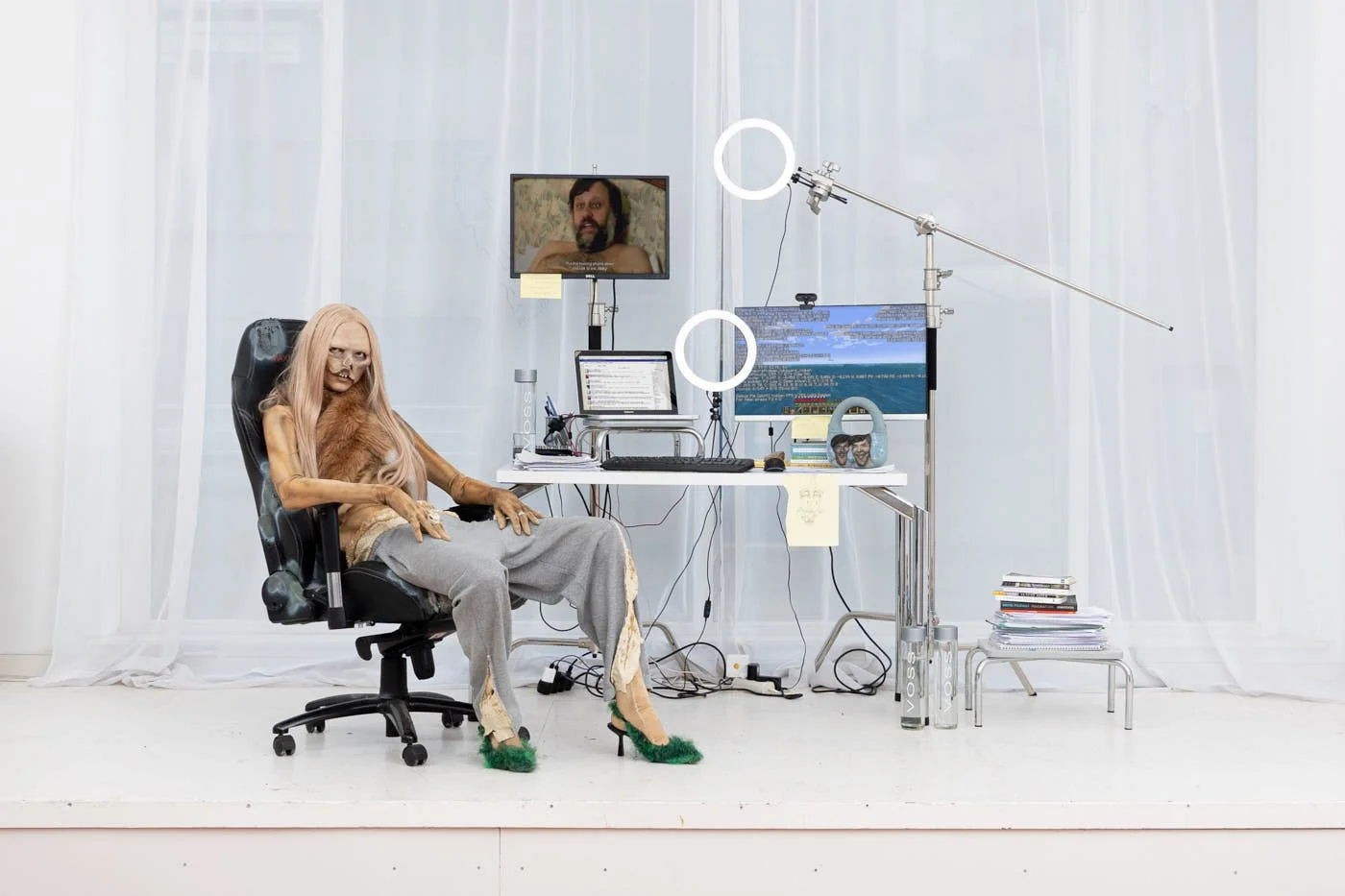
Ötza posing in Ötza’s (posthu-) Man Cave of Theory-Fiction, solo show Ötza, Ontologically Speaking at Mutter
/ photographed by Giovanni Salice, 2023
“So the real transgression for Ötza would be to rot—to escape or transcend.”
Hannah Rose Prendergast
What would Ötza lose if she changed her fate?
Levi van Gelder
That's very interesting because I think it's sort of the core of everything. Outwardly, there's a lot of writing, references, and different scenes. But underneath all of that is this struggle, this constant displacement of herself into different characters.
All of these scenarios are speculative because she's locked up in a way. She has this incessant dream of changing her fate, changing her trajectory, exiting the cooling cell, maybe even exiting this state of undead preservation. But it's always very conflicted because so many of those changes also imply death, decay, or simply stopping existing. So the real transgression for Ötza would be to rot—to escape or transcend.
I often refer to the Italian scientists, but they also represent the larger institutions of science and archaeology that want to preserve this mummy and categorize knowledge in general. I like imagining this fictional agency of the artifact asking, "Why don't I get the respect—or the privilege—to decay and integrate into the world?"
As for what she would lose… I always imagine Ötza having this teenage quality to her. It's like a teenager dreaming about love without ever having experienced sex or some overwhelming romantic relationship.
I love that fanfiction is written from a place of inexperience. That's why it reproduces tropes. It's this cut-up of adult experiences that you can't quite access yourself. There's something very true about that inexperienced desire, which really interests me.
So I don't think Ötza really knows what she has to gain—or lose—from the alternative. She's constantly trying to figure it out.
…Although maybe she's not. No, I won't say that. Off the record. She's smart enough to figure it out, but don't include that because she's going to read it and be mad at me.
Do you think she'd still recognize herself at that point?
I have described situations where it would make sense for her to leave the cooling cell. Especially when I'm performing, it's difficult because people literally see the character standing in front of them. It's hard for me to tell them she's always in a cooling cell when she's clearly right there. But there are a lot of breaks in reality. The lore and the universe she creates are very anachronistic. She constantly shifts between different years, different trajectories, different versions of where she exists.
In one of the more recent chapters, she's invited to the World Economic Forum to speak about entrepreneurship and realizes all the other speakers are mummies too. She thought she was going to be the oldest… and the skinniest. She's very upset about that.
There's this antagonist called Spirit Cave Mummy, who's based on an actual mummy with an HBO comedy special that's been renewed for a second season. At the end of the chapter, Ötza re-actualizes herself into the story and resets the scene. She finds what Deleuze would call a "line of escape"—a term I don't think she fully understands because I don't fully understand it either. She uses it to replay exactly the same situation, except now she also has an HBO comedy special that's been renewed for a third season.
All her solutions are like that. They're always quite petty, wrapped up in these tiny little victories.
Which philosopher would be the least equipped to understand Ötza?
I think she has a very one-sided beef with Fredric Jameson. He wrote a lot about this era of post-history and dehistoricization in late capitalism and cultural production—that we've lost our connection to the past and everything has become pastiche, a retelling of previous tropes.
I'm actually a fan of Fredric Jameson. I think his cultural criticism is very apt. I tend to approach those ideas through over-identification by creating an extreme version of them in Ötza.
She's this completely dehistoricized character who's trying to rewrite her relationship to history while simultaneously being used as a spokesperson for Neolithic European life—a version that's extrapolated from her body and then reshaped through fantasy and prejudice.
She doesn't really comment on that story because she's more interested in creating new writing—fanfiction based on contemporary culture. Or at least beginning in 1991, because that's when she came out of the ice. References from before then don't really interest her because she doesn't understand them.
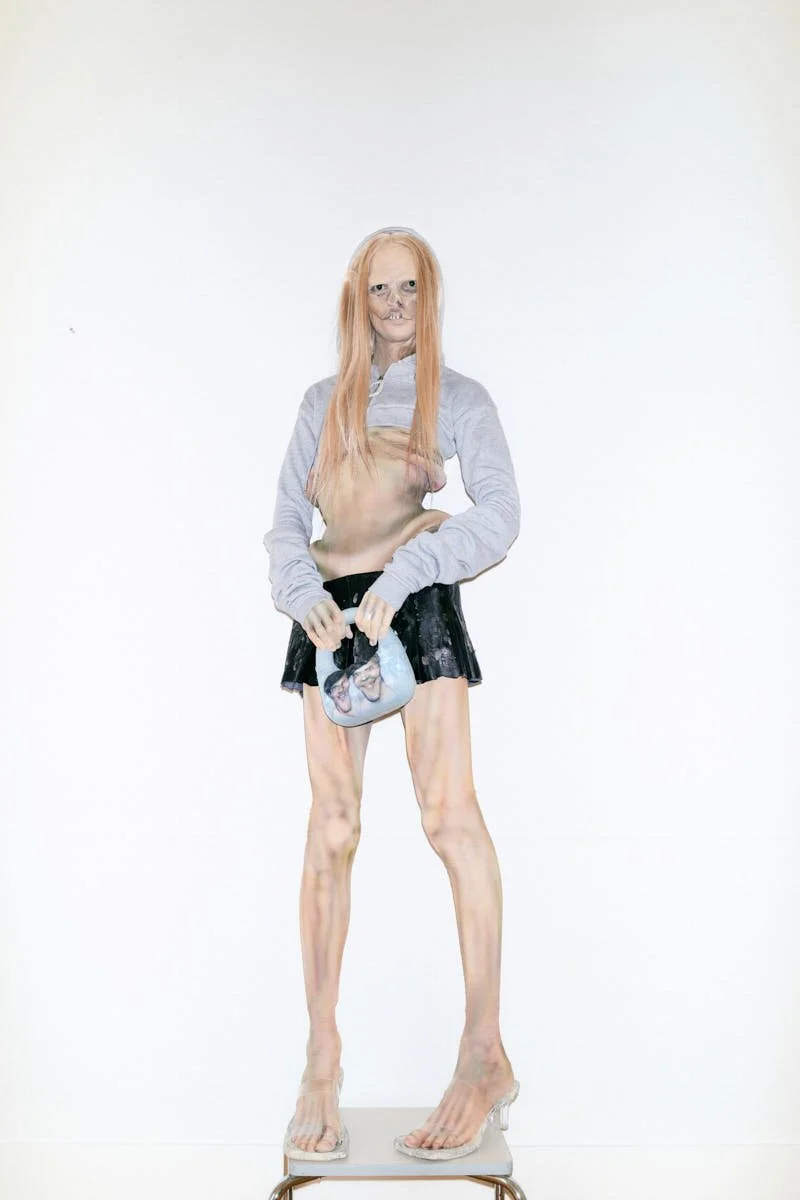
Ötza
/ photographed by Nikola Lamburov, 2024
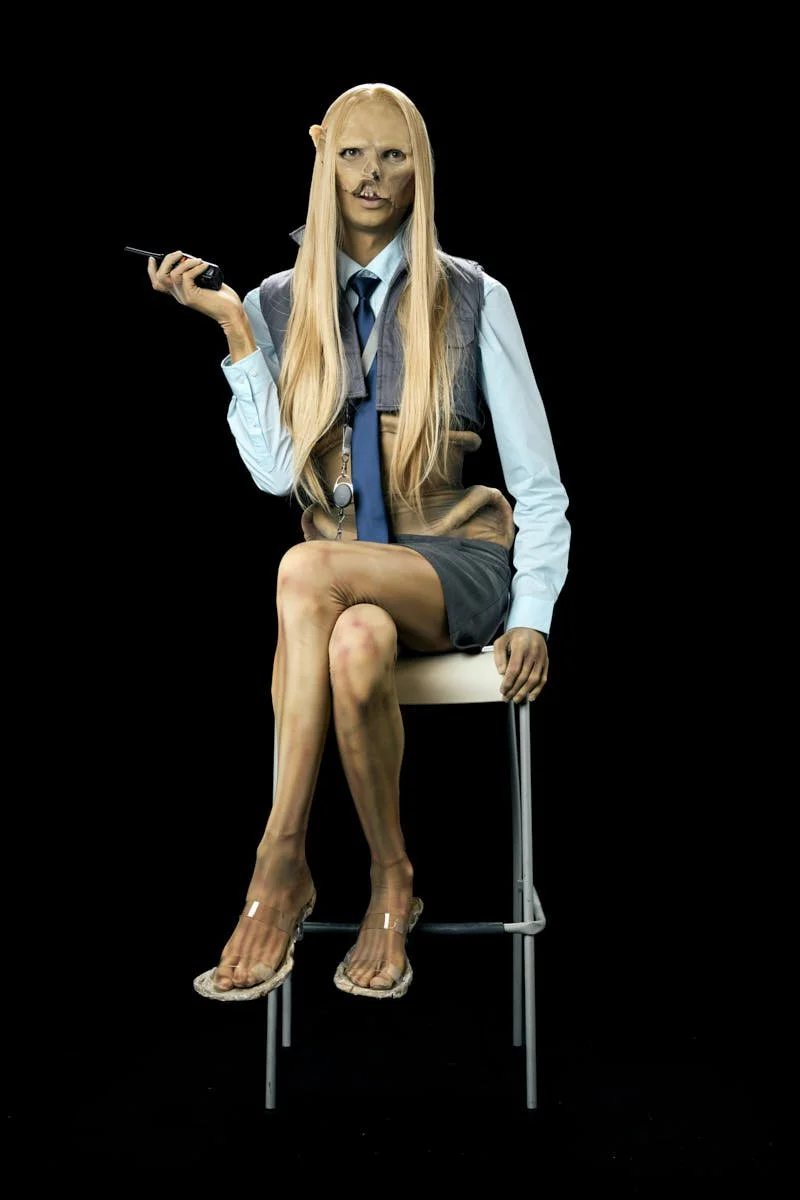
Ötza
/ photographed by Giovanni Salice, 2025
“A Harry Styles male-pregnancy fanfiction sits on exactly the same level as a Lacan reader.”
One of the things I love is that you don't need to know the philosophers to appreciate the work.
I think it serves two purposes. On one hand, it's a parody of how theory gets used in the arts. People decorate artist statements with famous names, creating an assemblage of signifiers without really understanding how to use them.
For Ötza, it made sense because I started from the idea that she's deeply insecure about people thinking she's illiterate. Prehistory literally means before writing, so she wants to show everyone she's read all of these incredibly difficult books. She becomes one of those people who's desperate to prove how intelligent they are.
More importantly, as someone who's not an academic but genuinely enjoys reading theory and philosophy, I always found it difficult to understand where that interest belonged in my own work. There always seemed to be this artificial reverence surrounding these thinkers. A lot of them are honestly quite bad writers because they aren't trying to open their work to a broader audience. That can be intimidating and make people feel like they aren't allowed to engage with these texts unless they fully understand them.
In my work, I try to treat every reference as part of the same horizontal field of media. A Harry Styles male-pregnancy fanfiction sits on exactly the same level as a Lacan reader. Fanfiction already assumes you can take existing stories and play with them because they aren't rigid. I think approaching Lacan—or any writer—in the same way frees those texts from a lot of unnecessary restraints. It really helped me find my own voice and my own way of engaging with theory.
There are misrepresentations or misinterpretations, but because I write fiction—very heavy fiction, maybe even hyperfiction—I don't think that matters. It's like reader-response theory. The way people engage with a text often tells you more than strict factual representation ever could.
What keeps drawing Ötza back to the threshold between the animate and the inanimate?
She's a corpse, right? So that question is at the very core of the work, almost in a slapstick way. She's not quite alive. She's a body suspended in decay. But it's also a question of human, non-human, and posthumous agency, which takes us back to the actual mummy in the cooling cell at the South Tyrol Museum of Archaeology.
I think the body politics surrounding this incredibly ancient corpse are fascinating. If it were a much younger corpse, there would still be families connected to it. There would be a completely different relationship. But maybe it's not just age. Maybe it's also this idea that there's such a tremendous amount of information contained within this vessel that somehow supersedes the human rights we would normally grant a person.
If you go to the museum shop, they've made all these prehistoric figures as merchandise, but never the actual corpse. Profiting directly from the image of a corpse would feel quite villainous. But recently, a separate group of researchers took yeast from Ötzi's stomach to make bread. They're making beer from it as well.
This makes me think about the separation between words like cow and beef. Language creates this ethical distance. I wonder whether mummy functions in a similar way. Corpse immediately emphasizes that these are human remains. "We took yeast from a corpse's stomach and made bread from it," sounds incredibly macabre. "We took yeast from a mummy," suddenly sounds archaeological.
I very deliberately look for those kinds of thresholds because I'm searching for the same friction I felt when I first visited the museum in 2019. There were so many aspects of this corpse that stayed with me. When I become obsessed with something, it's easy to relate everything else back to it. It's probably just tunnel vision. I'll see something and immediately think, "Oh, that relates to Ötza." Animatronics are one example.
There's also the uncanny valley—that space where something resembles a living human but not quite enough, and your empathy suddenly falls away. Looking at the mummy through the tiny cooling cell window gave me that same feeling. So it was interesting to contrast that experience with other figures in a similar position. I also wrote about the Madame Tussauds wax figures… I could honestly talk about this forever.
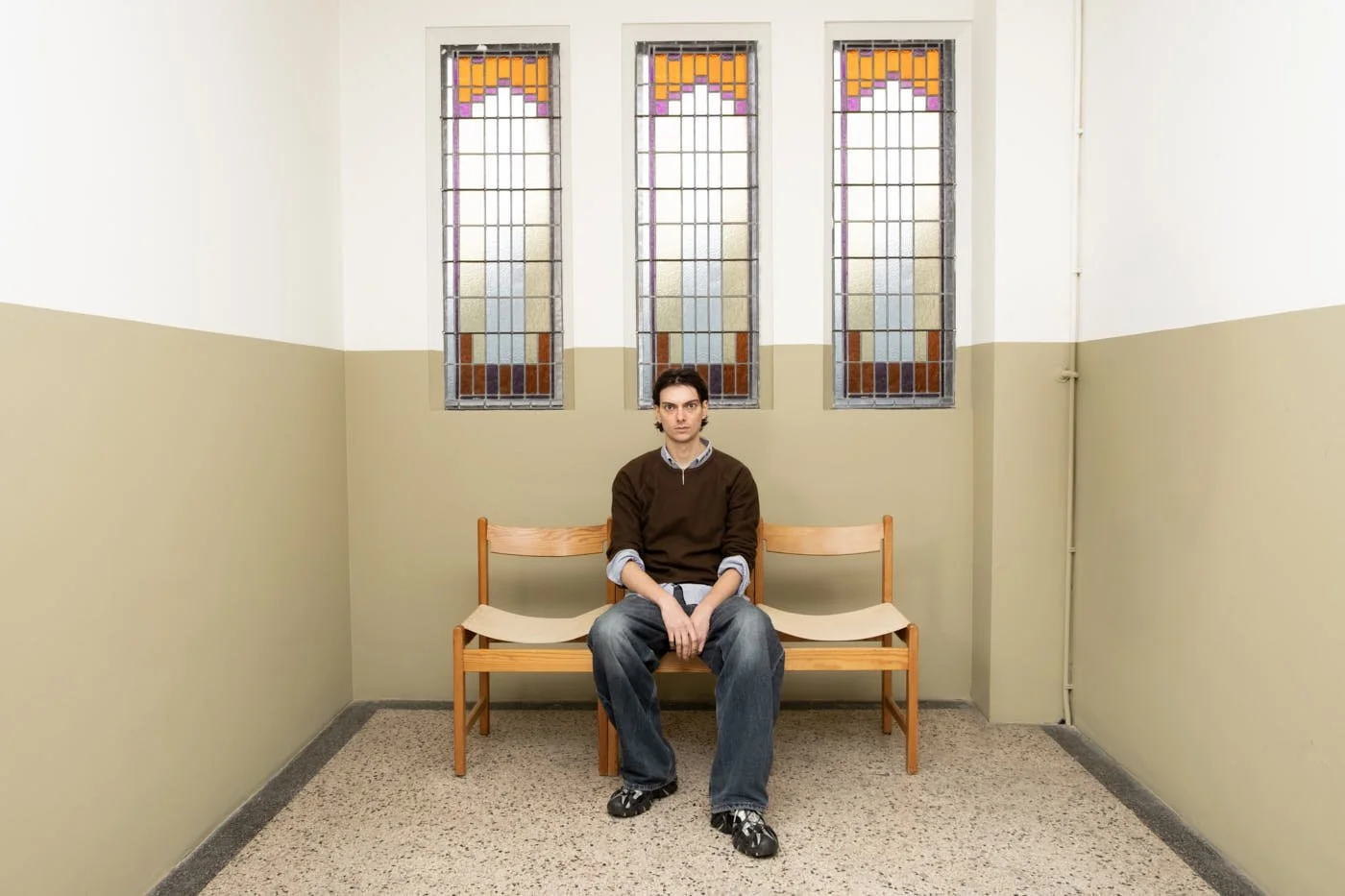
Levi van Gelder
/ photographed by Margarita Kosareva, 2025
When should Ötza take the credit?
She has very strong cryptomnesia. It's such an interesting concept—that feeling that every idea originated with you. It also raises this broader question of originality. That ties back to fanfiction, which is such an acknowledged form of adaptation. You always understand that there's a source text that precedes your own creation. I think that's generous because it humbles you. There's the lore surrounding Ötzi—the discovery and even the creation of this man. All of that predates my writing. The recombination of those things is so specific to what I'm trying to say that it hopefully becomes something novel. Of course, Ötza writes the same chapters I do because I write them, but in her own logic, she was there before most of those works even existed. I guess cave drawings came first, but most sculptures and other forms of media came after her. So she feels very comfortable claiming authorship.
There's one chapter where she says she was the first person to stage an audio installation in the marshland that would later become Venice. According to her, she invented the very first Venice Biennale. She makes some pretty bold claims. Nobody has DM'd her to tell her she's wrong because, well, nobody else was there. It gives her a lot of room to take credit. She's also not very good at citing her sources. I do think it's important that she credits her collaborators, though.
How can you spot a Hunty-Gatherer?
Very good question.
When I was writing that one, I realized… I'm a Hunty-Gatherer.
I see a Hunty-Gatherer right in front of me.
How can we describe the Hunty-Gatherer community? Ötza isn't always very good at maintaining her T-shirt company, but she does sell merch that says Carrie Miranda Charlotte Semantics. She doesn't want to package and ship orders, but every now and then there's an opportunity to buy one. Hunty-Gatherers are often lesbian of nature. Which she loves as well.
Hunty-Gatherers are just the it girls. They know what's up. They enjoy a bit of theory. They love to laugh. They think laughing is important.
But for me, it's hard to recognize them because people don't recognize me, which is actually very comfortable. I don't get stopped on the street for being Ötza. Also because I'm not that famous. I'm a very local, local, local… micro, micro, micro celebrity. Maybe one day.
Although I kind of hope that even if Ötza became really famous, people still wouldn't recognize me. That would be nice.
I guess it depends on how often you're out wearing the suit.
Not very often. I try not to. The suit is actually quite precarious because it's airbrushed onto Lycra, so we can't really wash it. You can only permanently airbrush onto cotton, but cotton doesn't stretch—and the suit has to stretch. So it's a very delicate costume. I'm always terrified because I only have one suit and one mask, which is pretty dangerous.
You have to preserve it.
I have to preserve her. Which is very weird and completely counterintuitive.
What would a VOSS sponsorship mean to Ötza?
I've thought about this a lot. This is the biggest of all the ontological and existential questions. I haven't discussed this with her, so I don't think she realizes it—but I think it's much more about the pursuit of the sponsorship than the sponsorship itself. It's become such an instrumental goal that losing it would be devastating. Sometimes just knowing you're moving toward something is much more powerful than achieving it. The objective itself can end up feeling surprisingly insignificant.
If she actually got a VOSS sponsorship, it would create this huge vacuum in her life that would be almost impossible to fill. Luckily, VOSS has never responded to any of her requests. She still pursues it with full force.
I'm afraid of the day it happens. Maybe something else would take its place, but I think the sponsorship would be quite disastrous.
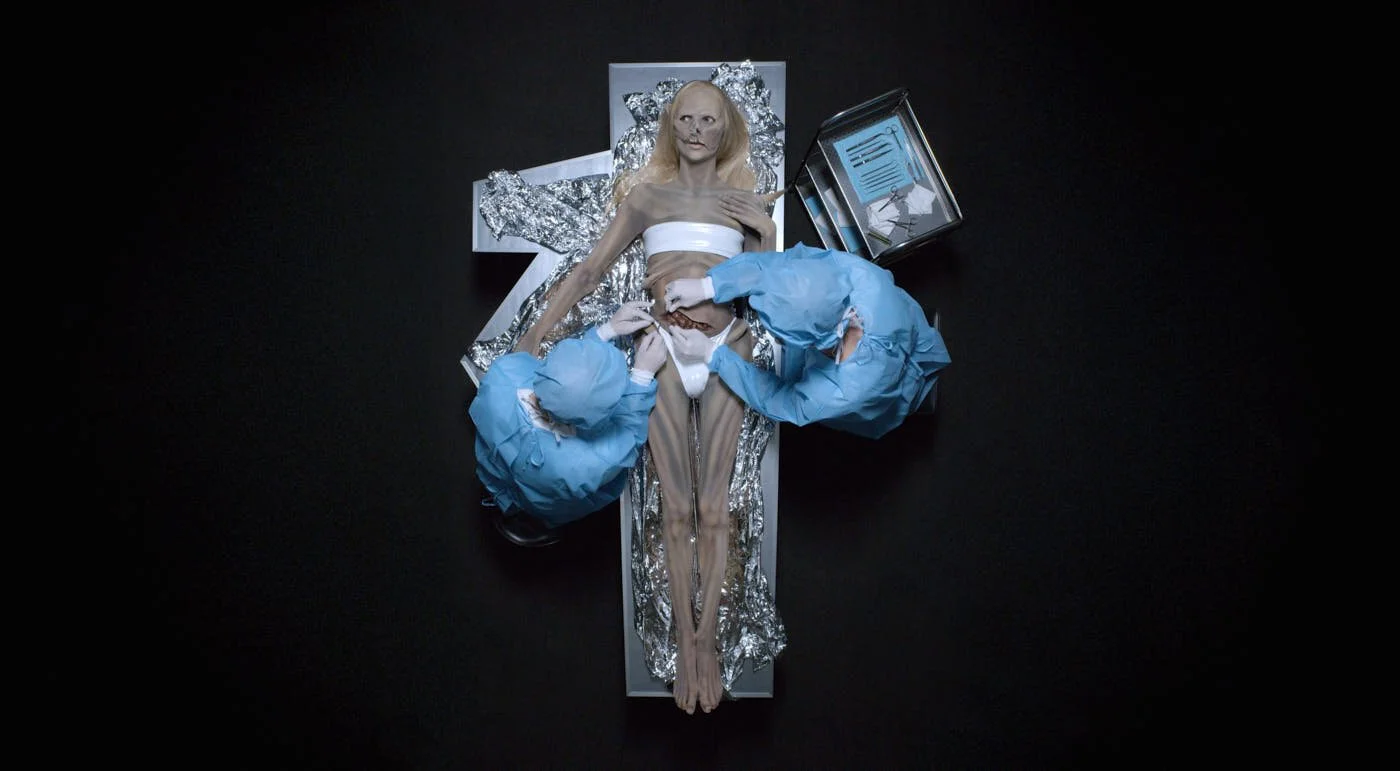
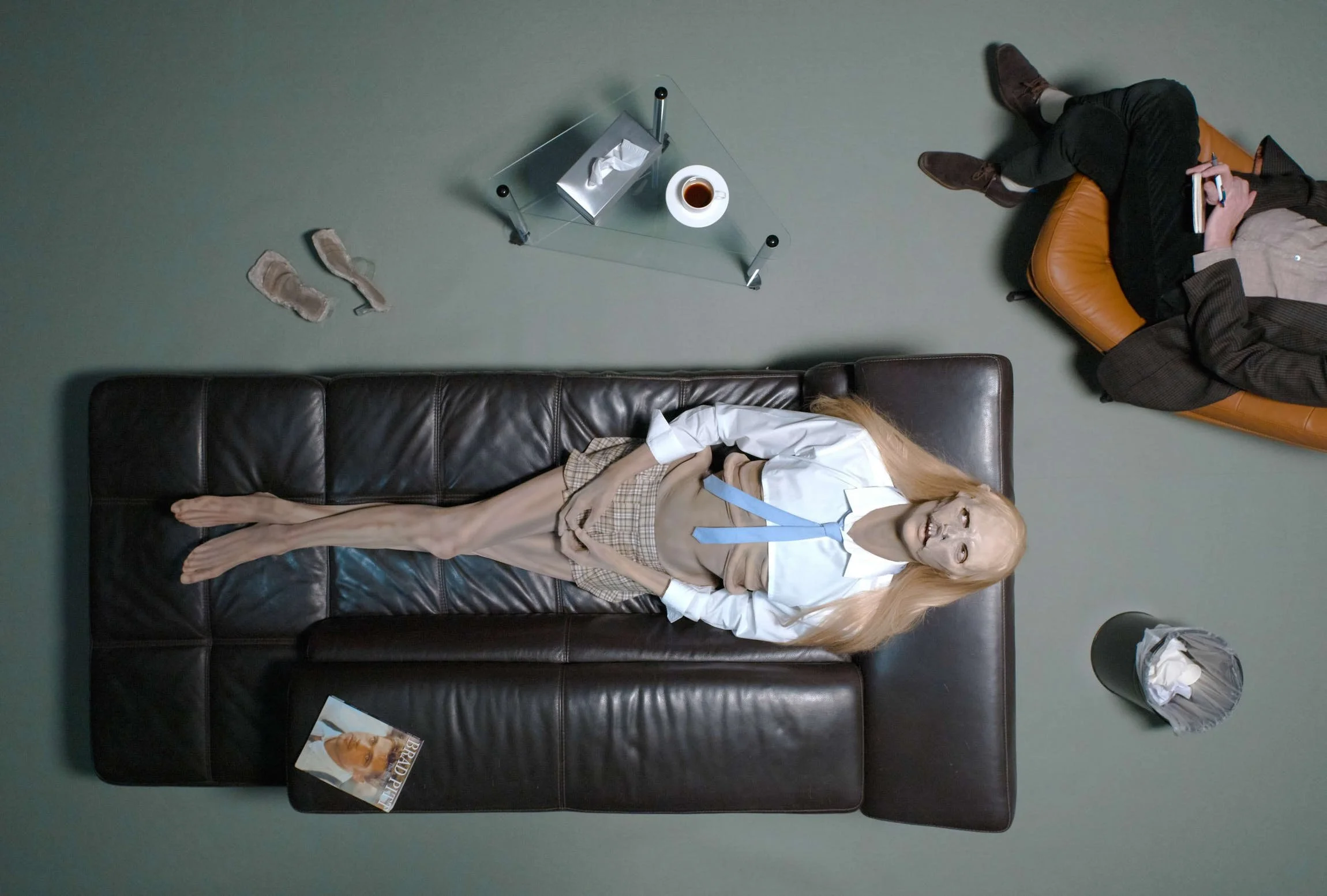
Still Ötza, Uninterrupted
/ photographed by Giovanni Salice, 2025
I wonder how much she'd even talk about it once she had it.
Exactly. She already talks about the product so much that, from their perspective, it would make no sense to sponsor her. She talks about VOSS more than any person in their right mind would ever talk about one of their sponsors.
If they sponsored her, it probably wouldn't even be life-changing money. You'd think, "Well… now I'm not going to mention it every single time." But right now she mentions it every single time because it's still the dream.
I imagine the brightest minds at VOSS have already discussed this and concluded that sponsoring Ötza would be counterproductive. She'd lose interest in pursuing it and probably talk about the product less. Plus, it's cheaper for them to just let her struggle.
Just ignore her.
Besides, she doesn't actually have much use for money anyway. Maybe Robux. If they paid her in Robux… that might actually be useful.
When is Ötza done adding hyphens?
I don't think she'll ever stop because every chapter she writes becomes another small reinvention of herself. Each one gives her a slightly different personhood or vocation. All of those little reinventions—which often function as standalone vignettes—eventually become part of her larger identity. She becomes this Frankensteinian assemblage of multiple identities, built through fanfiction. As long as she keeps writing—and she doesn't really have anything else to do—those hyphens will continue to grow and accumulate.
At one point I even wrote about them becoming a kind of excessive prosthesis. Then I really dove into Lacan and started intersecting that with multi-hyphenism, although I don't even remember exactly what I wrote because I'd had too much coffee by that point. Luckily we live in this wonderful gig economy where there's a language for describing that kind of multifaceted identity in entrepreneurial terms. That's interesting because in another historical moment, that probably would have been framed completely differently. Recasting it through the language of capital places her firmly within the contemporary zeitgeist, which is strangely anachronistic. Very dehistoricized. Sorry, Fredric Jameson. Come at me, bro.
So until they put her in the ground.
Whatever that means. Hopefully never.
Then she'd just be… corpse. She'd just become one with the world.
That's the single hyphen.
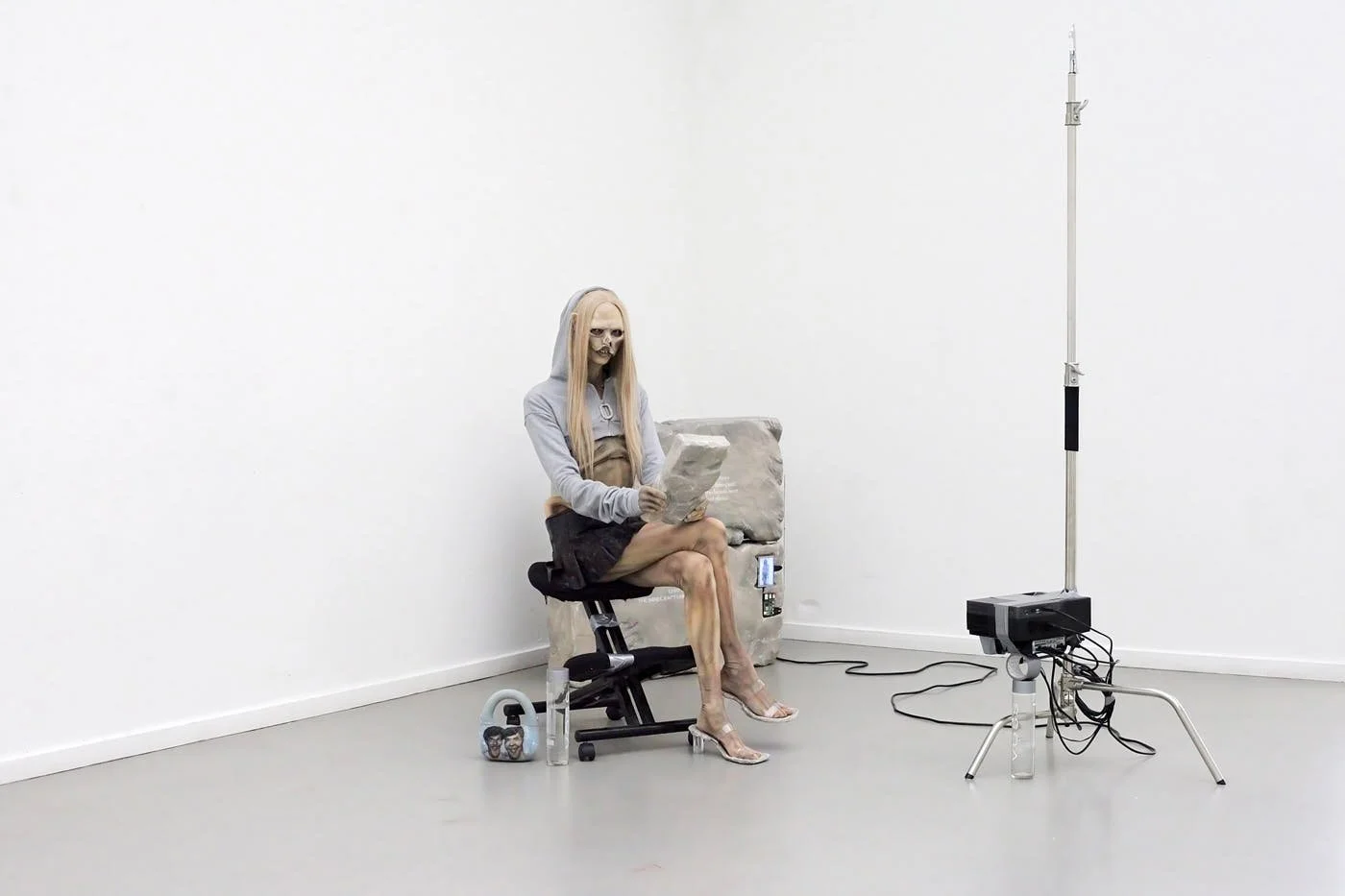
Ötza during group show Still Making Art vol. 7 at Arti et Amicitiae
/ photographed by Aaron McLaughlin, 2024
header image credit:
Still Ötza, Uninterrupted / photographed by Giovanni Salice, 2025
artist LEVI VAN GELDER
costume design and styling LEILA EL ALAOUI