
Alex Da Corte in conversation
Déjà Vu as Pop Memory
interview + written NICOLAS VAMVOUKLIS
Venezuelan-American artist Alex Da Corte approaches popular images as if they could change temperature. A cartoon figure or a shop-bought object enters his work already familiar, then begins to feel charged, vulnerable, almost alive.
Speaking from Philadelphia, in front of a studio wall covered with printed references, he described a way of working based on waiting rather than forcing an image into use. That patience gives his worlds their strange intimacy. They are bright, but not light; playful, but never innocent. In Parade, his recent exhibition at Matthew Marks Gallery, this attention became a passage through thresholds, where public icons carried the pressure of private feeling. Appearing three times as life-size sculptures, he used disguise not to disappear, but to become more exposed. The conversation begins there, with the moment an image stops behaving like itself and starts looking back.
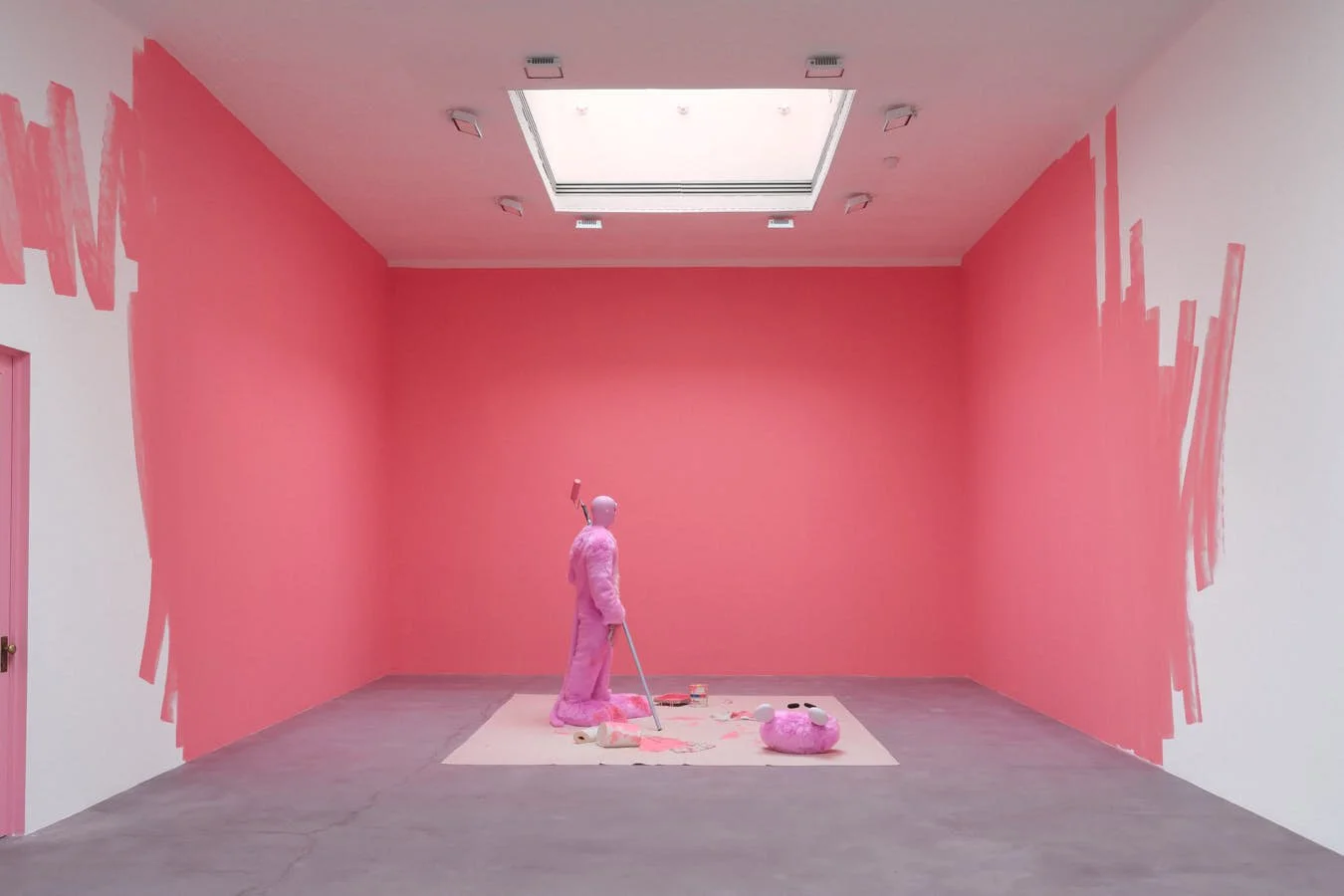
Alex Da Corte, Housepainter II, 2025
Foam, plywood, resin, silicone, fur, hair, steel, paint, hardware, muslin, glass
73 1/4 x 28 1/8 x 20 1/4 inches, 186 x 71 x 51 cm
© Alex Da Corte, Courtesy Matthew Marks Gallery
Nicolas Vamvouklis
Your work presents images we seem to recognise before we understand why, like déjà vu. Have you thought about your practice in those terms?
Alex Da Corte
Much of my practice hinges on what might be considered the opposite of déjà vu: jamais vu. It is the moment when the familiar becomes strange again, and suddenly beautiful, or seems to sit outside time. I think the pieces are scratching at that feeling, even if it remains an abstract desire. You can never really notice when that happens as it happens. It is quite elusive. I’m interested in memory’s slippery nature, and in applying that to forms we might collectively call familiar, at once ordinary, charged, and unstable. But familiarity is regional, generational, relative. When we talk about global icons, or figures fixed in history, we often forget that those histories can shift. An icon known and discussed now can quickly fade. What happens then? Does its ability to transform remain? Still, everything should always be able to change.
You have described your work as “an exploration of the nuances of contemporary life.” What feels truly contemporary now?
If I pay attention, as I do, to the feeling of being alive now, I sense a turn toward matters of the hand: a tactile, material concern, a care for the world in local ways, connected to one’s own body and physical space. I don’t think it is an opposition to the digital, or a complete turn away from it. It is more an embrace of the physical, an ability to commune with it, whether in nature, with others, or wherever it meets the ground.
Many of your projects unfold within dreamlike environments. What do they allow you to express that reality does not?
I’ve been having weird dreams lately, and thinking a lot about Magritte. He obviously paints motifs one could liken to dreams. I have often thought my practice is not so surreal, because the objects are born out of actual objects. Magritte paints an apple, a rose, a person floating in space. They exist, but in a dislocated way. So perhaps that must be dreams. What excites me about dream logic is its relationship to time, its fluidity, or its illogical order. Events move happily or scarily between past, present, and future, forward and backward in unexpected ways. You wake up thinking more acutely about those occurrences. I don’t know that we get much space to move like that in waking hours, but if we did, we might intercept daily banalities differently.

Alex Da Corte, ROY G BIV (still), 2022
Video (color, sound), 60 minutes
© Alex Da Corte, Courtesy Matthew Marks Gallery
Is there a cultural figure you have always admired?
I remember finding Leonardo da Vinci’s notebooks in the library. I thought: wow, there is so much around us, and the world is so bright with lessons to be learned. Anything is ripe for consideration: airflow, the way light hits glass, pigments, dirt, feelings, memory, our bodies, how they move and sweat, how we negotiate other people and ideas, including those that fail. All of that is baked into his writing. He has always been a model for thinking through my own life, and for remembering that there is an opportunity to find awe, novelty and strangeness, in everything. I don’t really get bored. If I think I might, I look to him.
Popular and consumer culture provide much of your visual language. What continues to excite you there?
I’ve always been interested in mathematics and systems-based logic. For all the emotional reasons that drive a decision, there is also a less emotional force behind so many choices we encounter, and those choices can provoke hard feelings. I like that collision. We see it constantly in cultural production. I’m curious about what informs culture as product: what is in favour or out of favour, what motivates society and its politics. It is born out of many people’s decisions, sometimes not so many. I like noticing where ideas germinate, and how the domino effect plays out. The handle of a comb, the colour of a suitcase, the way someone pins their hair back, can all be evidence of the times and their needs. The world is largely out of our control, and people keep trying to find control within it.
You often transform recognisable images into strange forms. How do you decide when one is ready to be reimagined?
I’m smiling because I’m looking at a wall of images in my studio. There are pictures printed from many periods, photos I’ve taken on my phone, material I found elsewhere. They stay there for a long time. I look at them every day, but never think about them in terms of readiness. I let them permeate my mind. I don’t know exactly how they function as I see them constantly. They change, I cycle through them, I print new ones. This collage, this analog way that I make, eventually meets me at night in a dream space, or while I’m walking in the park. Then I understand why I like an image, or why I’m drawn to it. Looking quickly now, some of what I see is about seasons, architecture, tension…

Performance view, Kermit The Frog, Even, Fridericianum, Kassel, September 7, 2024
© Alex Da Corte. Courtesy Matthew Marks Gallery, Kültur Büro Barcelona/Buenos Aires, and documenta und Museum Fridericianum gGmbH
Photograph by Nicolas Wefers
Can you pick one image for me now?
There is a fantastic Robert Morris work I have printed out. It is made of wood, metal, debris, building materials, just laid out. I love it because this unremarkable scatter, which could be in any workspace, ends up having such personality. The longer you look, the more specificity appears in the piles. They are evidence of a body that was there. These objects were made by somebody, by some machine, by a combination of the two. I think about those invisible histories, and they stay with me. It is so unlike my own pieces, so I let it be. I don’t need to remake it, or have it become anything more than a prompt. It is a joyous reminder of what it looks like to engage freely, maybe even unabashedly, with chaos or dishevelment. That isn’t so apparent in the practice, but it interests me in life.
Let’s turn to your recent exhibition at Matthew Marks Gallery in New York City. Why did you call it Parade?
I saw a performance of Arthur Rimbaud’s Illuminations by the Philadelphia Orchestra last year. Part of it speaks about a character witnessing the savage parade that is their life. Throughout the poem there is a perspectival shift: the author is watching a parade, then inside it, then observing that it has passed. I thought about this through those three positions. To witness an event, to stand at its edge, is to be at the beginning, at a precipice, like standing before the ocean. To enter it, to swim or sail in that body, space, or procession, is to participate, to live in the present, to engage, to find joy and loss. It activates the idea, rather than only imagining it. To watch the parade go by means you have arrived at the thing you dreamed of, executed what you wanted, lived through it, and perhaps grieved its passing. These parades do not have to be adventurous or grand. They can be minor. Every day is a parade, every conversation could be one.
Although you move across many media, sculpture had a strong presence in the show. You said that a sculpture “has a side you cannot see.” What interests you about this hidden dimension?
I have always loved sculpture for its insistence that you be in space with it, walk around it, and become aware of your own body here. That is a condition we negotiate all the time. It’s a call to resist screens and a flattened experience, and instead to participate. I believe in participation, and in all the ways it can yield a win, a loss, or any value in between. I love material so much. The show included artificial leaves, paint, wood, fur, plastic, rhinestones, flocking, prosthetics, rubber, glass, scents. All of it was there, as a proxy for who we are as human beings. We make gestures with our hands. We shift matter around. It is quite animal to make sculpture. It is quite primitive.
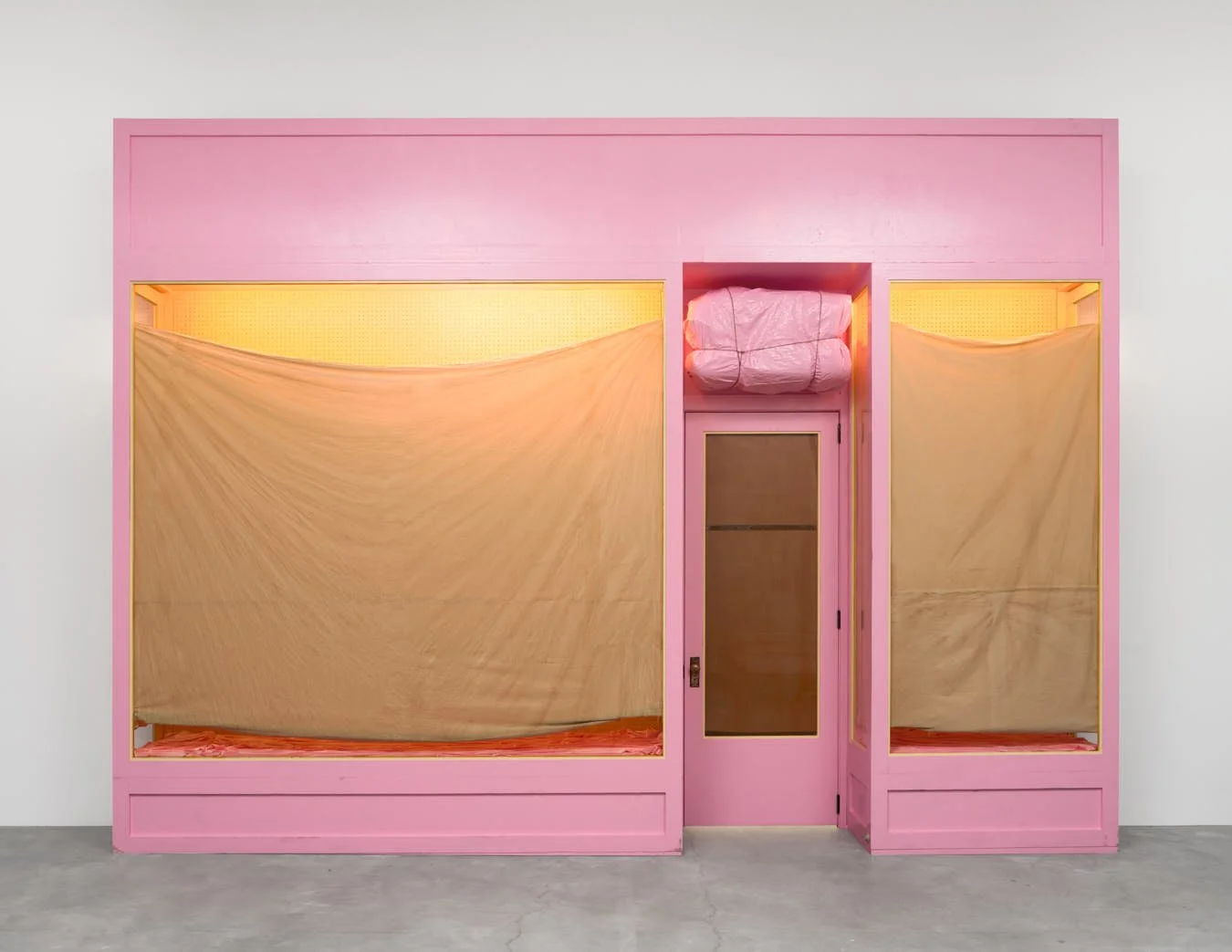
Alex Da Corte, Pink Store Front, 2025
Poplar, paint, brass, foam, plasticized fabric, twine, pegboard, muslin, coffee, velvet, fluorescent tube, acrylic, craft paper, acrylic medium, plastic tape
154 1/2 x 212 x 24 inches, 392 x 539 x 61 cm
© Alex Da Corte, Courtesy Matthew Marks Gallery
You appeared as the Pink Panther and Popeye. What made you want to inhabit these characters yourself?
You are born into a body. You don’t have much choice in it, so you spend your days negotiating what that feels like, and it is always changing. For brief moments, when I embody another figure, whether a real one like Paul Thek or a fictional one like Popeye, it disperses my own self and how I live inside it. It turns me into sculpture. My flesh and blood become no more remarkable than the Robert Morris piece I mentioned, made of wood, felt, scattered metal. I am not so dissimilar to Dr. Frankenstein’s monster, just a sculpture in the round moving through space. It takes away the sentimentality and first-person point of view of my own being for a time. It allows me to be free, to take on other psychologies and shapes.
Have you ever thought about disappearing?
I have. I always wanted to be a magician. Houdini was my hero when I was younger. It would have been cool to vanish. This brings me to Paul Thek, who was so tragically lost to AIDS, while his 1967-installation Tomb, I recreated for the exhibition, was lost for more complicated reasons. There is a moment when you could free yourself even from the death of yourself. To kill your ego is also to allow yourself to be born again. Disappearing need not be finite. Learning how to disappear regularly is probably good for the soul. It checks the ego and creates mini deaths, spaces for change. That change is urgent and necessary. I look for those sites in my work and life, so that when I am there, I am as present as I can possibly be.
What are you currently working on?
I’m developing a big project about Roy Lichtenstein: the largest retrospective he has had to date in New York City, and the first there in 33 years, in the city where he was born. I have co-curated it with Meg Onli, and it will open at the Whitney Museum in October. It has been a challenge and a joy to think through someone so ubiquitous, whose images are present in everything, in every mode of making, in every object one might find. I’m certain that if you went outside today, you could find some reference to Lichtenstein. That is curious, both a gift and a curse for the artist. I’m inside that question now, remaking some of his murals from the 1960s and 1970s, and working on a new film related to him.
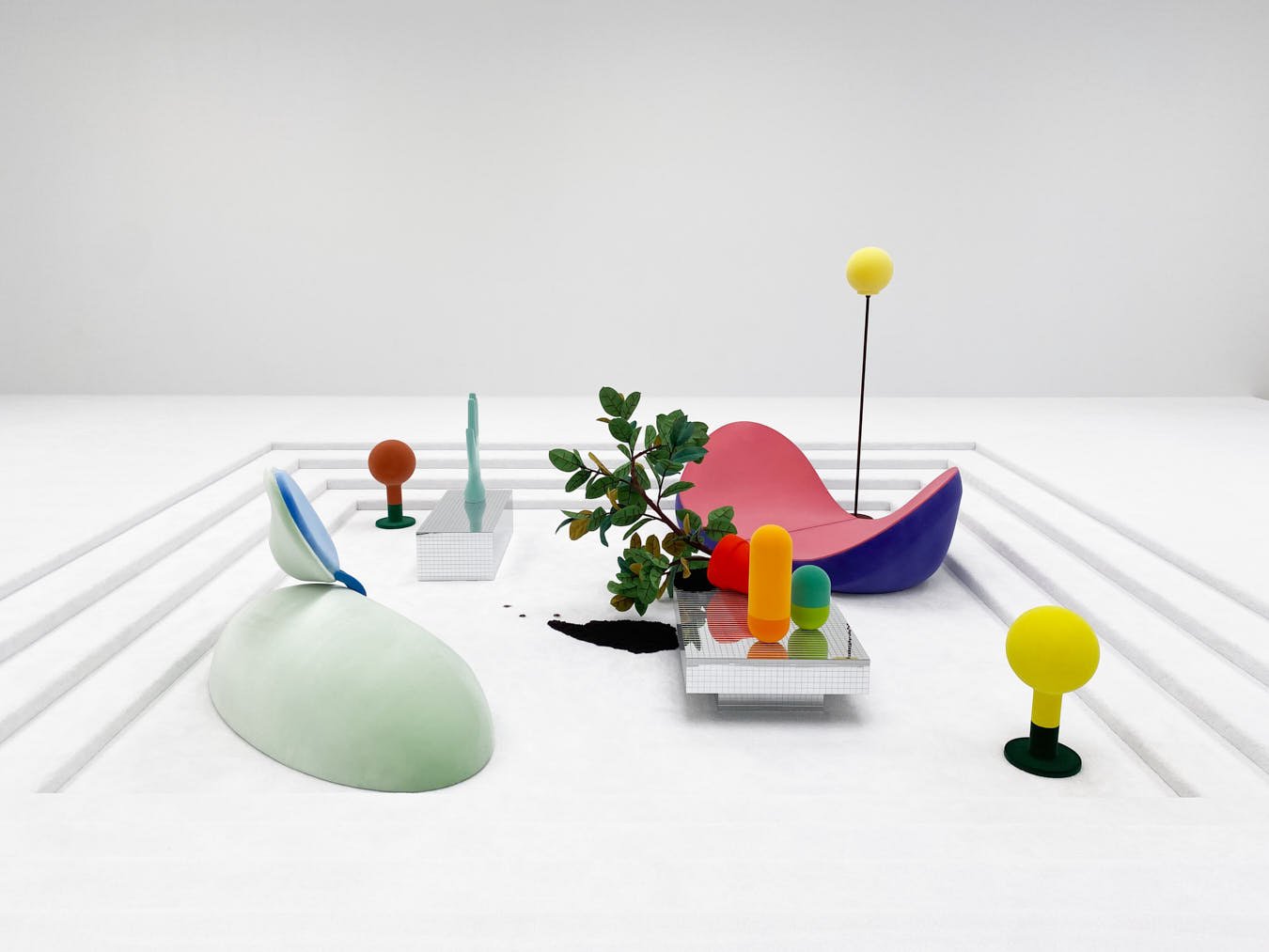
Alex Da Corte, The Conversation Pit, 2023
Flock, foam, velvet, steel, SLA-printed plastic, concrete, plywood, laser-cut mirrored plexiglass, wire-core urethane rubber plant, carpet
Dimensions variable
Installation view, THE DÆMON, Matthew Marks Gallery, Los Angeles, September 23 – November 4, 2023
© Alex Da Corte, Courtesy Matthew Marks Gallery
header image credit:
Alex Da Corte, ROY G BIV (still), 2022, Video (color, sound), 60 minutes, © Alex Da Corte, Courtesy Matthew Marks Gallery
about the author:
Nicolas Vamvouklis is an Athens-based curator and writer whose work spans contemporary art and performance. His texts have appeared in publications including Sternberg Press, Flash Art, Afterall Journal, Observer and tanz.
— follow via @vamvouklisn