Viewing entries tagged
designer

ESRA VON KORNATZKI *Developing Garments from Existing Materials and Process

ESRA VON KORNATZKI *Developing Garments from Existing Materials and Process

Esra von Kornatzki Works with Worn Materials and Fixed Surfaces in Contemporary Fashion


interview + written SARAH ARENDTS
seen JULIAN MELZER


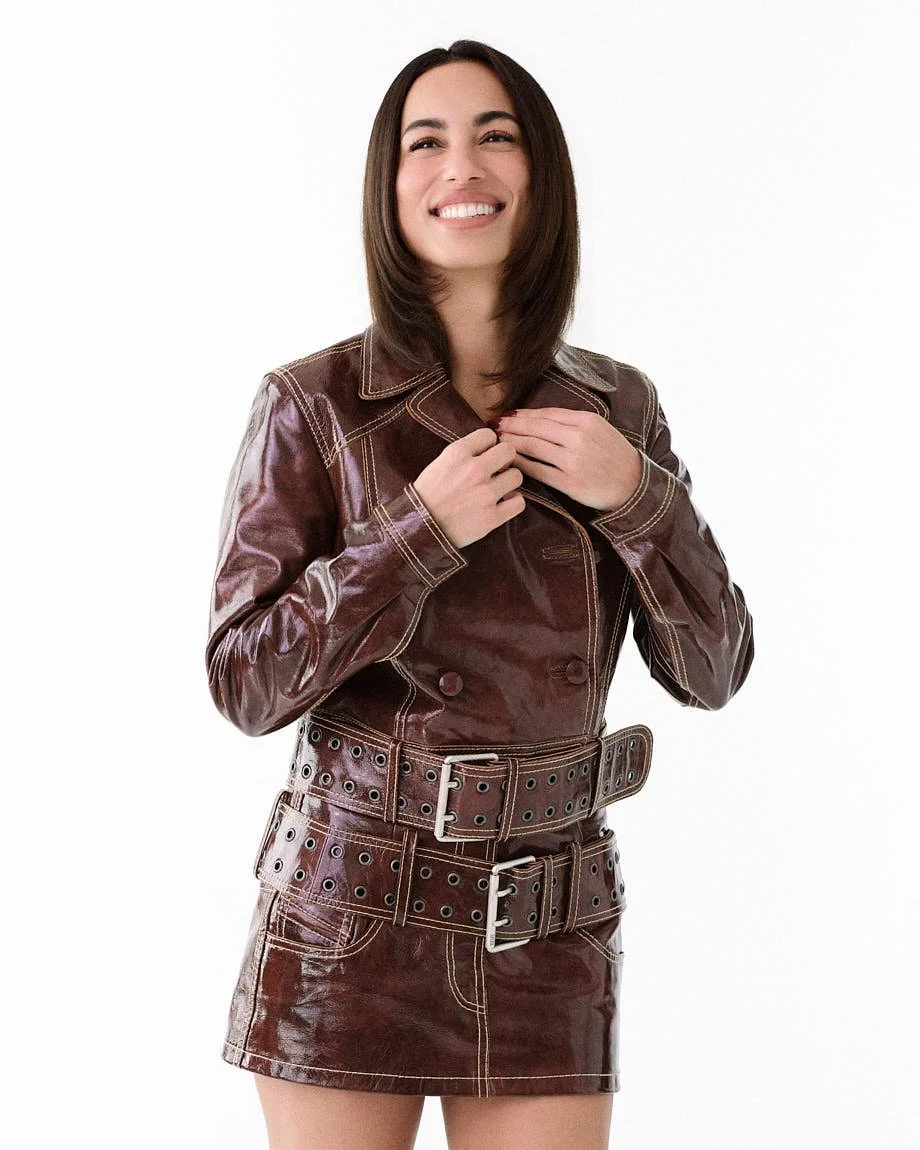
Esra von Kornatzki is a Berlin-based designer whose work develops from a background in sculpture and fine art studies at Universität der Künste. Her focus lies in constructing garments directly on and for the body, using methods that stem from mold-making, draping and surface treatment. Pattern cutting functions as a way of shaping the body, with each piece defined through proportion, weight and material resistance.


Esra von Kornatzki LE MILE Magazine photo Julian Melzer

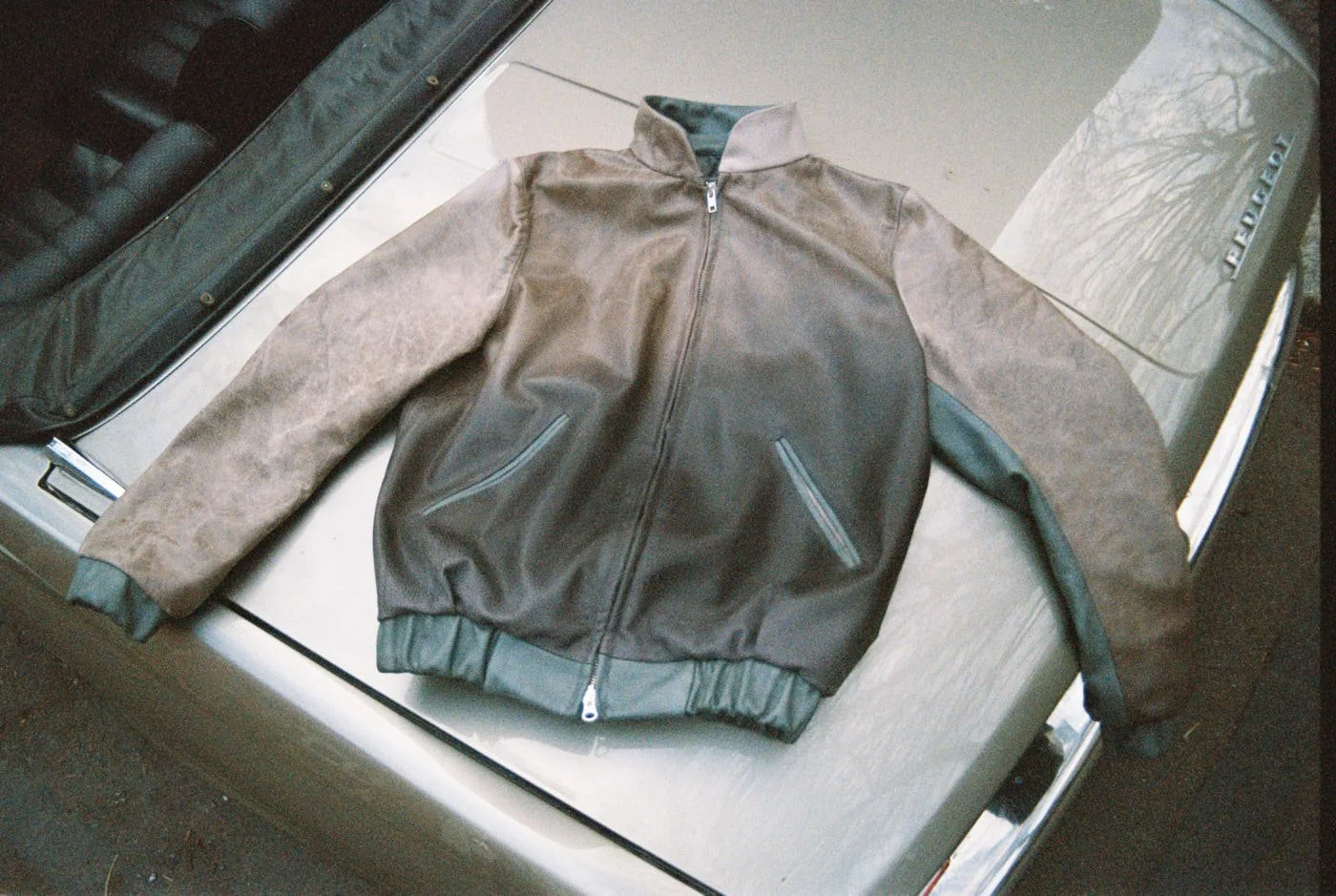
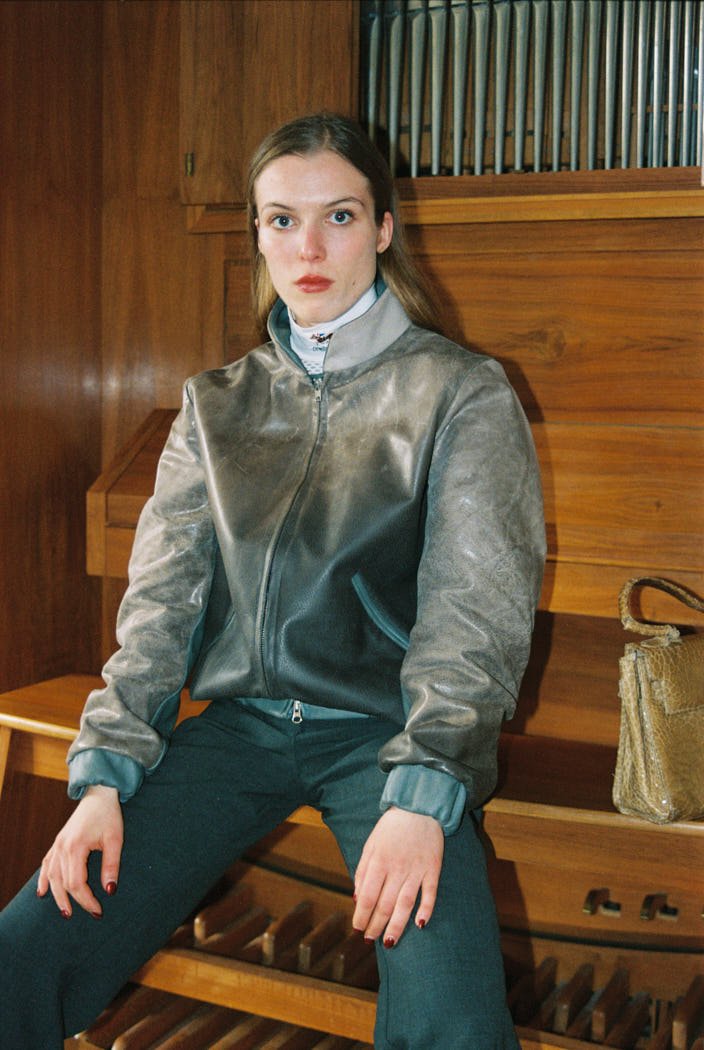
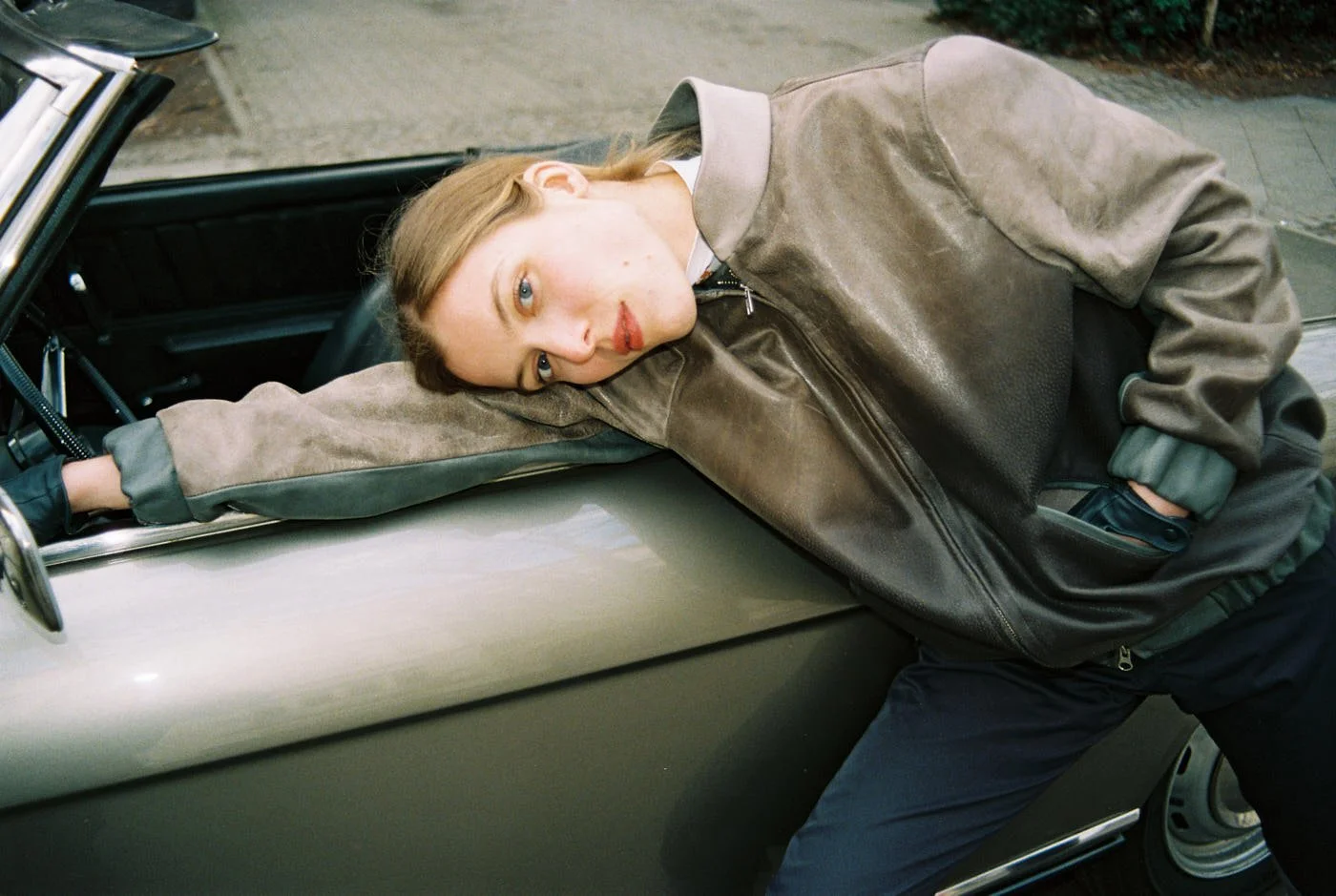
leather bomber jacket by ESRA VON KORNATZKI


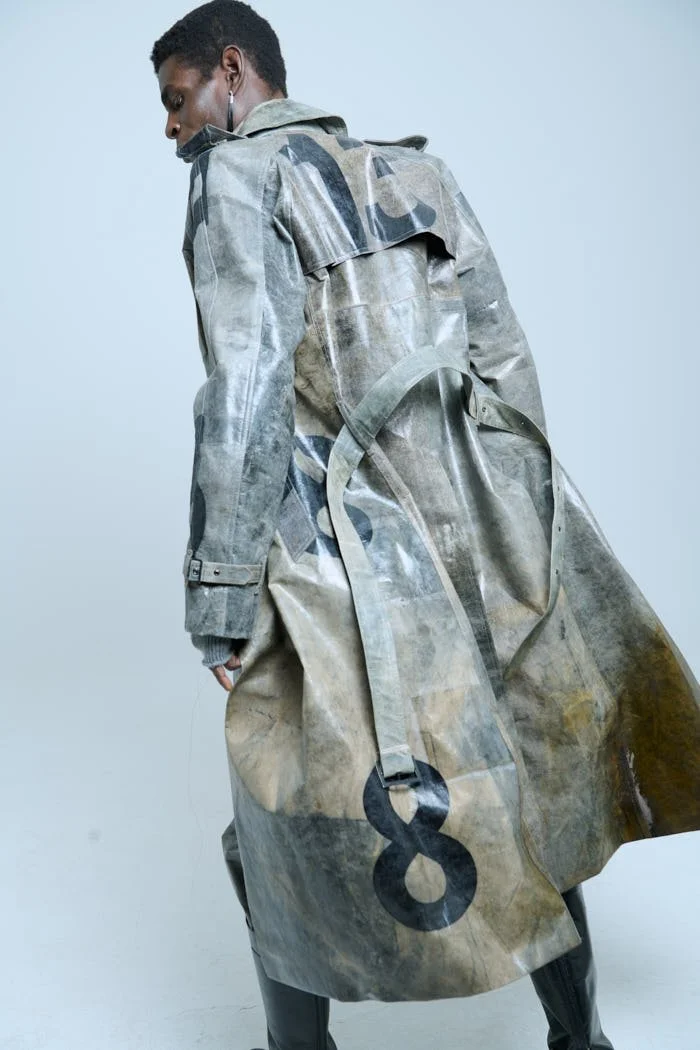
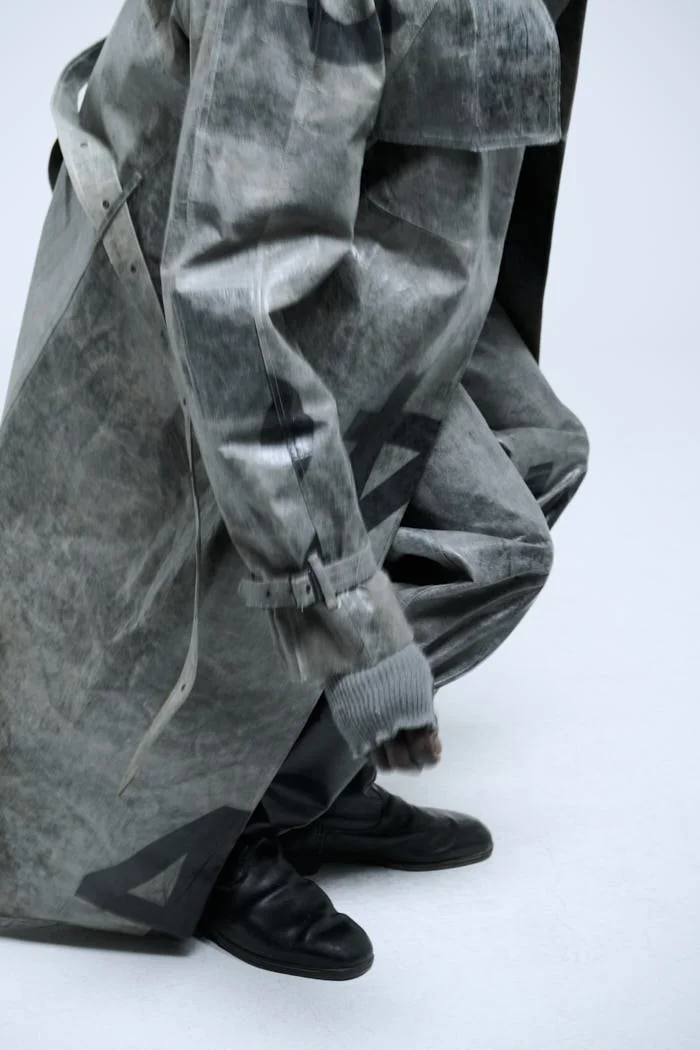
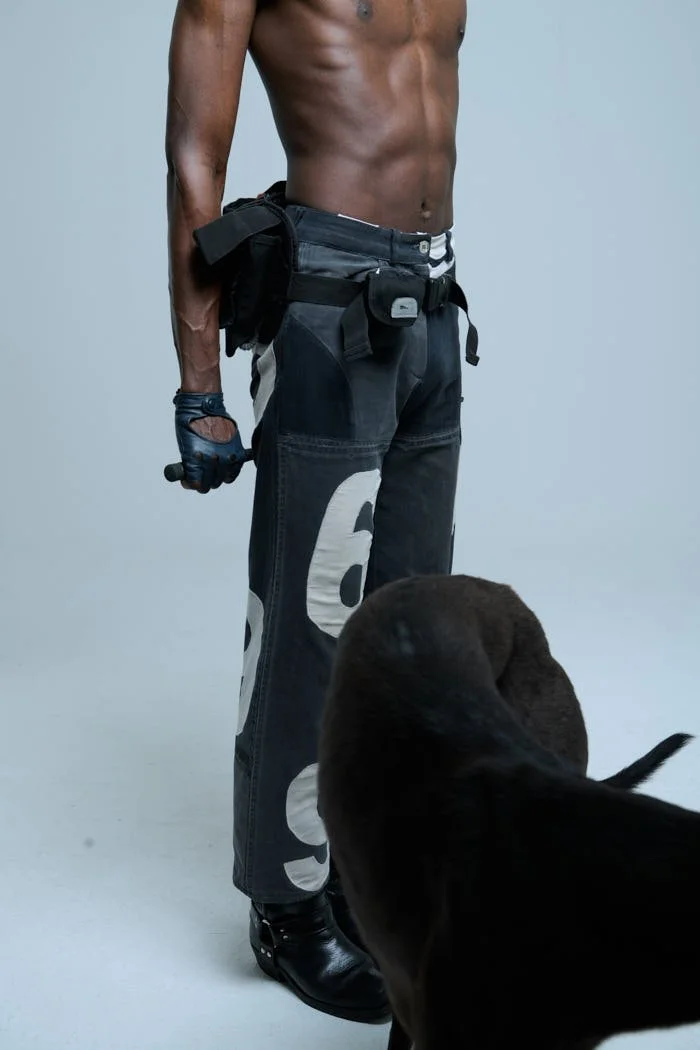
She uses existing materials such as discarded leather, inherited fabrics and used saddle blankets sourced from racetracks. These materials are chosen for their surface condition and durability. Signs of wear such as creases, dirt, sweat or discolouration are not removed. Instead, they are fixed into the garment through technical processes. Saddle blankets, for example, are treated with a water-based transfer glue, silk-screen printed and then fused with a transparent foil using heat, sealing the surface and preserving the traces underneath.

Esra von Kornatzki works directly with the material rather than outsourcing production, allowing the properties of each fabric to influence the final shape. Many of the materials resist standard sewing techniques, which results in firm, structured silhouettes.

Her parallel involvement in horse racing informs the way she works with time and preparation. Materials often come from that environment, and the process of developing a garment follows a similar logic of pacing and control. The garments retain visible information about their origin and a sofa becomes a bomber jacket, saddle blankets become coats and trousers. The previous use remains present through the surface, while the function changes through construction.

 
Esra von Kornatzki LE MILE Magazine photo Julian Melzer

Sekou is wearing a trenchcoat from ESRA VON KORNATZKI, GDR military boots from FASHION ARCHIVE, and knitted gloves from FASHION ARCHIVE

Esra von Kornatzki LE MILE Magazine photo Julian Melzer
 
Esra von Kornatzki LE MILE Magazine photo Julian Melzer

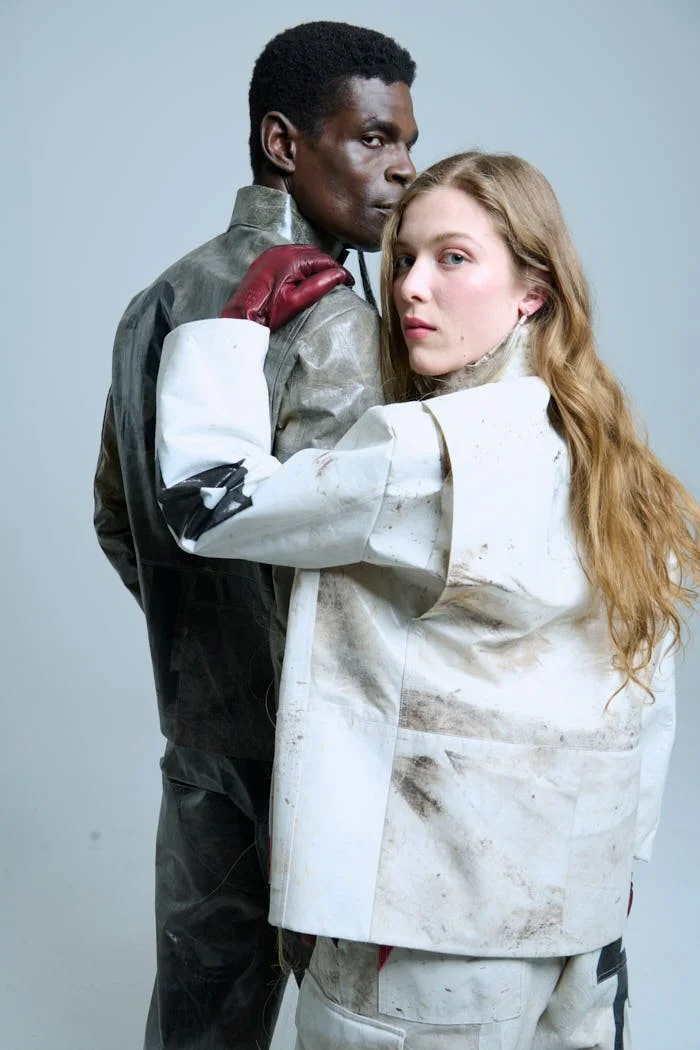
Sekou is wearing a grey suit, and Esra is wearing a white suit from ESRA VON KORNATZKI and red leather gloves from MAISON MARGIELA


Sarah Arendts
What led you from sculpture into fashion design?

Esra von Kornatzki
Sculpture has a tendency to be very removed from the body, an object in space, but I wanted to get closer to the human body and have that as my point of reference. Fashion design feels more urgent and relatable, as it implies everyday usage and thus becomes part of a new physical reality rather than something to look at. There is an intense, passionate relationship between people and their clothes that I find compelling. 


How does your fine art training influence the way you construct garments?

My background in fine art shapes the way I look at and construct garments. My studies were conceptual and that translates into the way I approach fashion design. There is the symbolic meaning a material carries but also its physical abilities. My first professor was a sculptor and the second a painter. You will find both influences in the garments I make in the way I stress the three dimensional aspect of clothing, treating the body like a canvas that the clothing wraps around. During my fine art studies I became an expert in mold making. Pattern making and drapage is an extension of that skill, molding the body and changing its properties, using the garment as a medium. I like to transform the fabrics and materials I find, treating the surface using dye and methods of coating like laminating. I tend to work with stubborn materials that resist being sown, but it gives them their strong sculptural quality and firmness in the silhouettes. 


What role does manual work play in your process? 

I think through making. That’s another reason why I place so much value on craftsmanship, which has always caused some residual tension between me and my conceptual art training. But I think of this tension as a strength and driving force, it's part of my identity as an artist and designer. As a designer I don’t like handing over the production part of the design process. Technology has detached many from manual work and I think certain ideas and refinement gets lost in this disconnect. For example, the stubbornness of the material I work with pushes me to find creative solutions and incidentally teaches me to be patient, which definitely hasn’t been my strong suit. I like to joke that I don’t have any impulse control, which can be a source of creative output, but also needs to be channeled carefully. Time is an important factor, manual work takes time, a rare commodity in our society, but something you see and feel, when you wear the garment. For me, manual work is more than a means to an end, it's a dialogue based on the material and the vision of the form it should take. 


What criteria do you use when selecting materials for a piece?

At art university it's a common notion that sculptors have a material fetish and I think it’s true for fashion designers as well. I have this obsession with the physical and symbolic qualities of certain materials that I’m intuitively drawn to and I think that materials age like fine wine. My selection process is a mixture of purpose and chance. I’m a nostalgic 90’s girl. I usually use worn materials, because I love a good story and worn materials are more likely to tell one. It started when my grandmother passed away and I inherited all her fabrics. Oftentimes I know an opportunity, when I see one. For example, I had to rework an old leather sofa for a client, the old leather was too gorgeous (showing off everybody who’s ever sat on it and every sunray that shown on it) to throw away and I came up with a piece, which is the bomber jacket, that suited the thick discarded leather of the sofa. It's the unused potential I see. For the other garments in this editorial, I sourced the material from a racetrack near me, each saddle blanket had been used once on a rainy day, meaning they were full of dirt and sweat, bearing witness to a specific moment in time, which made them interesting to me. However, I knew the material had to be modified in order to become desirable, which led me to coating it. In most cases I look for durability as well, functional, high quality materials that could last a lifetime, even if signs of usage add to their given patina, essentially continuing the story. 


What changes when a worn object like a sofa or saddle blanket is turned into clothing?

The context changes. The original object disappears physically, but remains conceptually present. The new garment gives clues to its origin through traces and marks on its surface, which aren’t immediately decodable for the audience, but felt anyhow by them. 


Esra von Kornatzki LE MILE Magazine photo Julian Melzer

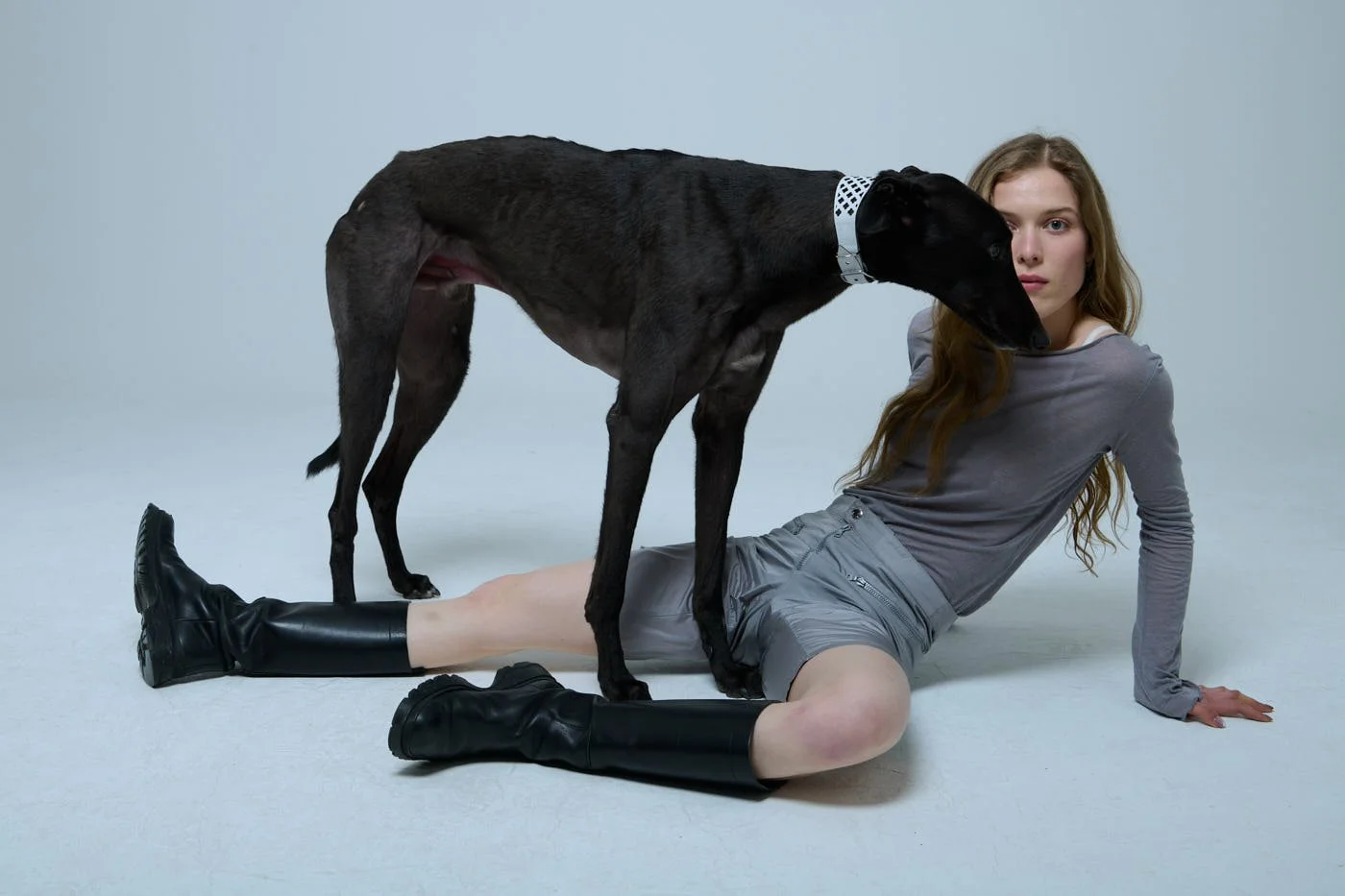
Esra is wearing a top from INTIMISSIMI, nylon shorts and boots from PRADA (via @velvetknife.archive), and Romeo Ultra is wearing a leather collar by ESRA VON KORNATZKI


Esra von Kornatzki LE MILE Magazine photo Julian Melzer

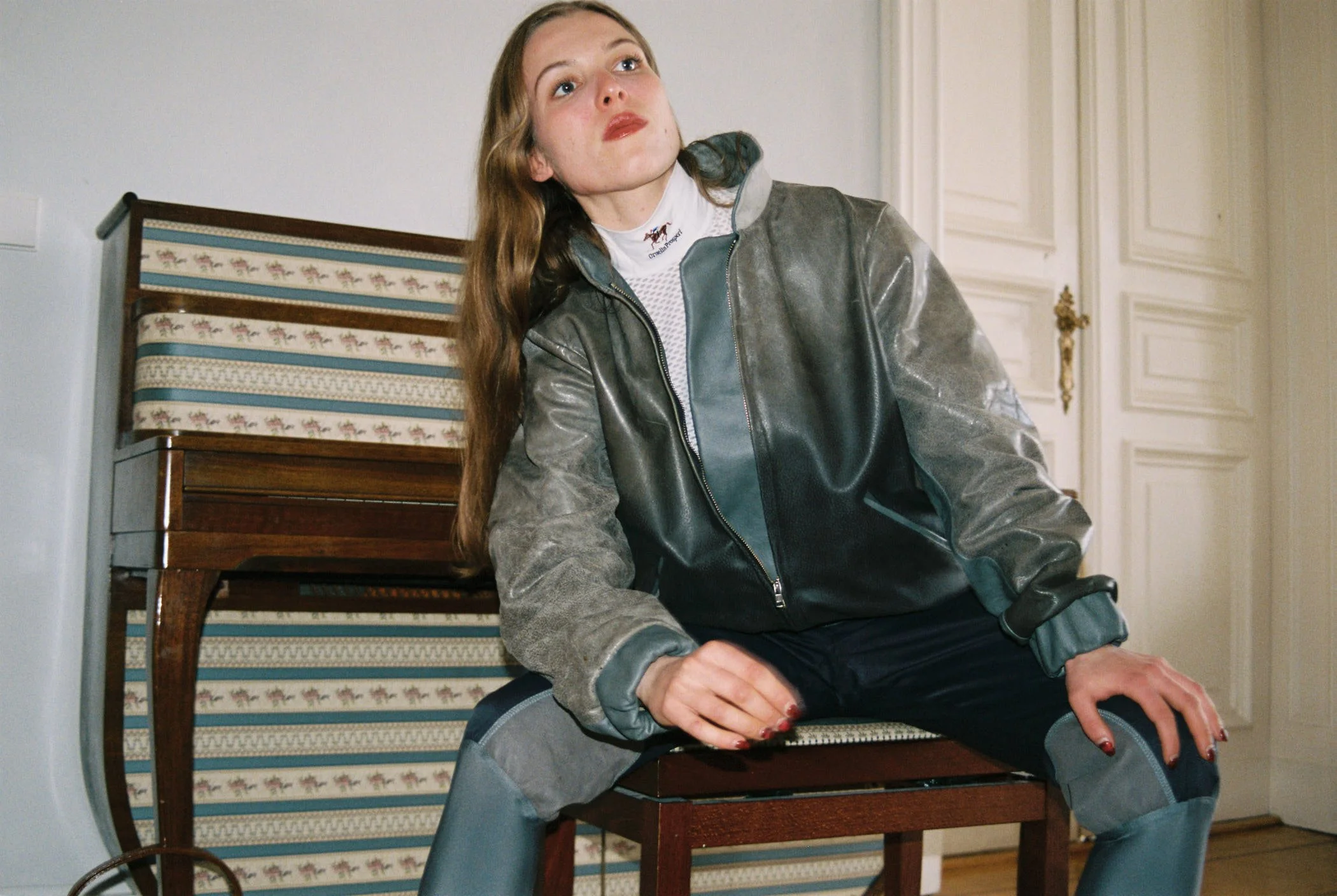
Esra is wearing a top from ORNELLA PROSPERI, a jacket from ESRA VON KORNATZKI, and pants and bag from FASHION ARCHIVE


Esra von Kornatzki LE MILE Magazine photo Julian Melzer

Sekou is wearing jeans from ESRA VON KORNATZKI, gloves and a waist bag from FASHION ARCHIVE


How do you technically preserve traces such as dirt, sweat or hair when coating materials?

For the saddle blankets I used a water based transfer glue (TRANSLAC BOND 55) that I silk screen printed onto the material and then fused with a glossy transparent foil using a heat press at 16o °C, essentially laminating the material and trapping the dirt, sweat and hair underneath.


What information do you want the material to retain once it becomes a garment?

I want the material to retain its history—where it came from, even if in an abstract sense—and its symbolic meaning. I’m interested in what a material carries physically and conceptually, and how that can continue to inform the garment once it is transformed.


How do you position your work within current discussions around material-driven design?

Generally speaking, material does come first in my design process and informs the outcome. I relate to practices like Martin Margiela or even Joseph Beuys, where material isn’t neutral but holds memory and meaning before it becomes form. The material has been exposed to time and happenings, which shape its physical and aesthetic reality, making it a witness and narrating agent. I hold a deep sensitivity for texture, fabric behavior, and tactility. Intuitively exploring and engineering materials while also respecting what they are rather than forcing them to fit a preconceived idea. It's a hybrid practice of a material-led, but conceptually-charged design approach.


What kind of relationship should exist between the garment and the body?

An emotionally charged one - somewhere between love, desire, mystery and comfort. A garment should be an extension of the body and soul. Fashion needs to be felt. My muses that I tailor the garments to, are often people close to me and how I feel about them shapes the garments they inspire me to make. It's another conversation: that between garment and body and I’m in a feedback loop with my muses during the design process in order to modify the garment based on their experience. 


How do you ensure your work is not reduced to sustainability or upcycling?

Sustainability is not my primary motivation. I work with materials sourced outside fashion’s conventional system, rethinking their use and making them desirable for clothes, giving them a stage to tell their own story. The focus is on aesthetic and conceptual value, quality and functionality, as well as sustainability. Although I would describe myself as somewhat of a hoarder, making it a coping mechanism to repurpose materials into polished and clean garments in order to declutter—literally and metaphorically.


What are the next steps for your work within fashion?

To expand the dialogue and deepen the narrative dimension—through collaboration, new contexts, and material experimentation —while exploring accessories as an extension of the practice.


Esra von Kornatzki LE MILE Magazine photo Julian Melzer

Esra is wearing a top from ORNELLA PROSPERI and a jacket from ESRA VON KORNATZKI


photography JULIAN MELZER
designer ESRA VON KORNATZKI
styling XUAN
talent SEKOU + ESRA VON KORNATZKI + ROMEO ULTRA
hair + make up JANETTE PETERS
assistant YEONGHYEON KANG

STIJN KOKS *Fashion, Process, and the Power of Objects

STIJN KOKS *Fashion, Process, and the Power of Objects

STIJN KOKS
*Fashion, Process, and the Power of Objects


written + interview SARAH ARENDTS


Stijn Koks builds worlds. Objects hold weight, fabric carries memory, silhouettes tell untold stories.


His work moves through instinct, shaped by process rather than control. Knights of Nostalgia extends this language—sci-fi headpieces, repurposed textures, the raw and the unreal. Film becomes a pulse, turning garments into atmospheres. Koks reworks discarded pieces, not to recycle, but to shift meaning. In this interview, he speaks about movement, material, and the tension between impulse and precision.


watch KNIGHTS OF NOSTALGIA


“It’s a childlike imagination. Playful, but with depth. Irony never outweighs sincerity.”

Stijn Koks speaks with Sarah Arendts
for LE MILE .Digital


LE MILE Magazine LE MILE Magazine Stijn Koks Interview 2025
 
LE MILE Magazine LE MILE Magazine Stijn Koks Interview 2025
 

Sarah Arendts
Your designs feel like relics of a past that never existed—surreal and nostalgic. Is your work about rewriting childhood or weaponizing it?

Stijn Koks
Weaponizing it. Reclaiming its imagination, but with a mature edge. It's about tapping into the raw, unfiltered emotions of that time—when everything was heightened, strange, and full of possibility—and turning them into something more potent, even unsettling. Harnessing childhood elements is not just a sweet reminder of the past, but a tool for imagining the future.

"Knights of Nostalgia" feels like a playground for the imagination. What’s the first thing you built when the idea hit you, and what did you destroy along the way?

I started with sci-fi-inspired headpieces, repurposing old cowhides and jeans—blending raw with refined. The goal was to create something that felt both nostalgic and futuristic? ‘Vintage sci-fi’ might be the best way to put it. I relied heavily on intuition throughout this collection, which sometimes led me to ideas that will never see the light of day. Still, I already have a million things I’d do differently next time, but I wouldn’t have reached that realization without going through this first. Because the process was so instinctive, editing became a constant push and pull—stripping things until the collection as a whole felt right (for now).


Fashion is often called armor, but your pieces feel more like portals. Are you dressing people to escape or confront the world?

I’d say confront, I don’t think there is much happiness in escaping. If I could spark a little imagination, that’d be great. It’s about navigating the complexities of the world, not running from them. There’s strength in facing the chaos head-on, and wearing something that makes you feel invincible. These pieces are tools for transformation, not retreat—focusing on things we can engage with, rather than escape from.


Walter van Beirendonck and Henrik Vibskov are both titans of the absurd. What lessons from their studios have you carried into your own chaos?

Mainly, the pace. At that level, creativity isn’t just about ideas—it’s intertwined with the business side of fashion. In art school, there’s endless room for absurdity, but in the industry, that space shrinks. Yet, they both find a way to make it work regardless. What intrigues me is the constant tension between artistic integrity and commercial viability. If you lean too much into what sells, you risk diluting your authenticity.

They were careful to preserve that balance. It reminds me of that Henry Ford quote: “If I had asked people what they wanted, they would have said faster horses.” I have zero interest in cars but that quote is cool.


Which designer or brand feels like a kindred spirit to your vision?

It shifts all the time but currently I like ERL. They have a nice, nostalgic, playful feel.


Your work demands a kind of physical interaction—it’s loud and textured. Do you think fashion in the metaverse can ever match the tactility of the real?

No. I’m currently in the middle of creating a large installation for my upcoming show, working with wooden branches and metal elements—letting the process take the lead. It’s all about problem-solving in real time, finding ways to connect and shape different materials as I go. I start with a general idea, but the execution is always shaped by the process itself. The same applies to my garments—the concept evolves as I dive deeper into creation. Along the way, you discover better ways to bring an idea to life, and materials often behave in unexpected ways. That kind of tactility simply doesn’t translate to the digital world. Sure, it’s fun to customize your metaverse avatar, but isn’t it cooler to be the actual avatar in real life?


Recycling, repurposing, rebuilding—your process feels part alchemy, part storytelling. Do you see discarded objects as ghosts waiting to be reanimated?

Absolutely. That’s where the idea of readymades comes in—transforming everyday objects, often discarded or overlooked, into something more profound just by shifting their context. A broken chair or a chandelier, for example, both hold certain references and could become vessels for something new—or something funny and unexpected, triggering a fresh perspective. That said, not everything carries that kind of value. Some things are just trash.

The film for "Knights of Nostalgia" is pure fantasy, but it’s also a manifesto. How do you use moving images to expand the language of your line?

The film for Knights of Nostalgia is almost the soul of the collection—like a visual pulse that injects life into the narrative. Moving images allow me to create an atmosphere that transcends static imagery or theusual fashion show format. Through film, the viewer can engage with the collection on a deeper, more visceral level. Fashion is fundamentally storytelling, but film gives that story a fluidity—it’s where fantasy and reality blend, and I get to play with those boundaries. It’s the ideal medium to expand the collection’s universe, capturing not just the look, but the mood, the atmosphere, and the symbolism. The movement, the soundtrack, the pacing—all contribute to turn the collection from something you wear into something you feel. Shoutout to the team for bringing this attitude to life.


There’s something wildly anarchic about pulling childhood toys into adult wardrobes. Are you reclaiming innocence, or are you throwing it into the fire?

I could never part ways with my action figure collection. Showing them off feels right, almost like paying tribute to a part of myself that shaped who I am today. I don’t think you ever truly outgrow your toys; they’re woven into the foundation of who you’ve become. The toys you played with as a kid reveal a lot about your personality, your interests, your imagination. So, why not embrace that? Incorporating them into adult life feels less like clinging to innocence and more like honoring the things that made you, you.

How do you stop irony from swallowing sincerity?

I’m always trying to strike a balance between kitsch, a bit of wittiness, and a level of maturity. I’m not interested in childishness, but rather in a childlike sense of imagination—something playful without losing depth. Back in art school, I was constantly experimenting, mocking certain aesthetics while exaggerating others, trying to find that sweet spot. It’s a careful process of navigating irony without letting it overpower the sincerity I want to preserve. So, I’d say it’s a fine line that I continue to explore.

Since your silhouettes blur edges and identities, breaking free from binaries, does gender even exist in your design vocabulary?

So, if I’m a rabbit walking into a local giraffe store, and I find this knitted balaclava made for zebras—it has two holes for ears, two for eyes. I have four legs, so it suits me as an oversized Raf Simons sweater. I’m walking out of the store with the zebra balaclava. I guess, as a designer, all I’m doing is giving suggestions based on how I feel at the time. A particular casting doesn’t exclude any other wearers—someone else might pull off the look even better. I can only encourage that.


What’s the last fashion show or collection that stopped you in your tracks, and why did it feel so electric?

I’m afraid I’m stating the obvious, but Maison Margiela’s Artisanal 2024 show was absolutely mental. Storytelling at its finest, and truly beautiful.


LE MILE Magazine LE MILE Magazine Stijn Koks Interview 2025 artist portrait

STIJN KOKS
Portrait

 
LE MILE Magazine LE MILE Magazine Stijn Koks Interview 2025


“There’s no happiness in escape. Strength comes from facing the chaos head-on. They’re tools for transformation.”

Stijn Koks speaks with Sarah Arendts
for LE MILE .Digital


credits
director JEROEN KOOISTRA
creative director STIJN KOKS
production company UNDERSCORE
producer WILLEM BEELAERTS VAN BLOKLAND
D.O.P. BOYD BAKEMA
1st AC TOM SELBECK
steadicam JARON JOOSTEN
gaffer BORIS PETERS
bestboy LENNERT ROIJACKERS
edit STAN VRIEND
grading BOYD BAKEMA
music TOM BRUINS
music mastering TIJMEN VAN STEKELENBURG

models
CARLOS KOK + MEGAN IRUSTA CORNET + KRISTJÁN STEINN KRISTJÁNSSON + COOSJE FROENTJES
styling assistant SOPHIE KOKS
production assistant JADE KLOET
all lookbook images seen by JELLE KOITER

William Fan *Crafting Futures

William Fan *Crafting Futures

William Fan
*Crafting Futures


written Alban E. Smajli

William Fan is scripting a new narrative in modern design, fusing his rich cultural heritage with an avant-garde approach to fashion. His designs emerge as an eloquent dialogue between architectural rigor and fluid dynamism, boldly questioning the industry's entrenched norms.


With each collection, Fan weaves together Asian heritage and European design sensibilities, crafting a sartorial rebellion that defies traditional boundaries and celebrates sustainability. Through his latest endeavors, Fan explores themes of gender fluidity and inclusivity, pushing the boundaries of conventional fashion. Fan's staunch commitment to using dead-stock materials and partnering with family-run businesses underscores his devotion to ethical fashion practices. This journey sets a bold new standard for what it means to be a designer today but also cements Fan’s status as a visionary and a profound storyteller in the ever-evolving fashion landscape.


William Fan Portrait by Clemens Poloczek LE MILE Magazine Interview

William Fan
seen by Clemens Poloczek

 
William Fan Portrait by Clemens Poloczek LE MILE Magazine Interview


“I feel the most empowered when I work close to my heritage because it feels the most authentic. The many travels to Hong Kong influenced my perspective on beauty, craftsmanship, and tradition. I look for the balance between Asia and Europe in every season.”

William Fan speaks with Alban E. Smajli
LE MILE Magazine TRANCE, Nr. 36


Alban E. Smajli
William, your journey in fashion has been inspirational and transformative. Could you share how your cultural heritage influences your design philosophy and how it has evolved over the years?
William Fan
When I started my brand, and also during my studies, I wanted my collections to be personal and close to my identity. I feel the most empowered when I work close to my heritage because it feels the most authentic. The many travels to Hong Kong influenced my perspective on beauty, craftsmanship, and tradition. I look for the balance between Asia and Europe in every season. In the beginning, the contrasts were more hard and visible. Nowadays, it has become a grey zone where you can hardly see the lines. It's more diffused now, like we work on the theme of unisex. You hardly notice which gender it's meant to be.

In your creative process, how do you enter a state of flow or "trance" to conceptualize and bring your visions to life?
I like to build up a storyline. At first, we started with a party night, 'THE DAY AFTER' came as a consequence. Then we had an afternoon in Chinatown and ended up in a karaoke bar. You know, it’s almost like a biographical film book; I try to visualize every occasion.

Now we've entered the 'CEREMONY' era, which is the current collection. Every season has a theme, and from that feeling, we create a full-vision world. From the set design to the music, we want to escape with our community and dive into 15 minutes of dreaming.

Your designs are known for their unique blend of architectural precision and fluidity. How do you balance these elements, and how has this signature style evolved in your SS24 collection?
I like to think about a functional wardrobe with a twist—things you can wear and be real about. Our garments are built to function and always have a little twist in color, texture, and material. I think clothing needs to move and flow and give the customer enough space between the body and the garment itself. I’m not a big fan of a very tight fit. If so, it’s knit where you still have the stretch element. I like to empower with simplicity and precise tailoring. Sometimes more formal, sometimes more playful. This season was a lot about textures and fabrics. The colors were mainly inspired by the LGBTQI+ Flag, which is mainly represented in monotone, single-color block looks. Furthermore, we questioned how we dress for ceremonial occasions and which general rules are given.


Can you give us a glimpse into the making of the SS24 collection? What were the key inspirations, challenges, and breakthrough moments during its development?
The SS24 collection was named 'CEREMONY,' and it's all about the special days we celebrate in our lives. Big Birthdays or Weddings. I got married myself in 2022 and was quite critical of what you have to do and all the rules you need to follow. We started researching Asian and European traditions—for example, for marriage. The red wedding in China and the white wedding in Europe. I wanted to be inclusive and make a statement through the rainbow color flag from the LGBTQI+ community. I wanted to put a sign out that everybody should have the same rights to celebrate, for example, a wedding independently of your sexuality. I gave a male model the veil or the final bride look a black short-sleeve tuxedo with feathers. For me, it felt very adult and emancipated.

Sustainability is a critical conversation in fashion today. How are you integrating sustainable practices into your work, particularly with the SS24 collection?
We work exclusively with dead-stock materials. I like that way of using non-wanted resources and having a limited choice. That also means that most of the products are limited in their availability. All the manufacturers I am working with are visited personally a few times a year. I'm lucky to build up great relationships with family-owned businesses.

Everyone is very innovative when developing new styles. We don’t overproduce our products, and we never go on sale. I want to create a value that is hopefully long-lasting and sustains many trends and decades.


Reflecting on your career, who has been your most significant mentor, and what was the most valuable lesson you learned from them?
I had many people supporting me from the beginning. To be honest, I would say my parents. They always taught me to be bold and proud, regardless of where and who you are at the moment. I always keep saying: Fake it till you make it. This helped me through many moments :)


“I feel privileged to be able to have the runway medium and the city of Berlin, which offers so many monumental spaces. From the TV Tower to the Underground, I've tried all levels in Berlin to express my emotions through many spectacular locations.”

William Fan speaks with Alban E. Smajli
LE MILE Magazine TRANCE, Nr. 36


William Fan Portrait by Clemens Poloczek LE MILE Magazine Interview


Fashion shows can be mesmerizing, almost trance-like experiences for the audience. How do you aim to evoke this sense of immersion and emotion in your runway presentations?
I feel privileged to be able to have the runway medium and the city of Berlin, which offers so many monumental spaces. From the TV Tower to the Underground, I've tried all levels in Berlin to express my emotions through many spectacular locations. I love to tell a story when it comes to runway presentations. Mostly, I'm looking for a space that has a certain power and an interesting history to tell. I also like to work with all senses. The moment you come into the venue, you will immediately experience a certain smell, texture, or lighting. Then the music starts, and I have 15 minutes to tell the concept of more than 6 months of intensive work.

From all the pieces you've created for the SS24 collection, is there one that stands out to you as a personal favorite or holds a special meaning? If so, why?
I’m a big fan of the 'Are you a friend of Dorothy?' jumper. A "friend of Dorothy" (FOD) is a euphemism for a gay man, first used in LGBT slang. Stating that, or asking if someone is a friend of Dorothy, is a furtive way of suggesting sexual orientation while avoiding hostility. I like the way to use historical references to hopefully remember we never need to talk in euphemisms again to express our sexuality.

What's next for William Fan? Are there any new projects, collaborations, or directions you're particularly excited about exploring in the near future?
Many new product groups will be added, and our new gift shop 'FAN PLAZA' just opened its doors a few months ago. We now have spaces for new visuals in partnership with artists, partners, and friends. I like the idea of bringing networks together that share the same love for small details and art.


follow artist @studiowilliamfan
discover online www.williamfan.com

all images (c) Clemens Poloczek