Objects Don’t Rest, They Plot
Adrian Kiss Keeps the Comfort Complicated
interview + written ALBAN E. SMAJLI
There’s a duvet folded in half in Adrian Kiss’s memory, heavy with wool and childhood, a private weather system pressed close in the dark. Long before anyone started calling it sculpture, there were mattresses, blankets, the stubborn geometry of safety and sleep, objects that promised comfort and ended up complicating it. Adrian grew up negotiating softness and weight, inventing worlds under covers that protected and sometimes trapped, learning early that the line between body and object is a moving target.
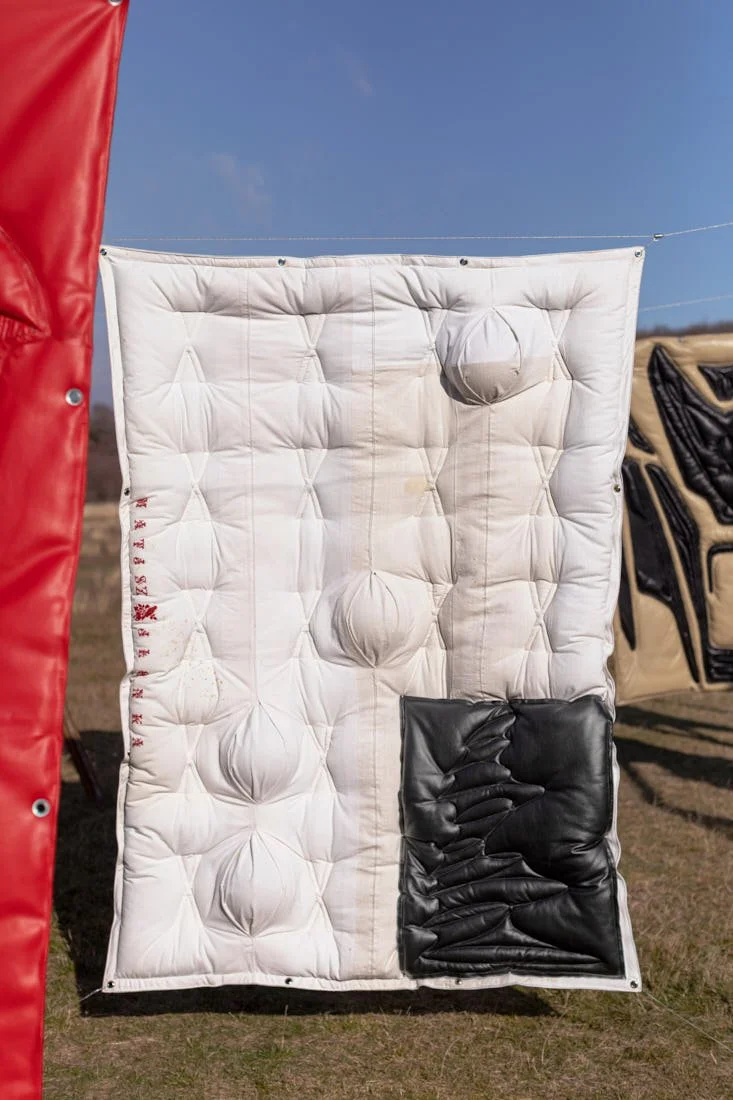
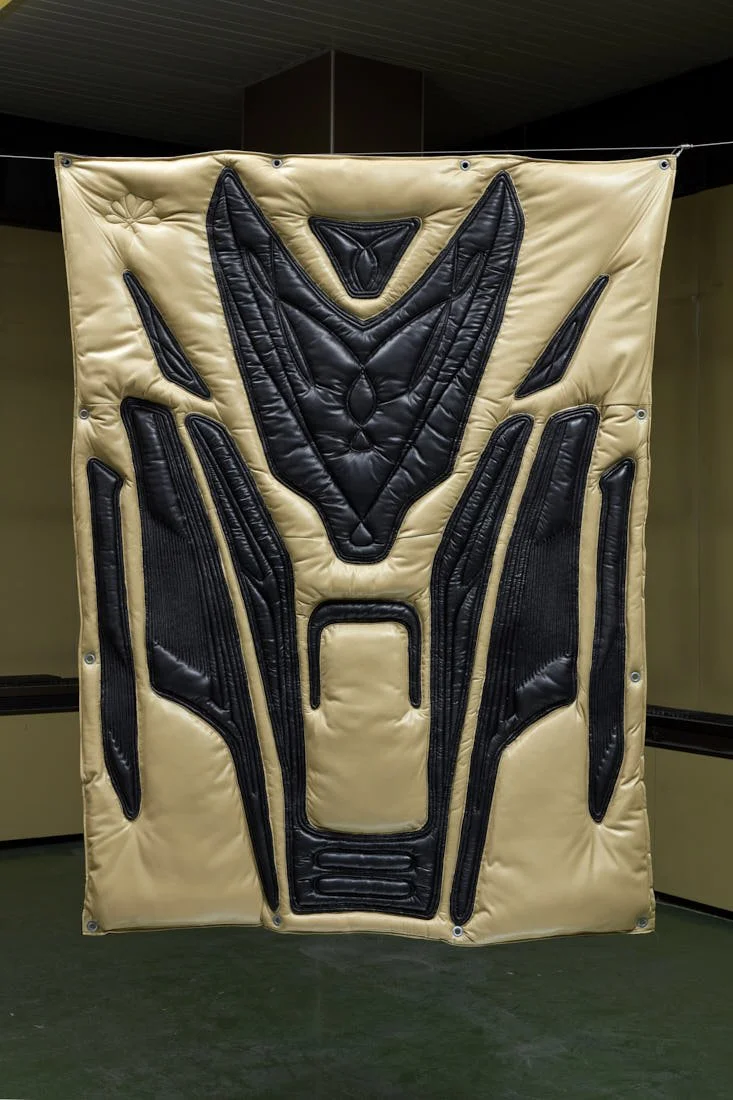
Dunyha Firka 1, 2021, quilted leather and canvas with acrylic spheres, 200 × 140 cm, presented as part of Dunyha Tomorrow at acb Gallery, Budapest, Hungary, 2021 / Image by Dávid Tóth
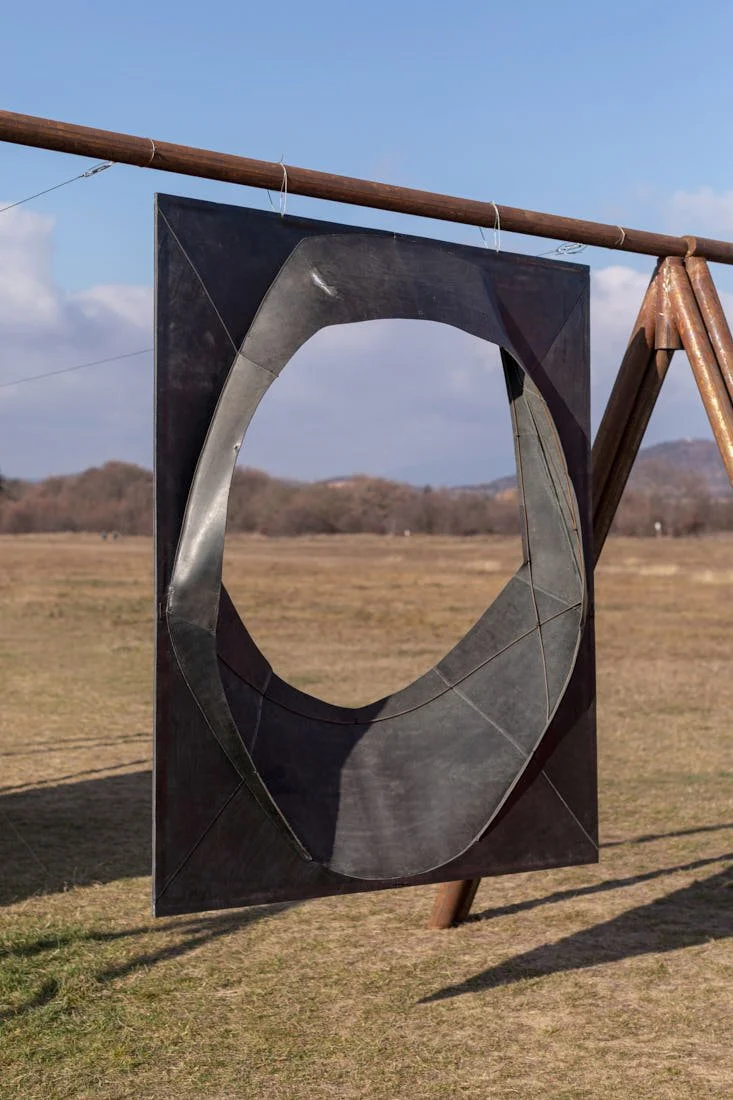
Leather Hole 1, 2021, leather on metal structure, 185 × 150 cm, presented as part of Dunyha Tomorrow at acb Gallery, Budapest, Hungary, 2021 / Image by Dávid Tóth
His work never hides its seams. Materials arrive marked, stained, scarred by use or time, sometimes freshly buried, sometimes coaxed into new shapes by the hands of collaborators or by gravity itself. Duvets and tyres, stitched suns and industrial leftovers, everything carrying traces of its past life, everything drafted into the ongoing drama of care and disruption. Nostalgia and hypermodernity don’t compete here. They mingle in the form of a quilt dragged across a concrete floor or a basket woven to hold more than bread.
The studio is both laboratory and cul-de-sac, a place where tools outnumber screens and the slow work of listening shapes every decision. When things risk getting too polished, Adrian ruins the surface, lets chaos in, or simply walks away until time itself gets bored and leaves its mark. He’s learned to trust whatever’s at hand, scrap, memory, silence, and to keep the choreography open, the outcome unresolved. Every object in the room wants to speak, but the story keeps shifting, between sleep and vigilance, labor and leisure, skin and structure. That’s the paradox Adrian returns to inhabit, over and over, until the work feels as alive and restless as the hand that made it.
Alban E. Smajli
Your work thrives on physical materials. How do you decide which medium becomes the “skin” of your next piece?
Adrian Kiss
For me, the “skin” of the work is often where the human body is, as that has been at the centre of my practice. My relationship with materials is intuitive, a safe space that forms the foundation of my artistic language.
In my earlier work, I struggled to translate my positionality and material intuition into larger narratives, often compelling me to symbolically bury my pieces for transformation and “curing”. This analogy became a guiding methodology for understanding the performativity of materials and the transformative potential of forces. I began investigating how the non-living can act as a performer, embodying time-based processes, under and beyond the influence of the human. When deciding what becomes the 'skin' of a work, I think about its capacity to resist or welcome the passing of time.
Tell us about your childhood obsession with duvets, why does that heavy comfort keep showing up in your installations?
I’m drawn to everyday gestures and the object culture associated with them. I’m especially interested in the things we all must do, like sleeping, but which, sadly, we’re not all allowed to do equally. We all need sleep, but are we given the right to rest? Mattresses, blankets, pillows, and duvets represent the care of home and the comfort of safety. In my installations and sculptures, they often appear without the human figure, and in that absence, they start to become the body. I use them to create a sense of insecurity by juxtaposing their softness and familiarity with more brutal or unstable surroundings.
I only started working with bedding a few years ago, after a long period of engaging with jackets and garments. Duvets, in particular, carry intimate traces, stains, scents, marks, subtle forms of memory and presence. They’re comforting, but they also speak of vulnerability. At my grandparents’, their duvet was filled with thick wool, making it very heavy. As a child, under its heavy-comfort, I often felt trapped and safe.
Say your studio suddenly went analog. No screens or signal, just tools and silence. How might that reshape the way you create, or even the way you think inside your space?
Answering this question tells much about how I work. I haven’t always been in the privileged position to do art full time, I’ve worked alongside my studio practice most of my life. This really shaped what I had access to, time and money-wise. So I often worked by collaborating with other creators to produce parts of my work. This meant I didn’t need much of a studio; much of the experimentation at the start was done on paper. With time, I reconnected with making, and that was a revelation, I found a new purpose in it. But havint this experience, I’m also comfortable working with whatever space and tools I have access to.
No screens and signals, just tools and silence, would mean I am a child again, probably getting bored soon, and through that, entertaining myself through creative explorations of what I have and what I know. Sounds exciting.
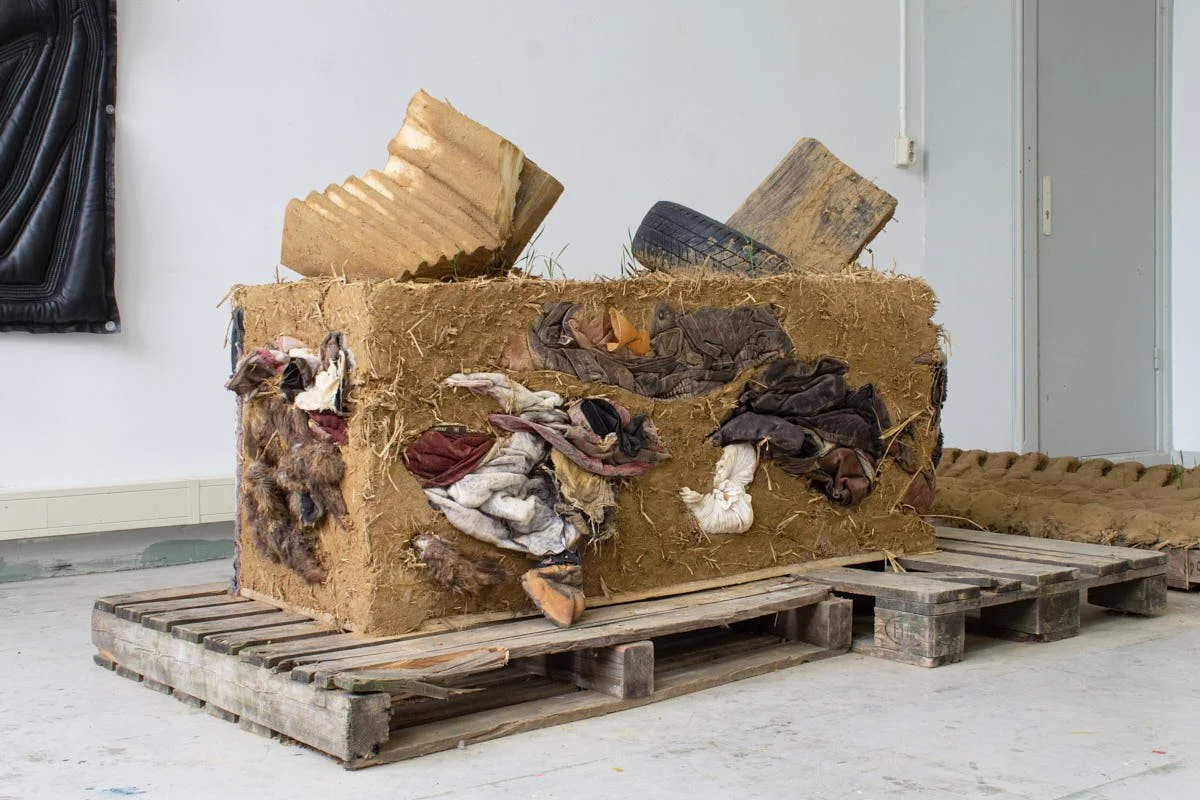
Is It Big? Is It Small? How Does It Smell?, 2024, textile objects with clay, sand, straw and wooden pallets, dimensions vary / Image by Adrian Kiss
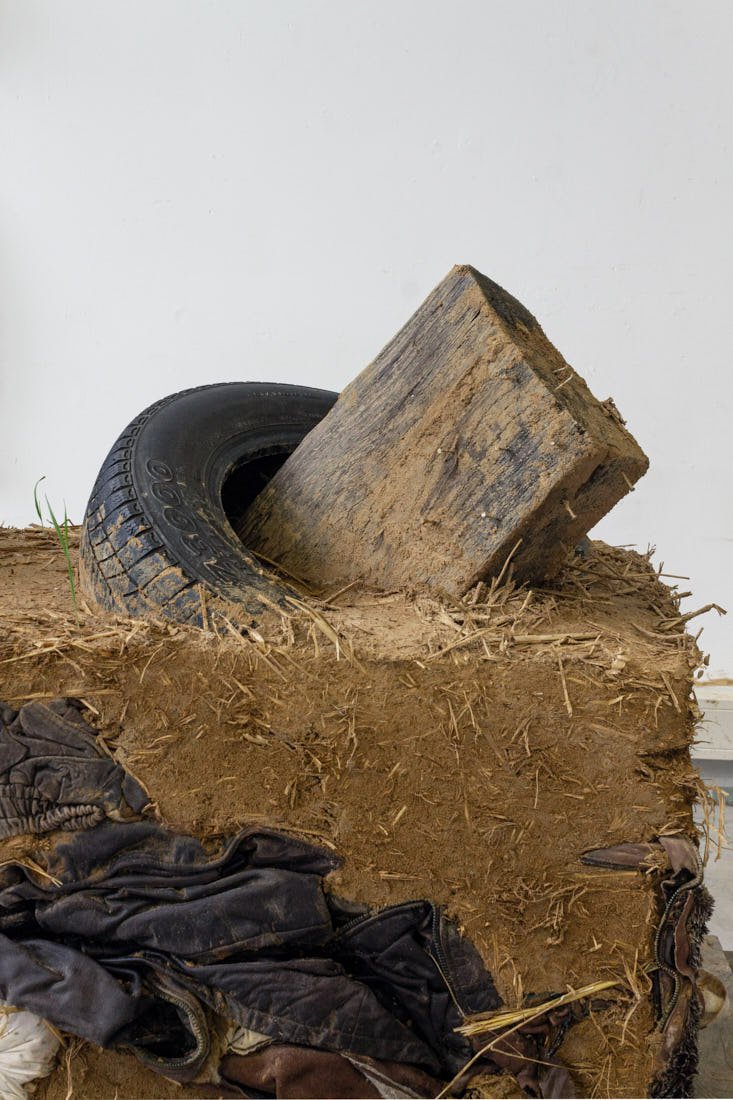
Is It Big? Is It Small? How Does It Smell?, 2024, textile objects with clay, sand, straw and wooden pallets, dimensions vary / Image by Adrian Kiss
Your inspirations range from brutalist architecture in Romania to internet visuals. How do you balance nostalgia with hyper-modernity?
These seemingly opposite sources of influence are not so far from each other. My work exists both in the countryside and the city, because that’s where I’m from. I live and work in the memory and nostalgia of my time spent in Romania and Hungary, but I’m constantly inspired by my surroundings. Having studied in the UK and the Netherlands, always being on the move, I’m constantly challenged to question my learnings.
It’s true that in my early work, right after graduating, I was very much a post-internet artist, deeply engaged with digital aesthetics. But over time, that shifted and I became more present in my physical surroundings and also began mingling more with memory, especially memories of my childhood in Coșnea.
I spent many summers in that cul-de-sac village, isolated in the Romanian mountains, at my grandparents’ home. It was largely untouched by urbanisation. The small rural working-class community, where folk traditions were still lived and performed through material culture, gave me a deep sensitivity to how objects carry meaning, and agency. Now, after living in two post-socialist countries, and then in London and the Netherlands, I see how the city is present in the village, and the village in the city. What seems like a contrast, between nostalgia and hyper-modernity, often overlap. I move between them intuitively.
When things get too polished, do you ever feel the urge to ruin them a little, just to keep the chaos alive?
Yeah, that is exactly what happened when I lost contact with the making. I felt like my works were coming out of a factory, and I’d been removed from them emotionally. It wasn’t an urge to create chaos that I felt, but an urge to “age” my work. This is how I came up with the idea of burying my early pieces and allowing them to cure. I’ve tackled this question frequently in the past years through different experimentations where I extended the making to forces outside my control. I dropped sculptures from my studio window in an improvised but directed sequence, a performance that lasted 16 minutes. The “final compositions” were shaped by gravity and inertia. The audience’s experience was guided by the expectation, what will fall next, and when?
On another occasion, in the performance titled Mom, Why Didn’t You Tell Me?, I wished to juxtapose the care embodied by six quilted wool blankets with the brutality of soil and the everyday. I demonstrated these tensions by disassembling a 500 kg adobe sculpture in front of an audience, and carrying the adobe’s weight down to the garden using the blankets..
How does physical context—like the sunken pool at VUNU or decaying industrial spaces—shape the way your work behaves in the real world?
I usually organise my studio time around larger projects that often respond to the spaces where the works will be shown. That was the case with my solo show at VUNU, Satin, Soil, Stomach, curated by Lilla Lipusz. When we first visited the space and submerged ourselves in the concrete basin of the former swimming pool, we were transported elsewhere, the space had a particular vibration that had to be respected.
It became a question of listening, of learning how to be in dialogue with both the space and the materials. Listening, arguably, has been suppressed today, whether through the silencing of others, the deliberate creation of noise and disinformation, or through our own disconnection from listening itself. The work created for VUNU would have a different dialogue in another space. Equally meaningful, but a different story.
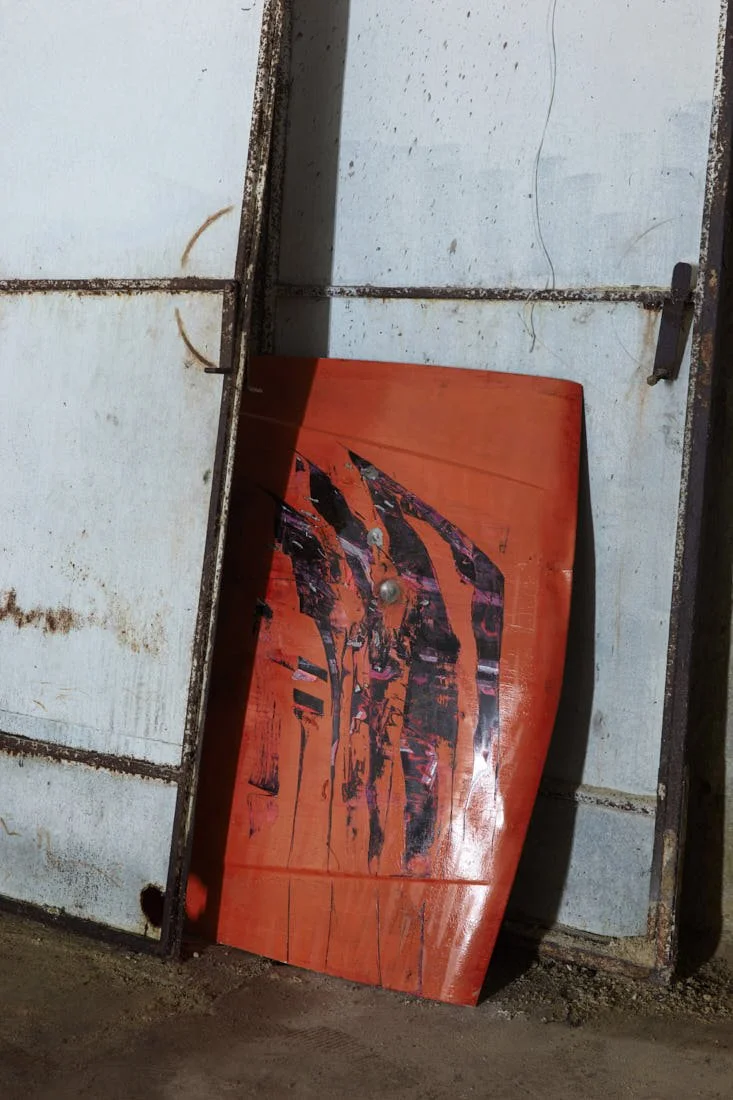
Untitled (bonnet), 2014, acrylic paint on car bonnet, 97 × 128 × 6 cm, presented as part of MMM at art quarter budapest, Budapest, Hungary, 2020 / Image by Dávid Biró
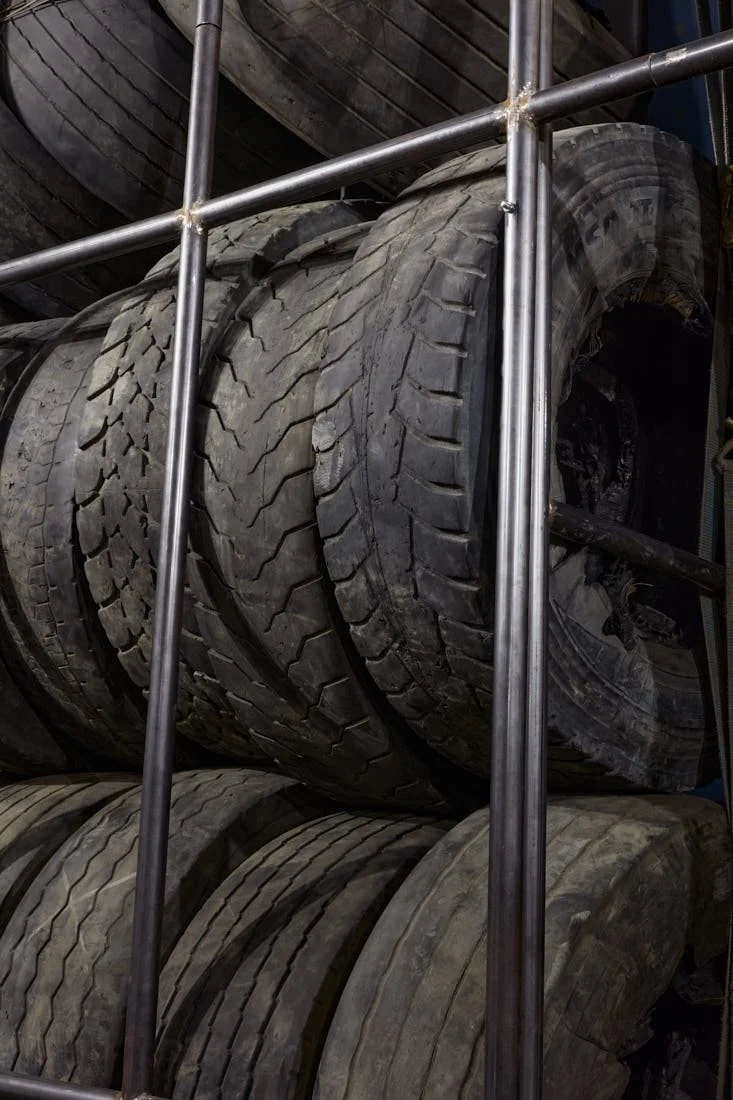
Roll Me, Squeeze Me, Say My Name (detail), 2025, quilted wool blankets, tires, ratchet straps and wire on metal structure, 544 × 400 × 150 cm, presented as part of Restless Dislocations at Ján Koniarek Gallery, Trnava, Slovakia, with Radovan Čerevka, 2025 / Image by Dávid Biró
Your moodboards often feel like industrial scraps meet sci-fi: what’s your trick for transforming found objects into uncanny-human extensions?
I’m compelled to juxtapose materials, shapes, and concepts with polar values. There’s a kind of specificity that emerges when you intersect them. Through their contradictions, something precise is revealed, often oddly familiar, rooted in the everyday. Like the harshness of quilted black leather paired with soft padding. Or the weight of an old used tyre placed beside a woven basket. Or the intimacy of a stitched sun on a wool blanket, a material usually meant to protect the body, now used to carry remains from a “burial site.” Care and brutality in the quotidian are not opposites, but entangled, complicating any clear notion of what care even means.
When do you feel the work is alive? Is it the moment you stitch it together, exhibit it, or let it sit and transform with time?
Most of my stitchwork is done by my fantastic colleague Eszter Előd, she gets to experience the slow catharsis of a quilt coming together, step by step. I often work as a producer, collaborating with others to create something together. Like Sándor Végh, a third-generation basket weaver, or Zoltán Ónodi, an incredible welder and metalworker. And more recently, I’ve been collaborating with the agency of time and chance itself. In other instances, I do the labour myself, because it’s conceptually important that I endure the weight of the soil, or because I technically can, and want to.
That said, while the process of making is always fascinating, what I enjoy most isn’t the making, it’s the human connections that come with it. I get to meet and work with talented people, to share stories and trust.
What’s the next paradox you want to explore? Organic vs. synthetic is “vintage Kiss.” Where do you go after that?
I’ve recently leapt into time-based media, and I’m enjoying the new challenges and the broader visual vocabulary it allows. Rather than seeking new paradoxes, I want to deepen the ones I’ve already been working with, exploring them in depth and more situated.
Lately, I’ve realised how much material has been right in front of me that I’ve overlooked, like the social interactions with my collaborators, the physical labour of preparing adobe for my sculptures. These aren’t just background processes, or invisible work, they’re part of the work.
header image
Adrian Kiss
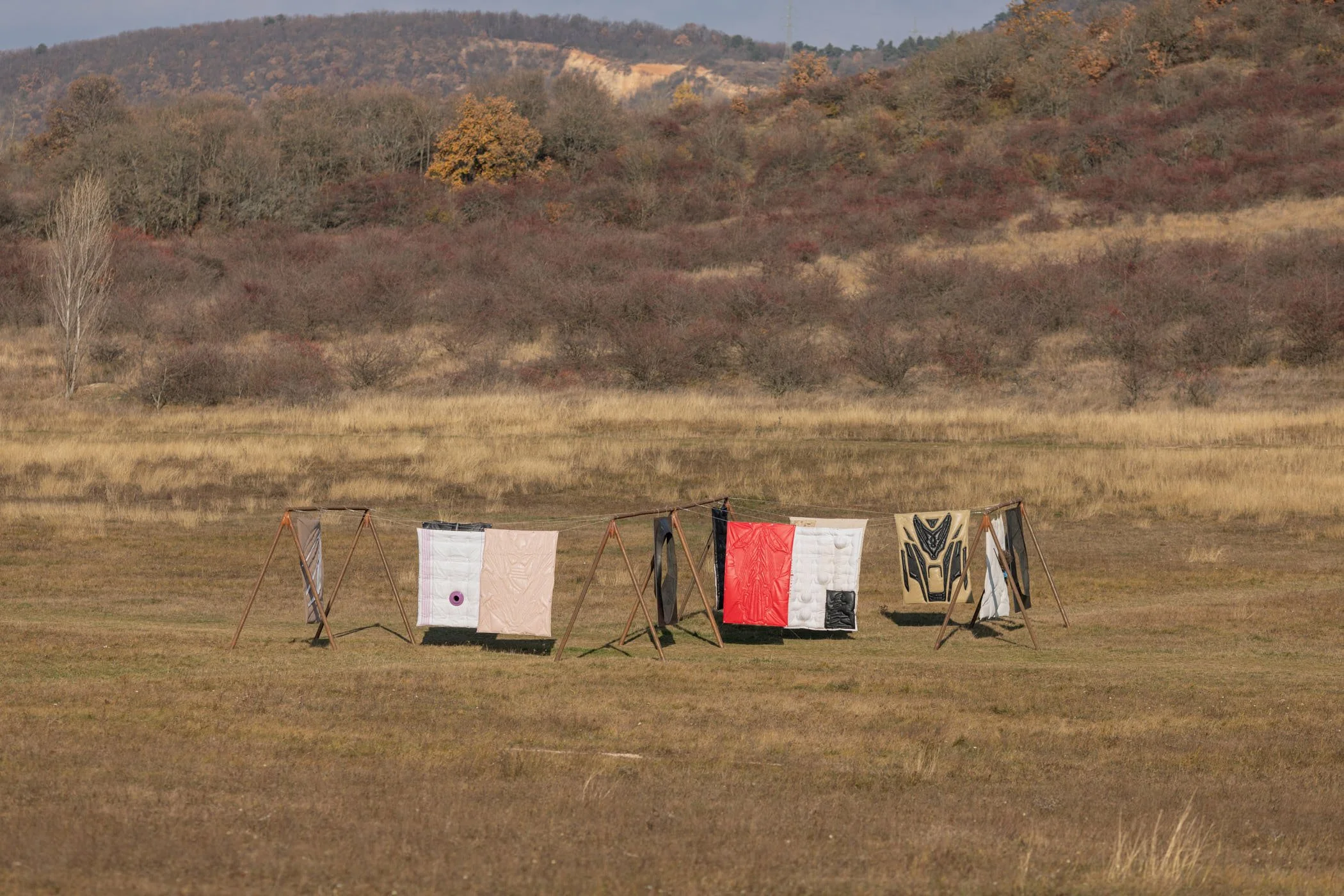
Dunyha Tomorrow, installation view, acb Gallery, Budapest, Hungary, 2021 / Image by Dávid Tóth