Viewing entries in
culture

ADRIAN KISS  *Keeping the Comfort Complicated

ADRIAN KISS *Keeping the Comfort Complicated

Objects Don’t Rest, They Plot

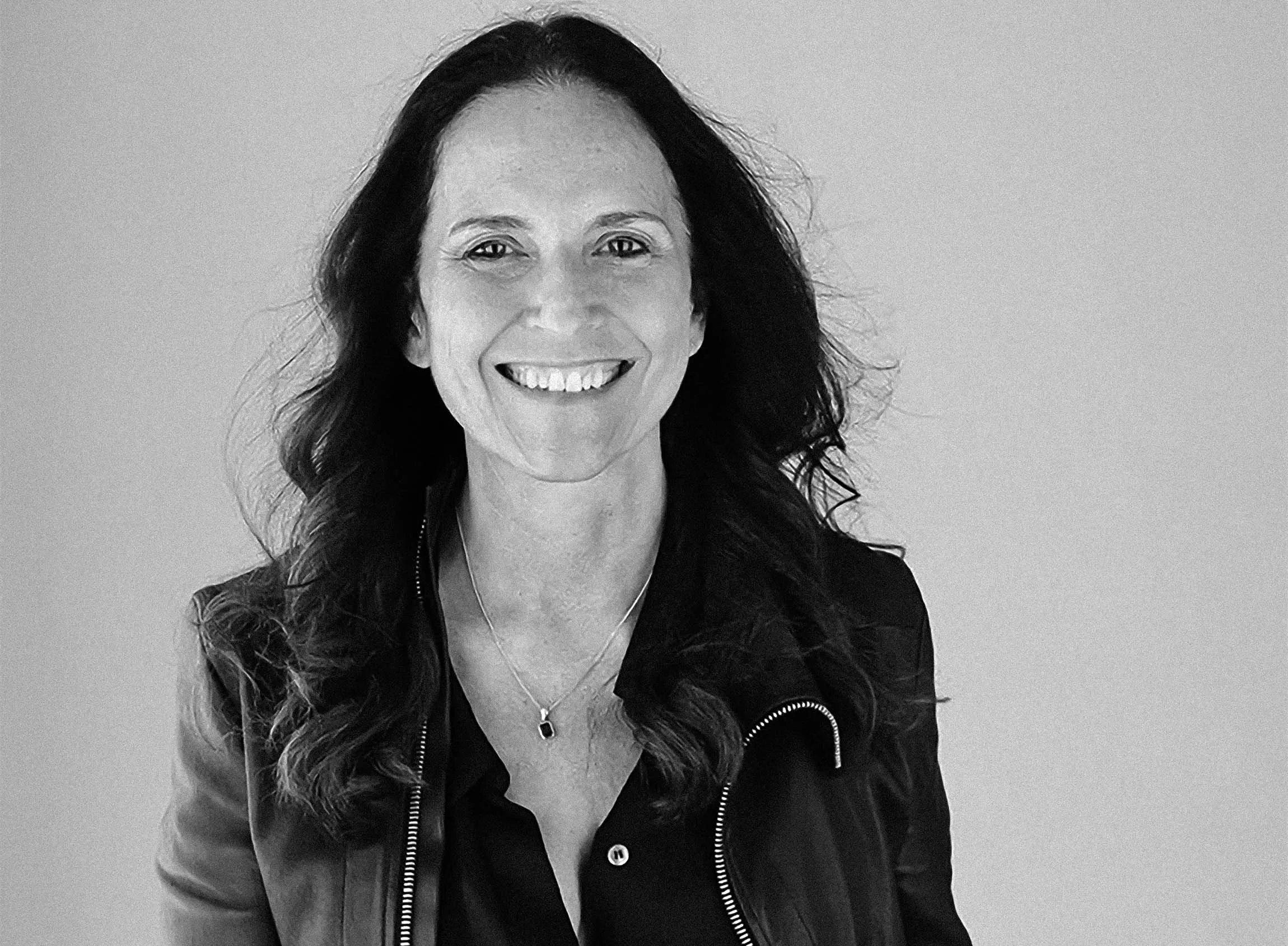
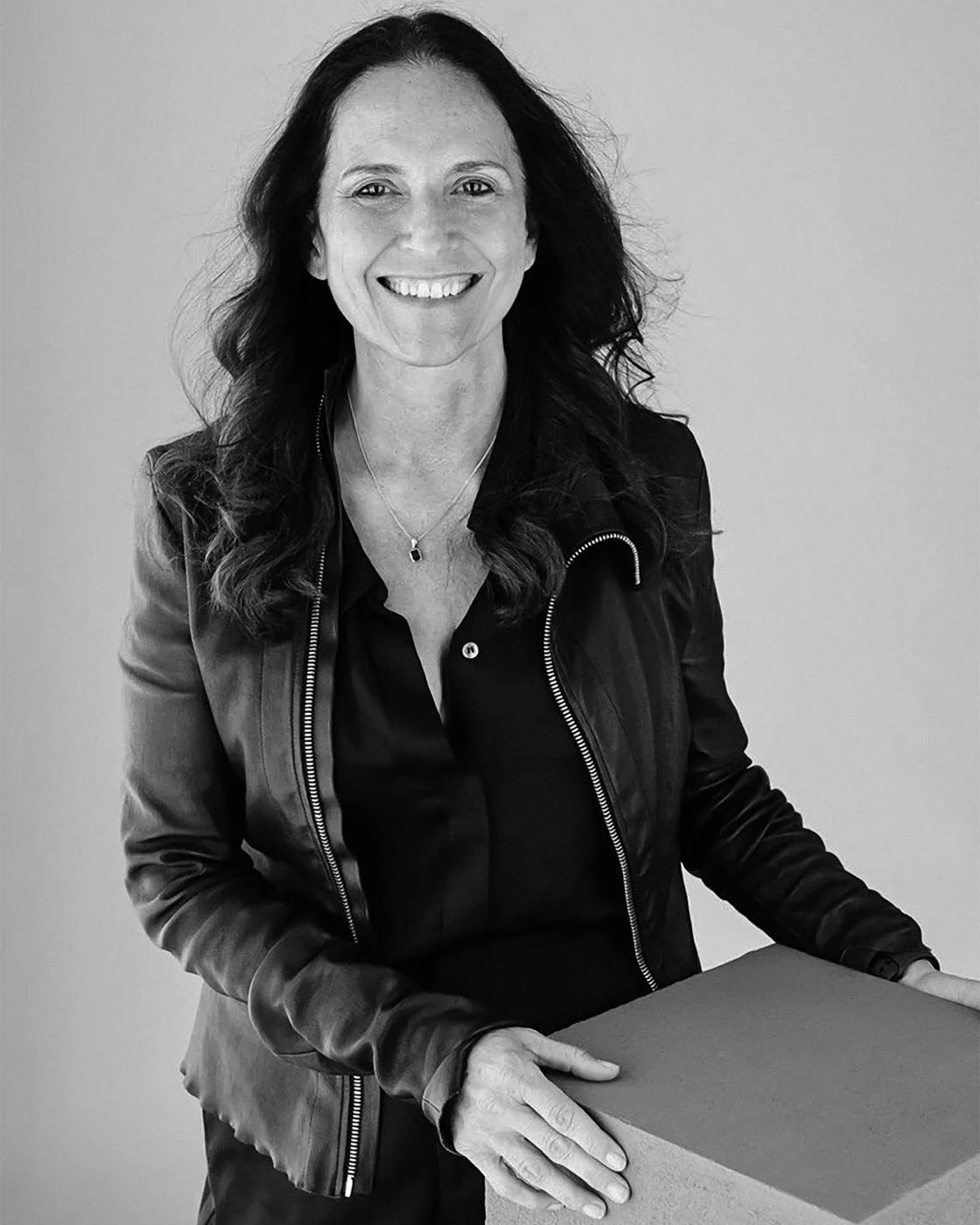
Adrian Kiss Keeps the Comfort Complicated


interview + written ALBAN E. SMAJLI


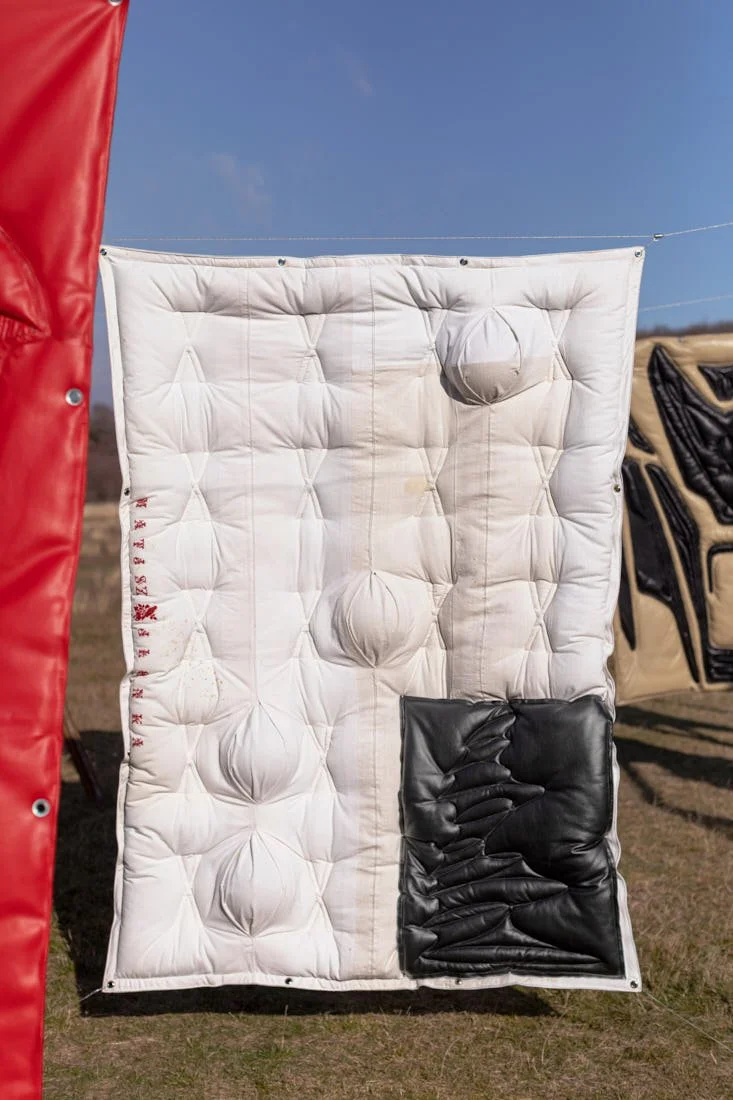
There’s a duvet folded in half in Adrian Kiss’s memory, heavy with wool and childhood, a private weather system pressed close in the dark. Long before anyone started calling it sculpture, there were mattresses, blankets, the stubborn geometry of safety and sleep, objects that promised comfort and ended up complicating it. Adrian grew up negotiating softness and weight, inventing worlds under covers that protected and sometimes trapped, learning early that the line between body and object is a moving target.


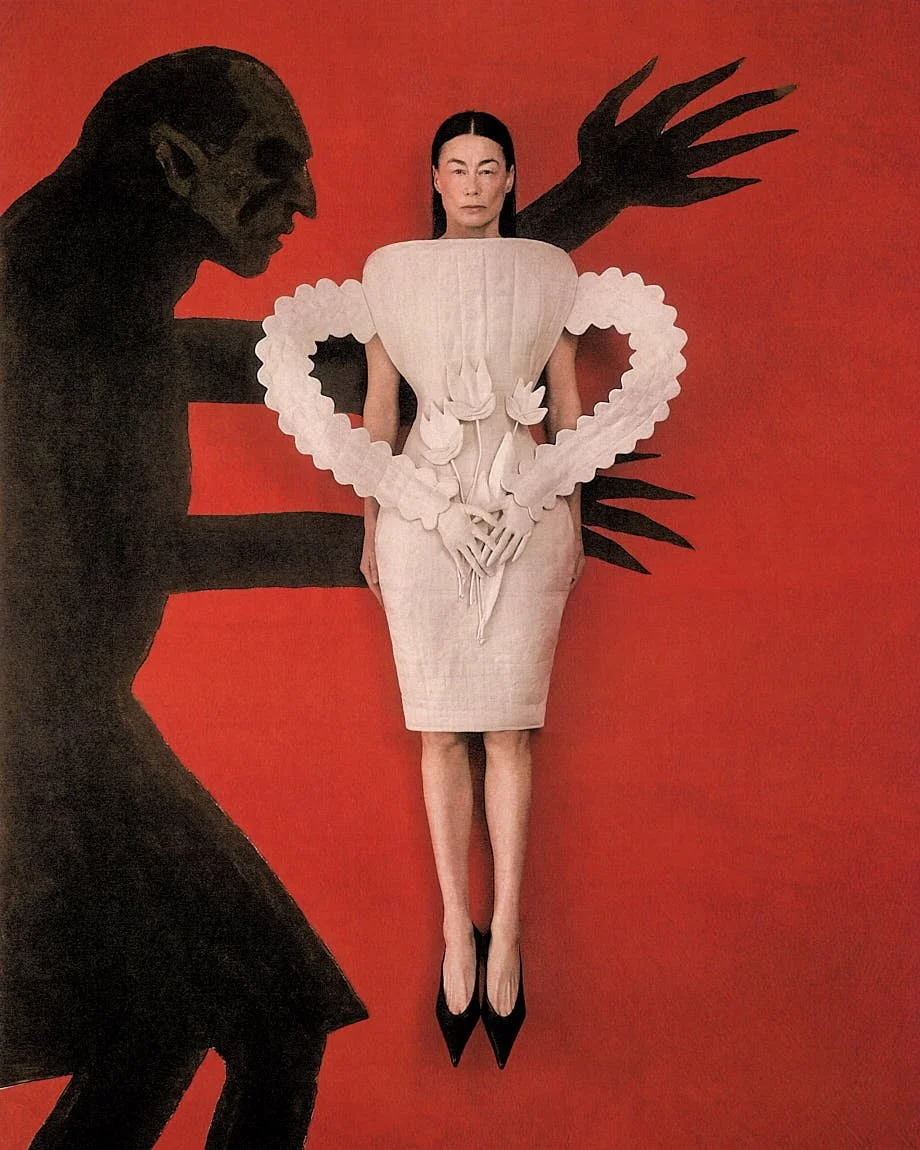
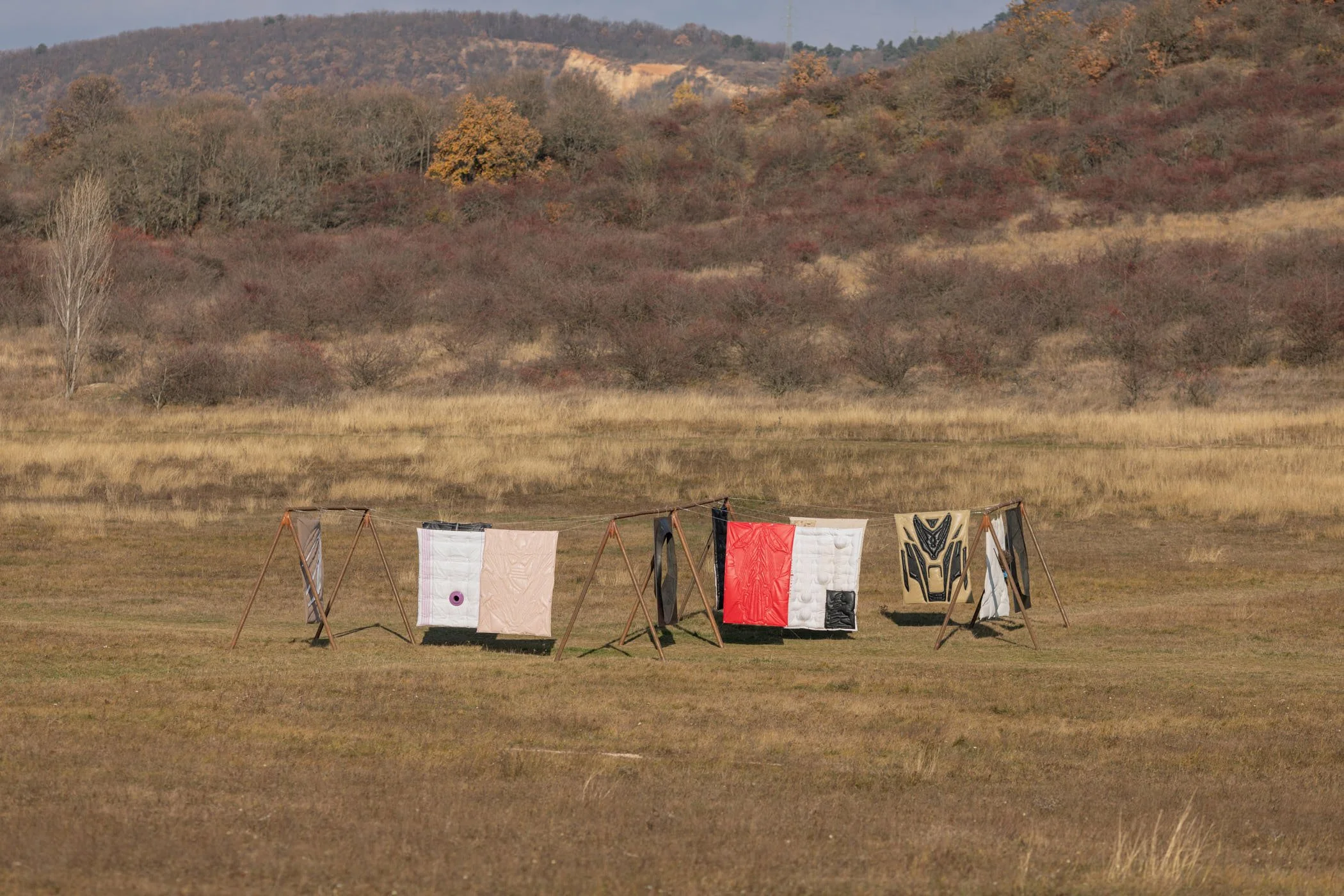
Dunyha Firka 1, 2021, quilted leather and canvas with acrylic spheres, 200 × 140 cm, presented as part of Dunyha Tomorrow at acb Gallery, Budapest, Hungary, 2021. Image by Dávid Tóth

Dunyha Firka 1, 2021, quilted leather and canvas with acrylic spheres, 200 × 140 cm, presented as part of Dunyha Tomorrow at acb Gallery, Budapest, Hungary, 2021 / Image by Dávid Tóth

 
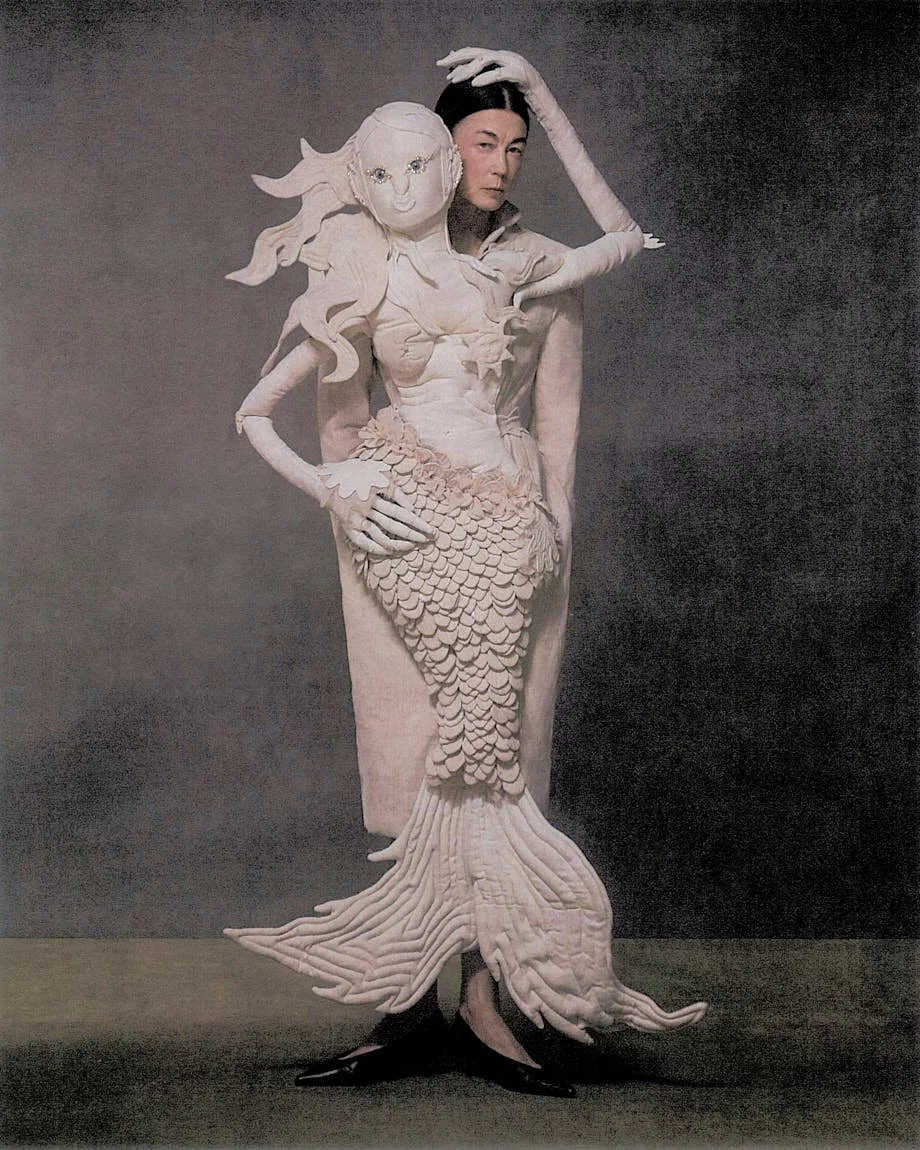
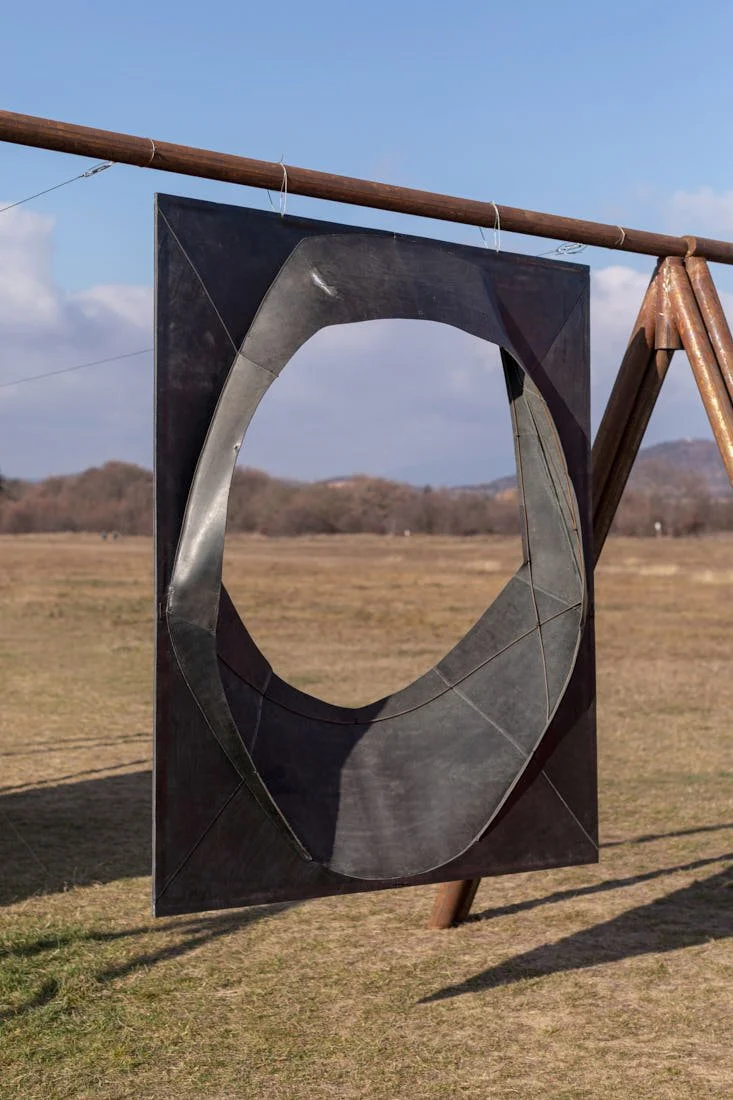
Leather Hole 1, 2021, leather on metal structure, 185 × 150 cm, presented as part of Dunyha Tomorrow at acb Gallery, Budapest, Hungary, 2021. Image by Dávid Tóth

Leather Hole 1, 2021, leather on metal structure, 185 × 150 cm, presented as part of Dunyha Tomorrow at acb Gallery, Budapest, Hungary, 2021 / Image by Dávid Tóth


His work never hides its seams. Materials arrive marked, stained, scarred by use or time, sometimes freshly buried, sometimes coaxed into new shapes by the hands of collaborators or by gravity itself. Duvets and tyres, stitched suns and industrial leftovers, everything carrying traces of its past life, everything drafted into the ongoing drama of care and disruption. Nostalgia and hypermodernity don’t compete here. They mingle in the form of a quilt dragged across a concrete floor or a basket woven to hold more than bread.
The studio is both laboratory and cul-de-sac, a place where tools outnumber screens and the slow work of listening shapes every decision. When things risk getting too polished, Adrian ruins the surface, lets chaos in, or simply walks away until time itself gets bored and leaves its mark. He’s learned to trust whatever’s at hand, scrap, memory, silence, and to keep the choreography open, the outcome unresolved. 
Every object in the room wants to speak, but the story keeps shifting, between sleep and vigilance, labor and leisure, skin and structure. That’s the paradox Adrian returns to inhabit, over and over, until the work feels as alive and restless as the hand that made it.


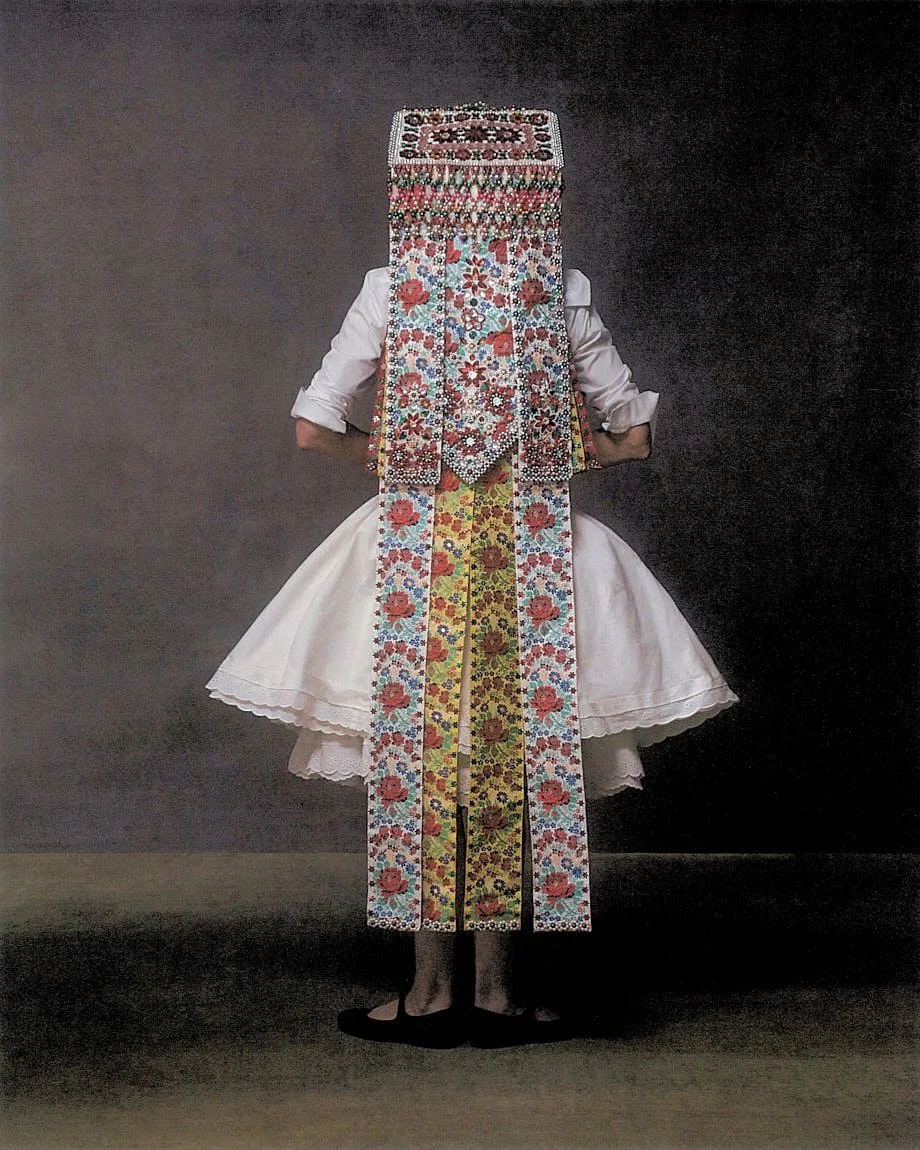
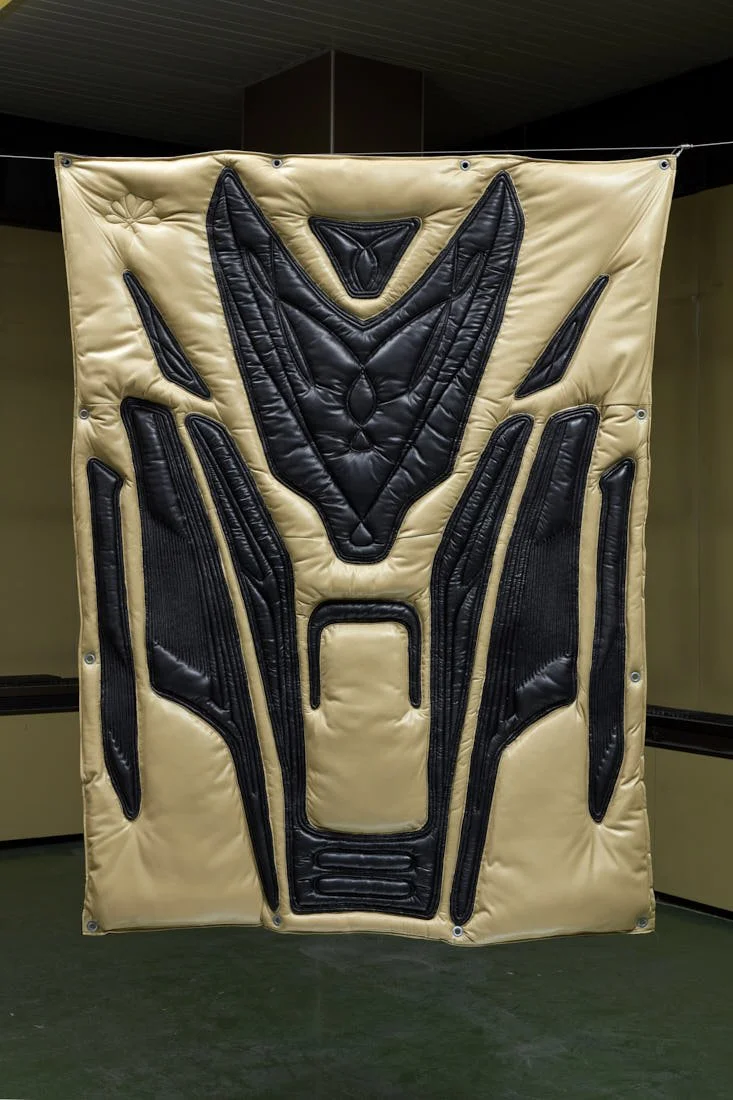
Moto 3, 2021, quilted synthetic leather, 190 × 135 cm, presented as part of Dunyha Tomorrow at acb Gallery, Budapest, Hungary, 2021. Image by Dávid Biró


Alban E. Smajli
Your work thrives on physical materials. How do you decide which medium becomes the “skin” of your next piece?

Adrian Kiss
For me, the “skin” of the work is often where the human body is, as that has been at the centre of my practice. My relationship with materials is intuitive, a safe space that forms the foundation of my artistic language.
In my earlier work, I struggled to translate my positionality and material intuition into larger narratives, often compelling me to symbolically bury my pieces for transformation and “curing”. This analogy became a guiding methodology for understanding the performativity of materials and the transformative potential of forces. I began investigating how the non-living can act as a performer, embodying time-based processes, under and beyond the influence of the human. When deciding what becomes the 'skin' of a work, I think about its capacity to resist or welcome the passing of time.


Tell us about your childhood obsession with duvets, why does that heavy comfort keep showing up in your installations?

I’m drawn to everyday gestures and the object culture associated with them. I’m especially interested in the things we all must do, like sleeping, but which, sadly, we’re not all allowed to do equally. We all need sleep, but are we given the right to rest? Mattresses, blankets, pillows, and duvets represent the care of home and the comfort of safety. In my installations and sculptures, they often appear without the human figure, and in that absence, they start to become the body. I use them to create a sense of insecurity by juxtaposing their softness and familiarity with more brutal or unstable surroundings.
I only started working with bedding a few years ago, after a long period of engaging with jackets and garments. Duvets, in particular, carry intimate traces, stains, scents, marks, subtle forms of memory and presence. They’re comforting, but they also speak of vulnerability. At my grandparents’, their duvet was filled with thick wool, making it very heavy. As a child, under its heavy-comfort, I often felt trapped and safe.


Say your studio suddenly went analog. No screens or signal, just tools and silence. How might that reshape the way you create, or even the way you think inside your space?

Answering this question tells much about how I work. I haven’t always been in the privileged position to do art full time, I’ve worked alongside my studio practice most of my life. This really shaped what I had access to, time and money-wise. So I often worked by collaborating with other creators to produce parts of my work. This meant I didn’t need much of a studio; much of the experimentation at the start was done on paper. With time, I reconnected with making, and that was a revelation, I found a new purpose in it. But havint this experience, I’m also comfortable working with whatever space and tools I have access to.
No screens and signals, just tools and silence, would mean I am a child again, probably getting bored soon, and through that, entertaining myself through creative explorations of what I have and what I know. Sounds exciting.

 
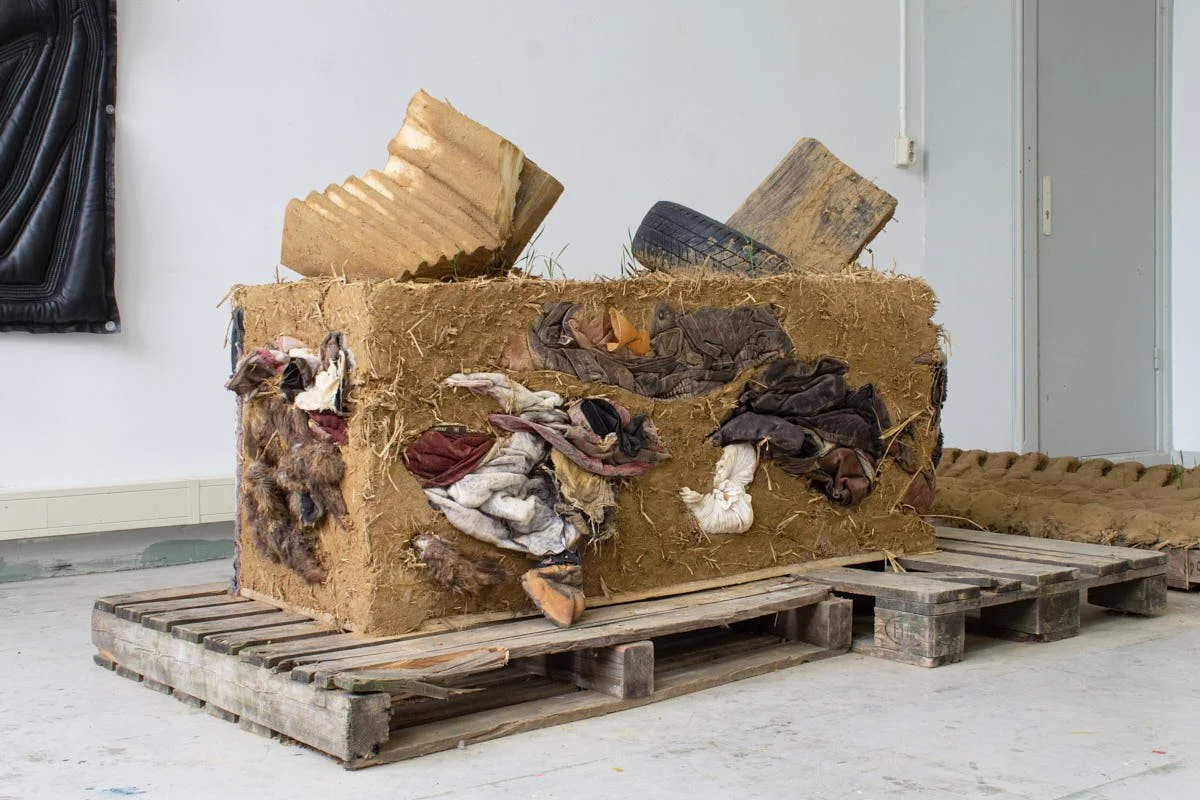
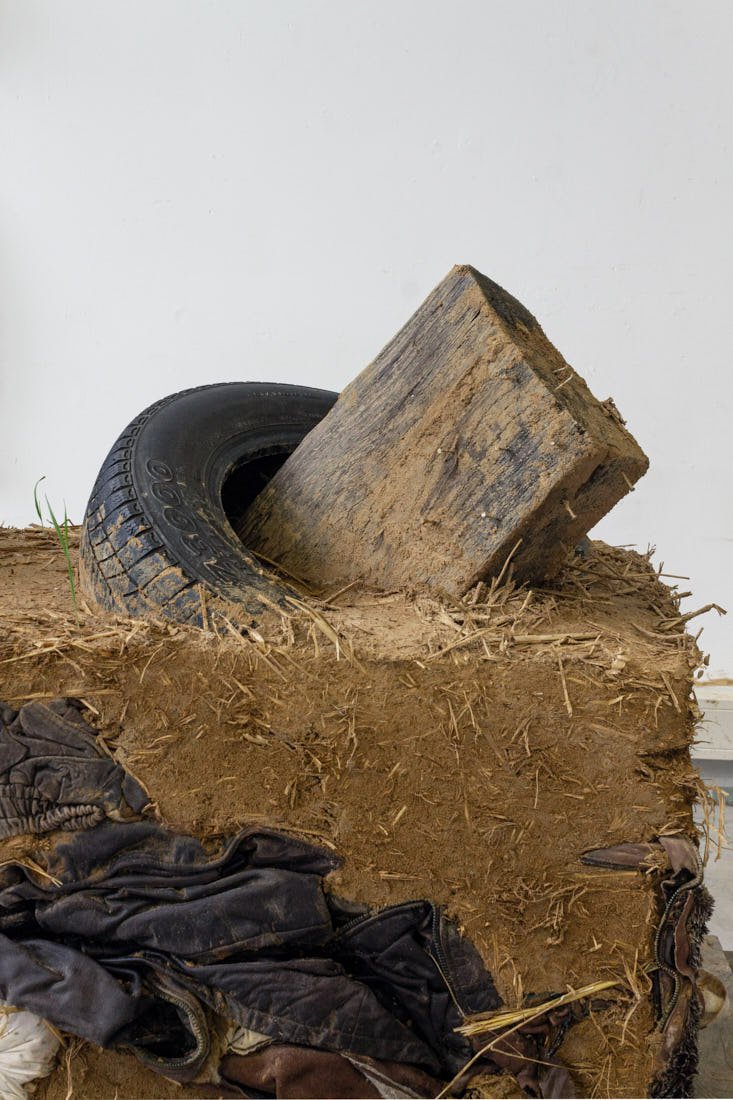
Is It Big? Is It Small? How Does It Smell?, 2024, textile objects with clay, sand, straw and wooden pallets, dimensions vary. Image by Adrian Kiss

Is It Big? Is It Small? How Does It Smell?, 2024, textile objects with clay, sand, straw and wooden pallets, dimensions vary / Image by Adrian Kiss

 
Is It Big? Is It Small? How Does It Smell?, 2024, textile objects with clay, sand, straw and wooden pallets, dimensions vary. Image by Adrian Kiss

Is It Big? Is It Small? How Does It Smell?, 2024, textile objects with clay, sand, straw and wooden pallets, dimensions vary / Image by Adrian Kiss


Your inspirations range from brutalist architecture in Romania to internet visuals. How do you balance nostalgia with hyper-modernity?

These seemingly opposite sources of influence are not so far from each other. My work exists both in the countryside and the city, because that’s where I’m from. I live and work in the memory and nostalgia of my time spent in Romania and Hungary, but I’m constantly inspired by my surroundings. Having studied in the UK and the Netherlands, always being on the move, I’m constantly challenged to question my learnings.

It’s true that in my early work, right after graduating, I was very much a post-internet artist, deeply engaged with digital aesthetics. But over time, that shifted and I became more present in my physical surroundings and also began mingling more with memory, especially memories of my childhood in Coșnea.
I spent many summers in that cul-de-sac village, isolated in the Romanian mountains, at my grandparents’ home. It was largely untouched by urbanisation. The small rural working-class community, where folk traditions were still lived and performed through material culture, gave me a deep sensitivity to how objects carry meaning, and agency. Now, after living in two post-socialist countries, and then in London and the Netherlands, I see how the city is present in the village, and the village in the city. What seems like a contrast, between nostalgia and hyper-modernity, often overlap. I move between them intuitively.


When things get too polished, do you ever feel the urge to ruin them a little, just to keep the chaos alive?

Yeah, that is exactly what happened when I lost contact with the making. I felt like my works were coming out of a factory, and I’d been removed from them emotionally. It wasn’t an urge to create chaos that I felt, but an urge to “age” my work. This is how I came up with the idea of burying my early pieces and allowing them to cure. I’ve tackled this question frequently in the past years through different experimentations where I extended the making to forces outside my control. I dropped sculptures from my studio window in an improvised but directed sequence, a performance that lasted 16 minutes. The “final compositions” were shaped by gravity and inertia. The audience’s experience was guided by the expectation, what will fall next, and when?
On another occasion, in the performance titled Mom, Why Didn’t You Tell Me?, I wished to juxtapose the care embodied by six quilted wool blankets with the brutality of soil and the everyday. I demonstrated these tensions by disassembling a 500 kg adobe sculpture in front of an audience, and carrying the adobe’s weight down to the garden using the blankets..


How does physical context—like the sunken pool at VUNU or decaying industrial spaces—shape the way your work behaves in the real world?

I usually organise my studio time around larger projects that often respond to the spaces where the works will be shown. That was the case with my solo show at VUNU, Satin, Soil, Stomach, curated by Lilla Lipusz. When we first visited the space and submerged ourselves in the concrete basin of the former swimming pool, we were transported elsewhere, the space had a particular vibration that had to be respected.

It became a question of listening, of learning how to be in dialogue with both the space and the materials. Listening, arguably, has been suppressed today, whether through the silencing of others, the deliberate creation of noise and disinformation, or through our own disconnection from listening itself. The work created for VUNU would have a different dialogue in another space. Equally meaningful, but a different story.


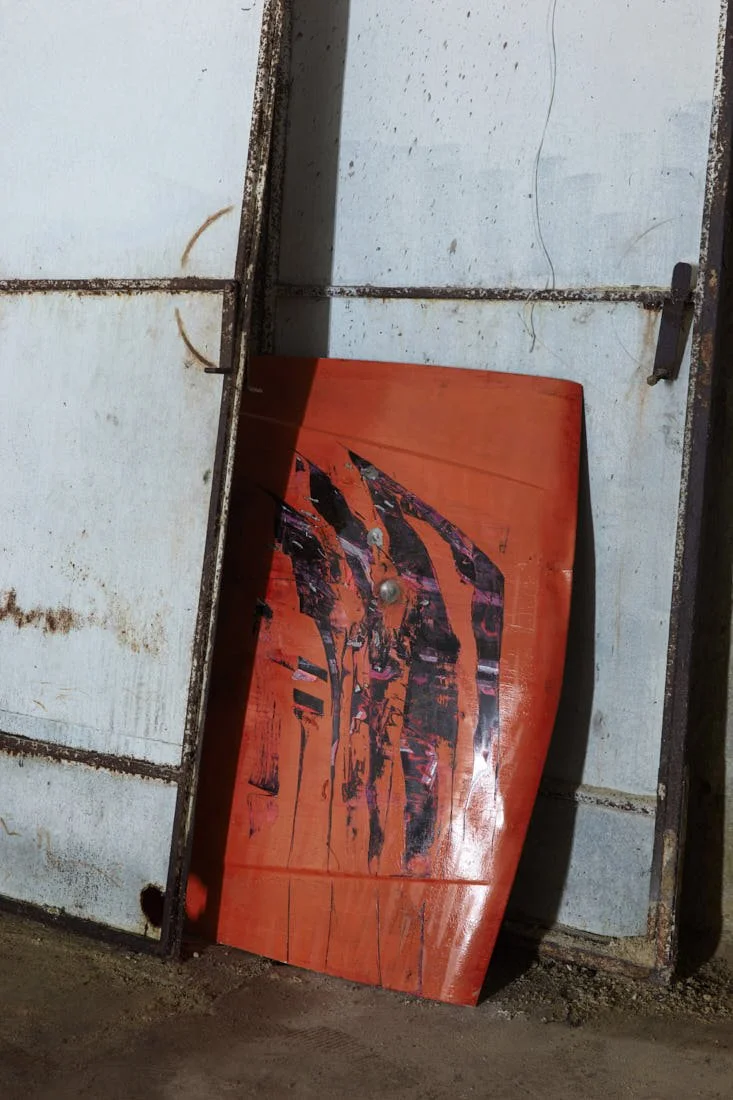
Untitled (bonnet), 2014, acrylic paint on car bonnet, 97 × 128 × 6 cm, presented as part of MMM at art quarter budapest, Budapest, Hungary, 2020. Image by Dávid Biró

Untitled (bonnet), 2014, acrylic paint on car bonnet, 97 × 128 × 6 cm, presented as part of MMM at art quarter budapest, Budapest, Hungary, 2020 / Image by Dávid Biró


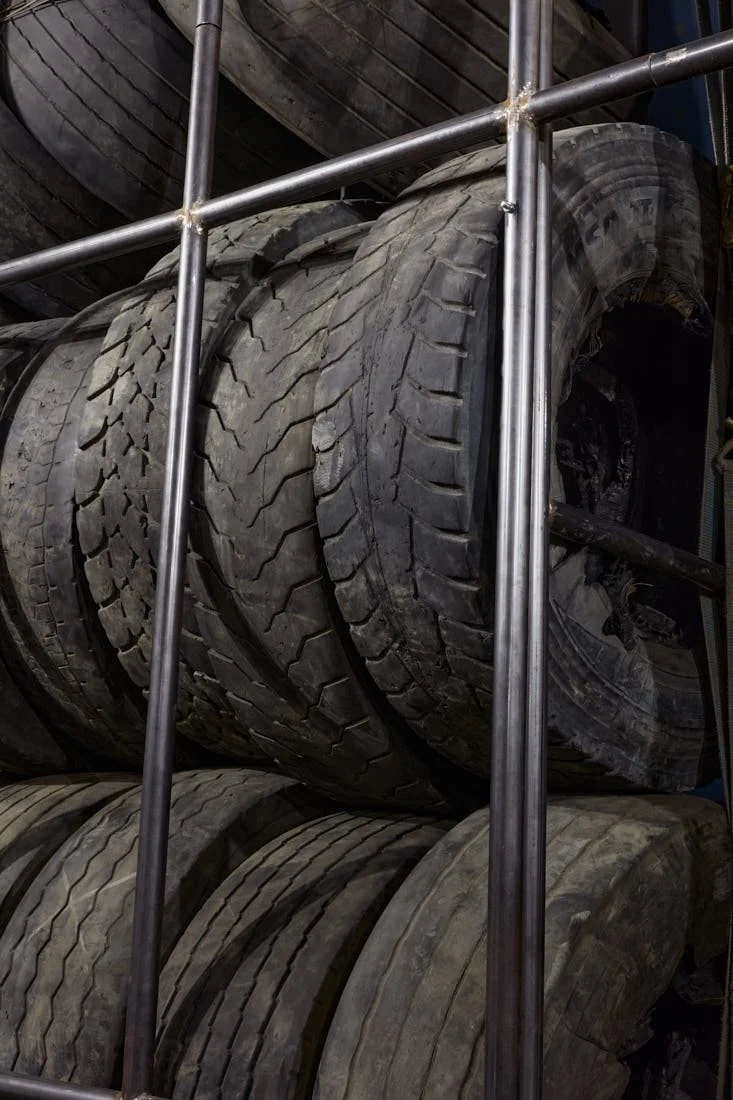
Roll Me, Squeeze Me, Say My Name (detail), 2025, quilted wool blankets, tires, ratchet straps and wire on metal structure, 544 × 400 × 150 cm, presented as part of Restless Dislocations at Ján Koniarek Gallery, Trnava, Slovakia, with Radovan Čerevka, 2025 / Image by Dávid Biró


Your moodboards often feel like industrial scraps meet sci-fi: what’s your trick for transforming found objects into uncanny-human extensions?

I’m compelled to juxtapose materials, shapes, and concepts with polar values. There’s a kind of specificity that emerges when you intersect them. Through their contradictions, something precise is revealed, often oddly familiar, rooted in the everyday. Like the harshness of quilted black leather paired with soft padding. Or the weight of an old used tyre placed beside a woven basket. Or the intimacy of a stitched sun on a wool blanket, a material usually meant to protect the body, now used to carry remains from a “burial site.” Care and brutality in the quotidian are not opposites, but entangled, complicating any clear notion of what care even means.


When do you feel the work is alive? Is it the moment you stitch it together, exhibit it, or let it sit and transform with time?

Most of my stitchwork is done by my fantastic colleague Eszter Előd, she gets to experience the slow catharsis of a quilt coming together, step by step. I often work as a producer, collaborating with others to create something together. Like Sándor Végh, a third-generation basket weaver, or Zoltán Ónodi, an incredible welder and metalworker. And more recently, I’ve been collaborating with the agency of time and chance itself. In other instances, I do the labour myself, because it’s conceptually important that I endure the weight of the soil, or because I technically can, and want to.
That said, while the process of making is always fascinating, what I enjoy most isn’t the making, it’s the human connections that come with it. I get to meet and work with talented people, to share stories and trust.


What’s the next paradox you want to explore? Organic vs. synthetic is “vintage Kiss.” Where do you go after that?

I’ve recently leapt into time-based media, and I’m enjoying the new challenges and the broader visual vocabulary it allows. Rather than seeking new paradoxes, I want to deepen the ones I’ve already been working with, exploring them in depth and more situated.
Lately, I’ve realised how much material has been right in front of me that I’ve overlooked, like the social interactions with my collaborators, the physical labour of preparing adobe for my sculptures. These aren’t just background processes, or invisible work, they’re part of the work.


header image
Adrian Kiss
Dunyha Tomorrow, installation view, acb Gallery, Budapest, Hungary, 2021 / Image by Dávid Tóth

COSIMA KAIBEL *Three Stripes and the Codes of a Generation

COSIMA KAIBEL *Three Stripes and the Codes of a Generation

Three Stripes and the Codes of a Generation
From Neukölln to Canvas with Cosima Kaibel


interview + written ALBAN E. SMAJLI


Adidas appears in contemporary painting with a frequency that would have seemed unlikely a generation ago. The three stripes have moved beyond sportswear and entered the visual vocabulary of a younger generation of artists. Tracksuits and sneakers circulate through studios and canvases in cities like Berlin, London or New York as a shared cultural code, carrying references to belonging, migration histories, street culture and urban identity. For many painters today, these garments carry a particular duality. They are instantly recognizable yet deeply ordinary.


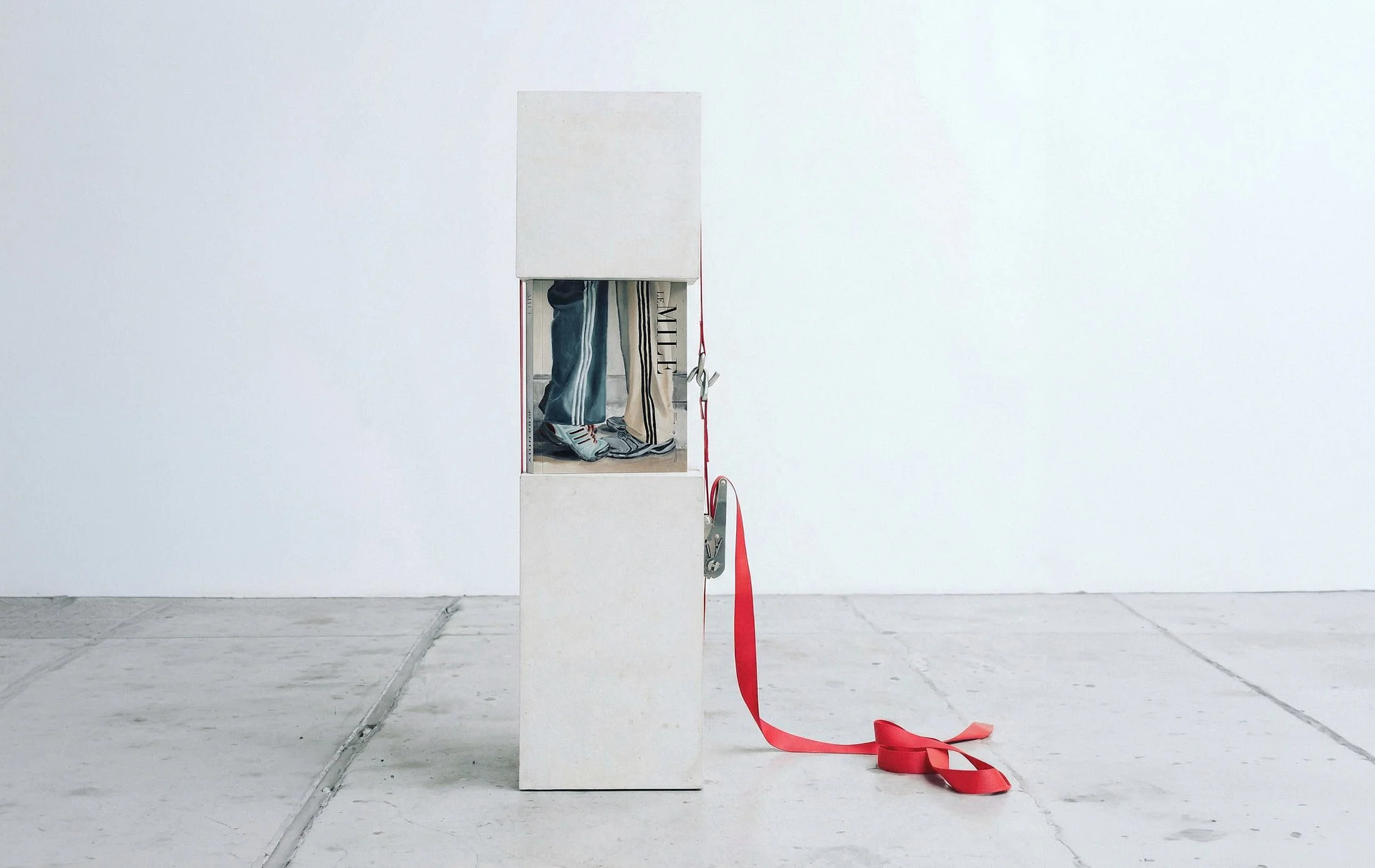
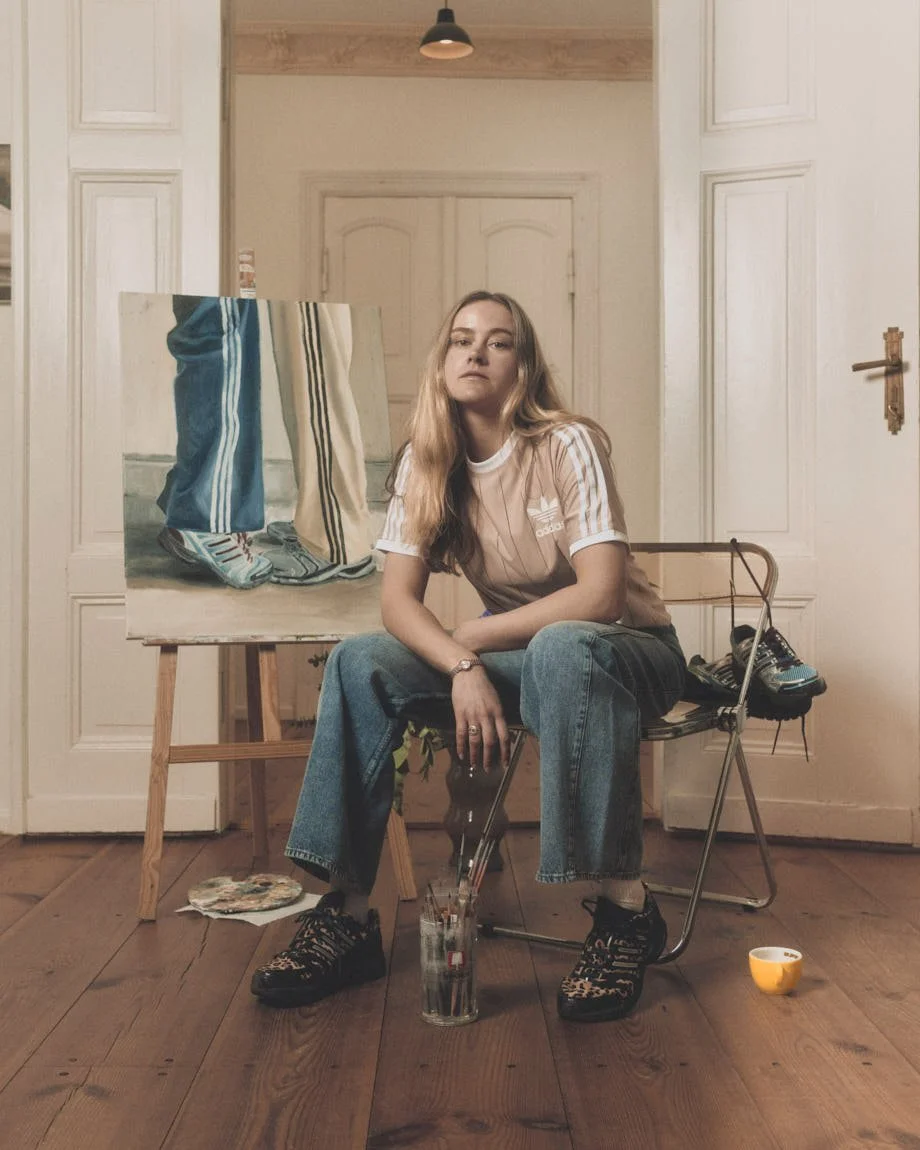
Cosima Kaibel first painted Cover for adidas adistar Control 5 with LE MILE Magazine photo Nicolai Sauer magazine identity issue 40 ss26 Alban E. Smajli Albina Imeri

leather bomber jacket by ESRA VON KORNATZKI


A tracksuit can signal attitude, nostalgia, irony or intimacy depending on how it is framed. Adidas has quietly become part of the visual language through which contemporary identity is read and expressed.

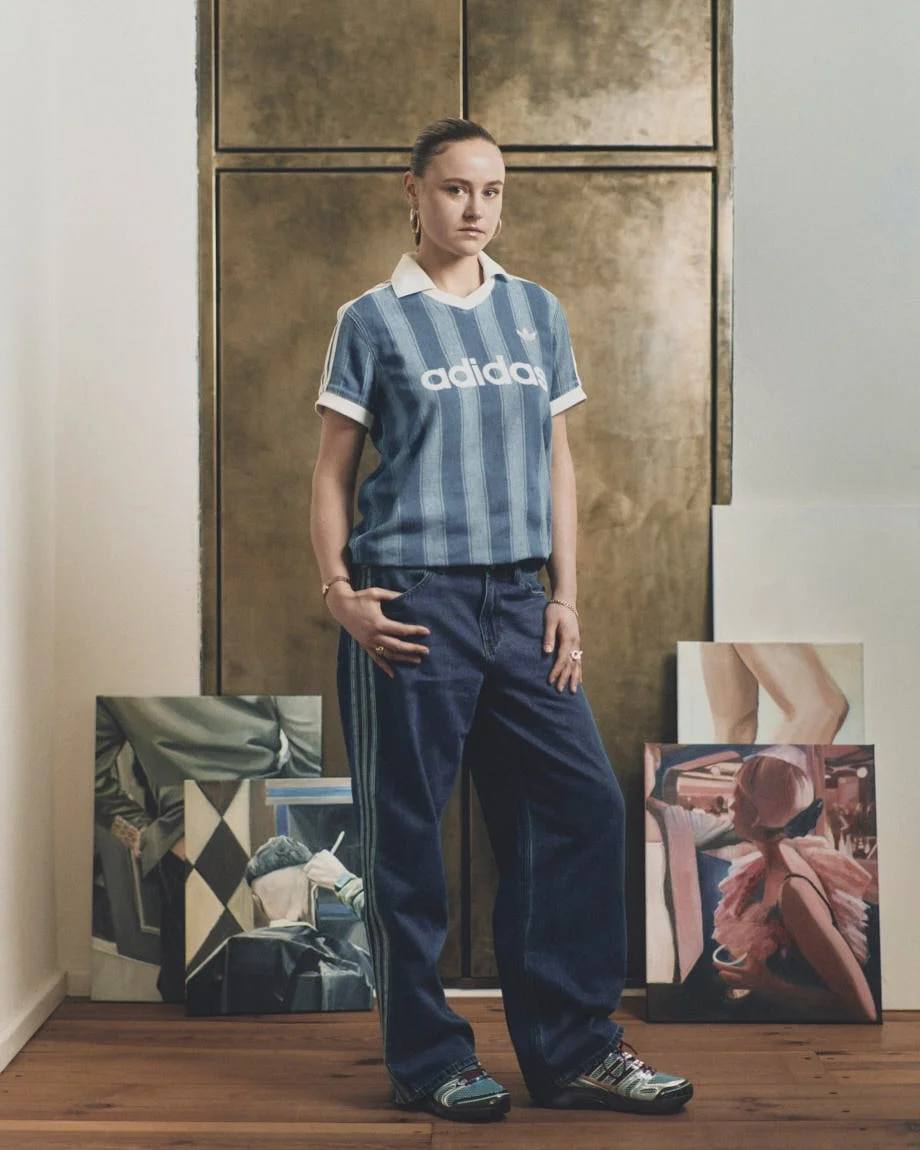
Berlin-based artist Cosima Kaibel approaches this language from within the environment that shaped her. After years abroad, she returned to Berlin, where her work continues to circle around Neukölln and the subtle social codes embedded in everyday scenes.

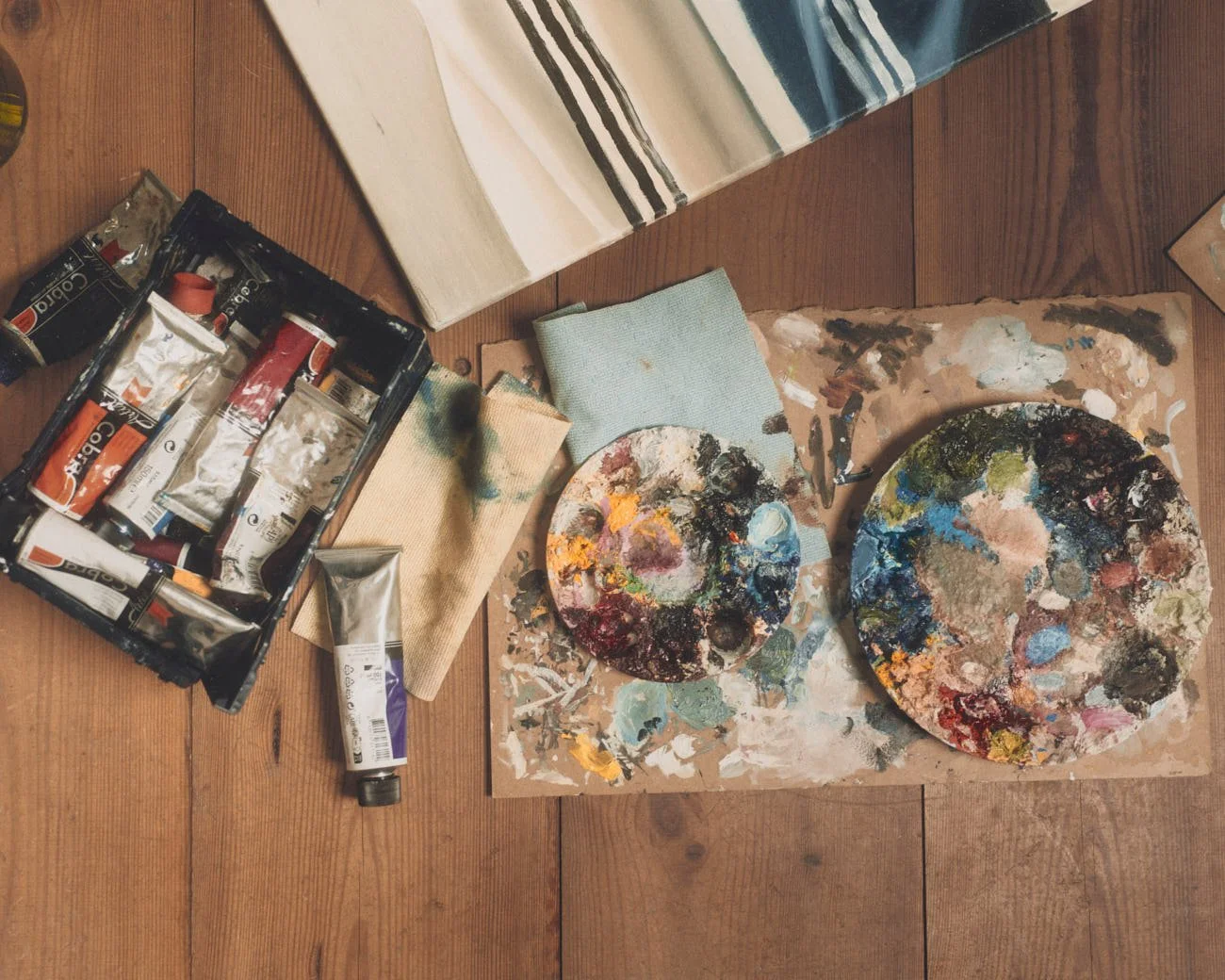
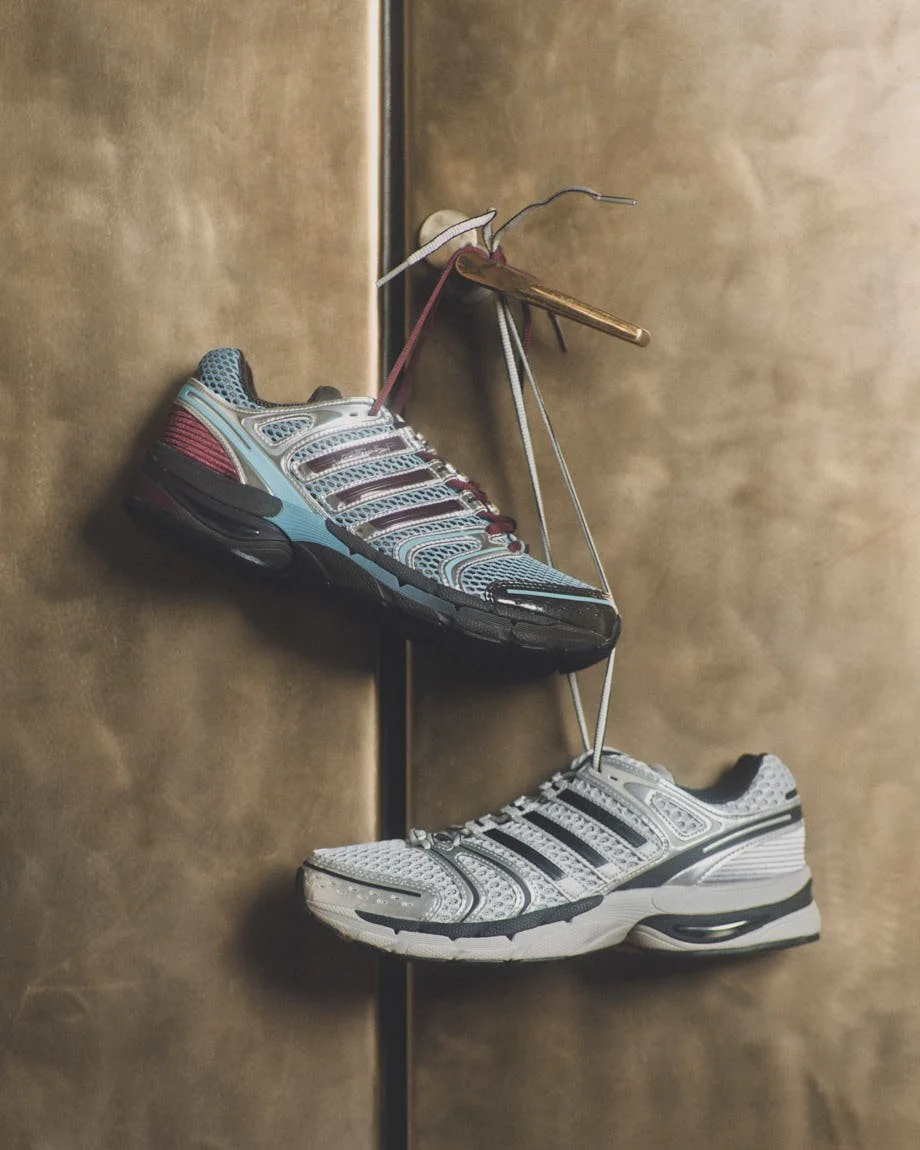
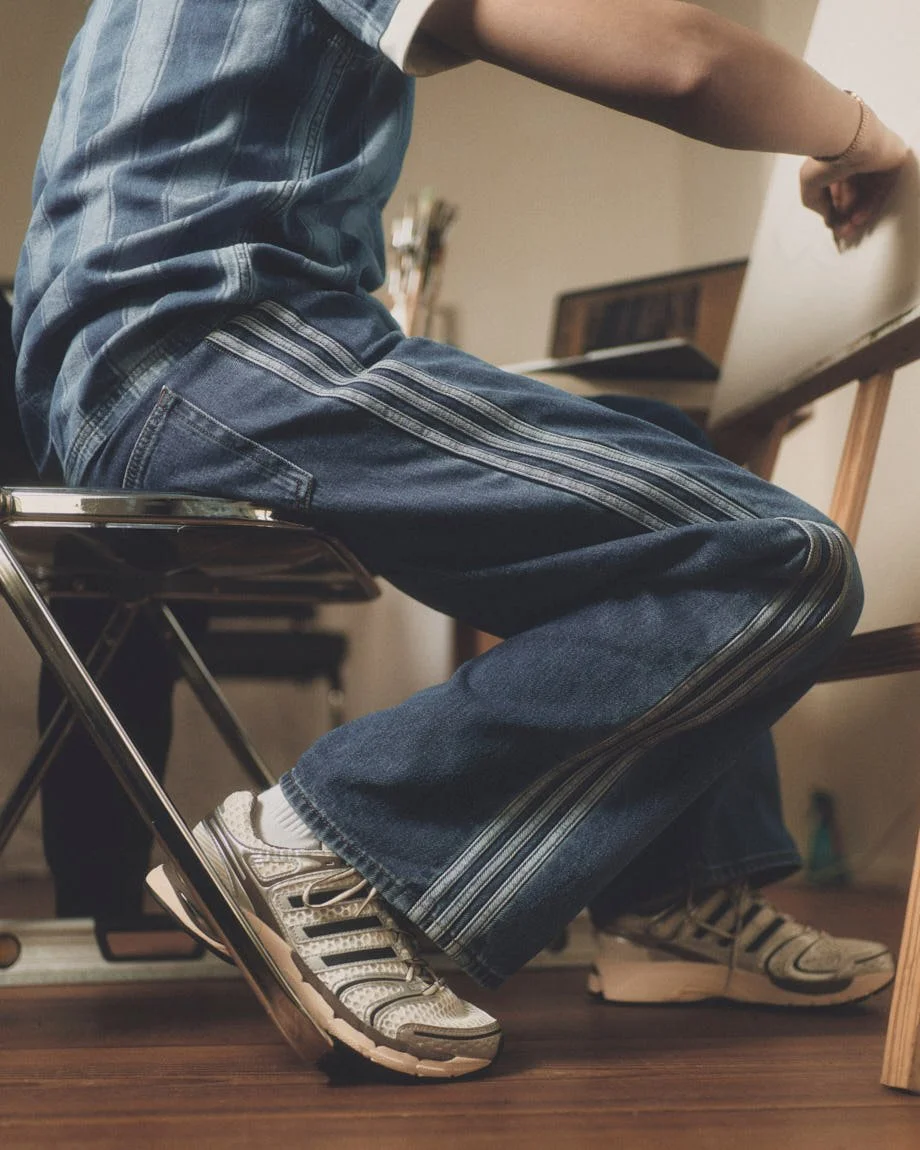
For this collaboration with Adidas, Kaibel condenses the scene into a fragment where two figures meet, visible only from the legs down, Adidas trousers falling into Adistar Control 5 sneakers as the three stripes trace quiet lines along the bodies. Everything above the frame remains open. Without faces, identity unfolds through posture, fabric and proximity, allowing the viewer to complete the moment while reflecting Kaibel’s wider interest in how bodies are framed and interpreted in contemporary visual culture.

 
Cosima Kaibel first painted Cover for adidas adistar Control 5 with LE MILE Magazine photo Nicolai Sauer magazine identity issue 40 ss26 Alban E. Smajli Albina Imeri
 
Cosima Kaibel first painted Cover for adidas adistar Control 5 with LE MILE Magazine photo Nicolai Sauer magazine identity issue 40 ss26 Alban E. Smajli Albina Imeri
 
Cosima Kaibel first painted Cover for adidas adistar Control 5 with LE MILE Magazine photo Nicolai Sauer magazine identity issue 40 ss26 Alban E. Smajli Albina Imeri
 
 
Cosima Kaibel first painted Cover for adidas adistar Control 5 with LE MILE Magazine photo Nicolai Sauer magazine identity issue 40 ss26 Alban E. Smajli Albina Imeri
 
Cosima Kaibel first painted Cover for adidas adistar Control 5 with LE MILE Magazine photo Nicolai Sauer magazine identity issue 40 ss26 Alban E. Smajli Albina Imeri


Alban E. Smajli
You lived in the UK, China, Uruguay, India, France and Italy before coming back to Berlin. Did leaving make you see the city more clearly, and why did you decide to return and paint it again? How does place shape identity for you?

Cosima Kaibel
Leaving and coming back definitely changed my perspective on the city. It made it feel much more like home. Exploring different places made me realize what’s special about Berlin to me and see the magic in things I thought were normal before, like the mix of cultures on Sonnenallee or the Queer culture here, the rough down-to-earth attitude of Berliners and the way all of these shape the whole energy of the city. Seeing things that are different helped me realize that there is no universal ‘normal’, but that ‘normal’ is always relative. That was freeing.

I believe that places are a big part of identity. They determine our experiences, what we learn, what we see, values people hold up around us. All of that eventually shapes who we become. Even if you try to live in your own bubble, you still move through streets, hear languages, deal with people. That does something to you, even if it means rejecting your direct environment. Traveling made me realize how much I do identify as a Berliner, if not a Neuköllner. (44 Represents! - That’s the number of the part of the district where my school was.)

Painting scenes from the city and my district is a way for me to show my appreciation for this place and the things it stands for in my view. I paint it because it formed me. 


What does identity mean to you right now?

To me identity means knowing who I am, which is rather an ongoing process than a fixed definition. It’s about understanding what matters to you and why. When I look at the people and places I grew up with, I understand myself better. Shared experiences stick. School friends, old memories, stupid stories you still laugh about - that creates belonging. Even if everyone came from different backgrounds and went in different directions later on.
Identity isn’t just how you see yourself. It’s also who you experienced things together with. I’m also interested in how identity is performed.
Through clothes, posture, the way someone stands or moves. You don’t just have an identity - you show it. Sometimes consciously, sometimes not. That’s something I explore in my Neukölln series and in my newer series „Anything Butt Dates“ - Bodies carry projection, control, vulnerability, stories, and power. 


For our first ever painted cover, you decided to show only the lower body, from the thighs down. Why did you leave out the faces? What changes when identity is told through posture, fabric and sneakers?

Omitting faces is something I often do in my work, because they often don’t matter for what I want to show. Posture, fabric and sneakers are carriers of cultural meaning and stories. A tracksuit, for example, is never just sportswear; in Neukölln it becomes part of a shared visual language. When faces disappear, the image becomes less about “this person” and more about structures: belonging, subculture, class, gender expression - which is what I’m more interested in, when I choose to paint this way.
At the same time, leaving out faces creates space for projection. The viewer completes the image, fills in what is missing, invents a story beyond the frame. I’m interested in that openness. I don’t want to over-explain or resolve everything. I want to provoke a certain unresolved tension, a friction that keeps the image alive. 


watch the making of
/ directed and filmed by FURKAN CETIN


And what do you imagine is happening beyond what we see (We only see part of the scene and everything above the frame is open)? Is that anonymity protective, political or simply poetic for you?

For me, it’s just a love scene. Two people kissing. Whether they’re men, women, or something else doesn’t matter. If that becomes political, that says more about society than about the image.


Also, in general I like to omit details in the stories I write and the images I create, when they’re not necessary. In this image it’s about two people in a moment of affection. It doesn’t matter which gender they identify with or what skin color they have. I also find it boring to be too explicit.
In “Anything Butt Dates,” anonymity has a protective dimension. The project deals with male bodies as carriers of social role models, beauty ideals, and power structures, but also as vulnerable and relational beings. In a digital culture shaped by dating apps and photographic self-exposure, the act of showing and withholding becomes charged. Omitting details protects the privacy of the models and shifts attention to the politics of the gaze itself. 


When you paint Adidas, do you think of it as a brand, or more as a shared cultural code for your generation?

Both - but primarily as a cultural code. In Neukölln, certain brands function almost like dialects. A three-stripe tracksuit carries references to migration histories, masculinity, street culture, aspiration. It can signal belonging or stereotype at the same time. I’m interested in that ambiguity. When I paint something like that, I’m not advertising a brand - I’m painting a social symbol. It’s similar to how Renaissance painters depicted fabric folds to signify status. Today, a tracksuit can communicate just as much.

That’s also why, in the painting with the tracksuit, I gave so much attention and care to the material itself. I treated it with a kind of tenderness - to show the texture, the shine, the weight of the fabric. By rendering it with that level of detail and affection, I elevate something often dismissed as ordinary or stereotypical and show how it carries dignity, complexity, and beauty. Even if the cover isn’t officially part of the Neukölln series, it speaks the same language.
Cropped bodies, sneakers close to each other, stripes running down the legs. You don’t see faces but you immediately read identity, generation, intimacy. Clothes tell the story.

In this image, the brand almost disappears.
The stripes become lines connecting the bodies.
It’s less about a logo, more about proximity and shared code.


Cosima Kaibel first painted Cover for adidas adistar Control 5 with LE MILE Magazine photo Nicolai Sauer magazine identity issue 40 ss26 Alban E. Smajli Albina Imeri
 
 
Cosima Kaibel first painted Cover for adidas adistar Control 5 with LE MILE Magazine photo Nicolai Sauer magazine identity issue 40 ss26 Alban E. Smajli Albina Imeri


You’ve often explored who is looking and who is being seen (especially in your series "Anything Butt Dates"). In this cover, without faces, who really holds the power of the image?

Me and the viewer. The models I work with agree to be directed by me. That way I create the image but every viewer has their own experience with it. They can notice different aspects of it and are free to let their own imagination interpret and judge it. It’s something that’s out of my control. Once I let an image go, it’s with everyone who sees it.


What does a typical day in your studio look like right now, and what kinds of images or moments in everyday life tend to catch your attention?

Sometimes I lock myself in, put on music, and paint for hours without talking to anyone. Other times I invite friends over. I like noise in the background and life happening while I work. I also host events here. Art shouldn’t sit in a white cube pretending it’s above everything. It’s part of society. So people come, we talk, we argue, we drink, we think.
Some days I feel like I have to go outside. Walk around. Call people. See what’s changing. Other days I don’t leave until something on the canvas finally makes sense. The beginning of a painting is usually messy, vague, like trying to remember a dream. I often don’t know what I think until I paint it. Sometimes I photograph models, sometimes I sculpt, sometimes I write. I like having a plan - and then ignoring it. Structure is good. Something to push against.

I’m drawn to things that feel slightly off. An old car overloaded with watermelons. Trash on the street, a bridal shop next to a men’s café, a male butt. Things people don’t consider “important” are usually the most interesting. They carry more story than they admit.


There is often a quiet tension in your work, between glamour and absurdity, closeness and distance. Where does that tension sit in this cover motif?

I think, in a sense, it has something voyeuristic about it, although there is nothing explicit and it’s entirely anonymous. However, it’s not me who is to judge. If I wanted to explain everything in words, I wouldn’t paint. I think the tension exists because something remains unresolved, and that’s where an image begins to breathe.

 
Cosima Kaibel first painted Cover for adidas adistar Control 5 with LE MILE Magazine photo Nicolai Sauer magazine identity issue 40 ss26 Alban E. Smajli Albina Imeri
 
 
Cosima Kaibel first painted Cover for adidas adistar Control 5 with LE MILE Magazine photo Nicolai Sauer magazine identity issue 40 ss26 Alban E. Smajli Albina Imeri
 
Cosima Kaibel first painted Cover for adidas adistar Control 5 with LE MILE Magazine photo Nicolai Sauer magazine identity issue 40 ss26 Alban E. Smajli Albina Imeri


Has growing up in Berlin shaped your sense of humor and irony in your work?

Berlin has a very specific dryness.
If you don’t develop a sense of humor here, you won’t last long. So you learn to laugh at things, including yourself. People will insult you and help you in the same breath. You either learn to find that funny or you suffer.
In Berlin, a grandmother might yell at someone in Arabic while two queer guys in crop tops walk past at 8 a.m. after a club night. No one blinks. That coexistence shapes your humor. You stop taking a lot of things seriously.

I use humor as a way in. Otherwise people shut down. I’m not interested in moralizing or lecturing people. I’d rather make them look twice.


What are you curious about exploring next in your practice?

When I was painting places, I was already dealing with power. Space shows you everything: Who takes it, who avoids it, who feels safe, who doesn’t.
A city isn’t neutral, it reflects how we live together.
Now I’m focusing more on bodies. But it’s the same question. Bodies are also shaped by power, by media, by art history, by what was idealized and what was excluded. The way we’ve learned to look at bodies affects how we look at ourselves and others, how we interact, how we judge, how much space we believe we’re supposed to take up and where.

In that sense I’m not really changing the topic, I’m just zooming in.


seen NICOLAI SAUER
styled + fashion editor KLAAS HAMMER
make up + hair LEO STERN
talent COSIMA KAIBEL
male model MERLIN FINN BARBER
head of production ALBAN E. SMAJLI
production LEMILESTUDIOS
film + direction FURKAN CETIN
in collaboration with adidas

ESRA VON KORNATZKI *Developing Garments from Existing Materials and Process

ESRA VON KORNATZKI *Developing Garments from Existing Materials and Process

Esra von Kornatzki Works with Worn Materials and Fixed Surfaces in Contemporary Fashion


interview + written SARAH ARENDTS
seen JULIAN MELZER


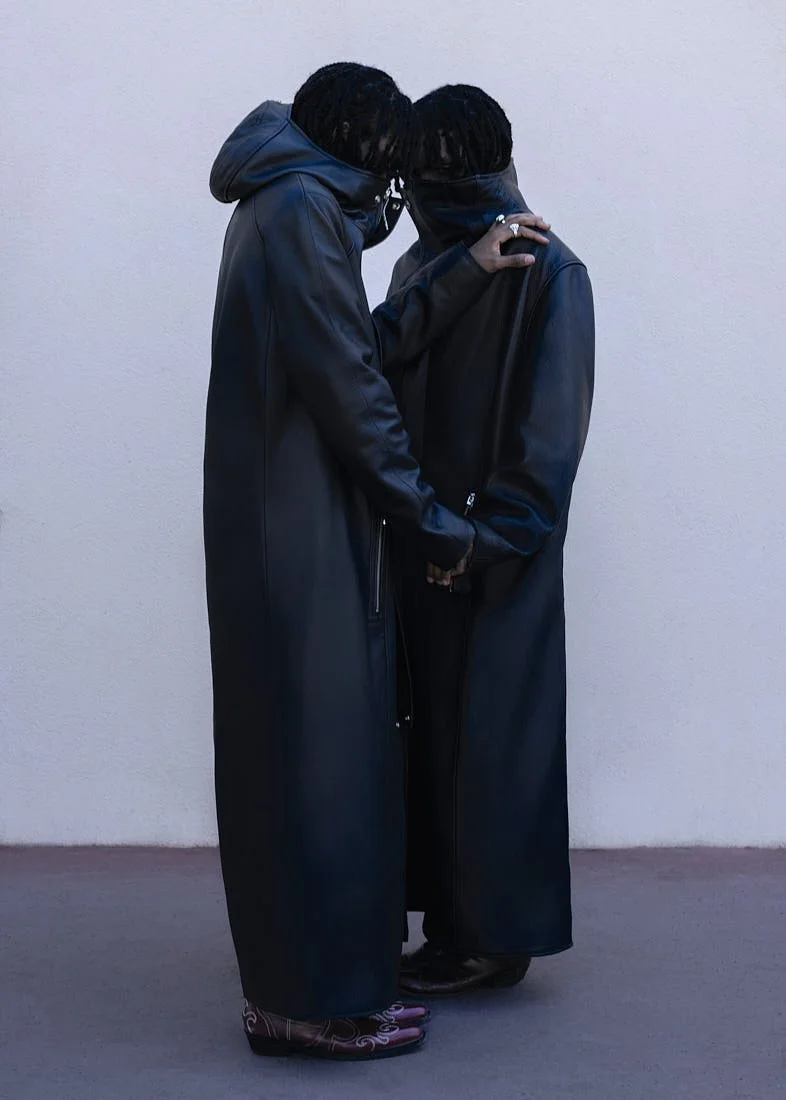
Esra von Kornatzki is a Berlin-based designer whose work develops from a background in sculpture and fine art studies at Universität der Künste. Her focus lies in constructing garments directly on and for the body, using methods that stem from mold-making, draping and surface treatment. Pattern cutting functions as a way of shaping the body, with each piece defined through proportion, weight and material resistance.


Esra von Kornatzki LE MILE Magazine photo Julian Melzer

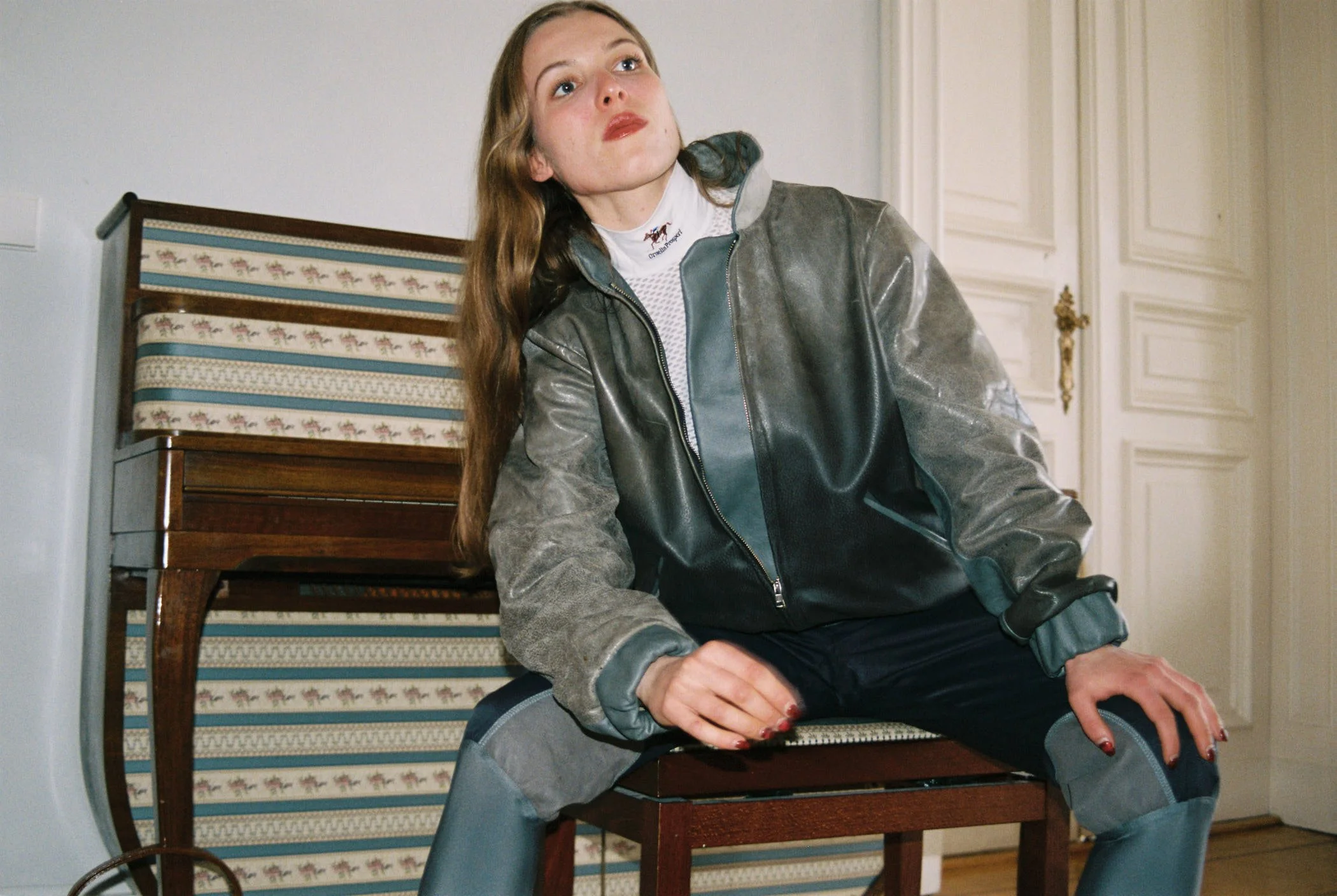
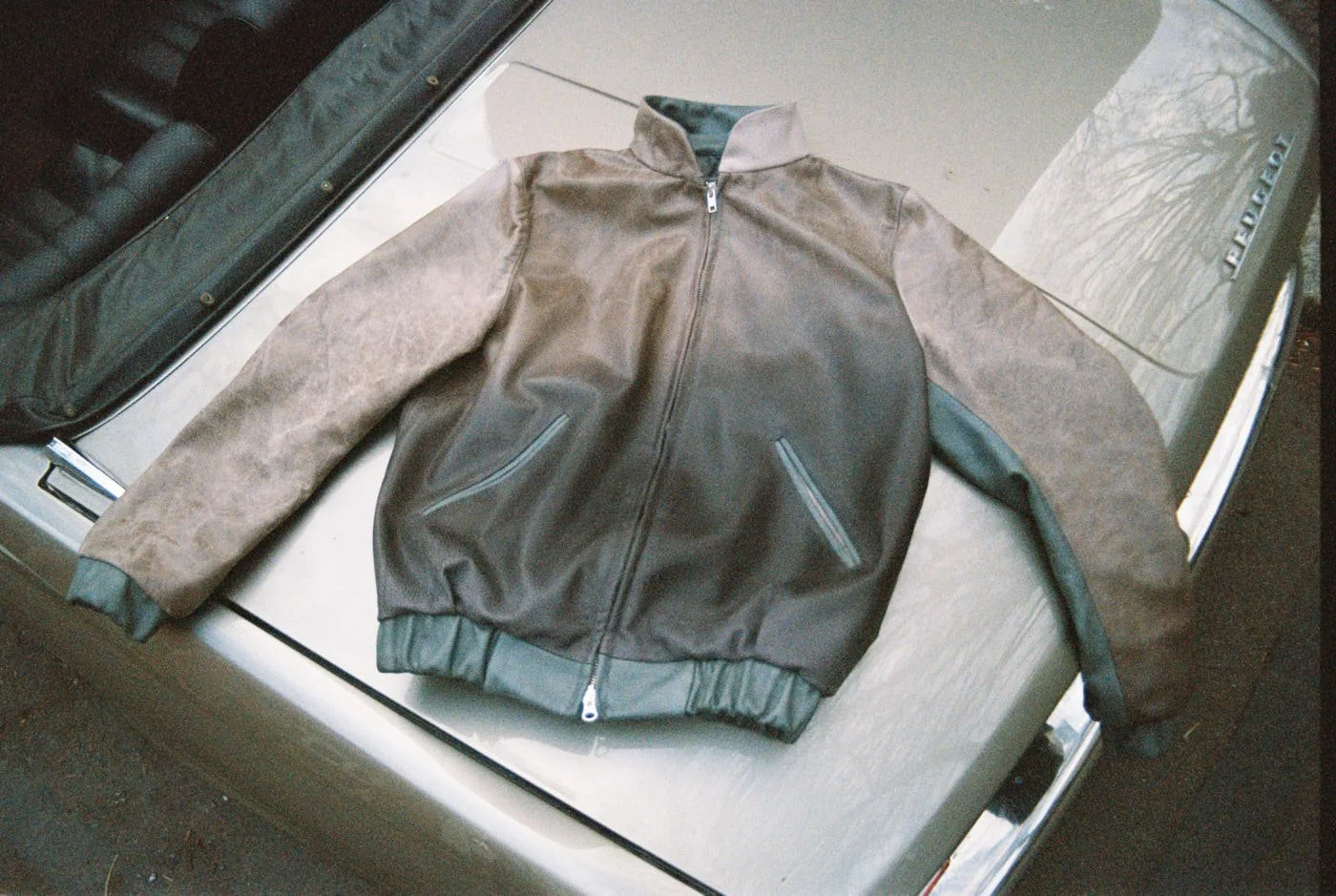
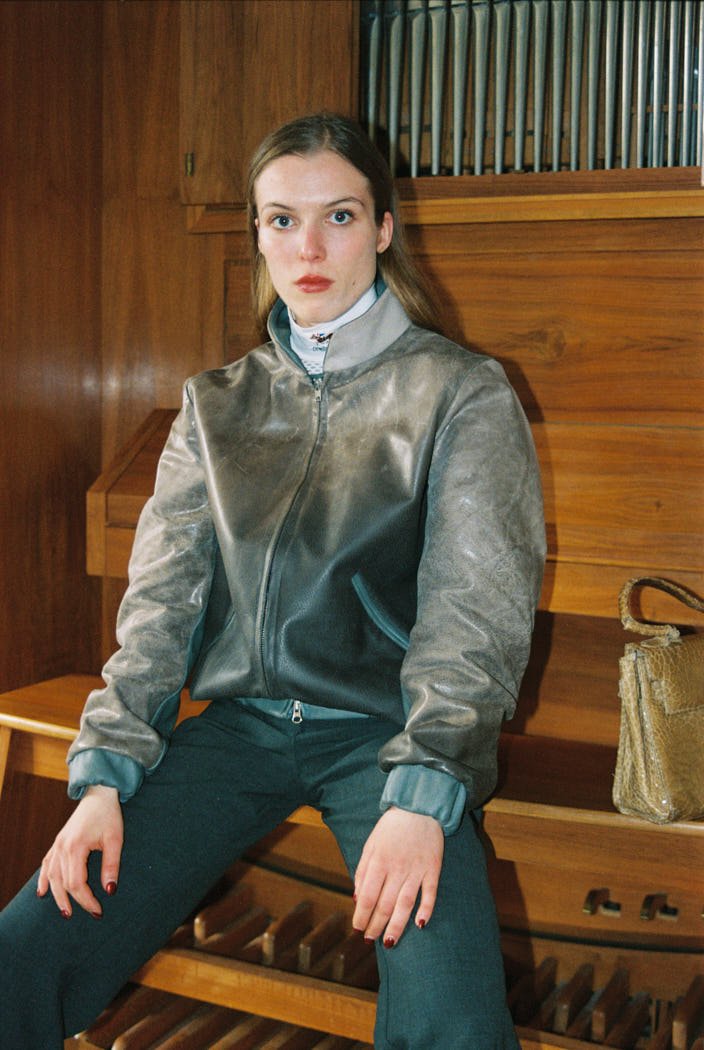
leather bomber jacket by ESRA VON KORNATZKI


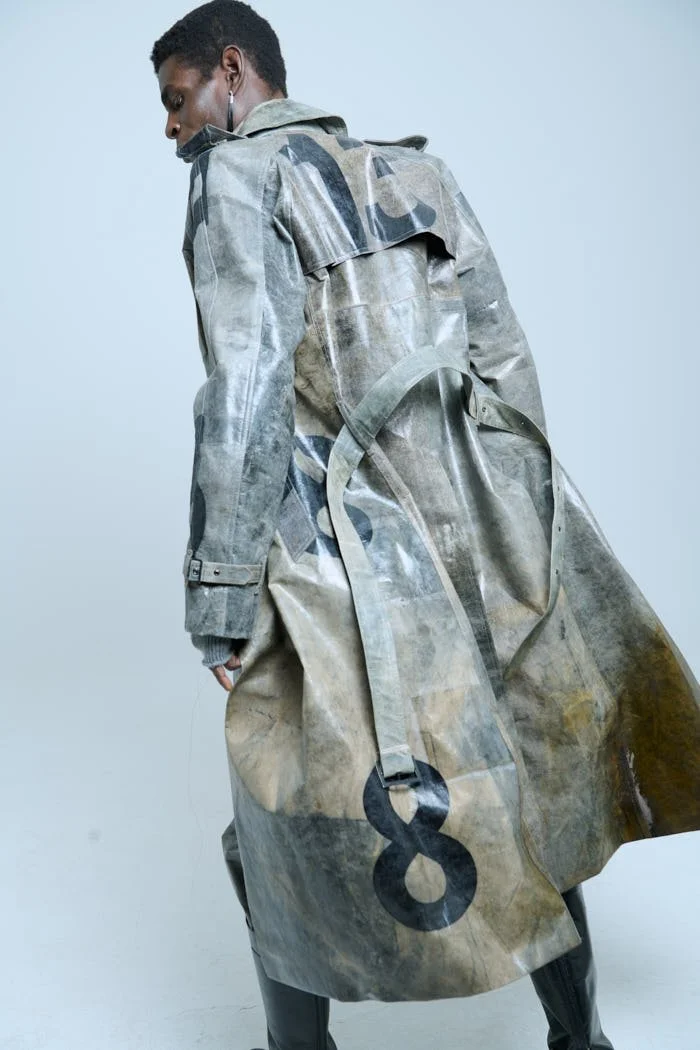
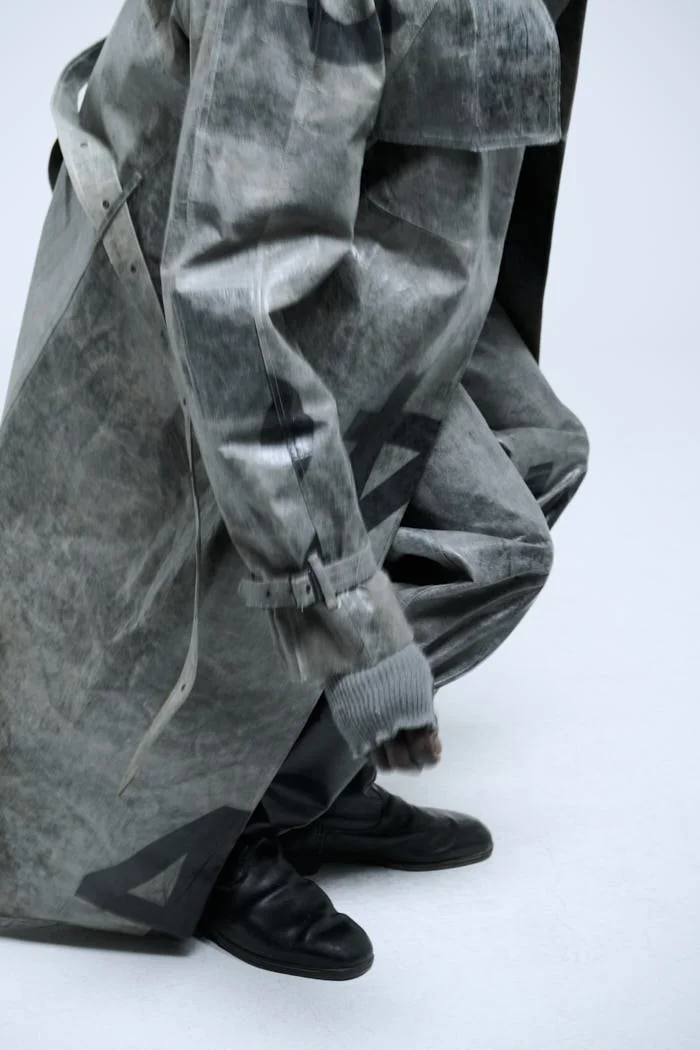
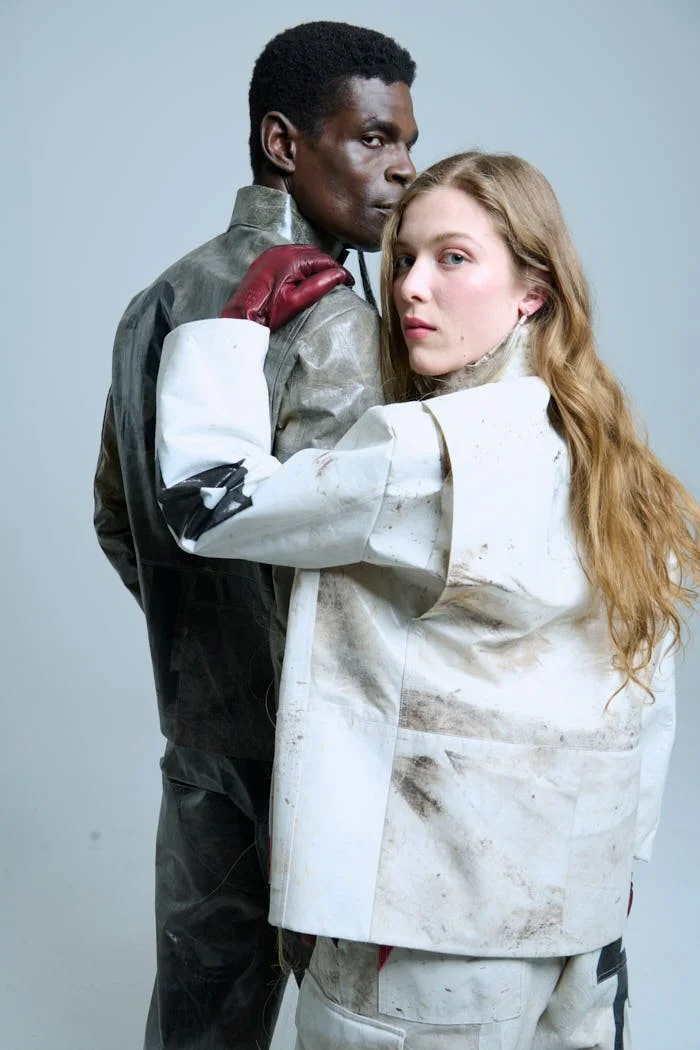
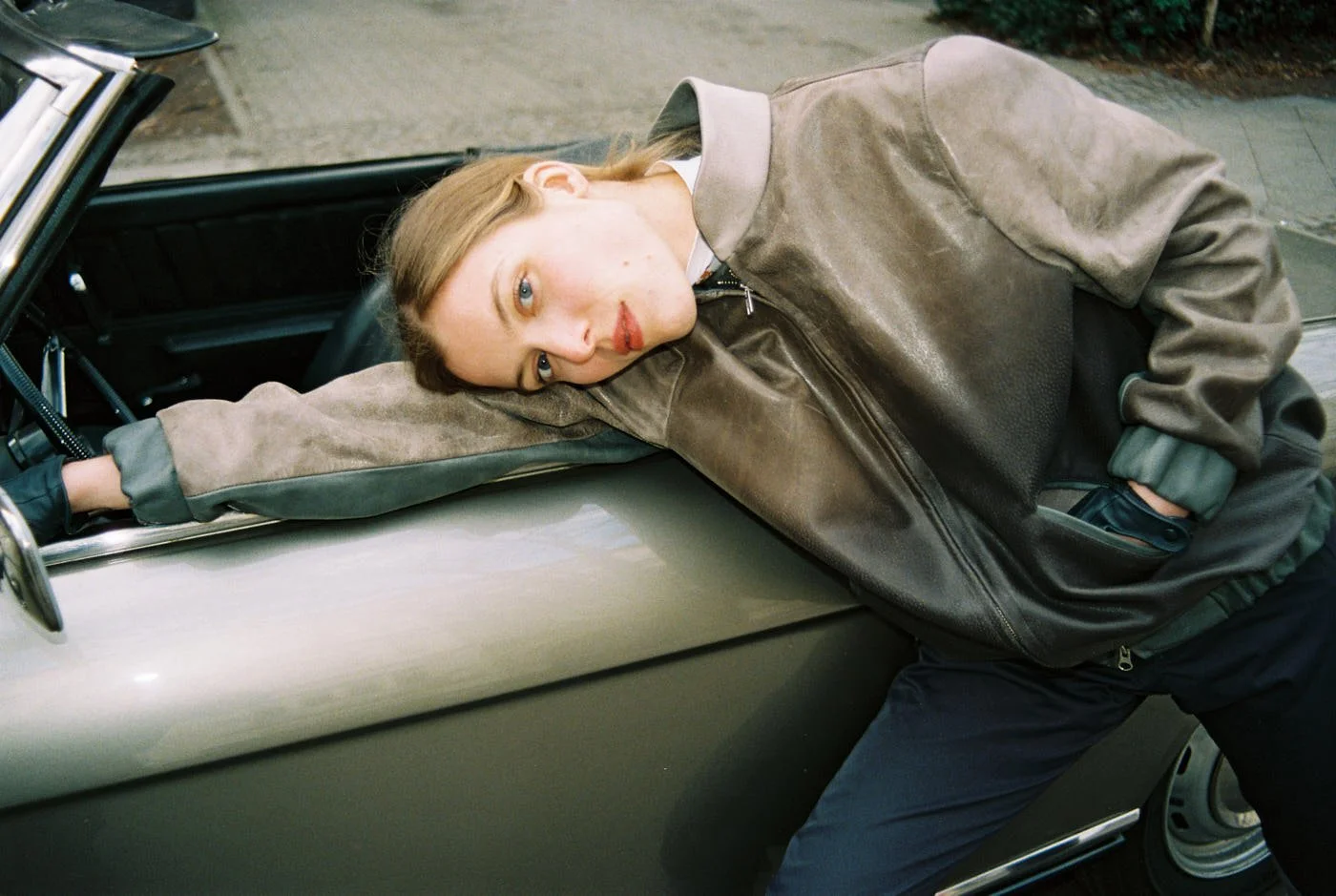
She uses existing materials such as discarded leather, inherited fabrics and used saddle blankets sourced from racetracks. These materials are chosen for their surface condition and durability. Signs of wear such as creases, dirt, sweat or discolouration are not removed. Instead, they are fixed into the garment through technical processes. Saddle blankets, for example, are treated with a water-based transfer glue, silk-screen printed and then fused with a transparent foil using heat, sealing the surface and preserving the traces underneath.

Esra von Kornatzki works directly with the material rather than outsourcing production, allowing the properties of each fabric to influence the final shape. Many of the materials resist standard sewing techniques, which results in firm, structured silhouettes.

Her parallel involvement in horse racing informs the way she works with time and preparation. Materials often come from that environment, and the process of developing a garment follows a similar logic of pacing and control. The garments retain visible information about their origin and a sofa becomes a bomber jacket, saddle blankets become coats and trousers. The previous use remains present through the surface, while the function changes through construction.

 
Esra von Kornatzki LE MILE Magazine photo Julian Melzer

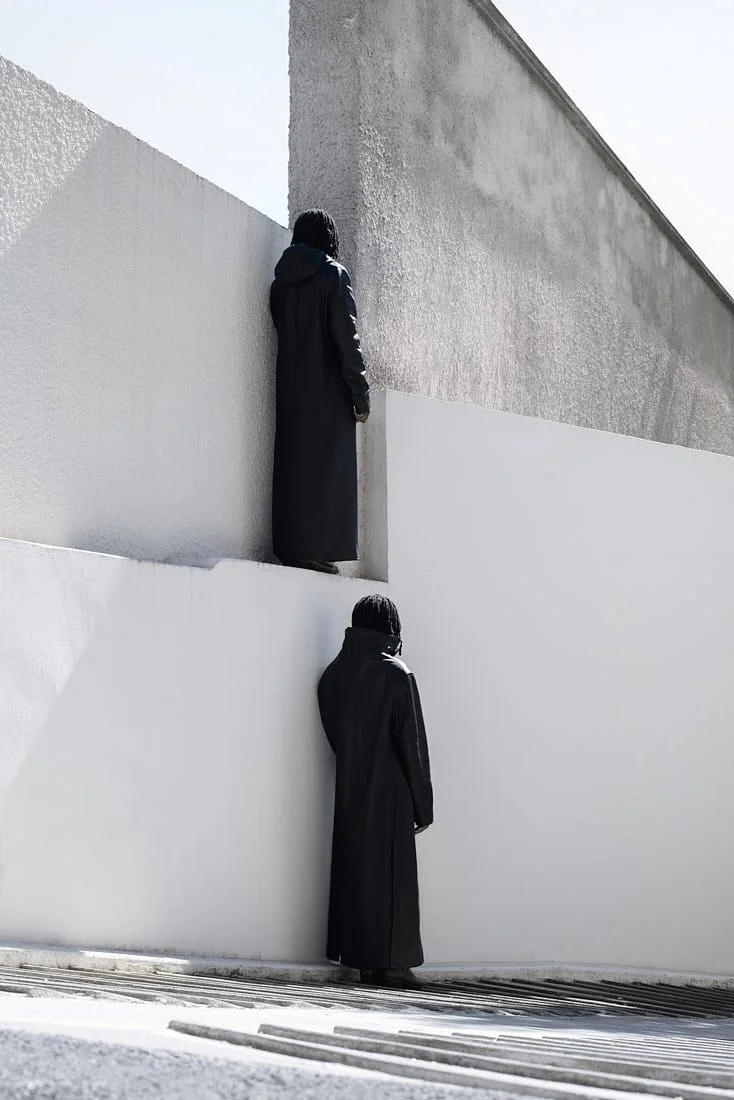
Sekou is wearing a trenchcoat from ESRA VON KORNATZKI, GDR military boots from FASHION ARCHIVE, and knitted gloves from FASHION ARCHIVE

Esra von Kornatzki LE MILE Magazine photo Julian Melzer
 
Esra von Kornatzki LE MILE Magazine photo Julian Melzer

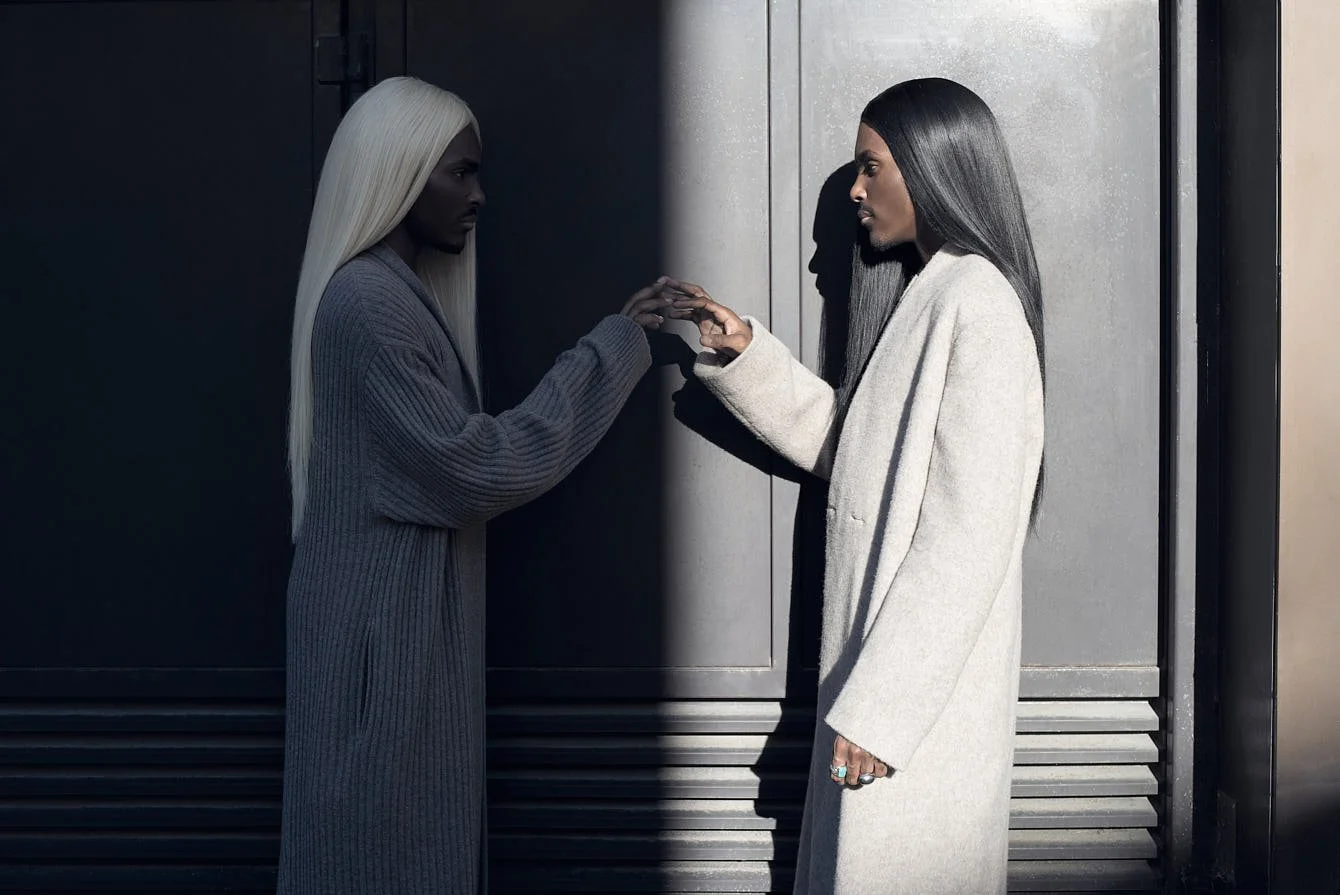
Sekou is wearing a grey suit, and Esra is wearing a white suit from ESRA VON KORNATZKI and red leather gloves from MAISON MARGIELA


Sarah Arendts
What led you from sculpture into fashion design?

Esra von Kornatzki
Sculpture has a tendency to be very removed from the body, an object in space, but I wanted to get closer to the human body and have that as my point of reference. Fashion design feels more urgent and relatable, as it implies everyday usage and thus becomes part of a new physical reality rather than something to look at. There is an intense, passionate relationship between people and their clothes that I find compelling. 


How does your fine art training influence the way you construct garments?

My background in fine art shapes the way I look at and construct garments. My studies were conceptual and that translates into the way I approach fashion design. There is the symbolic meaning a material carries but also its physical abilities. My first professor was a sculptor and the second a painter. You will find both influences in the garments I make in the way I stress the three dimensional aspect of clothing, treating the body like a canvas that the clothing wraps around. During my fine art studies I became an expert in mold making. Pattern making and drapage is an extension of that skill, molding the body and changing its properties, using the garment as a medium. I like to transform the fabrics and materials I find, treating the surface using dye and methods of coating like laminating. I tend to work with stubborn materials that resist being sown, but it gives them their strong sculptural quality and firmness in the silhouettes. 


What role does manual work play in your process? 

I think through making. That’s another reason why I place so much value on craftsmanship, which has always caused some residual tension between me and my conceptual art training. But I think of this tension as a strength and driving force, it's part of my identity as an artist and designer. As a designer I don’t like handing over the production part of the design process. Technology has detached many from manual work and I think certain ideas and refinement gets lost in this disconnect. For example, the stubbornness of the material I work with pushes me to find creative solutions and incidentally teaches me to be patient, which definitely hasn’t been my strong suit. I like to joke that I don’t have any impulse control, which can be a source of creative output, but also needs to be channeled carefully. Time is an important factor, manual work takes time, a rare commodity in our society, but something you see and feel, when you wear the garment. For me, manual work is more than a means to an end, it's a dialogue based on the material and the vision of the form it should take. 


What criteria do you use when selecting materials for a piece?

At art university it's a common notion that sculptors have a material fetish and I think it’s true for fashion designers as well. I have this obsession with the physical and symbolic qualities of certain materials that I’m intuitively drawn to and I think that materials age like fine wine. My selection process is a mixture of purpose and chance. I’m a nostalgic 90’s girl. I usually use worn materials, because I love a good story and worn materials are more likely to tell one. It started when my grandmother passed away and I inherited all her fabrics. Oftentimes I know an opportunity, when I see one. For example, I had to rework an old leather sofa for a client, the old leather was too gorgeous (showing off everybody who’s ever sat on it and every sunray that shown on it) to throw away and I came up with a piece, which is the bomber jacket, that suited the thick discarded leather of the sofa. It's the unused potential I see. For the other garments in this editorial, I sourced the material from a racetrack near me, each saddle blanket had been used once on a rainy day, meaning they were full of dirt and sweat, bearing witness to a specific moment in time, which made them interesting to me. However, I knew the material had to be modified in order to become desirable, which led me to coating it. In most cases I look for durability as well, functional, high quality materials that could last a lifetime, even if signs of usage add to their given patina, essentially continuing the story. 


What changes when a worn object like a sofa or saddle blanket is turned into clothing?

The context changes. The original object disappears physically, but remains conceptually present. The new garment gives clues to its origin through traces and marks on its surface, which aren’t immediately decodable for the audience, but felt anyhow by them. 


Esra von Kornatzki LE MILE Magazine photo Julian Melzer

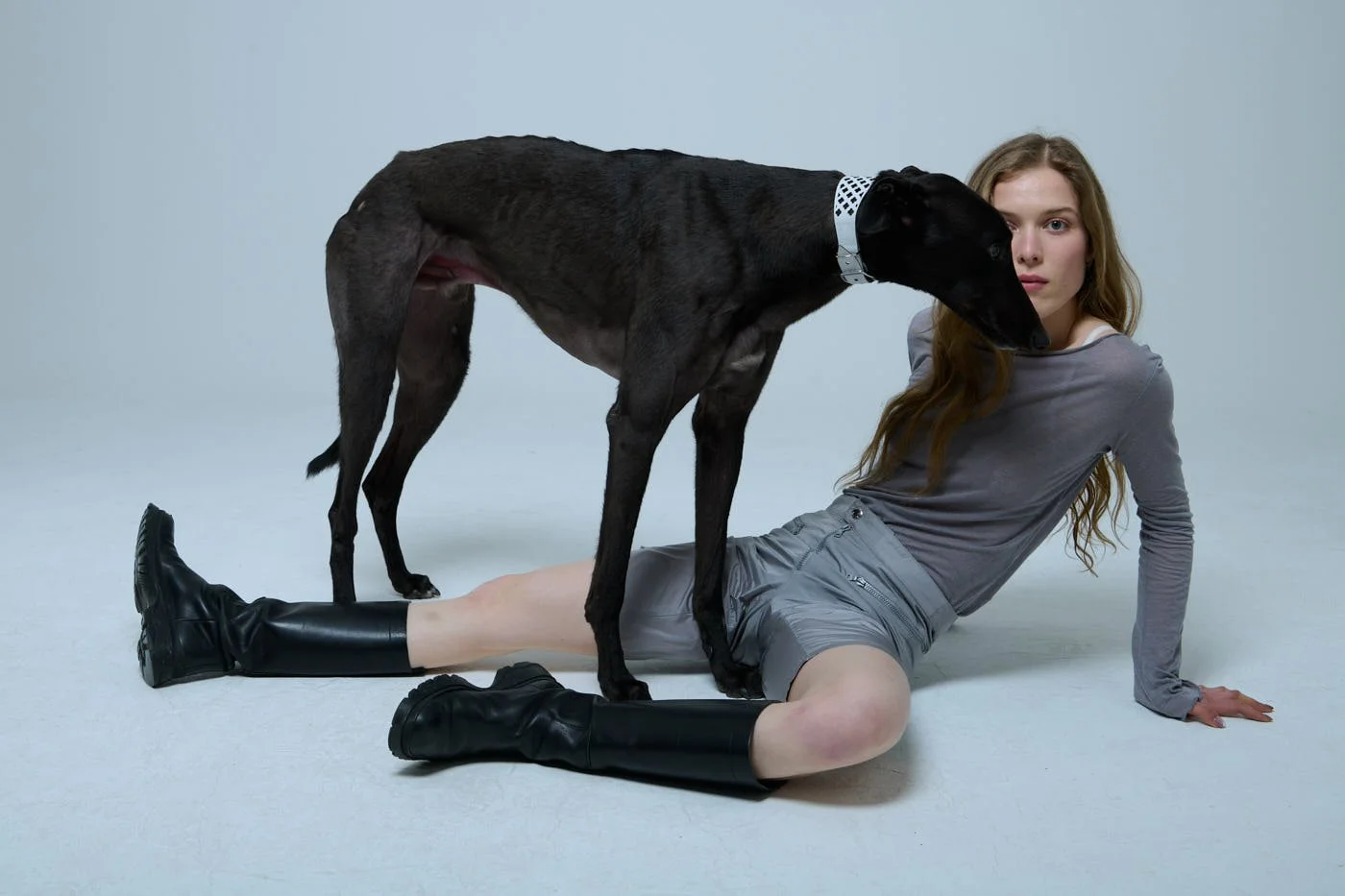
Esra is wearing a top from INTIMISSIMI, nylon shorts and boots from PRADA (via @velvetknife.archive), and Romeo Ultra is wearing a leather collar by ESRA VON KORNATZKI


Esra von Kornatzki LE MILE Magazine photo Julian Melzer

Esra is wearing a top from ORNELLA PROSPERI, a jacket from ESRA VON KORNATZKI, and pants and bag from FASHION ARCHIVE


Esra von Kornatzki LE MILE Magazine photo Julian Melzer

Sekou is wearing jeans from ESRA VON KORNATZKI, gloves and a waist bag from FASHION ARCHIVE


How do you technically preserve traces such as dirt, sweat or hair when coating materials?

For the saddle blankets I used a water based transfer glue (TRANSLAC BOND 55) that I silk screen printed onto the material and then fused with a glossy transparent foil using a heat press at 16o °C, essentially laminating the material and trapping the dirt, sweat and hair underneath.


What information do you want the material to retain once it becomes a garment?

I want the material to retain its history—where it came from, even if in an abstract sense—and its symbolic meaning. I’m interested in what a material carries physically and conceptually, and how that can continue to inform the garment once it is transformed.


How do you position your work within current discussions around material-driven design?

Generally speaking, material does come first in my design process and informs the outcome. I relate to practices like Martin Margiela or even Joseph Beuys, where material isn’t neutral but holds memory and meaning before it becomes form. The material has been exposed to time and happenings, which shape its physical and aesthetic reality, making it a witness and narrating agent. I hold a deep sensitivity for texture, fabric behavior, and tactility. Intuitively exploring and engineering materials while also respecting what they are rather than forcing them to fit a preconceived idea. It's a hybrid practice of a material-led, but conceptually-charged design approach.


What kind of relationship should exist between the garment and the body?

An emotionally charged one - somewhere between love, desire, mystery and comfort. A garment should be an extension of the body and soul. Fashion needs to be felt. My muses that I tailor the garments to, are often people close to me and how I feel about them shapes the garments they inspire me to make. It's another conversation: that between garment and body and I’m in a feedback loop with my muses during the design process in order to modify the garment based on their experience. 


How do you ensure your work is not reduced to sustainability or upcycling?

Sustainability is not my primary motivation. I work with materials sourced outside fashion’s conventional system, rethinking their use and making them desirable for clothes, giving them a stage to tell their own story. The focus is on aesthetic and conceptual value, quality and functionality, as well as sustainability. Although I would describe myself as somewhat of a hoarder, making it a coping mechanism to repurpose materials into polished and clean garments in order to declutter—literally and metaphorically.


What are the next steps for your work within fashion?

To expand the dialogue and deepen the narrative dimension—through collaboration, new contexts, and material experimentation —while exploring accessories as an extension of the practice.


Esra von Kornatzki LE MILE Magazine photo Julian Melzer

Esra is wearing a top from ORNELLA PROSPERI and a jacket from ESRA VON KORNATZKI


photography JULIAN MELZER
designer ESRA VON KORNATZKI
styling XUAN
talent SEKOU + ESRA VON KORNATZKI + ROMEO ULTRA
hair + make up JANETTE PETERS
assistant YEONGHYEON KANG

ELMIENE *That’s How Elmiene Lets Songs Become Someone Else’s

ELMIENE *That’s How Elmiene Lets Songs Become Someone Else’s

That’s How Elmiene Lets Songs Become Someone Else’s


interview + written KLAAS HAMMER


Elmiene proves that the future of neo-soul and contemporary R&B is in good hands. With his gentle voice, smooth production, and emotionally raw, poetic songwriting, the British-Sudanese artist blends modern sounds with a sense of nostalgia. His track “Someday” perfectly captures this signature style.

His rise began unexpectedly when a viral 2021 cover of D’Angelo’s “Untitled (How Does It Feel?)” caught the attention of producer Lil Silva, marking a turning point in his career. Since then, he has released several EPs and standout singles, earning recognition such as a top-five placement in the BBC Sound of 2024 poll and a BRIT Award nomination for Rising Star.

Following a steady stream of releases, including his 2026 single “Reclusive,” Elmiene now offers a first glimpse into the next chapter of his artistry with his debut album „sounds for someone“.


Elmiene photo by Andres Castillo LE MILE Magazine Klaas Hammer

Elmiene / photographed by Andres Castillo

 
Elmiene photo by Andres Castillo LE MILE Magazine Klaas Hammer


Klaas Hammer
The title of your album, “sounds for someone,” feels almost like an open-ended idea as if your music is speaking for or to someone specific. Who is that “someone” to you?

Elmiene
I don’t think it’s ever been one fixed person, you know. The songs feel like they belong to me at first, and then once they’re out, they don’t anymore—they become whoever needs them. So ‘someone’ could be anyone. It could be me at a certain time, it could be someone I’ve loved, or someone I’ve lost. I liked leaving it open, because I want the music to find people where they are, rather than telling them who it’s for.


You were born in Frankfurt, raised in Oxford and have Sudanese roots - three very different cultural spaces. How do these influences show up in your music and shape the way you create?

I think those different places show up more in how I feel than in anything obvious. Growing up in Oxford, I was quite internal, quite observant—I spent a lot of time in my own head, and that definitely shaped how I write. And then Sudan is more like memory and inheritance. It’s family, it’s stories, it’s emotion that’s been passed down. So the music becomes this mix of introspection and legacy—trying to understand what’s mine and what’s been given to me.


Listening to your recent work, there’s a strong sense of intimacy and introspection. What themes or inner tensions were you trying to explore or make sense of in this project? And can you tell us a bit about the recording process behind the album?

This project was me trying to sit with a lot of different emotions at once. I felt lonely sometimes, I felt loved sometimes, I felt guilty, I felt forgiven—it was quite overwhelming at points. A lot of it comes back to love and loss, especially around my dad, and just trying to make sense of memory. I wanted it to be really honest, even in the smallest moments, like zooming in on things that might seem insignificant but actually carry a lot. The recording process was quite instinctive—we weren’t chasing perfection, just trying to capture something real before it disappeared.


Elmiene photo by Andres Castillo LE MILE Magazine Klaas Hammer

Elmiene / photographed by Andres Castillo


When watching you perform, what stands out is not only the warmth and emotion in your voice, but also a very natural stage presence. Did you always feel like the stage was where you belong, or is that something you grew into over time?

I think I grew into it over time. I never really saw myself as someone who was meant to be on stage—it felt quite distant at first. But then I realised performing is just an extension of the song. I’m not trying to be anything different up there, I’m just singing something that means a lot to me. And I think that’s what makes it feel natural now—there’s no performance on top of it, it’s just the feeling.


Your music often feels like a very direct emotional outlet, almost like a diary set to sound. Are there things you find you can only express through music, but not in conversation?

Yeah, definitely. There are things I wouldn’t know how to say in conversation, or maybe I just wouldn’t feel comfortable saying them. With music, you can sit in a feeling without having to explain it or resolve it. You can contradict yourself, you can be vulnerable in a way that doesn’t need to be justified. It’s the only place where I feel like I can be completely honest.


With your family roots in Sudan, a country currently facing significant challenges, how does that reality shape your perspective as an artist? Do you feel a responsibility to reflect or respond to it through your music?

It’s always present in some way. Even when I’m not speaking about it directly, it shapes how I see things—family, identity, everything really. I don’t feel like I have to make explicit statements all the time, but I do feel a responsibility to be honest and to carry that part of me properly. If I’m telling my story truthfully, then Sudan is already in it. And if that resonates with someone or makes them feel seen, then that’s important.


seen by Andres Castillo
talent Elmiene
thanks to Cherry

GIULIO UGOLINI *Want to Learn About Love?

GIULIO UGOLINI *Want to Learn About Love?

Want to Learn About Love? Talk to Him.
*GIULIO UGOLINI


interview + written CHIDOZIE OBASI


Love, ay? We all feel it, think about it, and are hurt by it in one way or another. For 29-year-old lifestyle consultant Giulio Ugolini, this swirling, poignant emotion lays at the crux of his creative journey. But before we dive deep within, let’s look back at his early stints. After a path in political science, Ugolini decided to make his foray into the fashion world during his first year of university. He later modeled for nearly seven years.


LE MILE MAGAZINE Giulio Ugolini podcast Dillo a Giulio photo by Cosimo Buccolieri total look PRADA

Giulio wears a total look by PRADA

 
LE MILE MAGAZINE Giulio Ugolini podcast Dillo a Giulio photo by Cosimo Buccolieri total look PRADA


“I've always found it an interesting job, but simultaneously felt that I was missing something, because other than being able to express the aesthetic side of things I wanted to convey something more,” he says. Beyond the fixtures of the fashion industry, he then got engaged for the first time in 2021, and when he was trying to build a more serene and peaceful life, Ugolini came to terms with the fact that the industry never poured in a fixed economic or mental stability, which led him back to Florence with his girlfriend and study. “I took a master's degree in food and beverage management,” he says. And then, in the middle of the masters, my relationship with this person ended. “It was my first relationship, so with me being a very emotional person and someone with strong feelings, I suffered a lot myself,” he confesses. “Despite everything, I finished my studies and began working as a manager in Florence.”

During such a path, he was taking everything that the past relationship brought along the way. “It didn’t end very well, so I started to expose these shreds of fragility on social media,” he says. “When I started doing it, I saw that a lot of people saw themselves in this pain post-relationship,” he opines. “I saw that the hope within love was always less for most people, and my numbers started growing quite drastically.” But there’s more to the story.

Upon moments of deep introspection and wishful thinking, Ugolini decided to start a soft healing process with a podcast, titled Dillo a Giulio (Italian for ‘Tell Giulio’). “When I chose to embark on this journey, I noticed that love was always seen as an elite element, something only a few people have and that those who work across social media make it look just like a beautiful thing,” he says. “There were never weaknesses or frailties, so I wanted to bring the voices of all the people in order for them to be able to express themselves and tell their stories, to show that love is not always beautiful and that it is made up of more bumps and difficulties than straight lines.”

 
LE MILE MAGAZINE Giulio Ugolini podcast Dillo a Giulio photo by Cosimo Buccolieri total look PRADA

Giulio wears a total look by PRADA

 
LE MILE MAGAZINE Giulio Ugolini podcast Dillo a Giulio photo by Cosimo Buccolieri Giulio wears a coat by TELA, a shirt by MICHAEL KORS, and shorts by THE LATEST

Giulio wears a coat by TELA, a shirt by MICHAEL KORS, and shorts by THE LATEST


The more he went on with it, the more letters came through, marking a point of discernment for the podcaster: “I fully realised that love unites us all,” he tells me, his head tilting with joy. “Everyone's story is different and lives in their own way, but we’re all involved in this great feeling that unites us,” he says. “I’ve seen that people are afraid of showing themselves as fragile and vulnerable, but the moment they show it, they become even stronger than they were before.” Ugolini also understood the importance of freedom of expression within masculinity. “Men shouldn't feel powerless if they show themselves weak in front of others,” he says. “Everything was born from a break-up, and now I consider this format as a guide for all the people who want to state their story.”The podcast currently drops on YouTube, but there’s hope for expansion. “Everything is written and ready to be broadcasted on other platforms, because it's an idea that even listening to it without seeing it conveys a lot,” he says. “In fact, I'm a radio lover for this reason.” Ugolini is also eager to bring the format to the cinema spectrum, as a drama student, because of his curiosity to compare stories of real people to those of movie-related characters.

“The current format is between eleven and eighteen minutes, but I’m hoping to stretch it to perhaps half an hour and invite guests in the podcast such as psychologists and industry people,” he says. Ugolini’s well aware that he doesn’t want to tell anybody how to love. “I don't have a degree in that,” he grins. “I want advice and add tips about stuff I’ve experienced first-hand,” he concludes, adding his willingness to “analyse things in a neutral way, while giving advice that doesn't hurt but uplifts.”


LE MILE MAGAZINE Giulio Ugolini podcast Dillo a Giulio photo by Cosimo Buccolieri Giulio wears a coat by TELA, a shirt by MICHAEL KORS, and shorts by THE LATEST

Giulio wears a coat by TELA, a shirt by MICHAEL KORS, and shorts by THE LATEST


LE MILE MAGAZINE Giulio Ugolini podcast Dillo a Giulio photo by Cosimo Buccolieri Giulio wears a sweater by RANDOM IDENTITIES by Stefano Pilati, a T-shirt by MANUEL RITZ, and pants by HED MAYNER

Giulio wears a sweater by RANDOM IDENTITIES by Stefano Pilati, a T-shirt by MANUEL RITZ, and pants by HED MAYNER


LE MILE MAGAZINE Giulio Ugolini podcast Dillo a Giulio photo by Cosimo Buccolieri Giulio wears a sweater by RANDOM IDENTITIES by Stefano Pilati, a T-shirt by MANUEL RITZ, and pants by HED MAYNER
 

credits
all Images (c) LE MILE
and Cosimo Buccolieri

photography COSIMO BUCCOLIERI via STUDIO REPOSSI
fashion market director + stylist CHIDOZIE OBASI
head of production JESSICA LOVATO
fashion coordinators ALBERTO MICHISANTI + EDWARD PUSCA
make up CHIARA GUIZZETTI via THE GREEN APPLE ITALIA
hair FUJIWARA TAKAHASHI via MKS MILANO
talent GIULIO UGOLINI
photography assistant ANTONIO CROTTI
fashion assistants SIMONA VERNAZZA + ANGELINA PERSIANI + SOFIA FARINA + CHARISSE ORDINARIA + LUIZA ANGELOVA + CHIARA DE BONIS

CHARLOTTE DAY WILSON
 *That Version that Stays Untouched

CHARLOTTE DAY WILSON
 *That Version that Stays Untouched

That Version of Charlotte Day Wilson that Stays Untouched


interview + written ALBAN E. SMAJLI


Charlotte Day Wilson continues to work from a place that remains closely connected to how she began, building songs in isolation and protecting that condition as a necessary part of her process. What started as a private space to explore her voice and identity without interruption still defines how she approaches music, requiring a level of focus where outside noise, expectations, and constant communication are pushed aside in order to reach a state where decisions come from within.


CHARLOTTE DAY WILSON LE MILE Magazine Digital Cover SS26 April Edition Charlotte wears a Vector jacket by CAMPILLO, a shirt and pants by WANGDA, a ring by AGMES, earrings by GRISÉ, and shoes by TWOGAA

Charlotte wears a Vector jacket by CAMPILLO, a shirt and pants by WANGDA, a ring by AGMES, earrings by GRISÉ, and shoes by TWOGAA


For Patchwork, this way of working becomes more deliberate through repetition and revision, moving away from immediacy and toward a process that involves returning to songs multiple times, adjusting details, and testing whether they reach a point that feels fully resolved. Her earlier releases, including CDW, Stone Woman, Alpha, and Cyan Blue, already established a clear direction, but the most significant shift comes through her role as a producer, where growing confidence replaces previous doubt and allows her to define structure, pacing, and final decisions without relying on external validation. This position enables her to recognise that she is best suited to produce her own work, reinforcing a process that remains internally guided.

Collaboration stays part of her process, grounded in ease, mutual awareness, and working with people who know when to contribute and when to step back, creating a space where trust supports the work. Visual elements follow the music, with imagery and clothing developing from its tone, turning style into an extension of her language shaped by identity, perception, and the way she chooses to present herself in public. Her current direction moves toward a more reduced approach, with an interest in creating space within recordings and limiting the number of elements involved, allowing each sound to carry more weight without relying on density. This shift continues the logic that has defined her work so far, refining it through a more concentrated and controlled use of sound.

 
CHARLOTTE DAY WILSON LE MILE Magazine Digital Cover SS26 April Edition Charlotte wears a HELGA womens polo by CALVIN KLEIN COLLECTION and a necklace by GRISÉ

Charlotte wears a HELGA womens polo by CALVIN KLEIN COLLECTION and a necklace by GRISÉ

CHARLOTTE DAY WILSON LE MILE Magazine Digital Cover SS26 April Edition Charlotte wears a HELGA womens polo by CALVIN KLEIN COLLECTION and a necklace by GRISÉ
 
CHARLOTTE DAY WILSON LE MILE Magazine Digital Cover SS26 April Edition Charlotte wears a HELGA womens polo by CALVIN KLEIN COLLECTION, jogging pants by WANGDA, a necklace by GRISÉ, and Moto Boots 1.0 by SUNNI SUNNI

Charlotte wears a HELGA womens polo by CALVIN KLEIN COLLECTION, jogging pants by WANGDA, a necklace by GRISÉ, and Moto Boots 1.0 by SUNNI SUNNI


Alban E. Smajli
Looking back to the moment you started making songs alone in your room, what part of that early creative energy do you still try to protect today?

Charlotte Day Wilson
I think I still try to protect the aloneness of it. The feeling of uninterrupted exploration with oneself. It’s not always easy to truly be alone, even when you are alone. There are always creeping thoughts of other people, other music, texts and emails that need to be responded to, a friend you haven’t checked in on in a while. Tuning out all the noise and finding a flow state where none of that can penetrate your focus and it’s just you and the music.. I always hid who I was from the outside world so music became my sanctuary where I could express and discover myself. I protect that sanctuary with my life because I probably wouldn’t really have one if it weren’t for it.


Did you approach Patchwork differently than your earlier releases?

I approached Patchwork differently than the music I’d recently put out. I went back to the version that I was just talking about in the last question. Really indulging in myself, however long it takes. Deep focus, deep alone-ness, searching for magic and glorious lifts. On Cyan Blue, the approach was “first thought best thought” which was very fun. But this time I reconsidered a lot and repeated and repeated, adding slight variations, until I found the glory. If the glory never came, the song didn’t make the cut.


When you look back at CDW, Stone Woman, Alpha, Cyan Blue, and now Patchwork, what feels like the most important shift in your relationship with music?

I would say the most important shift in my relationship with music is my confidence as a producer. I needed this project to remind myself that I’m good at what I do. I lost the plot many times over the past few years, doubting that what I was making could possibly be good enough. I know now, that not only am I good enough, I am the best producer for my music.


What kind of creative chemistry do you look for when collaborating with artists like Kaytranada, BADBADNOTGOOD, or Saya Gray?

I look for ease. But most of all now, I look for people who empower me and I look for people who I want to empower. So much of the time our greatest critic is ourselves. Sometimes all you need is for someone like Saya to remind you you’re on the right track. A great producer knows when to intervene and when not to. This requires a tame ego, which is not always so present in this industry.


How do you feel when fragments of your music appear in songs by artists like Drake or John Mayer?

I think it’s incredible. Once my music is out in the world it takes on a life of its own and it always amazes me to see the unexpected places it goes.


CHARLOTTE DAY WILSON LE MILE Magazine Digital Cover SS26 April Edition Charlotte wears a jacket by WANGDA, a cropped shirt by CALVIN KLEIN, Arco pants by CAMPILLO, and boots by STONE ISLAND

Charlotte wears a jacket by WANGDA, a cropped shirt by CALVIN KLEIN, Arco pants by CAMPILLO, and boots by STONE ISLAND


CHARLOTTE DAY WILSON LE MILE Magazine Digital Cover SS26 April Edition Charlotte wears a hoodie by STONE ISLAND and a necklace by AGMES

Charlotte wears a uv-reactive hoodie by STONE ISLAND and a necklace by AGMES


CHARLOTTE DAY WILSON LE MILE Magazine Digital Cover SS26 April Edition


If Only” circles around the idea of moments just out of reach. Are there experiences in your life that continue to shape your writing years later?

Yes of course. A lot of the time when I’m writing I don’t even know who or what I’m writing about. I let my subconscious do the talking. Sometimes I won’t even realize until years later what my subconscious was trying to tell me, or what memory I was revisiting. I learn a lot about myself in the unraveling after a song is pulled out of me.


How important is the visual world around your music when you begin shaping a new project?

It’s important but it’s not everything for me. The music can often provide an answer to a visual question but not the other way around.


What role does clothing or style play for you when performing or creating visuals?

Clothing is very important to me. Like music, it’s a language that not everyone speaks. How we present ourselves in public says so much about how we want to connect or not connect with others. I always think about the very human desire to be accepted and I think clothing plays such a huge role in how we can achieve acceptance. I think that’s something a lot of people have a hard time being honest about when it comes to clothing but I know deep down it’s true for so many of us. It’s an expression of gender, of “class”, cultural identity, and the relationship we have between our body and our mind. On the days where I feel tired and lacking in personality, I might try dress better so that even though I’m a dud of a person that day, my odds of acceptance are higher with a nice outfit on. I think when I’m 60 I’ll start dressing without any concern for how my outfits impact others but for now I’m engaged in the social conversation of it all and I find it fun.


When you imagine the next phase after Patchwork, what kind of sonic territory feels exciting or still unexplored for you?

I get excited about the idea of extreme minimalism. Lots of air in a recording, less stacks of sound. I don’t think I’ve quite approached music like that yet and I want to try.


CHARLOTTE DAY WILSON LE MILE Magazine Digital Cover SS26 April Edition Charlotte wears an ASHLEY womens trench by CALVIN KLEIN COLLECTION, a shirt by WANGDA, and earrings by GRISÉ

Charlotte wears an ASHLEY womens trench by CALVIN KLEIN COLLECTION, a shirt by WANGDA, and earrings by GRISÉ


JOSH S. ROSE *on Performance, Movement, and Photographic Observation

JOSH S. ROSE *on Performance, Movement, and Photographic Observation

Technical Romanticism
How Josh S. Rose photographs Performance as a Technical and Human Act


written + interview JONATHAN BERGSTRÖM


Josh S. Rose is a visual artist and storyteller working across photography, film, and writing. His practice brings together visual and performing arts, centering on movement, emotion, and image. Recognized for his collaborations with leading visual artists, choreographers and dance institutions, Rose has built a unique artistic language that captures other art forms, especially performance, as both a technical feat and a deeply human experience, an approach he describes as “technical romanticism.”


Lenio Kaklea / The Birds
Performance documentation at MOCA November 2025
Performer Nefeli Asteriou
seen by Josh S. Rose

courtesy of MOCA

 
Lenio Kaklea The Birds Performance documentation from The Museum of Contemporary Art MOCA November 2025 Performer Nefeli Asteriou Image by Josh Rose courtesy of MOCA LE MILE Magazine


From photographing Lenio Kaklea’s The Birds to developing contemplative series such as Tired and The Standouts, Rose turns his lens toward how bodies move through space, time and social expectation. Whether documenting choreography, tracking the passage of daylight, or observing everyday gestures, his work focuses on the patterns and interactions that shape each moment. In this interview with LE MILE, Rose discusses the trust required to document dance, his approach to experimentation within live performance, and the ways repetition and observation inform his evolving work.


Jonathan Bergström
How did you come to photograph The Birds by Lenio Kaklea?

Josh S. Rose
This is one of those things that happens in a minute, but really over years. Kaklea’s piece was coming to the States for the first time and being performed at the Geffen Contemporary at MOCA. Dimitri Chamblas, a longtime collaborator and prominent choreographer and artist, recommended me to shoot it, as they were looking for someone who could jump in and capture the essence of the piece. Almost every performance I capture happens either with someone I have worked with a lot, or recommended by them. Dance is very personal and needs to be captured with care, but also very technical. The light is always changing, the movement can go from fast to slow and a shape comes and goes very quickly. I’m often seeing it for the first time with the audience. So, I’ve built up the kind of trust over the years that makes me a viable person to explore still photography during a performance like this.

When photographing choreography, what visual moments are you paying attention to?

Most choreographers who design for the stage are thinking about a mix of things: there is the meaning of the piece that is expressed through blocking, movement, shape and the interplay of dancers, but there is also wardrobe, art and lighting that help define that concept. Incredible works, like what Kaklea has created, have other things going on, too. At one point, she had a performer fly a drone and projected the drone’s view to the backdrop of the stage. In another, a trapeze hangs from the ceiling. Chamblas, who I mentioned earlier, does a piece with a giant floating balloon structure above the stage. Los Angeles Dance Project has a piece running that uses artwork from Barbara Kruger.

I often shoot dancers performing in and around art installations. So, I try to understand what it is that is trying to be impressed upon the audience and then heighten or accentuate that. I’m very interested in where the interplay of these elements happen. I like to find compositions within those juxtapositions. It’s like shooting a meteor shower or something. Every shot you take is different and you have to be okay with that and accept that a lot of this is stochastic. You’re in the design, so there is no bad shot. You don’t think in terms of good or bad, but rather in deeper explorations of the meaning of the work. It’s interesting that Kaklea’s piece is called The Birds, since birds are a great example of natural patterns of design. For whatever reason, I am very comfortable in a space like that, if not entirely amazed and inspired by it. I think that excitement and curiosity fuels how I see and shoot.


Lenio Kaklea The Birds Performance documentation from The Museum of Contemporary Art MOCA November 2025 Performer Jaeger Wilkinson in the back Louis Nam Le Van Ho and Amanda Barrio Charmelo Image by Josh Rose courtesy of MOCA LE MILE Magazine

Lenio Kaklea / The Birds
Performance documentation at MOCA November 2025
Performer Jaeger Wilkinson in the back Louis Nam Le Van Ho and Amanda Barrio Charmelo
seen by Josh S. Rose

courtesy of MOCA


How do you balance documenting the work with expressing your own visual style?

My own style is a bit more experimental, or maybe looser, than it is straight documentation. Though when shooting a performance, I make sure I honor the work put into the production. Often what will happen is that I get inspired to try something within any performance and take the time to explore it. Sometimes that is literally two different cameras, but more often it’s a quick idea in between something more formal.

When I am being more expressive in my shooting, I like to experiment with double exposure, filters and often I will mess with the horizon line or find a surprising or unconventional composition. I think of these as tools for emotional expression. I think my visual style is a result of that personal approach, where my own chaotic-curious way of shooting meets the frenetic-emotional nature of dance. When it hits right, I think it sits at the edge of abstraction and that is what makes it beautiful. A certain level of unknown in art is meaningful because it leaves some things to the imagination, plays in the dark and feels wild and free. Often you have to fight against the exactitude of photography to achieve that kind of work.


Let’s talk about Tired. Why did the sun’s passage across the sky feel like the right structure for the project and what did committing to the full arc of daylight reveal that a single moment could not?

Tired is also about movement. But in this case, it is expressed through time. To feel the sun move, not by looking at it but by seeing how it changes something static, seemed like an observation worth pursuing. I became aware while shooting it that I was spinning, or the Earth was spinning with me on it. The interplay of movement here only happens if you sense the sun’s movement, or, in reality, ours. Once that idea entered into the equation, I could no longer see the piece without the narrative element of time.

I think with Tired, the visual is so arresting. This pile of tires is immediately metaphorical. If you look at two shots of it, the movement of the sun is actually hard to notice at first. But that’s what is interesting to me. You have to ask why it’s being duplicated. When you see the difference and focus on the subtleties, that’s when the idea reveals itself. I like an image or series that invites you to explore it. Less immediate, but the potential to reveal more.


You mention the contrast between movement and stationary objects whose purpose is movement. How did that idea guide the project?

I mean, who doesn’t feel a little run over by the wheels of time? Especially these days. This is the flip side of moving, of the revolutions we go through in our lives, of aging. I think we look at tires and think, yeah, that’s me, too - round and round and round. I just wanted to make sure that idea hits you when you look at it. You might have felt a bit of that with just one image, but spread out the images over time and I think it becomes an unavoidable takeaway.


The Standouts Josh S. Rose LE MILE Magazine

The Standouts
seen by Josh S. Rose


“Dance is very personal and needs to be captured with care, but also very technical. The light is always changing, the movement can go from fast to slow and a shape comes and goes very quickly.”

Josh S. Rose speaks with Jonathan Bergström
for LE MILE .Digital


Compared to Tired, The Standouts feels more outward-facing. How did that change your role as an observer?

The Standouts is still me wondering out loud. In that work, I’m the outsider who quietly sits in the shadows and observes the louder, bolder, more assertive animals of the species. In all my photos, I feel like observation is key, but I think what might be felt in The Standouts is perhaps just a little bit more of an opinion. It’s not about all people, which a lot of art strives to be, it’s about a certain kind of person. But we all know this person, we even have a little of them in us, too. It’s not me, but it is something I recognize in me, in all of us. So, I’m observing others, but I’m questioning it inside myself, too.


In The Standouts, you describe behaviors such as running, shopping, and adding flair as efforts to “be more than who we are.” What made you want to examine these actions through this work?

I remember when I came of age and started finding myself at bars in my twenties, one of the things that stood out to me the most was the way people got louder as the night went on. To a point where, late into the night, a guy would just yell at the top of his lungs or a girl would take her top off, or cry performatively in public. It happened every time. And being, let’s just say less outgoing, it always seemed odd, behaviorally. I mean, I’ll be honest, I never liked it. But there’s a phrase, “We often dislike in others what we most dislike in ourselves.”

So, this is how I see people, or at least a subset of people, or subset of ourselves, as striving to be seen, heard and appreciated: look at me. But if I examine it, this is about me not really putting myself out there in that way and wondering about it, observing it, dealing with it.

I should talk about the stretching part. It’s purposefully rudimentary. It is supposed to feel almost clumsily done because it’s meant to show the thinking, the observation, and how when we do endeavor, it’s often less refined than we believe it to be, verging on rude, or abrasive. These are simplistic desires, being big. I’m just sort of anthropomorphizing it, having it over-manifest in them. There’s some Kafka in it.


When working on this series, did you find yourself observing people, culture, or behaviors, or all three at once?

All three are access points when I’m capturing for this series because some displays are more individualistic and others happen culturally. Going to the beach and being on display in a bathing suit is cultural, so is shopping or going to a museum. But running or standing on a wall with your arms outstretched is more of a personal choice that can be behavioral or even just one person’s colorful feather display.


The Standouts Josh S. Rose LE MILE Magazine

The Standouts
seen by Josh S. Rose

 
The Standouts Josh S. Rose LE MILE Magazine

The Standouts
seen by Josh S. Rose


Each of these projects presents endurance in different forms, physical, temporal, and social. Was that connection intentional?

Humans do have to contend with endurance. Doing things over and over again creates patterns and I put myself in positions to observe and shoot these patterns. I think what the question is keying in on is that there is also a human effect from this. I think that what I am often most intent on is how we respond to our need to endure in order to live. I imagine that is coming across in all of this.

Looking across these three bodies of work, what stands out to you now that may have been invisible at the start?

Movement has been a big part of my trajectory as a photographer. A lot of people know me through my dance work. I think what is coming out as my work evolves into series like this is that there is a deeper meaning to movement; there is more to it than the beauty of doing it gracefully. You can do that, but the full spectrum of how we move through life is on display through these works.

Are there any current works or cultural movements in music, film, literature, or art that feel especially inspiring to you at the moment?

I call my work “Technical Romanticism.” It’s an homage to the Romantic painters with whom I most identify as an artist. This was a time in art when artists were making works that captured the human response to the environment around them, with all the emotions and drama that that entailed. This reaction against order, reason and restraint is important in art. It empowers the emotional being and discusses the intersection of world events with its effect on us as human beings. People responding to their environments, it takes many different forms. But all of them feel inspiring to me. That is the direction my curiosity goes when I have a camera in my hands.


Tires Josh S. Rose LE MILE Magazine

Tires
seen by Josh S. Rose


“What is coming out as my work evolves is that there is a deeper meaning to movement; there is more to it than the beauty of doing it gracefully.”

Josh S. Rose speaks with Jonathan Bergström
for LE MILE .Digital


all photography (c) Josh S. Rose

SHAHRAM SADAAT *on Photography, Identity, and Visual Culture

SHAHRAM SADAAT *on Photography, Identity, and Visual Culture

SHAHRAM SADAAT
Catches What Slips Between The Hours


written + interview HANNAH ROSE PRENDERGAST


Some sports aren’t sports at all. And yet, the groceries won’t take themselves in. Every day runs its course, but Shahram Saadat is there for the moment it falters — shut out in the hiss of closing doors. What most overlook, he catches instinctively, letting the absurdity frame itself. Life is so good at this; we rarely bother to notice everyone trying to make it in one trip. For now, you are here.


Photography by Shahram Saadat. Styling by Katie Shaw. Hair by Moe Mukai. Make-up by Stevie Squire. Casting direction by Emma Matell with casting assistance from Oliwia Jancerowicz. Set design by Sophia Willcox. Production by Sophie Hambling. Photo assistance by Dylan Massara with styling assistance from Sorcha Kennedy. Design by Stela Kost. Set assistance by Oliver Bell. Models: Cam, Don, Freddie, Isabella, James, Lian, Patrick, and Sarah.

OOO Shahram Saadat LE MILE Magazine Offline FW25


Hannah Rose Prendergast
How has growing up between British, Iranian, and French cultures shaped your perspective and the relationships you form through the camera?

Shahram Sadaat
I’ve always lived between cultures, surrounded and shaped by them — but never fully belonging to just one. Growing up in different countries with parents from different backgrounds, I picked up pieces of each place: the language, the food, the traditions, the humor. I’ve learned to adapt, to blend in, to understand people from all walks of life. At the same time, I’ve often felt like an outsider, carrying parts of many homes without ever fully settling into one. It’s a strange in-between space, but it’s also where I feel most myself. My identity isn’t tied to one culture or place; it’s made up of all the little things I’ve absorbed along the way.

You staged Target Practice in Norwich in 2022 — a setting far from American gun culture, at least on the surface. What unexpected parallels stood out to you?

Target Practice was part of an ongoing series exploring the social dynamics and demographics of British cities. Each project involved traveling to a new location with a concept in mind, allowing the work to unfold through spontaneous interactions with locals. I found striking similarities: a shared fascination with control, threat, and spectacle, shaped by media, pop culture, and imported imagery.

Working with “real” people rather than actors brought a rawness to the project. Many participants were initially taken aback by the setup, but they quickly leaned into it — adopting poses, expressions, and gestures that revealed both playfulness and deeper social conditioning. It was in these unscripted moments that the tension between reality and performance became most visible.

 
OOO Shahram Saadat LE MILE Magazine Offline FW25


How do you navigate the responsibility of representing a community you’re both part of and apart from?

It means holding a unique and sometimes challenging position: speaking from lived experience while also acknowledging that my perspective may not align perfectly with those who feel deeply rooted in that community. I carry parts of the culture with me — its values, stories, and struggles — but I also observe it from a distance, shaped by my own mixed background and experiences.

This dual position gives me the ability to translate, to bridge, and to connect. At times, it feels like I’m walking a tightrope, trying to honor the culture without claiming to speak for everyone in it. It also gives me a deep sense of responsibility: to listen carefully, reflect honestly, and represent with humility and care.


In both Jogging with Shopping and Out of Office, you explore how wellness and burnout are performed rather than felt. What draws you to these displays of efficiency and exhaustion?

We’re constantly under pressure to live efficiently — eat well, exercise regularly, and never waste a minute. Jogging with Shopping came from observing people in East London, where these expectations collide in everyday life. Society tells us to stay fit, eat healthy, and be productive, but also not to let any of it slow us down. So we merge it all — jogging with shopping bags. It’s a reflection of how wellness and efficiency get tangled, turning even self-care into something performative and rushed.

We’ve learned to wear exhaustion like a medal. In a world that measures worth by output, showing how drained we are becomes a way to prove we’ve tried hard enough, cared enough and pushed far enough. It’s not just something we feel — it’s something we display, hoping our struggle will be seen and, maybe, finally, validated.


How do you think our relationship to images has shifted, especially in the age of AI and visual manipulation?

We’re more skeptical than ever — even real images or videos can feel suspect. At the same time, we’re also more vulnerable to falsehoods, because manipulated content can look so convincing. The line between what’s real and what’s fabricated has blurred, forcing us to question not just what we see but how we decide what to trust. Believability now relies less on what looks true and more on context, source, and critical thinking.

For me, it’s less about exaggeration and more about reflection. Performance and documentationbegin to overlap — you’re not creating the surreal, you’re revealing it. In those moments, thework becomes a mirror, holding up the chaos, contradictions, or humor that already exist. It’sless about inventing absurdity and more about finding clarity within it.


OOO Shahram Saadat LE MILE Magazine Offline FW25


“Machines give us structure in a world that rarely slows down.”

Shahram Sadaat speaks with Hannah Rose Prendergast
for Offline Edition - FW 2025 Nr. 39


How does going cashless change not only how we spend, but how we value ourselves?

When money becomes invisible, transactions feel less personal and more abstract. We’re less aware of what we’re giving up, and that can blur the emotional weight behind our choices. At the same time, with digital payments and financial tracking, our worth can start to feel tied to numbers on a screen — credit scores, spending habits, digital footprints — rather than our real-world character or contributions. In a cashless world, there’s a risk that self-worth becomes more transactional, more measurable, and less human.”


In The Whale (2024), the car wash becomes “a forced moment of respite.” Why do you think we rely on machines to grant us permission to pause?

Machines give us structure in a world that rarely slows down. Notifications stop, timers end, apps tell us to breathe — it’s as if we need external validation to justify rest. In a culture that values constant productivity, a machine’s signal can feel more acceptable than our own intuition. It becomes easier to listen to an app than to our bodies or minds, because we’ve been conditioned to associate rest with guilt — unless it’s scheduled, measured, or approved by something outside ourselves.


What place does Duende hold for you and the wider community?

Duende began as a gallery space and continues today as a publishing platform. Co-run by Sophie Hambling and me for several years, our mission was to showcase emerging artists with a strong emphasis on community and accessibility. As our practices evolved, it became more challenging to maintain a regular exhibition schedule. Duende remains active, though — we continue to participate in international art fairs and publish editions throughout the year, keeping the spirit of the project alive in a more flexible form.

 
OOO Shahram Saadat LE MILE Magazine Offline FW25
 
OOO Shahram Saadat LE MILE Magazine Offline FW25


What makes a compelling lookbook image?

It comes from the everyday — those small, often overlooked moments that carry their own strange poetry. I’m drawn to the idiosyncrasies that naturally unfold: a misplaced object, an awkward gesture, a clashing pattern. These aren’t staged or manufactured — they just are. But when you frame them in a photograph, they take on new weight. You’re not just documenting something mundane; you’re elevating it. You’re exposing its quiet absurdity or beauty. In doing so, you heighten that strange, liberating feeling of who the fuck cares — a kind of irreverence that resists perfection and embraces the mess of real life. It’s not about spectacle; it’s about attention — seeing what’s already there and choosing to care just enough to capture it.

What’s the secret to successful living?

I have no idea. Let me know if you find out!


OOO Shahram Saadat LE MILE Magazine Offline FW25


“When money becomes invisible, self-worth risks becoming transactional.”

Shahram Sadaat speaks with Hannah Rose Prendergast
for Offline Edition - FW 2025 Nr. 39


all photography (c) Shahram Saadat

MIA FINEMAN *Casa Susanna

MIA FINEMAN *Casa Susanna

MIA FINEMAN
Casa Susanna - 160 Ways to Be Seen Without Being Seen


written + interview AMANDA MORTENSON


These days, visibility begins with a screen, curated, uploaded, compressed into metrics before it even has a chance to breathe. The Casa Susanna photographs were born in another tempo. Their images were exchanged by hand, slipped into envelopes, held close. The Metropolitan Museum of Art’s Casa Susanna exhibition opens a door into this quieter visual world, one that sustained a cross-dressing community in 1960s New York long before hashtags or timelines existed.


In that era of strictly defined gender roles, Susanna Valenti and her wife Marie Tornell operated two small resorts in the Catskills. They were modest in size but expansive in purpose—safe havens where guests could arrive as themselves and leave the constraints of their day-to-day identities behind. The gatherings at these resorts and in New York City became a ritual. Cameras were constant companions, tools for recording and for becoming. Each photograph affirmed an identity, captured a gesture, and expanded a shared archive of self-expression.


Andrea Susan (American, 1939–2015)
Donna (Buff/Cynthia) in a navy dress in Susanna and Marie’s, New York City apartment, 1960s, Chromogenic print, 12.9 x 9 cm
Art Gallery of Ontario, Purchase, with funds generously donated by Martha LA McCain, 2015 / Photo ©AGO


The exhibition gathers around 160 works from three major collections—photographs from the Art Gallery of Ontario, from artist Cindy Sherman’s personal holdings, and from The Met’s own collection, gifted by Betsy Wollheim, whose father was part of the Casa Susanna circle. The selection includes chromogenic prints, silver gelatin prints, and Polaroids—the latter a breakthrough technology for this community. Polaroid cameras delivered instant results without the risk of sending film to a commercial lab, a critical safeguard in a time when gender nonconformity could lead to blackmail, arrest, or worse. In their own time, members of Casa Susanna used the term “transvestite” to describe themselves, a word now widely recognized as pejorative. The exhibition uses “cross-dressing” to describe the practice of wearing clothing associated with another gender than one’s daily presentation. The photographs show the kind of femininity these guests aspired to inhabit.

The ideal was deliberate, even nostalgic—rooted in the postwar archetypes found in McCall’s and Ladies’ Home Journal: the well-put-together neighbor, the serene housewife, the respectable matron. In the photographs, every detail—hemline, handbag, hairstyle—becomes a note in the visual composition of that identity. Poses are practiced and drawn from the vocabulary of mid-century magazine photography, with a hand on the hip and a pointed foot, knees together when seated, and legs crossed at the ankle. The images carry tenderness and defiance, each present in equal measure.They resist cultural norms simply by existing, but they also protect and nurture “the girl within,” as Susanna herself described it. In this way, the lens becomes a co-conspirator, a mirror that reflects back the self each sitter longed to see.

The exhibition extends beyond the walls to include issues of Transvestia, the underground magazine that served as a lifeline for the community. Published six times a year and mailed directly to subscribers, it offered autobiographical essays, style advice, and fiction alongside readers’ photographs. Functioning as a pre-digital social network, it stitched together a far-flung group into something resembling a public, though one that operated entirely out of sight. The curatorial approach, led at The Met by Mia Fineman, preserves this intimacy. Many of the photographs are small, close to the dimensions of a smartphone screen, but their presence in the gallery invites a different kind of looking. Here, scale becomes personal, measured in proximity. Standing before them, the viewer is drawn into the same hand-held space their original owners occupied, the same vantage from which they were once studied, treasured, and shared.
The quietest details in the exhibition are often the most affecting. A snapshot of Sheila and her wife Avis in matching dresses, tailored so they could wear them together; the patterned wallpaper behind Susanna and Felicity as they laugh in a summer kitchen. These are lived moments, captured for the circle that understood them, free from the staging of outside expectations.

Casa Susanna refrains from universalizing its story, presenting its subjects outside the frame of contemporary trans narratives. It invites visitors to encounter a community as it saw itself, through the images it made for its own eyes. In doing so, it restores a fragment of history to the broader photographic canon, reminding us that some of the most radical acts of visibility happen far from public view.


“One of the most important things you cannot experience when viewing images on a screen is a true sense of scale — the physical size of a picture in relation to your own body.”

Mia Fineman speaks with LE MILE
for Offline Edition - FW 2025 Nr. 39


Unknown [Gloria in Susanna and Marie’s New York City apartment] 1960s Chromogenic print 3 1/2 x 3 9/16 in. (8.9 x 9 cm) Art Gallery of Ontario, Purchase, with funds generously donated by Martha LA McCain, 2015 Photo © AGO

Unknown
Gloria in Susanna and Marie’s New York City apartment, 1960s, Chromogenic print, 8.9 x 9 cm
Art Gallery of Ontario, Purchase, with funds generously donated by Martha LA McCain, 2015 / Photo ©AGO

Andrea Susan (American, 1939–2015)
Photo shoot with Lili, Wilma, and friends, Casa Susanna, Hunter, NY, 1964–1968, Chromogenic print 8.4 x 10.8 cm

Art Gallery of Ontario, Purchase, with funds generously donated by Martha LA McCain, 2015 / Photo ©AGO


Amanda Mortenson
These days, visibility begins with a screen. They´re curated, uploaded, compressed into metrics before it even has a chance to breathe. But the Casa Susanna images were never chasing an audience. How does their analog quietness speak to us now, in this overstimulated world?

Mia Fineman
In our current moment, when our visual lives are so completely dominated by screens, I think people — or at least some people — are beginning to crave firsthand encounters with the physicality of images, whether on the pages of books or magazines or on the walls of a museum or gallery. One of the most important things you cannot experience when viewing images on a screen is a true sense of scale — the physical size of a picture in relation to your own body. Ironically, these twentieth-century snapshots are almost exactly the size of a phone screen, created to be held in the palm of your hand.


Photography has always had a thing for secrets. When you first saw the Casa Susanna images, what did they whisper to you before you even read a word?

The first thing I noticed was that these are images of men wearing women’s clothes, makeup, and wigs — yet they are not drag queens. They are not performing an exaggerated, theatrical version of femininity. Rather, they are making a deliberate effort to appear authentic, to “pass” as ordinary women.
In their time, members of the Casa Susanna circle described themselves as “transvestites,” a term now widely considered pejorative. In the exhibition, we use the preferred term “cross-dressing” to describe the practice of wearing clothing typically associated with a gender different from one’s daily presentation.


What kind of woman did these guests want to become and what kind of woman did the camera let them be?

Their ideal of femininity was highly conventional, even somewhat old-fashioned for the time, rooted in the gender stereotypes of the 1940s and 1950s found in magazines such as McCall’s and Ladies’ Home Journal. The women they aspired to emulate were well-put-together and ladylike — the neighbor, the housewife, the respectable matron. The camera became a tool for creating and expressing these identities, drawing on the visual language of magazine photography and family snapshots. Posing was deliberate: when standing, often with a hand on one hip and one foot pointed and extended; when seated, with knees together and legs crossed at the ankles.


Unknown
Susanna standing by the mirror in her New York City apartment, 1960 – 1963 Color vintage print, 23 x 19 cm

Collection of Cindy Sherman / Photo ©AGO

Unknown [Susanna standing by the mirror in her New York City apartment] 1960 – 1963 Color vintage print 9 1/16 x 7 1/5 in. (23 x 19 cm.) Collection of Cindy Sherman Photo © AGO


“These are images of men wearing women’s clothes, makeup, and wigs — yet they are not drag queens. They are not performing an exaggerated, theatrical version of femininity.”

Mia Fineman speaks with LE MILE
for Offline Edition - FW 2025 Nr. 39


In a way, the lens was a co-conspirator, do you think these photographs were acts of resistance, or rituals of tenderness? Maybe both?

For those in the circle, seeing photographs of themselves dressed en femme was a profoundly powerful and affirming experience. The images carry a tenderness alongside a quiet resistance to prevailing cultural norms and expectations. Above all, the photographs functioned like magic mirrors, reflecting back an internalized self-image — what Susanna called “the girl within.”


How do you curate something that was never meant to be seen in a museum?

It’s not unusual. Most photographs, from the 19th century up through the present, were never meant to be seen in museums. That’s what makes the photographic medium so interesting—it’s capacious and touches on every aspect of our lives..


Let’s talk about the Polaroid. What role did that specific technology play in shaping the identities we see in these frames?

During this period, gender-nonconforming people faced intense persecution and lived with the constant threat of blackmail and denunciation. Sending film to a commercial lab carried a significant risk. A few members of the community learned to process film themselves, but the arrival of the Polaroid camera in the late 1950s proved especially popular among cross-dressers, offering both privacy and instant results.


Unknown [Lili on the diving board, Casa Susanna, Hunter, NY] September 1966 Chromogenic print 5 1/16 x 3 9/16 in. (12.8 x 9 cm) Art Gallery of Ontario, Purchase, with funds generously donated by Martha LA McCain, 2015 Photo © AGO

Unknown
Lili on the diving board, Casa Susanna, Hunter, NY, September 1966, Chromogenic print, 12.8 x 9 cm

Art Gallery of Ontario, Purchase, with funds generously donated by Martha LA McCain, 2015 / Photo ©AGO

 
Unknown [Sheila and her GG Clarissa and friend, reading Transvestia] 1967 Gelatin silver print 3 5/16 x 4 5/16 in. (8.4 x 10.9 cm) Collection of Betsy Wollheim Photo © AGO

Unknown
Sheila and her GG Clarissa and friend, reading Transvestia, 1967, Gelatin silver print, 8.4 x 10.9 cm

Collection of Betsy Wollheim / Photo ©AGO


What’s the quietest detail in the entire exhibition? The one that most people miss, but you still think about on your way home?

I was surprised to learn that several members of the Casa Susanna circle had wives or girlfriends who accompanied them to cross-dressing gatherings. There is a small photograph in the exhibition of a cross-dresser named Sheila with her wife Avis, standing together in front of a fireplace in matching patterned dresses. They had these dresses tailored so they could wear them together. Avis wrote a column for their community magazine recounting her struggle to understand Sheila’s cross-dressing, with concerns ranging from anxiety about being outed to frustration over sharing the family clothing budget.

There’s something almost radical about someone printing their truth in black-and-white and mailing it across the country, long before Likes existed. These photos were passed hand to hand, folded, hidden, held close. What does "Offline" mean inside a show like Casa Susanna, where the act of sharing was slower, riskier, and maybe more intimate?

The members of this community exchanged pictures at gatherings and sent them by mail. They also published them in an underground magazine called Transvestia. It put out six issues a year, distributed to subscribers by mail. It was a community magazine in the sense that nearly all the content was created by its readers. In effect, the magazine functioned as a social network that helped them ease their loneliness and connect with others.

If you had to choose one photograph from the show to hang in your home — not as a curator, but as Mia — which one would it be and why?

There’s a photograph of Susanna and Felicity (whose public identity was John Miller, the brother of photographer Lee Miller) joking around in the kitchen at one of the resorts. I love how it shows Susanna’s sassiness and warmth, and the playful connection between the two women. I also love their tailored summer dresses and the vintage scenic wallpaper behind them. I’d be happy to look at this picture every morning.


header image
Unknown
Susanna, Marilyn, and Marianne, Hunter, NY, 1963
Gelatin silver print, 9 x 12.5 cm
Collection of Cindy Sherman
Photo ©AGO

Alla Kostromichova *In Her Element

Alla Kostromichova *In Her Element

IN HER ELEMENT
*
Alla Kostromichova on Beauty and the Energy That Endures


interview + written SARA DOUEDARI


There is a certain intensity that follows her — not loud, but unmistakably present.


In conversation, she moves with the same awareness she brings on set: attentive, sincere, and luminous without effort. Alla Kostromichova has built a career on resilience, discipline, instinct — and a deep respect for the creative process. Here, she speaks about growth, purpose, and the rare alignment that occurs when the right people meet on set.


LE MILE Magazine photo Stefan Kokovic Alla Kostromichova interview

Alla wears a dress by DIEGO GULLIEN and shoes by EMPTY BEHAVIOR


“When I’m given real artistic freedom — not just showing garments, but becoming something — that’s when the magic happens.”

Alla Kostromichova speaks with Sara Douedari
for LE MILE .Digital


LE MILE Magazine photo Stefan Kokovic Alla Kostromichova interview

dress by DIEGO GULLIEN

 
LE MILE Magazine photo Stefan Kokovic Alla Kostromichova interview

lla wears a dress by R.L.E and shoes by EMPTY BEHAVIOR


Sara Douedari
How has growing up in Ukraine shaped the way you move through the fashion world?

Alla Kostromichova
I grew up in a small city on the Crimean seashore, in a 40-square-meter apartment with my parents and grandfather. I was born in the USSR and came of age in the 90s, when life was extremely difficult. There was uncertainty, chaos, and very little stability. That environment taught me to rely on myself early. It made me adaptable and alert — which is exactly what you need to survive in fashion.

We didn’t have fashion magazines then — only Burda or Make It Yourself, which people shared because they were impossible to find. I remember looking at those models like they were angels from another universe. I didn’t dare believe I could belong there. My father was a musician, sometimes he painted, and we always had music playing at home — Pavarotti, Joe Cocker — even if it was recorded in terrible quality. When he passed away, I was 13, and I started working during every school vacation. Hard work became part of me. So when I entered fashion and people complained about 14-hour days, I felt lucky — because I knew what real struggle looked like.
Growing up like that made me humble, hungry, appreciative, ambitious. And, yes — I wanted to prove something. To others. But also to myself..


What was the first moment you realized your career would truly become international?

The beginning of my career was mostly rejection. I had been seen by major agencies many times — and always heard no. I walked Armani in Milan, but nothing followed. I finished university with a degree in medical engineering, but I knew I couldn’t live a 9-to-5 lab life. Two weeks after graduation, I went to Paris — to a small, unknown agency. Months later, I was confirmed as a fit model at Givenchy. Riccardo Tisci was preparing a couture collection. I spent long days in the atelier, watching a collection being created from scratch. One day, I was standing there in a gown they were adjusting on me. The window behind me opened slightly and I saw the Eiffel Tower reflected in the mirror — and then it began to sparkle. My reflection and the tower side by side.

In that moment, a quiet voice inside me said: You did it. What changed was simple: I felt relief. Relief that I wouldn’t have to return to the uncertainty I came from. Relief that I could finally help my mother. Those were the two things that mattered most..


Fashion demands constant evolution. What has helped you stay resilient — and relevant?

I think there are several personalities inside me — and one of them is a wild, creative performer who comes alive on set. When I’m given real artistic freedom — not just showing garments, but becoming something — that’s when the magic happens. It’s an exchange of creative energy, and for me, that exchange is one of the core values of my life.

Not every model can bring that slightly strange, almost otherworldly, performative energy. But when I’m on set, I feel alive. People can sense that. Discipline, professionalism, and love for the craft matter — but that energy is what keeps me here. And I felt that deeply during the shoot with Stefan. At one moment, it was like we tuned into the same frequency — instantly. That alignment is rare, and you can see it in the images.

 
LE MILE Magazine photo Stefan Kokovic Alla Kostromichova interview

Alla wears a headpiece by JEROME BLIN, bottoms by WOLFORD, accessories by MEL + MARIE, and shoes by RAMI AL ALI


LE MILE Magazine photo Stefan Kokovic Alla Kostromichova interview

headpiece by JEROME BLIN


Through Ukraine’s Next Top Model, you became a mentor to new talent. How did teaching change you?

It changed me completely. We filmed seven seasons, and during that time I gained a large audience — with that comes responsibility. Around the same time, I opened my mother agency KModels. Teaching felt natural to me — as a child, I used to “play school” with my dolls.

Later, I started a summer model camp for teenage girls — not only to teach modeling skills, but to help them build self-esteem. Talking to them, supporting them — that opened a new part of me. It gave my career a deeper purpose. Unfortunately, the camp had to close during Covid, and the war ended it completely. But that experience made me stronger and more responsible — and it showed me the impact my voice can have.


Today, when you think about beauty, what matters more — image or presence?

Presence. Sincerity. Depth. We live in a world where content is everywhere. Beauty that is only visual doesn’t mean much anymore. What matters to me is the feeling behind it — a real connection.
In my agency, I see beauty in potential — in watching girls grow into strong, independent, self-aware women. In coaching, I see beauty when someone allows themselves to be authentic, vulnerable, real.

A truly beautiful person is someone who gives themselves the freedom to be sincere. Not perfect — sincere. Especially now, with AI and everything becoming more artificial, the value of real human presence has only grown.For me, the most beautiful thing is sincerity.

 
LE MILE Magazine photo Stefan Kokovic Alla Kostromichova interview

Alla wears a headpiece by SANDRINE BOURGMODISTE, a top by MAISON MOGHARAB, and shoes by RAMI AL ALI


talent ALLA KOSTROMICHOVA

all Images (c) LE MILE / Stefan Kokovic

 
LE MILE Magazine photo Stefan Kokovic Alla Kostromichova interview

Alla wears earrings and bracelets by MELISSA + MARIE and a dress by JUANA MARTIN


“A truly beautiful person is someone who gives themselves the freedom to be sincere. Not perfect — sincere.”

Alla Kostromichova speaks with Sara Douedari
for LE MILE .Digital


seen   STEFAN KOKOVIC
hair + make up   MARYSE KANARELLIS
stylist   STEPHEN BARRINGTON via STUDIO CTRL
bts   ANGEL FERRER BOSCAN
photo assistant   YANA LAUMONIER
beauty assistant   BEATRICE ROSE FATIER
interview   SARA DOUEDARI

Just Riadh *The Shape of Stillness

Just Riadh *The Shape of Stillness

JUST RIADH
in the Flow of His Own Frequency


interview + written ALBAN E. SMAJLI


Just Riadh carries a sense of awareness that feels immediate yet measured, a creative rhythm that unfolds from the inside rather than reacting to what surrounds him.


His world moves through frames that blur laughter and reflection into a single gesture, where editing becomes thought and motion becomes language. Nothing about his presence feels rehearsed; it moves with the quiet logic of someone who listens before he speaks, who lets feeling lead before structure appears. His work hums at the pace of attention, absorbing fragments of daily noise and turning them into a texture of emotion that lingers longer than the scroll it lives inside.


LE MILE Magazine Just Riadh Maxence Renard lemilestudios Cover

Riadh wears a total look ALAIN PAUL for the cover


“Being alone isn’t a void, it’s just the moment when you can finally hear yourself.”

Riadh Belaïche speaks with Alban E. Smajli
for LE MILE .Digital


When Riadh talks, the energy shifts from movement into something slower, almost cinematic in the way ideas form and stretch.


Riadh describes silence as a necessary state, a soft, breathing space that lets meaning resurface after being dispersed by the constant pulse of connection. Each sentence lands as if it has already travelled through stillness, carrying traces of observation, intimacy, and restraint. There is no division between what he shows and what he holds back, only a continuity that runs through everything he makes — an instinctive trust in rhythm as a way of existing. For LE MILE, he opens that rhythm further, revealing the subtle architecture of how emotion takes shape before it becomes visible. The conversation unfolds like an unseen edit, alive with the sense of something quietly assembling itself beneath the surface. His presence stays within the moment, without urgency or distance, holding time long enough for it to mean something again.

 
LE MILE Magazine Just Riadh Maxence Renard lemilestudios Cover wears a total look by ACNE STUDIOS

Riadh wears a total look by ACNE STUDIOS


Alban E. Smajli
When you put your phone down, how long does it take before you feel alone?

Riadh
Depends on the day. Sometimes silence feels like a break, sometimes it feels like a slap. I’ve learned that being alone isn’t a void, it’s just the moment when you can finally hear yourself. We spend so much time connected that we forget what our own thoughts sound like. When I put my phone down, it’s almost like meeting myself again — awkward at first, then peaceful. I don’t always feel lonely; sometimes I just feel quieter. It’s not emptiness, it’s space. And that space reminds me that my worth doesn’t depend on notifications or numbers. It’s weirdly grounding, like hitting pause on a world that never stops talking.


Your videos move fast — when does speed turn into emotion?

When the pace starts saying what words can’t. Speed, for me, is how life feels when it’s too much — messy, loud, but real. I edit the way I think, so the chaos isn’t random; it’s emotional. Sometimes a fast cut says more than a sentence ever could. It’s the rhythm of scrolling, switching, reacting, but under all that motion, there’s a heartbeat. I like to think people don’t just watch the energy, they feel it. The movement becomes meaning. It’s not about keeping up, it’s about catching a feeling that flashes by in a second before it disappears again.


You’ve built a version of yourself online. What remains when the camera cuts?

Pretty much the same person, just quieter. The difference isn’t in who I am, it’s in the energy. Online, you give; offline, you breathe. When the camera cuts, I’m not performing, I’m just being. There’s something refreshing about not having to think in captions or timing jokes. That’s when I get to be slower, softer, and real in a way that doesn’t need to be posted. People assume creators are always “on,” but most of us crave silence. When the camera’s off, I’m not the highlight reel, I’m the unedited version. And that’s where I remember why I started doing this in the first place.

 
LE MILE Magazine Just Riadh Maxence Renard lemilestudios Cover Riadh wears a total look by DRÔLE DE MONSIEUR

Riadh wears a trenchcoat by AMI, scarf by HERMÈS, and a shirt by UNIQLO


LE MILE Magazine Just Riadh Maxence Renard lemilestudios Cover Riadh wears a top by AMI, tie by CÉLINE (vintage), pants and skirt by JADED LONDON, and shoes by TABI.

Riadh wears a top by AMI, vintage tie by CÉLINE, pants and skirt by JADED LONDON, and shoes by TABI


Your humor connects millions. What colour does quiet take in your world?

A soft grey. Not sad, not bright, just balanced. Quiet isn’t absence for me, it’s recovery. It’s the colour of breathing out after being loud for too long. People see humor as constant energy, but real humor needs stillness too. The funny stuff often comes from moments when I’m not trying to be funny, when I’m observing instead of performing. In the quiet, I remember that making people laugh isn’t about noise, it’s about connection. And to connect, you have to pause sometimes. Grey is that in-between shade where new ideas start forming before the next laugh arrives.


What does your younger self ask you now, from before all of this began?

He’d ask, “Are you still real?” And I’d tell him, “Still real, just better framed.” I think he’d be surprised, maybe proud, but also a little suspicious. There’s always a fear of losing your truth when people start paying attention. I’d tell him it’s okay to grow, to shape yourself, to play with light and angles, as long as you don’t forget your core. The kid I was didn’t care about followers; he just wanted to make people feel something. I try to stay loyal to that version, the one who created out of joy before anyone was watching.


Imagine a story you haven’t posted yet — what happens in it?

A guy turns off his phone and realises the world’s still here. It’s funny and a bit sad, maybe too real to post for now. In that story, he walks outside and everything feels louder, slower, more alive. He’s confused at first, like he forgot how to exist without a screen telling him how. Then he starts noticing things: people, sounds, small coincidences. It’s not a viral story, it’s a quiet one. No hashtags, no filters, just presence. Maybe that’s why I haven’t made it yet. I think I need to live it before I can share it.

 
LE MILE Magazine Just Riadh Maxence Renard lemilestudios Cover Riadh wears a long veste by COURRÈGES, sunglasses by GUCCI, pants by THE FRANKIE SHOP, and shoes by NEW BALANCE

Riadh wears a long veste by COURRÈGES, sunglasses by GUCCI, pants by THE FRANKIE SHOP, and shoes by NEW BALANCE


talent JUST RIADH

credits
all Images (c) LE MILE / Maxence Renard

 
LE MILE Magazine Just Riadh Maxence Renard lemilestudios Cover Riadh wears a top by AMI, scarf by HERMÈS, shirt by UNIQLO

Riadh wears a total look by DRÔLE DE MONSIEUR


“He’d ask, ‘Are you still real?’ And I’d tell him, ‘Still real, just better framed.”

Riadh Belaïche speaks with Alban E. Smajli
for LE MILE .Digital


seen   MAXENCE RENARD
assistant photography   ELLIOTT SB
art direction   BENJAMIN DAUGEARD
make up   CHRISTOPHE PUJOL
assistant make up   CLEMENCE HELFMAN
hair   CLOTHILDE LAISNE
styling   FLORIAN SUDRES
assistant styling   AYRTON
movement direction   ISMAÏL
set design   DEBORAH SADOUN
production   MATIAS FAURE
assistant production   PAOLA RURIACK

Jonell Lennon & Mark Pittman - Interview

Jonell Lennon & Mark Pittman - Interview

.aesthetic talk
DOROTHY RICE
*New Look Model & Painter


written + interview Jonathan Bergström


Dorothy Rice (1924 - 2023) was an artist whose work spanned across multiple disciplines, including painting, sculpture and silkscreens in addition to her celebrated career as a fashion model.


Known for her bold approach, she defied traditional boundaries throughout her life. Her iconic role as the face of Christian Dior’s New Look collection catapulted her into the fashion limelight, resulting in collaborations with top fashion photographers, as well as performances in more than 100 plays and several acclaimed TV shows.

In this conversation with Le Mile Magazine, Jonell Lennon and Mark Pittman (representatives of Dorothy's estate) offer a deep dive into Dorothy’s legacy, shedding light on her artistic evolution, her global influences, and the guiding philosophies behind her work.

 
Dorothy Rice, painting in studio, 1975, courtesy of Dorothy Rice Art Company LE MILE Magazine

Dorothy Rice
painting in studio, 1975
courtesy of Dorothy Rice Art Company


Dorothy Rice
Marshes, ca. 1988-1990
Silkscreen on Paper, 22 x 30 in


Jonathan Bergstrom
Dorothy displayed artistic talent from a young age. earning an invitation to the Art Students League of New York at 14. What sparked this early interest?
Jonell Lennon & Mark Pittman
Dorothy’s early interest in the arts was deeply rooted in her familial origins. She descended from a long line of talented artists, including her father who had a successful commercial art studio in Manhattan. Dorothy spent summers working with him at his studio where she learned to draw and do illustration work. Dorothy wanted to be an artist, and her father supported her. Upon his urging, Dorothy applied and was accepted to the Art Students League when she was just 14. She went to high school during the day and took art classes at night where most of her classmates were more than a decade older than her.

To someone who isn’t familiar with Dorothy, how would you characterize her as an artist?
Dorothy was a versatile artist whose intellectual curiosity about people, culture, fashion and the human spirit pushed her to try not only a variety of mediums but also different artistic fields. Despite her father wanting her to paint, Dorothy explored a variety of art forms. Her resolve was evident in her artistic journey, beginning as an illustrator in her father's studio at 13, transitioning to modeling at 15, and later, acting in more than 100 plays and multiple television movies before shifting her attention back to painting in her 40s. Dorothy spent the next several decades experimenting with materials, technique and subject matter, using oils with a palette knife, watercolors, sculptures and silkscreens. She typically built collections based upon specific locations throughout the world. She did not want to be put into a box and felt it was essential for an artist to continuously evolve. 


How did she go from being an artist to becoming a highly sought-after model in the fashion industry? 

When Dorothy was 15, on an evening out with Art Students League classmates at the legendary nightclub El Morocco in Manhattan, she was "discovered" by Vogue photographer John Rawlings. That connection led to a shift in focus to modeling. Dorothy started with girl-next-door shoots for Town & Country and pinups for Earl Moran. Her big break came shortly after WWII when Christian Dior chose her to be the face of his “New Look” collection for American Vogue. Dorothy traveled to Paris for the shoot. She said the French models she met were upset that she was chosen for this honor; they felt a French woman should represent Dior’s clothes. Once the Vogue issue featuring Dorothy hit the newsstands, Dorothy shot to stardom. 

What qualities do you believe led Christian Dior to choose Dorothy as the face of his “New Look Collection” for American Vogue?
Dior scouted hundreds of models in France before expanding his search to America to find the woman he felt best projected the sultry image he wanted for his collection. Dorothy believed Dior was initially interested in her because she had the physical attributes he required: a voluptuous body and a young, blank face. Interestingly, Dorothy didn’t yet see herself as a sophisticated woman. She was just 21 and had done mostly girl-next-door shoots. It was Bettina Ballard, the fashion editor at Vogue, who convinced Dorothy that with the right makeup, styling, and attitude she could adapt to fit the part. Dorothy worked with the creative team and studied every aspect of Dior’s collection to ensure she could deliver the look and presence Dior wanted. 


“Dorothy was a versatile artist driven by intellectual curiosity, starting as an illustrator in her father’s studio at 13, modeling at 15, acting in over 100 plays, and returning to painting in her 40s. She believed in continuous evolution, experimenting with various mediums and styles throughout her life.”

Jonell Lennon & Mark Pittman speaks with Jonathan Bergstrom on Dorothy Rice
LE MILE .Digital


Dorothy Rice Mountain View,  ca. 1988-1990, Silkscreen on Paper, 22 x 30 in LE MILE Magazine

Dorothy Rice
Mountain View, ca. 1988-1990
Silkscreen on Paper, 22 x 30 in


In what ways did her modeling career influence her artistic work?
As a model, Dorothy spent years working with renowned designers, stylists and high art fashion photographers such as Milton Greene, Horst P. Horst and Francesco Scavullo, honing her adaptability and attention to detail. She constantly evolved her look to suit changing tastes; one minute she could look like an ingenue, the next a glamorous runway model. Most of the time Dorothy did her own makeup and hair and credited her artistic eye to keeping her in demand for 18 years. When she transitioned to painting, she said she was happy to turn the focus away from herself to the world around her. Dorothy took a similar approach to painting as she did to modeling, constantly studying and experimenting with different styles and techniques. 

Could you point out some of the standout collaborations Dorothy had with top fashion photographers and designers throughout her modeling career?
The two standouts are her collaborations with designer Christian Dior and photographer Peter Basch. Dior chose Dorothy to be the American face of his “New Look” collection, but she also modeled his clothes numerous other times. In the mid-1950s, Dorothy teamed up with Dior again for a documentary about his life that was filmed in New York. They became good friends and planned to work together on more projects, but he died tragically of a heart attack in 1957. 
Peter Basch was a well-known fashion photographer in the 50s with whom Dorothy collaborated extensively. He loved her versatile look. When Dorothy was starting out, Basch helped her by taking photos for her lookbooks, which were books models used to get work before the rise of the internet. When Dorothy’s career later took off and she was a top model, she repaid Basch by regularly posing for him. 

Which of Dorothy’s photos or collaborations do you hold as personal favorites?
Jonell Lennon
All of Dorothy’s modeling photos are incredible. One of my favorite collaborations of Dorothy’s was with the photographer Ewing Krainin, who coincidentally was my maternal grandmother’s cousin, which Dorothy and I discovered years into our friendship. Dorothy said the photos Krainin took of her didn’t portray her as the most glamorous or sophisticated version of herself but captured her exactly how she saw herself.  

How did she balance her modeling career with her passion for painting during the height of her modeling success?
Dorothy didn’t paint during the peak of her modeling career. Instead, in order to achieve the level of perfection she sought as a model, Dorothy focused exclusively on every aspect of the craft: fashion, design, lighting, photography, hair, makeup, etc. When Dorothy first started out, she was uncomfortable in front of the camera and spent months learning to overcome her fear. She referred to modeling as her “first acting role.” After years of studying and working on her craft, she learned to create and portray the persona each shoot called for.  During this time, Dorothy was repped by John Robert Powers who negotiated her deals, but she had to get her own work, which she said she did through hustling and word of mouth. Dorothy returned to painting only after her modeling and acting careers ended. Once she made that transition, she was solely committed to her art.  

With the move from New York to Beverly Hills, Dorothy began to transition more into television and acting. How did this change of environment impact her personal life and professional work?
Dorothy met her husband, Stanley Chase, in New York while she was transitioning from modeling to acting and studying with Uta Hagen. Stanley was an up-and-coming theater producer, backing Bertolt Brecht’s The Threepenny Opera (which ran for seven years and helped legitimize off-Broadway productions), as well as plays written by Eugene O’Neill and Graham Green. During their New York years, Dorothy and Stanley were in the center of the social scene, befriending authors such as Gore Vidal and Tennessee Williams, and stage legends such as Rosemary Harris, Anne Bancroft and Marlene Dietrich. Dorothy and Stanley supported each other’s careers and were also colleagues. When they moved to Los Angeles, they both shifted their focus to television and film, collaborating when they could. For example, Dorothy appeared alongside George C. Scott in the Emmy award-winning Fear on Trial, which was produced by Stanley. Dorothy helped Stanley with his projects, including giving notes on scripts and advising on casting and directors. While Dorothy embraced much of the California lifestyle, she was always a New Yorker at heart, including never learning to drive.  

What drove her decision to go back to painting after her successful modeling and acting careers, and did her artistic focus shift when she came back to it?
When Dorothy transitioned from modeling to acting, she deeply enjoyed the craft but didn’t enjoy the business, the politics or the way women were treated. Despite being offered prime roles, she wanted to challenge and express herself in a more in-depth way which led her back to her first love, painting. While modeling and acting, Dorothy developed a disciplined artistic approach that emphasized constant study, practice and experimentation. That same process was applied to her painting career but instead of concentrating on her own performance she found joy through engaging with inspiring people and places, whether a farmer’s market in Morocco, a street scene in France, a beach in California or children playing in Mexico. 

Do you have any personal stories or anecdotes about Dorothy that capture her creative spirit and the influence she had on those around her?
While modeling, Dorothy lived for nine years at the Barbizon Hotel, a women’s only residence in Manhattan, which was filled with aspiring models, actresses, dancers and artists. She loved being part of a female artistic community and supporting other women.  As her career blossomed, Dorothy mentored younger models and enjoyed passing along what she had learned about the craft and business.  She displayed the same generosity with actor Jack Lemmon. She had known Jack for years as their fathers were friends and also through studying together in an acting group. Jack was not yet successful, but Dorothy was struck by his immense talent.

She felt his lack of confidence was preventing him from landing good roles. Dorothy spent hours working with Jack on scenes for their classes and prepping for auditions. His confidence blossomed and his career soon took off.  Later, Dorothy and Jack worked together professionally in a French comedy called La Ronde, which was a nice full-circle moment for both of them.


Dorothy Rice
Untitled, ca. 1976-1979
3.5 x 12 in


“Dorothy’s big break came when Christian Dior chose her as the face of his "New Look" collection for American Vogue, propelling her to international fame. Her collaborations with top photographers and designers, including Dior and Peter Basch, solidified her as a highly sought-after model.”

Jonell Lennon & Mark Pittman speaks with Jonathan Bergstrom on Dorothy Rice
LE MILE .Digital


all images (c) Dorothy Rice

DANA MONTLACK *Microscopic Worlds

DANA MONTLACK *Microscopic Worlds

DANA MONTLACK
*Microscopic Worlds


written + interview Jonathan Bergstrom


As both an interdisciplinary biospheric artist and researcher, Dana Montlack bridges the gap between art and science.


Montlack's work, distinguished by its unique composite style and mixed media, urges viewers to see the unity of all living things and to reflect on our environmental impact. Her work has been exhibited in museums and galleries worldwide, including the Whitney Marine Biology Research Center, Atlantis The Palm in Dubai, and the Museum of Contemporary Art in San Diego. Alongside her artistic career, she is also a devoted educator, teaching Visual Arts and Contemporary Art History at Georgia State University. We had the chance to talk with Montlack about the challenges of translating science into art, her deep affection for the ocean, and how art can bring awareness to the wider public about the state of the environment.


Dana Montlack
SIO-24. Sea snail, Venus comb murex
topographic and bathymetric map of the Sea of Cortez


Dana Montlack
SIO-75. Giant Kelp, Gulf of California
Sea Nettle tendrils


Jonathan Bergstrom
I understand that your grandfather played a pivotal role in shaping your career path. Can you share more about his influence and the ways he impacted your journey?
Dana Montlack
Both my grandparents were hugely influential in my life and career. My grandfather was a physician in Cleveland, Ohio. When I was 15, he took me under his wing and taught me how to take and develop X-rays in his office, probably to keep me out of trouble. My grandmother was a dancer who left Akron, Ohio, at 15 to pursue a career in dancing with the American Ballet School in NYC. They were a continuous stream of encouragement, emphasizing that falling and getting up again and again is part of the journey.

What is your method for merging art and scientific elements in your interdisciplinary work?
I merge artistic and scientific elements, propelled by a relentless pursuit of understanding and decoding nature's secrets. I perceive each layer as an intriguing challenge to uncover, akin to sifting through the layers of sediments on the seafloor, excavating soil strata or deciphering the growth rings of a tree. Importantly, I thrive on collaborative efforts, as they not only provide ongoing personal and intellectual development opportunities but also foster a sense of shared achievement.


Can you walk us through your process for creating your composite imagery pieces?

I am inspired by geological locations, species that one cannot see with the naked eye and the behavior of particular animals like the octopus, bower bird, and the waggle dance of honey bees. Then I do a deep dive to know everything about the area, species, etc. I take hundreds of photographs, both microscopic and macroscopic, including archival maps, topographics and bathymetrics. I juxtapose this with scientific data using layers of information, often drawing and painting on top of photographs and reincorporate that into the final image.

What difficulties do you encounter in making scientific concepts accessible to viewers through visual art?
The allure of abstract ideas and forms is undeniable, and I've come to realize that it can pose a challenge for many. Viewers often find it difficult to extract information from abstraction, leading them to overlook its significance. To tackle this, I've started incorporating subtle hints in my work, be it in the title or a quote, to nudge viewers towards their own understanding.


“I merge artistic and scientific elements, propelled by a relentless pursuit of understanding nature's secrets. Collaborative efforts foster ongoing personal and intellectual development and a sense of shared achievement.”

Dana Montlack speaks with Jonathan Bergstrom
LE MILE .Digital


Dana Montlack
W-30. Southern goose barnacles, jellyfish polyps, Catostylus blue blubber jellyfish
Chromogenic print mounted on acrylic, 24 in x 48 in


What do you think the microscopic world can tell us about our daily lives? 
The microscopic world creates curiosity and awe, prompting us to ask questions and wonder about the unseen aspects of the world around us. By examining the intricate details at a microscopic level, we can better understand the world around us and how it impacts our daily experience.

Is it challenging to maintain scientific accuracy while also conveying artistic creativity?
It is less about accuracy and more about my understanding of the science and the narrative I want to create. The images are multi-layered and complex. Sometimes I get lost in the creative process and forget some of the essential data I have encompassed. It’s more about remembering which data and imagery I’ve included; at a certain point the images are not recognizable.

Your work can be seen in Waves of Wonder at the Ships of the Sea Maritime Museum in Savannah, Georgia through September 2024. Can you tell us more about it?
My work there draws its inspiration from the delicate and captivating interplay between land and sea. This exploration is a testament to the vulnerability and resilience of coastal ecosystems, where the ebb and flow of tides reveal a hidden world of diverse life forms and intricate interactions. This opportunity was awarded by the Georgia Sea Grant, NOAA, and the assistance from Dr. Mona Behl (UGA), Dr. Joel Kotska (Georgia Tech), and the Imaging Core Facility (GSU).

What draws you to the ocean as a central theme in your work?
My work is a tribute to the ocean, a testament to its scientific and sensory significance. The ocean is where I find clarity and grounding. The thick, invigorating salty air keeps me present. The sight of the vast, ever-changing sea brings me calm.
Scientifically, the ocean is a lifeline for our planet, shaping weather patterns, providing a home for countless species, and generating a significant portion of the oxygen we breathe. Sensory-wise, the ocean's sounds, smells, and sights are a wellspring of inspiration for my creativity. By infusing the ocean into my art, I strive to share its beauty and importance, fostering a deeper appreciation and a call to action to protect this invaluable resource.

You have collaborated with scientists from institutions such as the Scripps Institution of Oceanography. How has that experience been for you?
I am deeply honored by my collaborations with scientists at the Scripps Institution of Oceanography and others around the globe. I am grateful for the time and insights these scientists share with me, as each interaction is a relationship that informs my work. I continue to work with scientists, finding kindred spirits in their curious pursuit of understanding and interpreting the world around us.
Scientists’ approach to rigorous research and dedication to uncovering truths about our natural world inspires me every day. It is a privilege to witness their commitment firsthand and to translate their findings into visual narratives that can resonate with a broader audience. This collaboration has reinforced my belief in the power of interdisciplinary efforts to address and solve some of the most pressing environmental challenges we face today.

How do you think art can influence people’s perspectives on environmental issues?
Art can transform how people perceive and interact with the environment, encouraging a more thoughtful, informed, and proactive approach to environmental stewardship. It can also illustrate the interconnectedness of all species and ecosystems, emphasizing the importance of biodiversity and the impact of human actions on the environment.
Lastly, art can be an educational resource, making scientific concepts and data more accessible and understandable, as well as a lasting record of the state of the environment, preserving the beauty of natural landscapes and documenting environmental changes over time.

Beyond the art world, what or who inspires you? Are there any rituals or activities that connect you with creativity?
The philosophers Wittgenstein and Paul Feyerabend have had a profound influence on my thinking and continue to be relevant in our present culture. Wittgenstein’s work, particularly his concept of rule-following in the Philosophical Investigations, resonates with me as I see the growth of natural language coding as closely aligned with this idea. At the same time, Feyerabend’s realisation that science is a belief system like any other and is shaped by culture, but is not necessarily hierarchically progressive, helps to balance my perspective and encourages me to think critically about the role of science in society. These philosophers have provided me with valuable insights and have helped me to think more deeply about the nature of language, knowledge, and the ways in which we understand and engage with the world.

What impact do you hope your artwork will have?
As an artist, I am driven by a profound purpose to ignite curiosity and inspire a deeper understanding of the Earth's need for protection, shedding light on both its visible and invisible aspects, which is why I often underscore the interconnectedness and interdependence of all species for survival. By bringing these critical issues to the forefront, I urge individuals to introspect on their relationship with nature and to actively contribute to its preservation for future generations.


Dana Montlack
C-17. Coral, ocean, netting, seaweed, cells, giant kelp
Photograph printed on archival paper


“Art can transform how people perceive and interact with the environment, encouraging a more thoughtful, informed approach to environmental stewardship and emphasizing the interconnectedness of all species and ecosystems.”

Dana Montlack speaks with Jonathan Bergstrom
LE MILE .Digital


follow talent @vonwolfe_

all images (c) Wolfe von Lenkiewicz Studio

Wolfe von Lenkiewicz *AI in Art Reimagined

Wolfe von Lenkiewicz *AI in Art Reimagined

Wolfe von Lenkiewicz
*AI in Art Reimagined


written + interview Tagen Donovan

Wolfe von Lenkiewicz’s practice modifies our visual understanding of the past through reconfigurations of iconic pre and postmodernist imagery.


Occupying the periphery of convention, Von Wolfe utilises innovative techniques with use of AI technology, harnessing the tools of a visually hyper-saturated landscape. The revered artist has been described as both ‘an unbound geneticist turned artist’ and ‘a contemporary iconoclast’. Steadily commandeering the intersection of classics and modernity.

Graduating with a degree in Philosophy from the University of York, specialising in Contemporary Epistemology. Naturally the exploration between linguistics, mythology, and the complexities surrounding identity remain at the forefront of Von Wolfe’s practice, combined with the nuances of AI generation - the artist engages his audience with critical thought-systems, and invites the notion of a (re)contextualised trajectory of art. Most importantly, what lies at the core of his visual consideration remains the use of language, and it’s reinterpretation within the sphere of visual arts. On all counts, Von Wolfe remains a disruptor. Eliciting an awareness of a subtle complacency towards our visual world that we have in turn grown indifferent towards.

 
Wolfe von Lenkiewicz LE MILE Magazine Hiways screaming When Her Voice Is

Wolfe von Lenkiewicz
Always Screaming When Her Voice Is Cracked, 2022
40 x 40 cm
Copyright The Artist

 
Wolfe von Lenkiewicz LE MILE Magazine The Kiss  The Kiss, 2022 Works 85 x 80 cm Copyright The Artist

Wolfe von Lenkiewicz
The Kiss, 2022 Works
85 x 80 cm
Copyright The Artist


It could be said that our understanding of visual language has become somewhat warped through the avalanche of cultural knowledge that we often get overwhelmed by. The extent to which we place our trust in almost familial reproductions of iconic artworks, begs to question if we still maintain the ability to appreciate these monumentally important artefacts from bygone eras. It is through this concept of inquisition where we see the importance of the artists exploration of complex issues within the contemporary and artificial intelligent realm. Provocative by nature, Von Wolfe's work reveals the breaking of barriers by way of a distinct visual-syntax. Conceptualising ‘meta-history’ in order to fashion a new mythology - a history about the history of art.

Holding philosophers Wittgenstein and Paul Feyerabend as having a profound influence on the artist. It would be the work of Wittgenstein’s that particularly enamoured Von Wolfe, and the concept of rule-following among philosophical investigations. Deeply resonating with the growth of natural language-coding remains closely aligned with the artists fixation. However to the same degree, Feyerabend’s realisation that science is a belief-system much like any other, and is intrinsically shaped by culture balances out Von Wolfe’s perspective and encourages the process of critical thinking, especially to the tune of the role science plays among society. Wittgenstein and Feverabend have provided valuable insight to the artist, allowing a deeper grasp relative to the nature of language and the ways in which we understand and engage with the world.

In contrast to other artists, Von Wolfe does not position himself as a singular artist with an overarching desire to dominate visual history by virtue of the unparalleled works that he creates. Instead, Von Wolfe operates from a meta- postmodernist vantage-point, examining society’s construction of art history as a fiction, yet remaining authentic to his approach. Extracting meaning within our preexisting realms of information, Von Wolfe unearths and resurrects works from the past, stretching to the self-professed “red hot period of art history”, spanning between 33,00 BC to 1519 AD.
Embellished with symbolism and an undeniable classical skill. Von Wolfe employs a full mastery of the techniques utilised by the original artists tinged with the fluency of AI technology. The sheer magnitude of his work, together with a dexterous grasp of contrasting aesthetics work to dissect and reconstruct. Most importantly, Von Wolfe warmly embraces history – equally with scope to challenge it. Through the cultivation of disparate elements, belief-systems pertaining to the modern and postmodern leads the artist down the rabbit hole, encountering new worlds and beyond.

As the course of visual and contemporary culture continues to evolve, so must the perception of the language and imagery around us. Continuing his exploration into a non-linear history, Von Wolfe single handedly disrupts traditional artistic practices by reverse engineering and adapting techniques to fit the current zeitgeist.


“AI raises questions about ethics, aesthetics, and autonomy. It disrupts traditional practices and challenges our notions of 'art', operating independently and raising questions about human control and agency.”

Wolfe von Lenkiewicz speaks with Tagen Donovan
LE MILE Magazine DAZED, Nr. 34


Tagen Donovan
What are your thoughts on the relationship between artificial intelligence and contemporary art? In what way does this mesh with your practice?
Wolfe von Lenkiewicz
When it comes to artificial intelligence and contemporary art, there are many complex issues to consider. One of the main areas of concern is ethics, as the use of AI raises questions about the roles and responsibilities of both the artist and the technology. There are also aesthetic concerns, as AI has the potential to disrupt traditional artistic practices and create new forms of art that challenge our traditional notions of what constitutes “art”. Another important aspect to consider is autonomy, as AI has the ability to operate independently and make decisions on its own, which raises questions about human control and agency. Finally, there is the issue of the very nature of art itself, as AI has the potential to fundamentally alter our understanding of what art is and how it is created. These are just a few of the many facets that must be unpacked when considering the intersection of artificial intelligence and contemporary art, and they all contribute to the complex and dynamic landscape of this rapidly evolving field.

Your work evokes a sense of history, the characters inhabit their own world that resembles a bygone era. How do you interpret the environment and the figures depicted in your paintings? And what cultural references do you lean towards when mapping out a new piece?
In my artistic process, I carefully consider the cultural references that I choose to incorporate into my work. I often prompt the AI to focus on artists who are centuries old and whose works are in the public domain, as these provide a rich source of inspiration that is outside of copyright restrictions. By reverse engineering these artists and adapting their styles to fit the contemporary zeitgeist, I am able to create art that is rooted in tradition but also relevant to the present moment. When the AI produces less coherent results, I sometimes turn to traditional drawing techniques to help guide the direction of the work. Finally, I physically paint the digital works using traditional methods such as oil painting on canvas or panel; seeing both the AI- generated and human-made images as independent and equal art manifestations of the process. It is important to me that both aspects of the process are given equal weight and attention.

What is the impetus behind your body of work – what idea did you begin with, and how did this develop overtime to where it is at present?
One of the main goals of my work is to identify and explore aesthetic “outliers”; or unusual traits within the thousands of artworks I have created with AI. By testing these pieces against each other at a high frequency, I am able to identify those that stand out artistically and may be relevant to contemporary issues such as gender, race, sexuality, and disability. Rather than approaching these subjects in a journalistic manner, my work aims to delve into them in a more visceral and psychological way. In addition, I strive to counterbalance any biases that may have been present in the data used to train the AI by carefully considering the prompts and post-production processes. By seeking out and examining these outliers, I hope to shed new light on important social issues and offer fresh perspectives on the world around us.

What kind of relationship do you have with your work? Does this relationship extend itself to the characters portrayed within your practice?
One of the byproducts of creating my work at such a high frequency is that I am able to approach it as if I were a stranger, rather than becoming too attached to it.This allows me to survey the meaning within the shared language and culture of our society in the same way that others might. By creating a sense of dislocation between myself and the work, I am able to retain a certain level of objectivity and perspective. Too close an attachment to the “self” within the image could potentially lead to biases or subjective interpretations that might distort the intended message or meaning. By maintaining a sense of distance, I am able to better understand and communicate my ideas to others in a clear and effective way. This does not mean I fail to have an emotional response but rather my aesthetic choices and reactions are not distorted by my sense of ownership.


With a considerable presence on social media, do you find the intertwining of virtual and physical worlds at all invasive? How important do you feel it is for a contemporary viewer to relate to the subjects of your work?

I take my use of social media very seriously and see it as a crucial platform for sharing my art with the world. Despite being virtual, my presence on social media puts me in the public realm, much like a street artist who performs for a live audience. I find social media to be both rewarding and challenging, as it allows me to connect with a wide audience but can also expose me to criticism and polarising debates. In addition to social media, I also use Discord as a way to engage with a community, particularly for my upcoming NFT project TREASURY, which is set to launch in 2023. Overall, I see social media and online communities as an important part of my artistic practice and am always seeking to find new and creative ways to engage with my audience.

Humour is a common thread that runs deep within your practice, could you elaborate on this?
It is not something I consciously try to incorporate. In fact, I see myself as being completely devoid of it. However, I have had experiences where my work has been met with unexpected laughter, such as when I showed a film featuring characters in strange costumes I had made, who were supposed to be enlightened thinkers having an argument on a beach. Despite my initial embarrassment, I have come to realise that the humour in my work is of a peculiar, uncanny nature. I want viewers to approach my digital images or large- scale paintings in a gallery and feel a sense of uncertainty about whether they should laugh or cry. Upon closer examination, they may be drawn to the intricate details of the outfits and design elements, even as the overall image is disturbing or unsettling. It is as if the horror of Joseph Conrad’s Heart of Darkness, is inappropriately followed by an unexpected appreciation for the aesthetics of the cool jumpsuits the characters are wearing.

Beyond the art world, what or who inspires you? Are there any rituals or activities that connect you with creativity?
The philosophers Wittgenstein and Paul Feyerabend have had a profound influence on my thinking and continue to be relevant in our present culture. Wittgenstein’s work, particularly his concept of rule-following in the Philosophical Investigations, resonates with me as I see the growth of natural language coding as closely aligned with this idea. At the same time, Feyerabend’s realisation that science is a belief system like any other and is shaped by culture, but is not necessarily hierarchically progressive, helps to balance my perspective and encourages me to think critically about the role of science in society. These philosophers have provided me with valuable insights and have helped me to think more deeply about the nature of language, knowledge, and the ways in which we understand and engage with the world.

There’s a timelessness about your work, yet your paintings are rich with references to other decades. Which eras and movements do you feel most affinity with?
Of the narrow range of European art culture, I have a particular fondness for the work of Rogier van der Weyden and Leonardo da Vinci, particularly da Vinci’s lost works such as the Battle of Anghiari, Leda and the Swan, and the early Garden of Eden. I particularly like the span of a wide range of time, from 33,000 BC to 1519 AD, which represent what I consider to be a “red hot”period in art history. However, my fascination with art is not limited to just European culture. I have a nearly infinite curiosity and appreciation for the art of all cultures around the world and am captivated by the creativity and cultural significance of all forms of art.

 
Wolfe von Lenkiewicz LE MILE Magazine Magdalene

Wolfe von Lenkiewicz
Magdalene, 2022
130 x 130 cm
Copyright The Artist


“My goal is to explore aesthetic 'outliers' in AI-generated artworks, addressing contemporary issues like gender, race, and disability in a visceral and psychological way.”

Wolfe von Lenkiewicz speaks with Tagen Donovan
LE MILE Magazine DAZED, Nr. 34


Wolfe von Lenkiewicz LE MILE Magazine The Runners

Wolfe von Lenkiewicz
The Runners, 2022
220 x 220 cm
Copyright The Artist


Could you elaborate on your background and your journey to becoming an artist?
I guess I am more comfortable with a blank bio.

What is your stance and relationship between the fusion of contemporary art, architecture, fashion, craft and fine-art (Gesamtkunstwerk)?
My goal is to create a unique and innovative form of art that combines and reimagines the styles of historical artists, much like how NASA fine- tuned the mirrors on the James Webb telescope. I am deeply interested in the psychology of my subjects and strive to create art that is relevant and meaningful for the contemporary moment. In regards to fashion, I also design original clothing, shoes, and hairstyles to complete my artistic vision within the paintings.This new form of art is intended for both the digital realm of social media and the physical world, and can be described as a type of international high frequency art that embodies metamodernism.

Your paintings communicate a sense of optimism, accentuated by vivid colour palettes, comical gestures and jovial expressions. This tongue-in- cheek approach to cultural critique feels inherently British. Would you agree that this method of evaluation behind your work lends itself to being more accessible to a wider audience?
Although I have never personally been inspired by a British artist, with the exception of the esteemed portrait miniaturist Nicholas Hilliard, I must acknowledge that Britain has a rich history of artistic and cultural contributions. The country’s literary and scientific achievements are well-known and respected throughout the world. Despite my lack of personal connection to British art, I cannot help but be impressed and inspired by many of its artists such as Gwen John, Augustus John, Meredith Frampton and Alfred Gilbert.


follow talent @vonwolfe_

all images (c) Wolfe von Lenkiewicz Studio

Enzo Lefort *Fancing Frontier

Enzo Lefort *Fancing Frontier

Enzo Lefort
*Fancing Frontier


written Sarah Arendts

With a blend of skill and style, Enzo Lefort invites us into the intricate realm of his sport, where athleticism meets artistry in a symphony of movement. Lefort's journey to the forefront of fencing is a testament to dedication and innovation.


With each fluid motion, he challenges the status quo and pushes the boundaries of athletic expression. Engage with Enzo Lefort as he shares insights on its evolution, the fusion of athleticism and fashion, and his unwavering commitment to inspiring future generations of athletes. Learn all on the arena where passion ignites performance, and witness the extraordinary through the lens of a true visionary.


Enzo Lefort
seen by Jojo Harper

 
Enzo Lefort by Jojo Harper LE MILE Magazine TRANCE Issue 36


“Being able to compete at the Olympics at home is a once-in-a-lifetime chance! […] My goal is to make everyone who is going to watch me proud.”

Enzo Lefort speaks with Sarah Arendts
LE MILE Magazine TRANCE, Nr. 36


Sarah Arendts
Enzo, as a fencer who has reached the pinnacle of your sport, how do you balance the intense focus required in competition with relaxation and leisure in your personal life?
Enzo Lefort
Professional sport can be really challenging on a daily basis, as failure has a constant place in our journey. I personally try to always have side projects outside of fencing. These projects help me keep my head fresh and always be fulfilled. It is important as I need to put this mental energy into my competitions.

Your collaborations with Louis Vuitton and Nike merge the worlds of elite sport and high fashion. How do you see these partnerships influencing the perception of fencing within the fashion industry and among its followers?
Fencing is kind of a "niche" sport with a really poor representation on TV. I feel that being able to work with these two leaders in their industries proves that visibility isn’t everything. Nowadays, people often think about your number of followers and your reach. I personally think you can be more legitimate by being true to yourself, having a great image, and doing beautiful and useful things outside your sport.

During a match, athletes often describe entering a ‘zone’ or a state of flow that feels like a trance. Can you share an experience when you were completely absorbed in the moment? How does this mental state contribute to your performance?
This is a state of mind where your body moves by itself. You’re so in phase and in the present moment that you’re not thinking anymore. By instinct, you take all the good decisions during the action, leading you to see everything slower, as if you were outside your body! I’m lucky enough to have felt this feeling in the Olympic Games finals in Tokyo 2021 team event!

With the Paris 2024 Olympics on the horizon, what does competing in your home country mean to you personally and professionally? How are you preparing for this monumental event in your career?
Being able to compete at the Olympics at home is a once-in-a-lifetime chance! I like to think I train harder than ever to give my very best on the day of the competition! My goal is to make everyone who is going to watch me proud. I’m thinking about my wife, my daughter, my parents, my sister, my friends, and the whole French people! I’m also aware of the spotlight that will be pointed at the athletes during these months. And I try to use them to shed light on my personal projects such as my charity or my documentary about fencing in Guadeloupe that I wrote.


Fencing is a sport with deep historical roots. How do you think modern technology and training methods are changing the game, and where do you see the sport going in the next decade?

Modern technology and training methods help fencing become more spectacular, in a physical way and in terms of visual show for the spectators. I can see the sport evolving even further in these two directions during the next decade.

Working with brands like Louis Vuitton and Nike, how do you ensure that sponsorships align with your personal values and the essence of fencing? What do you look for in a partnership?
Fencing being an amateur sport, I need these sponsorships in order to make a living from it. But not at any cost. I am really paying attention to the brand I work with, matching my image in terms of values and positioning. I always make sure the brand I’m working with will help me with my side projects such as photography, my podcast, or my charity. Also, I pay attention to the brand being subtle when it communicates, especially using my image.

As a prominent figure in fencing, you have a unique platform. How do you hope to use your influence to impact the sport and inspire the next generation of athletes?
I always make sure that I share the values of sport such as hard work, resilience, fair play... I also try to show that we can be more than athletes, that there are other things we are good at. I reached a moment in my life and my career where I can give back to the younger ones and the ones in need. At my very own level, I try to help those in need, and if everyone is doing the same, things can change.

With your keen eye for fashion, how do you integrate style and functionality in your training and competition wear? How important is personal style in expressing yourself within the sport?
When it comes to fashion in training and competition, I am very functional. I tend to wear mostly black outfits, but I pay attention to the materials and the fit of my clothes. I personalize my outfit with my "jewelry," a thing that other fencers mostly don’t do. Fencing is a very normative sport, and the uniform is very codified. I like to keep my freedom wearing my personal jewels, in order to keep my personality.

 
Enzo Lefort by Jojo Harper LE MILE Magazine TRANCE Issue 36


“By instinct, you take all the good decisions during the action, leading you to see everything slower, as if you were outside your body! ”

Enzo Lefort speaks with Sarah Arendts
LE MILE Magazine TRANCE, Nr. 36


Enzo Lefort by Jojo Harper LE MILE Magazine TRANCE Issue 36


The mental aspect of sport is often as challenging as the physical. How do you maintain mental health and resilience during the highs and lows of your career?
My different projects outside of fencing help me to always be curious, to always learn new things. Doing this, my mind isn’t filled 100% of my time with fencing. Because when you win, everything is perfect, but when you lose, you see yourself as someone not capable. Doing other things outside my sport really helps me to relativize this.

Looking towards the future, what legacy do you hope to leave in the world of fencing and beyond? How do you want to be remembered both as an athlete and as a person?
In my sport, I would like to be remembered as an athlete who always played by the rules, who never cheated, and who respected every single one of his opponents. And then, I would like to be remembered as someone who marked the history of his sport. And then I will do my best effort to help and empower the next generation of athletes in sport.


follow talent @enzo_lefort

all images (c) Jojo Harper