
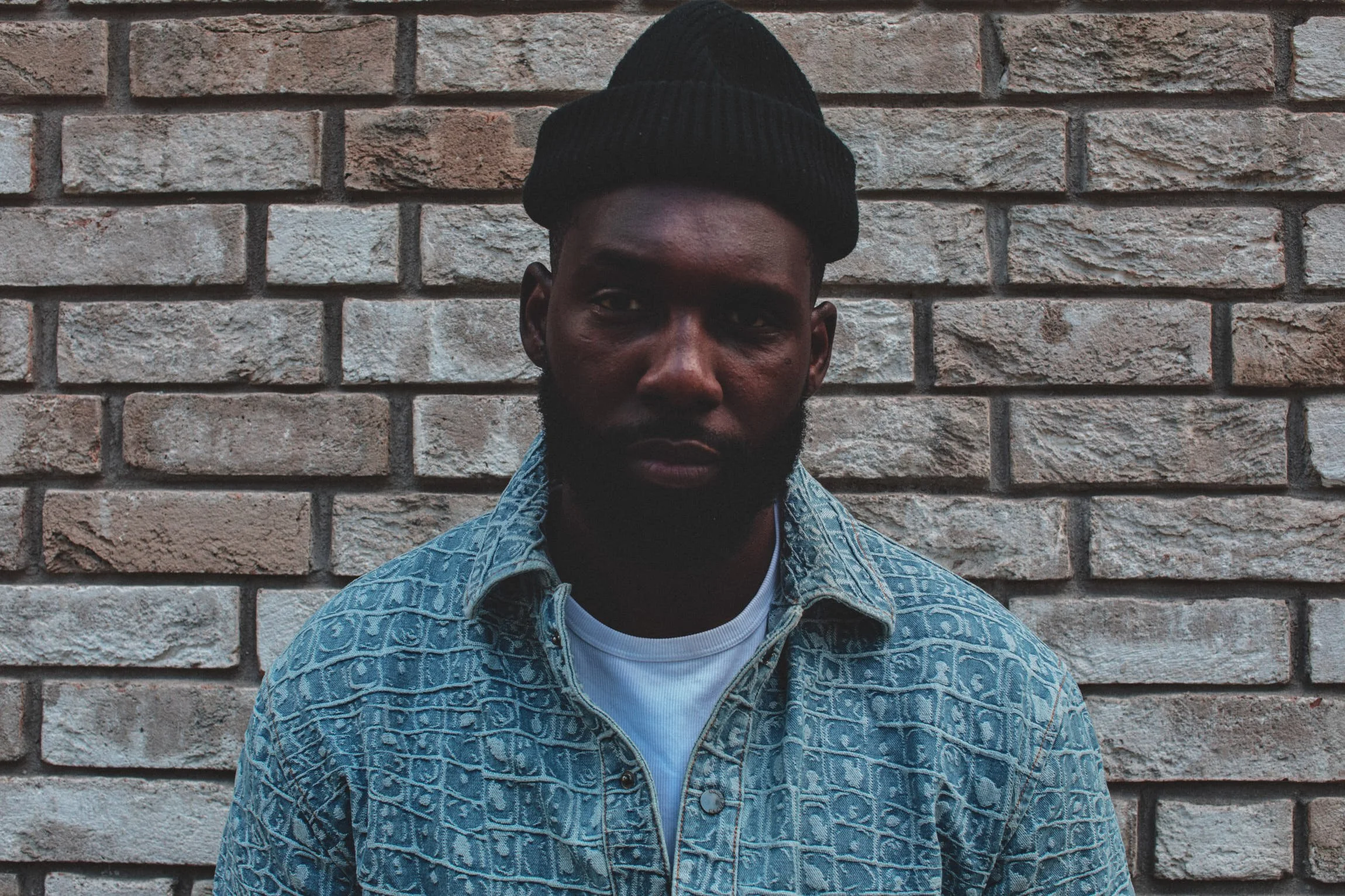
Fola Adeleke Makes Home Public
interview by SARA DOUEDARI
Fola Adeleke grew up learning early that the things that felt completely normal at home could look very different outside it. In East London, that meant Nigerian food, Yoruba, family functions, matching prints, gold and his mother’s gele existing alongside school, basketball and streetwear. Years later, those worlds meet again in his work. Adeleke builds images from memory, fashion, collage and digital tools, often returning to details he once tried to separate from his public self. What interests him now is the opposite. He wants African identity to occupy space without explanation, apology or adjustment, and to feel as natural in public as it does at home.
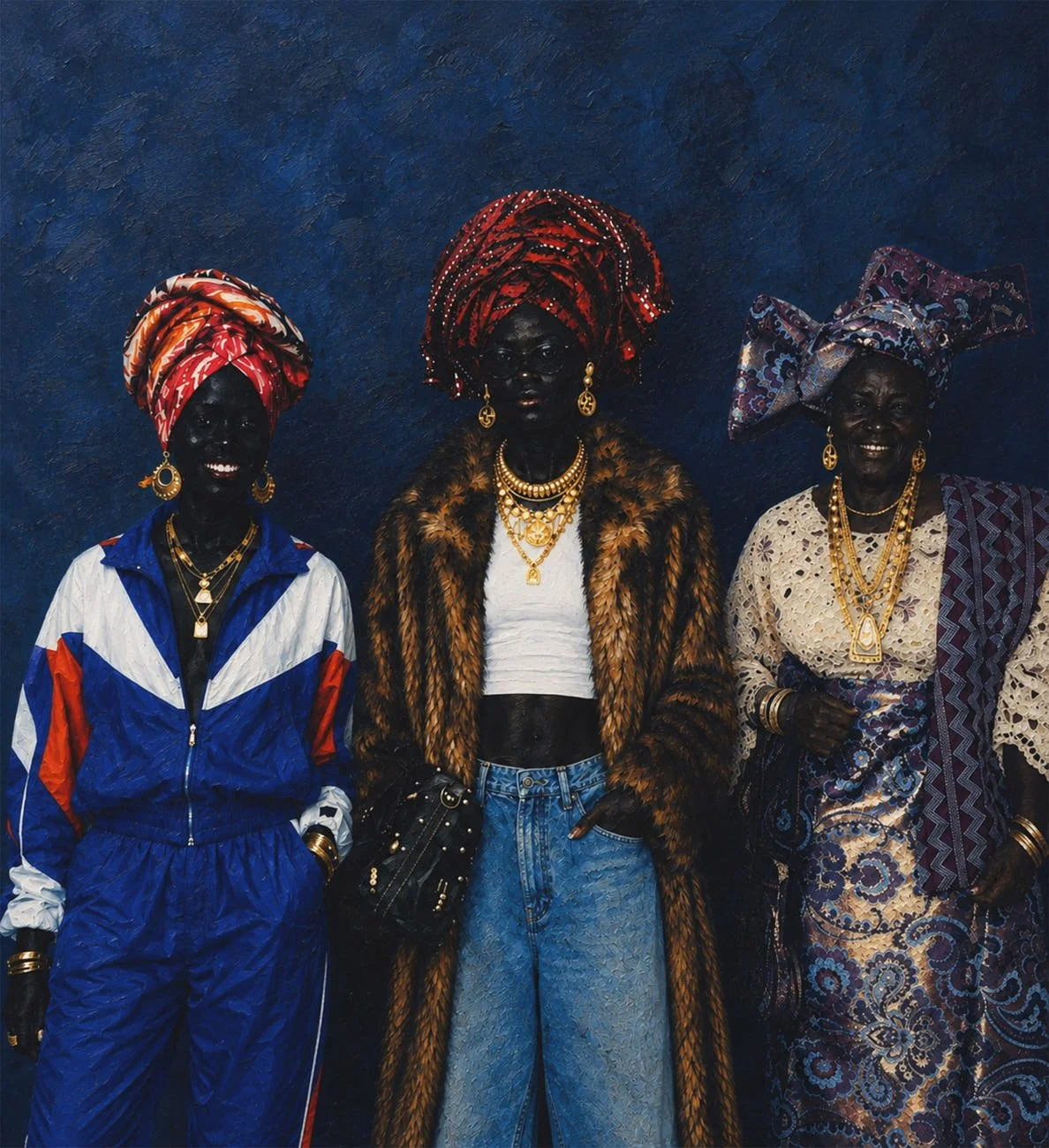
Fola Adeleke, Generations
Sara Douedari
How did you grow up in a Nigerian family in East London? What was home like?
Fola Adeleke
Home was, I believe, very cultured. I would say that about 80 per cent of the food in our fridge and cupboards was Nigerian. A fun fact I remember from growing up: I would see an ice cream container in the freezer and get really excited that there was ice cream at home. I’d get myself a plate, open it — and there would be soup inside. That kind of sums up how African the home was.
It was very cultured. The language my mother spoke to me and my siblings was Yoruba. The music was Nigerian. I think the main things that were really English were that we listened to hip-hop from an early age and watched UK television, from EastEnders to Neighbours and Home and Away. I think cereal was probably the most British thing we had. Beyond that, we had African home-cooked meals every single day. Whether it was lunch or dinner, it was always very Nigerian.
What traditions did your family keep alive?
We always ate together and prayed. That was something we always did. We also had our Saturday chores, which we all had to finish before breakfast. Mine was the bathroom. Once we had all collectively finished our chores, my mum would make what I would call an African breakfast — something really heavy — and we would eat together. While we were doing the chores, there was always music playing, usually Nigerian music. Even to this day, I don’t know which artists it was, but I remember it playing in the background.
Leaving the home, there was even more tradition. Saturdays were always a function. There was always someone’s birthday to go to, and there was always an outfit we were all meant to wear. My brother and I would, for some reason, always have the same thing on, even though we were four years apart. My mum always had an outfit that matched a bag — and she had several bags. I think she was a huge inspiration for what I do because she was the first powerful Black woman, or African woman, I saw. We followed her lead. It was a single-parent household, and I watched her just power through everything.
When did you first become aware of your cultural identity?
I think it was as early as school. I had an uncle who lived with us when I was really young, and he used to come and pick me up wearing open-toed brown sandals and a two-piece set of native clothing, always with prints, and a hat — the fila.
I used to be somewhat embarrassed because he was so different from everyone else who was picking up their kids. When he came to pick me up, I didn’t really want him to. I think I was around five at the time. That experience of being embarrassed by that difference made me aware that my culture was different from everyone else’s. Then, around the same time, my mum made me pack lunch for a school trip. It was beans with stew — quite a spicy stew — and plantain, which I loved at home. I never realised how different it was from what everyone else was going to bring. That was another embarrassing moment of being different. That was when I realised that my culture was different. At that time, there weren’t enough of us for that difference to feel positive. It often felt like we were somewhat alone in those spaces.
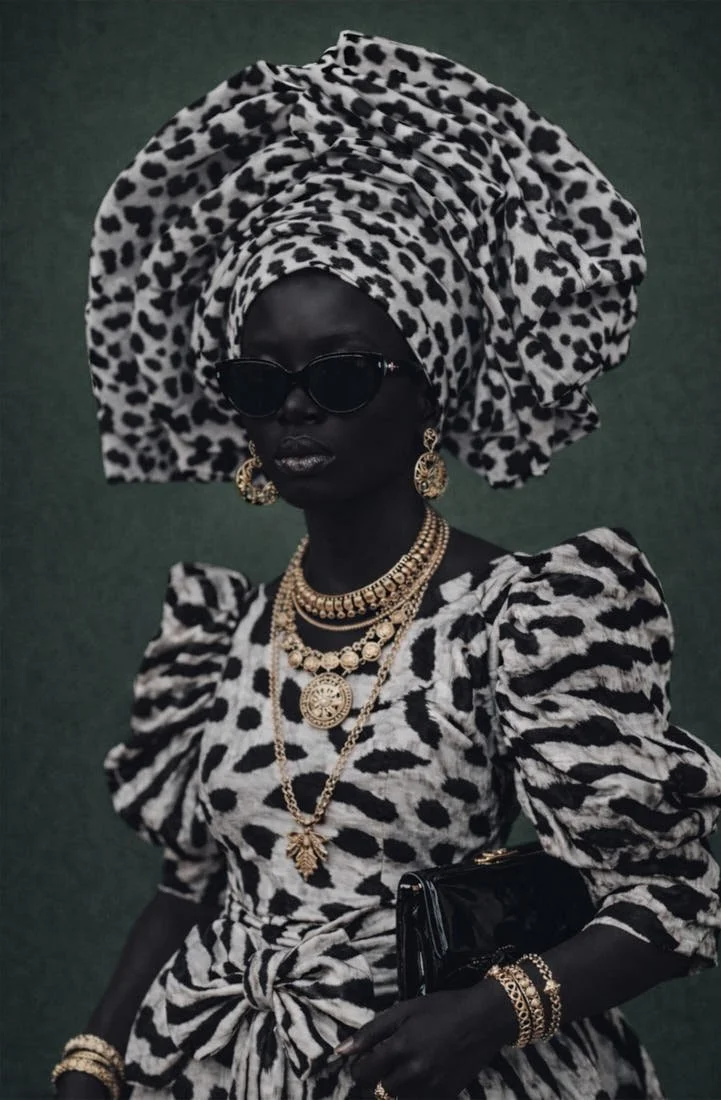
Fola Adeleke, Rich in Culture, Spirit and Presence
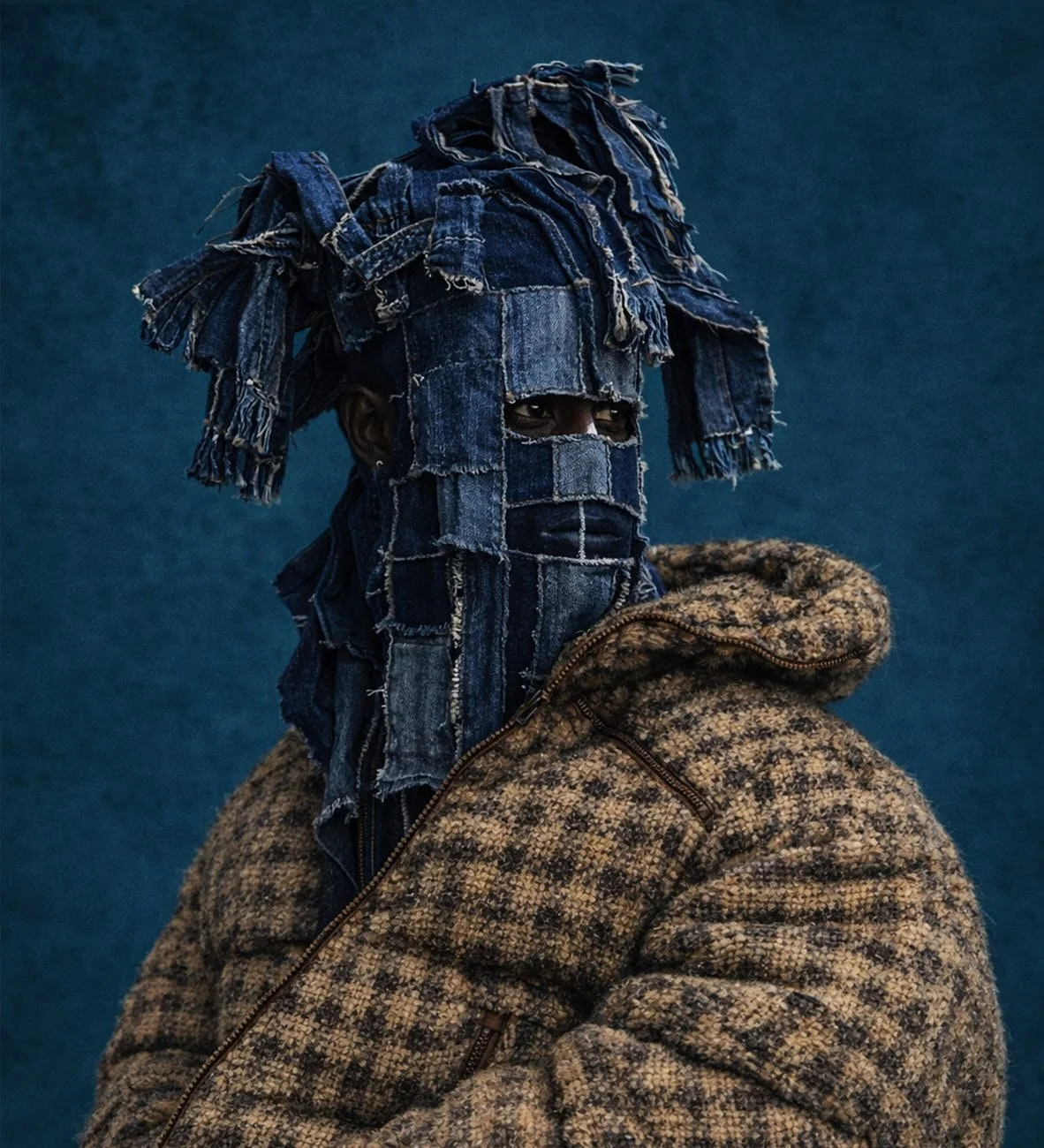
Fola Adeleke, Lagbaja
Did you ever feel caught between two cultures?
I would say I’ve always been caught between two cultures. Or at least I was. At this stage of my life, I blend both because I don’t believe I need to shape-shift to make anyone feel comfortable. I’ve come to understand that I don’t need to lower my tone, make myself smaller or adapt my culture to appease people or make them feel comfortable, because that’s not what the world is doing for anybody.
From a young age, I’ve always felt that anyone from Africa living in the Western world has to have a dual identity. It even shows in people’s names. Growing up, I knew a lot of people who were Oluwatosin or Oluwafemi, but all of a sudden one day their name was James or Peter. To me, that was them adapting and changing. I actually chose to shorten my own name because it was too hard and complicated for people to digest and say. I shortened it twice. Again, that was me being caught up in that, and I think a lot of people were caught up in it too.
I’m glad I never had an English name. I’m glad my mum never gave me one. But I think that can sometimes be an indication of families adapting to their surroundings so they can fit in rather than be seen as different. So, yes, I’ve always felt that way. But over the last few years, I’ve tried to blend both cultures because I should feel comfortable being who I am wherever I am.
What do you think the world still misunderstands about African culture?
There are so many things. I think the obvious one is the depiction of Africa that the Western world has created through adverts like Oxfam, showing areas of extreme poverty. There is extreme poverty in every country in the world. You can build a narrative that looks just as bad in any country where you see poverty. Maybe some places are more extreme, but that depiction of Africa is not the Africa that I know. Of course, there are places of poverty, but there are many more places of beauty, wealth and hardworking people across the whole continent.There is also this understanding that Africa needs help from everyone else. If we strip it back, Africa is extremely wealthy in minerals on its own. If it stood on its own two feet and was left alone by the colonial countries, I think Africa would be thriving amazingly.
On a lower level, people sometimes think we’re loud. I think we need to change that narrative. That loudness is actually confidence — extreme confidence in who we are. Africa is beautiful, and African culture is beautiful. There needs to be more said about the wealth and rich heritage of Africa. All of that is still misunderstood. And to link it back to my work, my biggest mission is to share the beautiful aspects of African culture and make sure they are seen. I actually believe the backbone of African culture is African women, and I need them to be seen in an amazing light. That’s my soul mission with the art I do.
Where does fashion enter that story?
For me, fashion has been around me before I even knew why I identified it as fashion. Every week, my mother, my siblings and I were off to another house party. Every week, my mother had another print, another gele, another outfit, matching shoes and a matching purse. I saw that all the time. But because, at a young age, there was no connection between African culture and coolness, there were these red threads of culture starting to bubble up in me without me really knowing. I created my own identity away from African culture. I played basketball. I travelled, represented England and travelled all over Europe playing basketball. That allowed me to see how different every culture was and made me curious from the age of 13. I travelled to Slovenia, Portugal, France, Italy, and eventually America.
I veered away from African culture through fashion, which is why I entered the realm of streetwear. But I think African culture was always close to my heart. It just took me away before it eventually brought me right back to where it all began, which is where I am now. I believe all of my pieces speak to different realms and practices. I see myself as a designer and a concept creator, and more so now as a composer — with art being the form of composition and storytelling.
I’m able to take one vision and put all of those things together to build a new world. I don’t think it was something I consciously meant to do. I just kept knocking on the door and scratching the surface until something started to form, which is what we see today. Every piece is more than the composition. It is aligned with storytelling that connects to my life, my fashion, my eye and my sense of composition.
When did you move from fashion into art?
That’s a good question. I don’t think I ever moved. By practice, I’m a designer. Art is a realm I’ve stepped into because I’ve created more and more concepts, and through creating those concepts, I started scratching the surface of an ongoing concept that has become a practice. Through that practice, art formed.I still consider myself a designer, an artist, a conceptual creator and a world builder. Sometimes I don’t feel worthy of the title artist because I still feel that I’m creating a world that exists. If I can create enough of that world, it will be seen from every angle, no matter what kind of collaboration it is. It will always be the same world.
I embarked on this journey about a year and a half ago. I had a conversation with a friend who told me, “I don’t know if you fit in the brief. You’ve given the client you were working for too much of who you are.” My thought was: the client came to me because they wanted my vision. That made me question what was better. Is it better to be a designer who can execute a brief, or is it better to be a designer who has refined his own ethos and aesthetic?
That one conversation led me to embark on my own vision wholeheartedly, without worrying about anyone’s opinion or trying to tread lightly to make people feel comfortable. That brought me to where I am today: storytelling from my own point of view through historical things, reference points, nostalgia, a conversational lens and world-building as a whole. So even though I am an artist, I believe there are lots of tiers to it. If anyone asked me what I am, I would say I’m a world builder.
What made you want to tell stories through images?
I think I have a lot to say. I have a lot in my mind. Part of my practice comes from my sporting background. I believe in reps. I believe that if you think something is the best idea, you need to do a hundred of them, and the best idea will come out at the hundredth one. So I’m trying to let out all of my ideas. And within letting those ideas out, I want conversations to happen. I feel like these conversations need to exist.
What I love about building stories through images is that I can show four different people and they can have four different conversations about the same work — about why something is the way it is. I remember creating a piece where one of my good friends said to me, “It doesn’t seem realistic because they look Nigerian but they’re wearing too much gold, and the amount of gold they’re wearing belongs to another culture.” I told him, “That’s fine.” We’re not trying to build a sense of reality. We’re trying to build something that intrinsically sparks conversation with people. There are a lot of conversations that need to happen in the creative space, and I believe I might be someone who can bridge that gap and help those conversations happen.
How would you describe your artistic language?
There are a number of words I would use to describe my artistic language: rich, African, proud and unapologetic. I would like to keep it as rich, loud and unapologetic.I think it’s very important not to be afraid to share your opinion and your point of view and to stand by it. It’s also important for me to share the beautiful aspects of Africa.
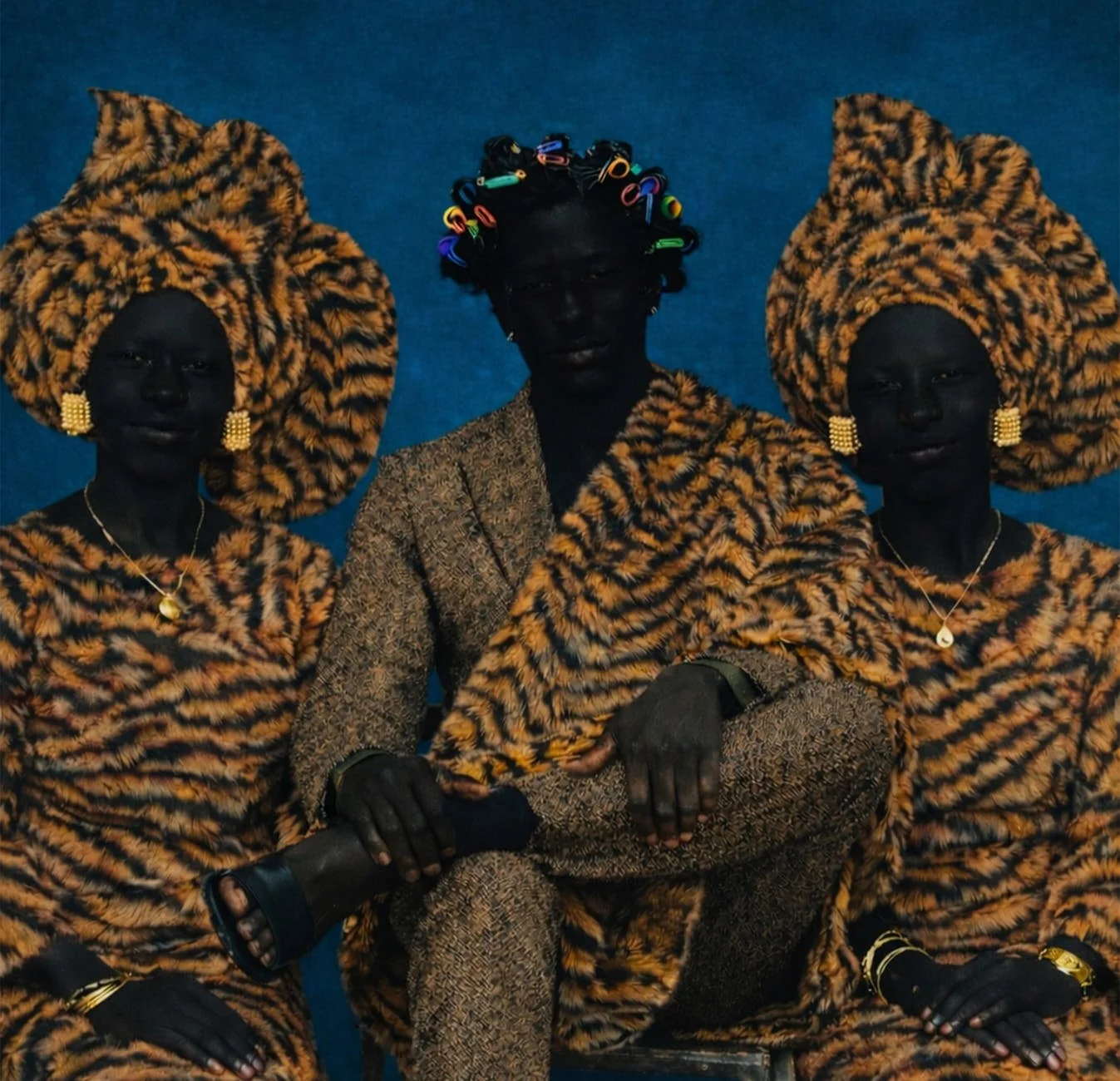
Fola Adeleke, Aunty Funke, Ola’s Mum & Uncle Dele
Your work combines photography, texture, graphics and digital composition. How do you build a piece?
I build a piece starting with storytelling. What is it I want to tell? What dots am I trying to bring together? In fashion, I normally come from a place of nostalgia. I think nostalgia is no different from sampling in music. That’s usually where I begin. Then I ask, what is the story I’m trying to tell? Once I can moodboard — which is similar to design, throwing a few images together to storyboard the idea — I build from there. I start collaging, bringing all my images together digitally through Photoshop and Illustrator, grading them, and then moving towards the accessories and prints I need as part of the story. Once I’ve done that, I try to blend everything using AI tools. My hope is that people see the composition and see beyond the image — that they see some of the storytelling. It doesn’t mean I need to scream from a rooftop what the story is about. If five people see the image and see something different, but it moves all of them and sparks a memory, then I’ve achieved something.
I remember creating an art piece about growing up. If you ask people, especially people who grew up in the 90s, where they would get their drink from at an African party, a lot of us would have to think because we couldn’t remember where we got our drinks from. But we actually got them from a bathtub full of ice. I created a piece with that memory in mind, and so many people commented and messaged me personally saying, “Wow, you’ve helped me unlock a memory I never knew existed because it’s been so long.” For me, it’s about sparking that nostalgia and building through all of those digital platforms.
Where does an artwork usually begin — an idea, a memory or something else?
For the most part, it’s a memory. Sometimes it’s a memory I didn’t actually live. Sometimes it’s an idea. I’m working on a piece that I haven’t quite finished yet. It’s taken me a long time to finish because it’s about the era when a lot of Africans moved to the Western world — America, New York, Houston, London — that first wave. What did that look like? That memory doesn’t exist for me because I was born first-generation. I didn’t have to come over and understand the difference.
I have a collection called Unapologetic, where some of the models and figures are wearing Western clothes, like grey-mile tracksuits, alongside head wraps and gold. They are so far removed from each other, but that must have been something that happened when people were merging cultures. They had just come from wearing what they wore in Africa — for me and my family, that would have been Nigeria — but at that point they would naturally have started mixing Western clothing with their native clothing. What did that look like? That comes from a memory I don’t possess. It comes from imagination. Some ideas come from memory, some from a futuristic ideology or a thought about how things could be, and others simply come from deep imagination and dreaming.
You also use AI in your process. Where does AI enter, and where does your own hand take over?
Similar to how I described my process, I build my work through collage and reference points, understanding design and composition. I build the structure and layout of the scene I want in order to strengthen the idea and message I’m putting together. It could be a seat at a table with a family of African royalty. I put that together through collage and research, understanding what kind of lighting I need, what scene needs to take place and what angle needs to be used to make it the strongest possible idea. Once I get to a good place, I use AI to blend the research and make everything more cohesive. Once I’m happy with that, I take it out of AI and go into a photo-grading process. That gives the image an overarching lighting mood and allows me to make sure the gold remains the statement piece — that the gold and the skin tone are married with the pattern, or that they have a significant centre-stage presence within the image. So AI is a secondary tool. After that secondary process, I step away from it again and find the grade that feels intrinsically like me.
Where do art, fashion and culture meet for you?
I think it’s interesting because they’ve always been married. They’ve always existed together, especially when your culture is rich in celebration. My culture is African culture, and African culture in general is so rich in celebration. Every moment of success — whether it’s a marriage, a birthday or a christening — is rich in ceremony and dressing. It’s a marriage. It’s something that is deeply rooted together.
Growing up, I never knew that watching my mother get changed and matching her gold with her outfits was a process. I didn’t think anything of it. But that was fashion. That was culture. And that was art. The fabric was art. The pattern was art. The composition of everything together was beyond art. It was a statement, and it was effortless. It didn’t feel like it was trying too hard. It just felt intrinsically African. I think that intersection has always existed. I’m trying to make people aware that it exists. I want the pieces I’m creating to make more African women want to wear their gele with denim on a regular day. Some of these pieces aren’t only for African functions. Some of them can become part of everyday life. That intersection has always existed. The question is whether we have been ready and confident enough to own it in a Western society. And I think this is the time. They have always been joined at the hip.
What kind of future do you want to help create through your work?
I want an abundance of my work to be displayed everywhere and used as reference points — for music videos, art, films, collaborations, anything — beyond simply being defined by my country or my nationality as a Nigerian. I want my art to make everyone feel comfortable being African. I’ve had messages from people saying, “Thank you. You make me proud to be Nigerian.”
I want this normality of fashion and art being intrinsically African to push people to be themselves outside of their homes. I don’t want people to feel that they have to change the second they leave their house. I would love for African people living in the Western world to feel confident enough to take their food into their corporate offices and warm it up in the microwave. I want to normalise African beauty and richness so that people don’t have to experience this huge difference between who they are inside their home and who they are outside of it. Because, at the end of the day, living like that is crippling. That’s part of the mission and why I want to show the beautiful aspects of Africa — because there are a lot of people who don’t know Africa looks as beautiful as I portray it to.
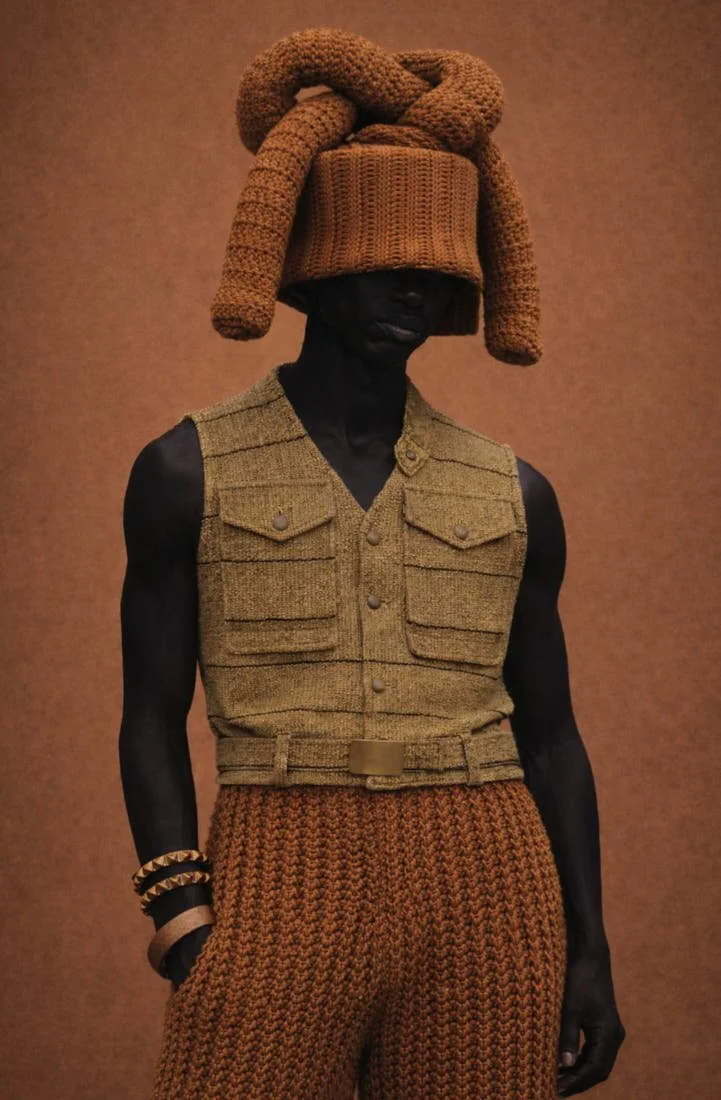
Fola Adeleke, African Elegance
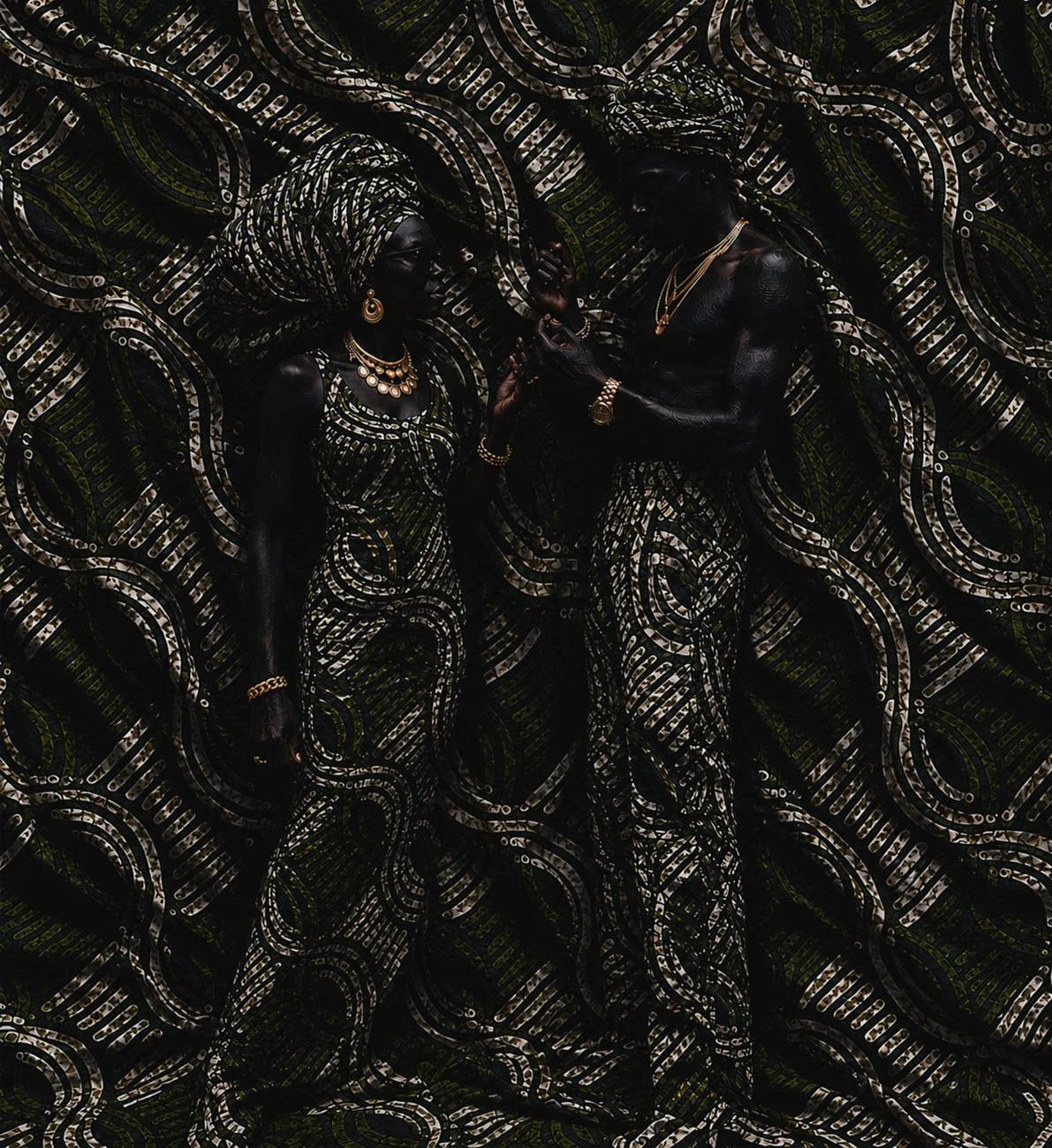
Fola Adeleke, Husband and Wife