
perspectives
An Evening That Never Was With Franki Domino
interview + written AMANDA MORTENSON
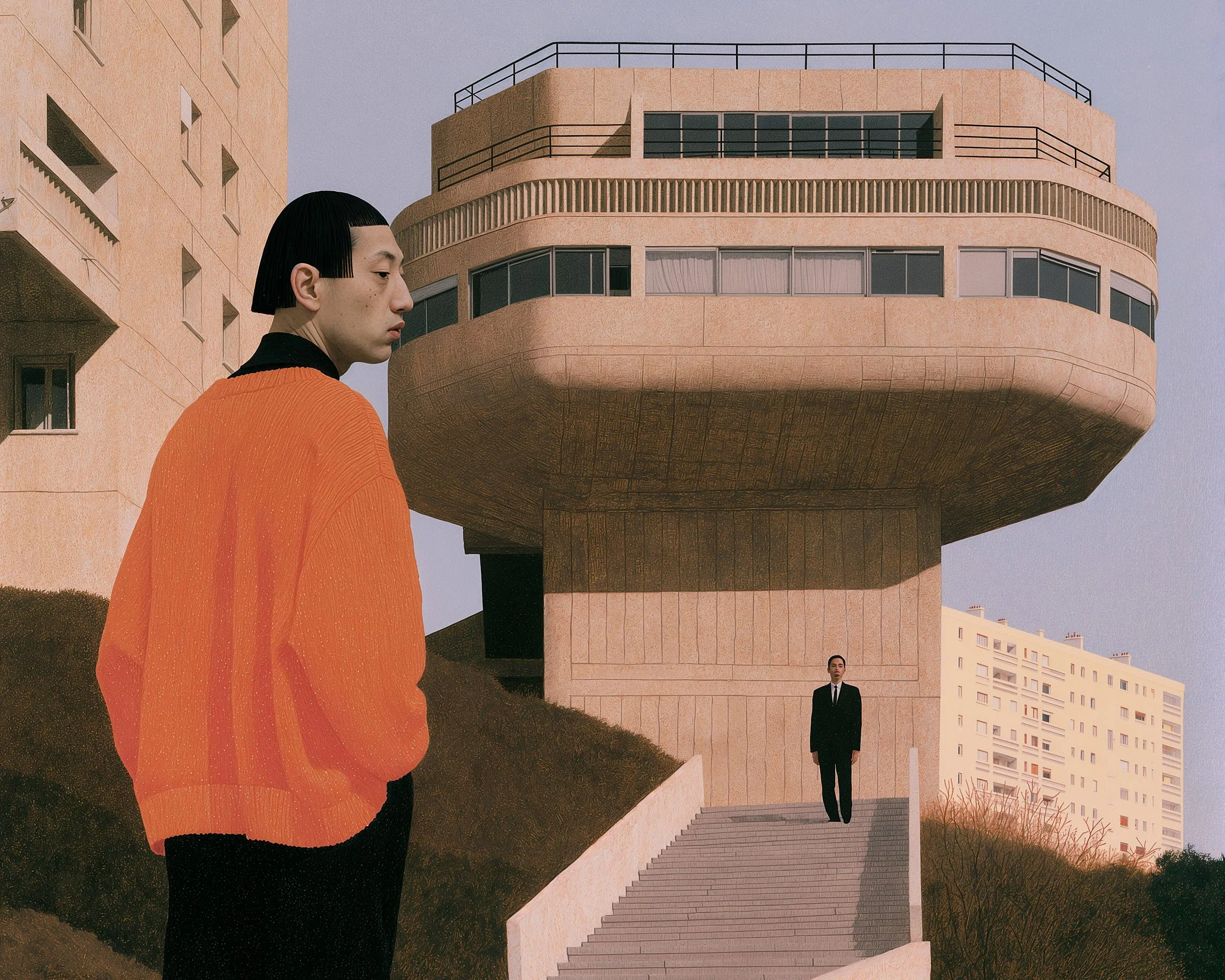
Franki Domino emerged when Julien Pacaud’s long-established collage practice began opening into a much wider field of image-making. After more than two decades of working with found photographs and digital composition, generative AI introduced a new rhythm, a new volume of possibilities and a freedom that no longer fit comfortably within the visual language people already associated with his name. Franki Domino became the space in which those experiments could develop without having to explain themselves too early, allowing styles, atmospheres and references to shift until something coherent began to appear.
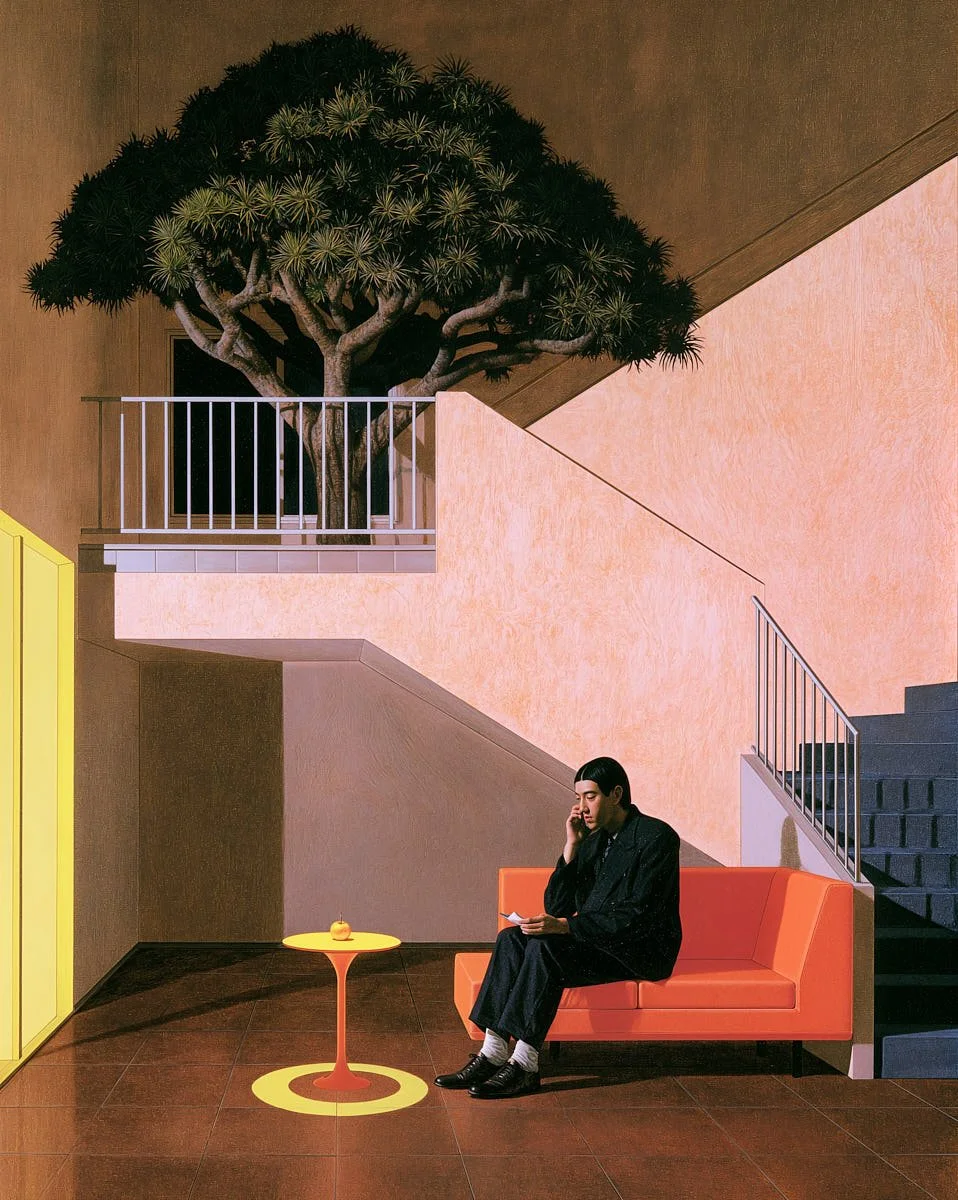
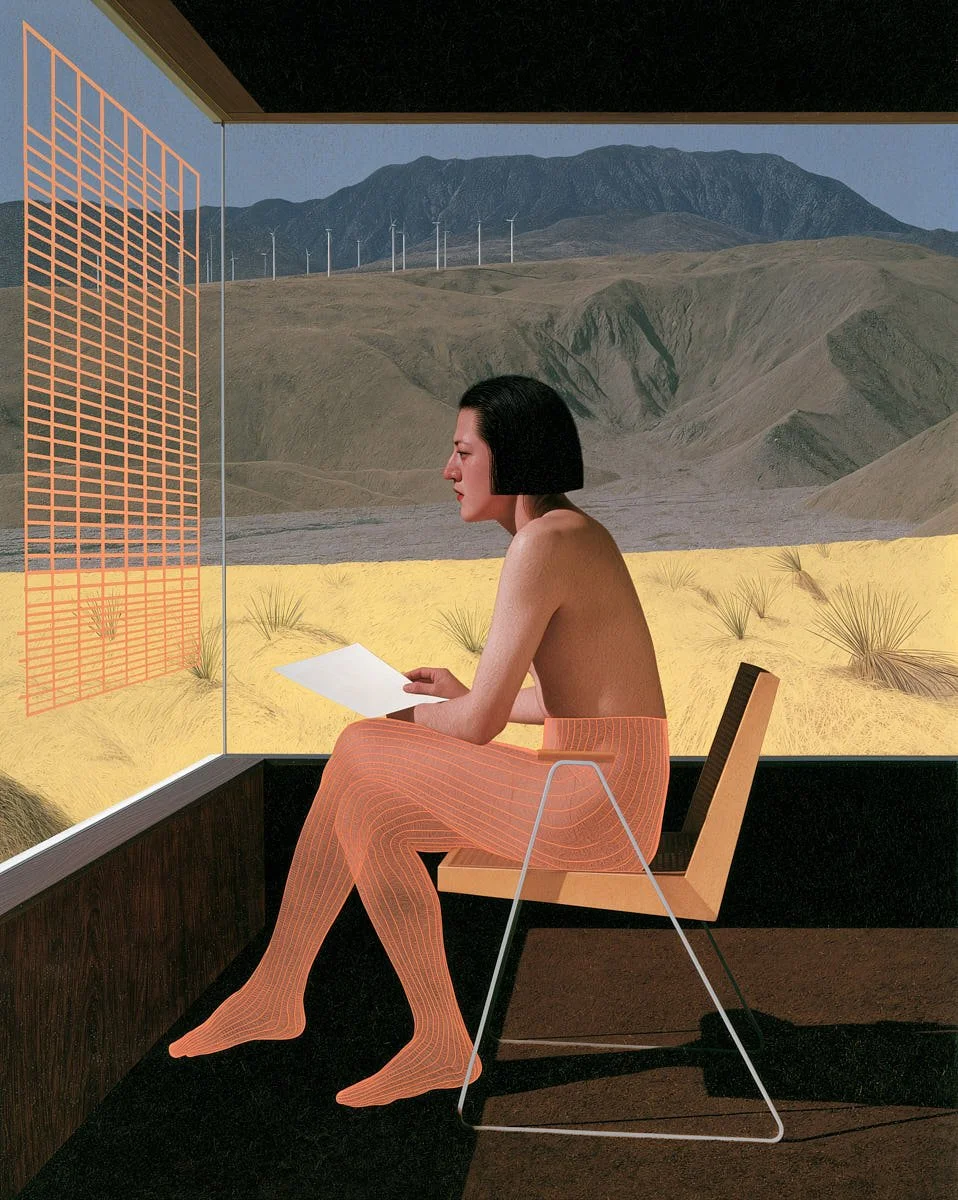
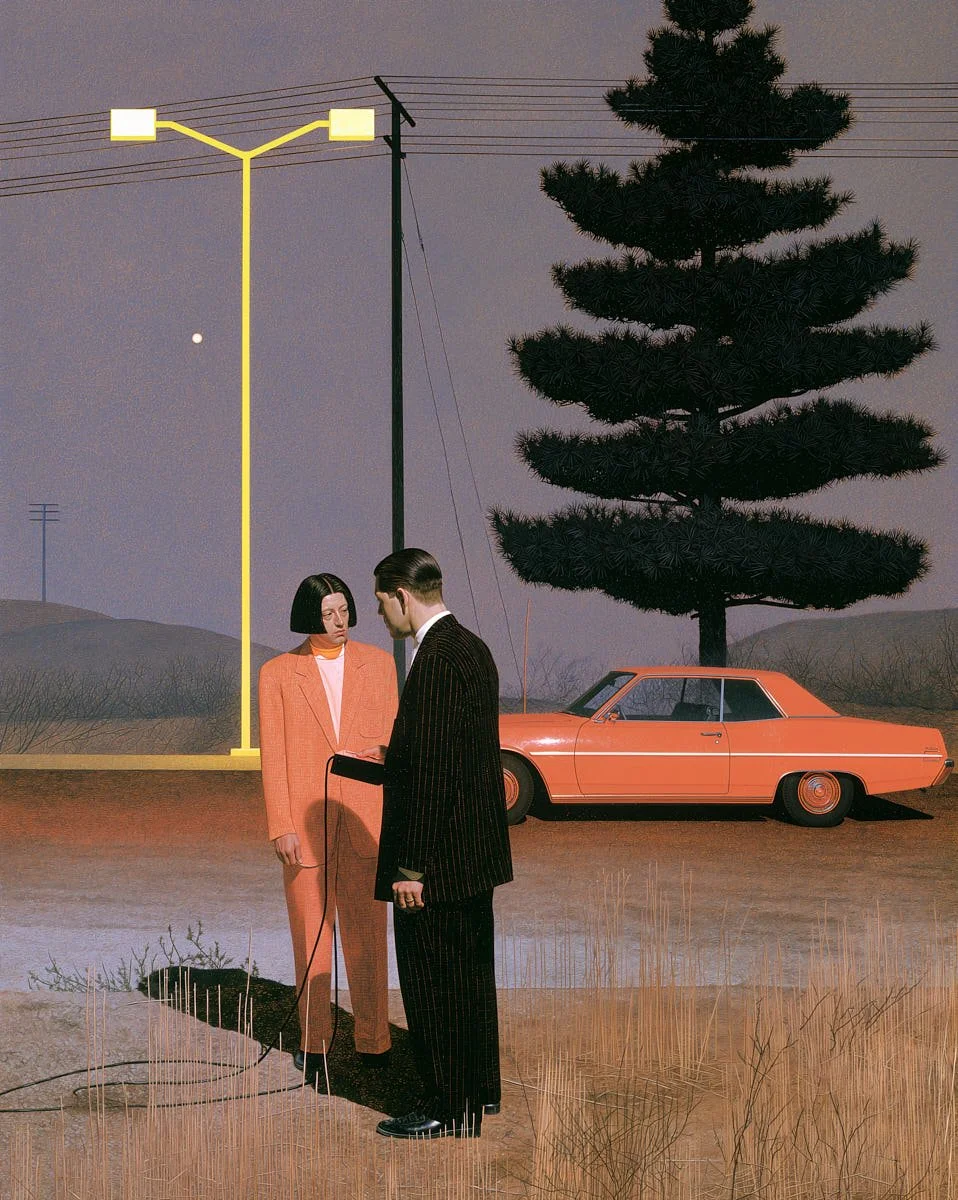
Evening Avant grew from that process of looking, selecting and recognising. The series was never planned around a fixed narrative, yet its images gradually began to share the same light, the same restraint and the same uncertain sense of time. Roads, cars, buildings and clothes carry traces of the twentieth century, though no single decade fully contains them. Evening settles over each scene without ever becoming night, leaving the characters suspended in moments that feel incomplete. Some are waiting, some are watching, some seem to have arrived too early or remained too long, and the spaces around them hold the quiet tension of a story that has not yet declared itself.
That atmosphere is closely tied to the way Domino understands visual memory, he describes his influences as a kind of magma made from films, books, music, photographs, conversations and everything else absorbed over time. These references return without preserving their original form, passing through instinct until they become part of a world that feels familiar without offering a clear point of recognition. The same is true of the solitude that runs through the series. It was never introduced as a subject, yet it appears repeatedly in the distance between figures, in the architecture around them and in the silence that seems to continue beyond the edge of the frame.
Generative AI gives Domino access to an enormous field of images, though the work begins through his decisions about what deserves to remain. Images may appear quickly, but the world of Evening Avant is built through the slower act of choosing which possibilities belong together. What finally emerges feels neither retrieved from a specific past nor projected toward a defined future. It exists in a parallel time of its own, close enough to memory to feel known and distant enough to resist explanation.
Franki Domino, Evening Avant
/ courtesy Franki Domino
Franki Domino, Evening Avant
/ courtesy Franki Domino
Amanda Mortenson
Who is Franki Domino to Julien Pacaud?
Franki Domino
Franki Domino was born for practical rather than conceptual reasons. I’ve worked as an illustrator and collage artist for more than twenty years, and people know me through a very specific visual language. When AI entered my practice, I suddenly found myself exploring many different aesthetics. My agent suggested creating a separate identity so there would be no confusion between my long-established collage work and these new experiments. Franki Domino isn’t another person. It’s simply the name under which I can freely explore everything AI makes possible.
Once Franki Domino found that freedom, how did Evening Avant begin to take shape?
There wasn’t a plan. That’s true of almost everything I make. I rarely begin with a fully formed concept. I let the work reveal itself as I go. With AI, generating images is easy. Choosing between them is where the work really begins. Evening wasn’t an idea I started with. It gradually emerged through that process of selection. More than the evening itself, I was drawn to an in-between state, a moment that’s difficult to define, where daylight hasn’t completely disappeared. I’m always trying to create places that remain slightly elusive.
oes the uncertainty of Evening Avant extend to time itself, and do you see the series as belonging to the past, the present or the future?
I’ve never been interested in placing my images within one clearly defined period. I’m naturally attracted to twentieth-century imagery, especially from the 1920s through to the 1980s. Those references have always been part of my visual vocabulary. But I’m not interested in recreating a particular decade. I prefer images that seem to exist outside historical certainty. I sometimes describe them as “perpendicular dreams” — parallel realities that briefly intersect with our own. I like worlds where you can’t quite say where they are or when they exist. That ambiguity is essential to me.
If Evening Avant doesn't belong to one particular time, why can an image of something that never happened still feel like a memory?
I’m not sure “memory” is the right word. Every viewer brings something different to an image, which is why I’m always reluctant to explain my work too much. I don’t want to tell people what they should see or feel. What interests me is whether an image can awaken something that already exists inside us. Sometimes that’s a memory. Sometimes it’s simply an emotion or an intuition we’ve never been able to put into words. For me, what matters isn’t whether an image is true or fictional. What matters is what it sets in motion.
What are your characters waiting for?
That’s exactly the kind of question I prefer to leave unanswered. I don’t believe there’s a single explanation, and I wouldn’t want to impose one if there were. If I answered today, it would only reflect how I feel today. Tomorrow, my answer might be different. I think mystery is part of the artwork itself. Once the image exists, it also belongs to the viewer, and I’m happy if someone sees something completely different from what I see.
Many of those characters seem to exist in their own worlds. What role does solitude play in Evening Avant?
Looking back, I realise solitude has always been present in my work, long before AI. It wasn’t a conscious decision while making this series. I never said to myself, “I’m going to make images about loneliness.” Those things emerge on their own. That’s true of many recurring themes in my work. They return because they’re part of me, not because I’ve planned them.
Franki Domino, Evening Avant
/ courtesy Franki Domino
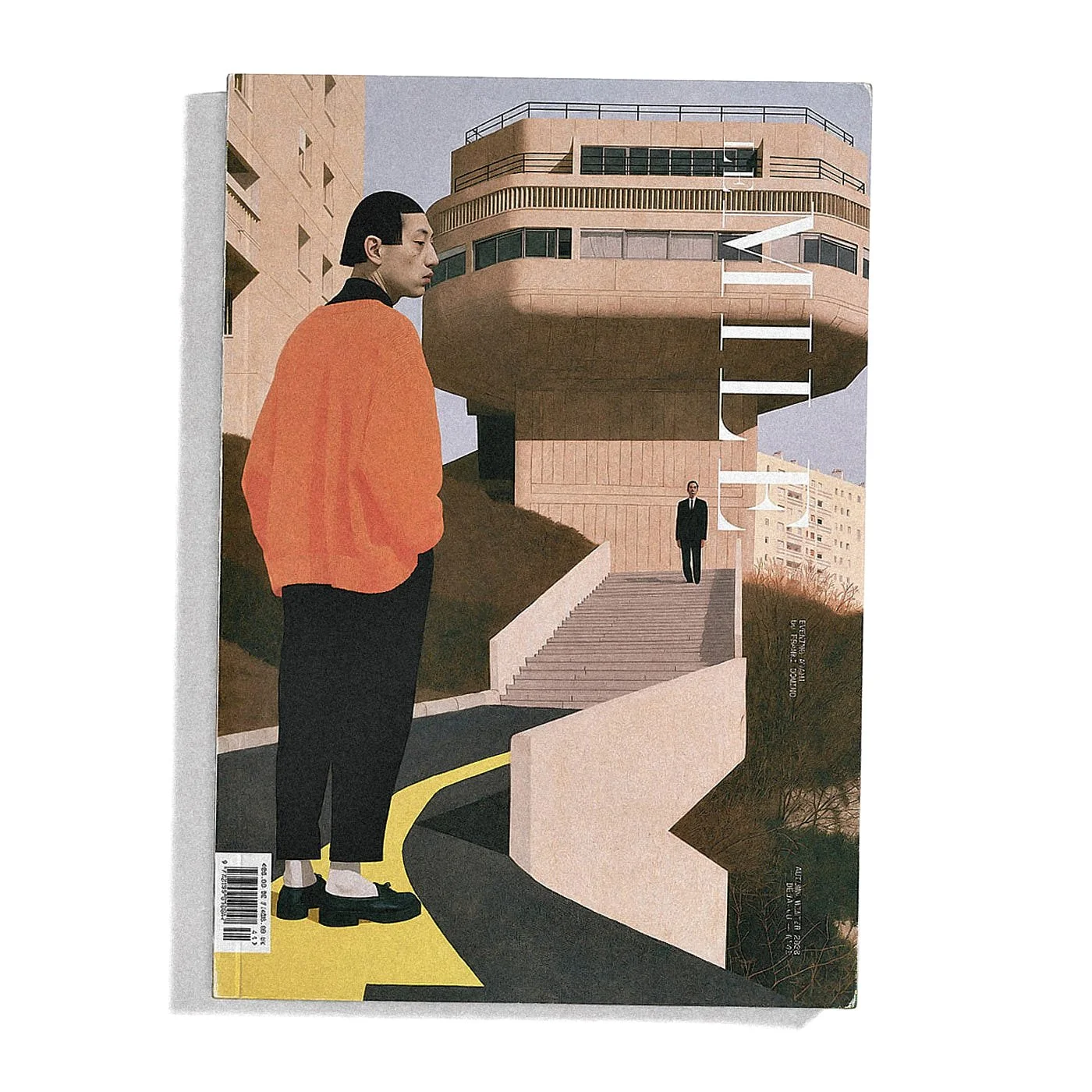
Does that sense of solitude also shape the ambiguity in your images?
I’m not even sure I would call it unease. Some viewers may experience it that way, but that’s their reading, not my intention. What attracts me is uncertainty. Images become more interesting when they resist clear definition and leave room for doubt. I don’t consciously try to create discomfort. Through the process of choosing images, I’m simply drawn to those that contain a certain strangeness or ambiguity.
You have described your inspiration as a “magma” made from everything you have seen, read, heard and experienced. Which parts of that mental archive surfaced most clearly while creating Evening Avant?
I think that’s true of artistic creation in general. Every artist carries a mental archive made up of films, books, music, photographs, conversations and everything else they’ve absorbed throughout their life. Those references don’t remain separate. They melt together and eventually come back out in a form that’s unique to each person. In some ways, I think AI works similarly. It isn’t so different from the way artists have always worked, absorbing influences, transforming them and combining them into something personal. For Evening Avant, there wasn’t one dominant reference. What gradually emerged was a shared atmosphere, a certain light, a palette and a rhythm that simply felt right.
How does AI become part of that creative process?
For me, AI isn’t interesting because it can produce images quickly. It’s interesting because it opens an extraordinary number of possible directions. It allows me to explore visual territories that I couldn’t easily reach before. But that freedom also makes artistic judgement more important than ever. Working with AI is largely a process of selection. In a way, it turns the artist into an art director. Marcel Duchamp famously suggested that art is also a matter of choice, and I think that’s especially true here. AI constantly offers possibilities. The artwork is defined by the paths you choose to follow, and even more by the countless ones you decide to abandon.
Does the machine help you recover images that already existed somewhere in your imagination, or does it give you memories you never had?
I don’t think AI gives me memories I never had. What it can do is help me reach certain unconscious or intuitive places more quickly. Because it allows such a wide exploration of possibilities, it sometimes reveals something that was already there but hadn’t yet taken shape. It doesn’t invent those inner images. It simply makes them easier to discover.
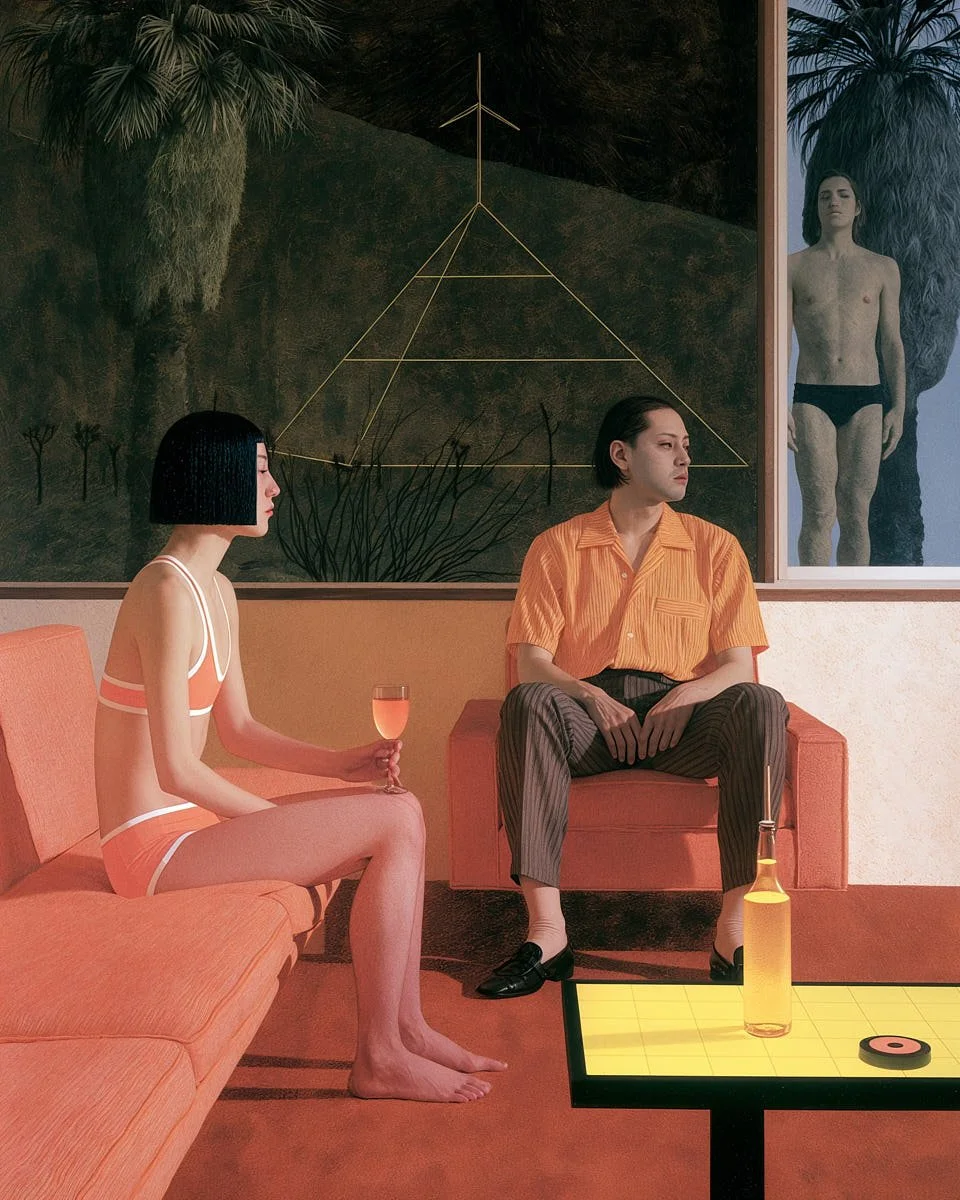
Franki Domino, Evening Avant
/ courtesy Franki Domino
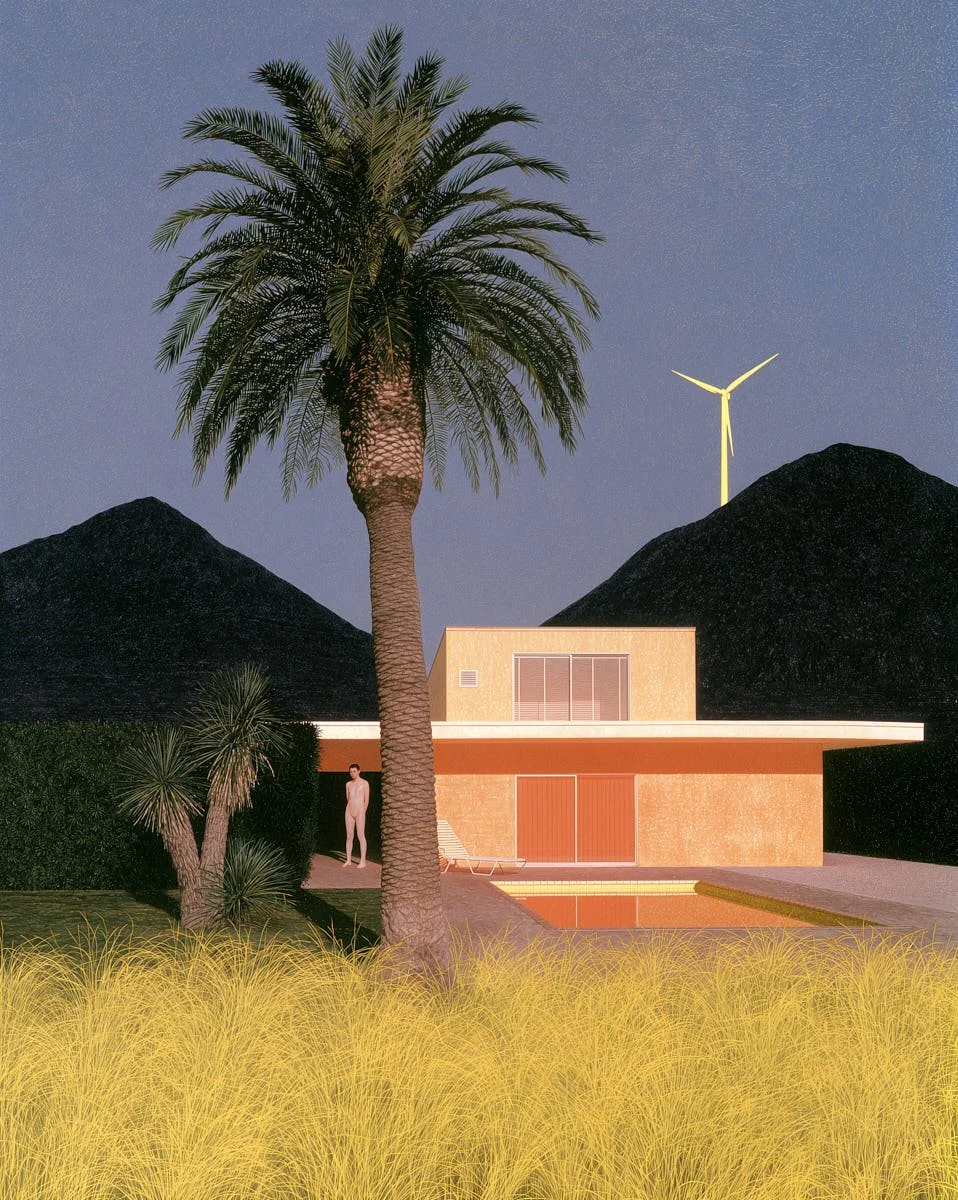
Franki Domino, Evening Avant
/ courtesy Franki Domino
all art works (incl. header) courtesy Franki Domino